



Phonics 2: fl/pl/bl, cl/gl/sl, sm/sn/st/sk and silent e
Play, class, smile and skate begin with consonant blends. Cape and kite end with a silent e that changes the earlier vowel sound. Practise the semester 2 spelling patterns through word sorting and spoken comparison.

Ta fiche PDF illustrée
Le support, la méthode et les exercices corrigés à imprimer.
By the end of this lesson, you can
- Keep consonant blends together
- Compare short vowels with silent-e pairs
- Use the pattern without treating it as universal
Before you startRead simple English sentences; use the starter lesson if you need help with names or numbers.
Un bon cours, ça se partage.
How does silent e change cap into cape and kit into kite?
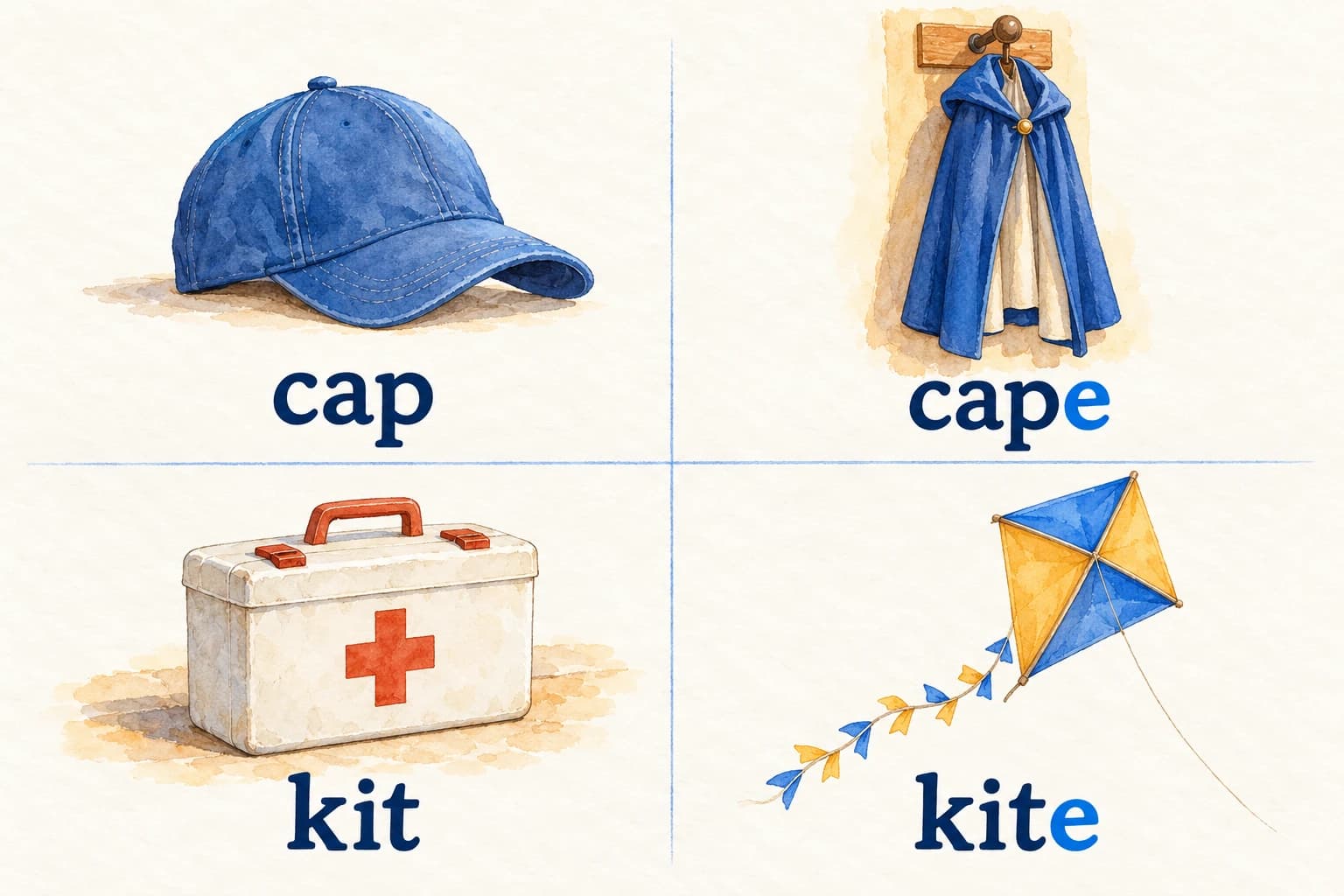
In these common patterns, adding a silent final e changes the earlier vowel to its long sound: cap/cape and kit/kite. The final e is not pronounced separately. Learn these pairs alongside consonant blends such as fl, pl, bl, cl and sk.
Keep consonant blends together
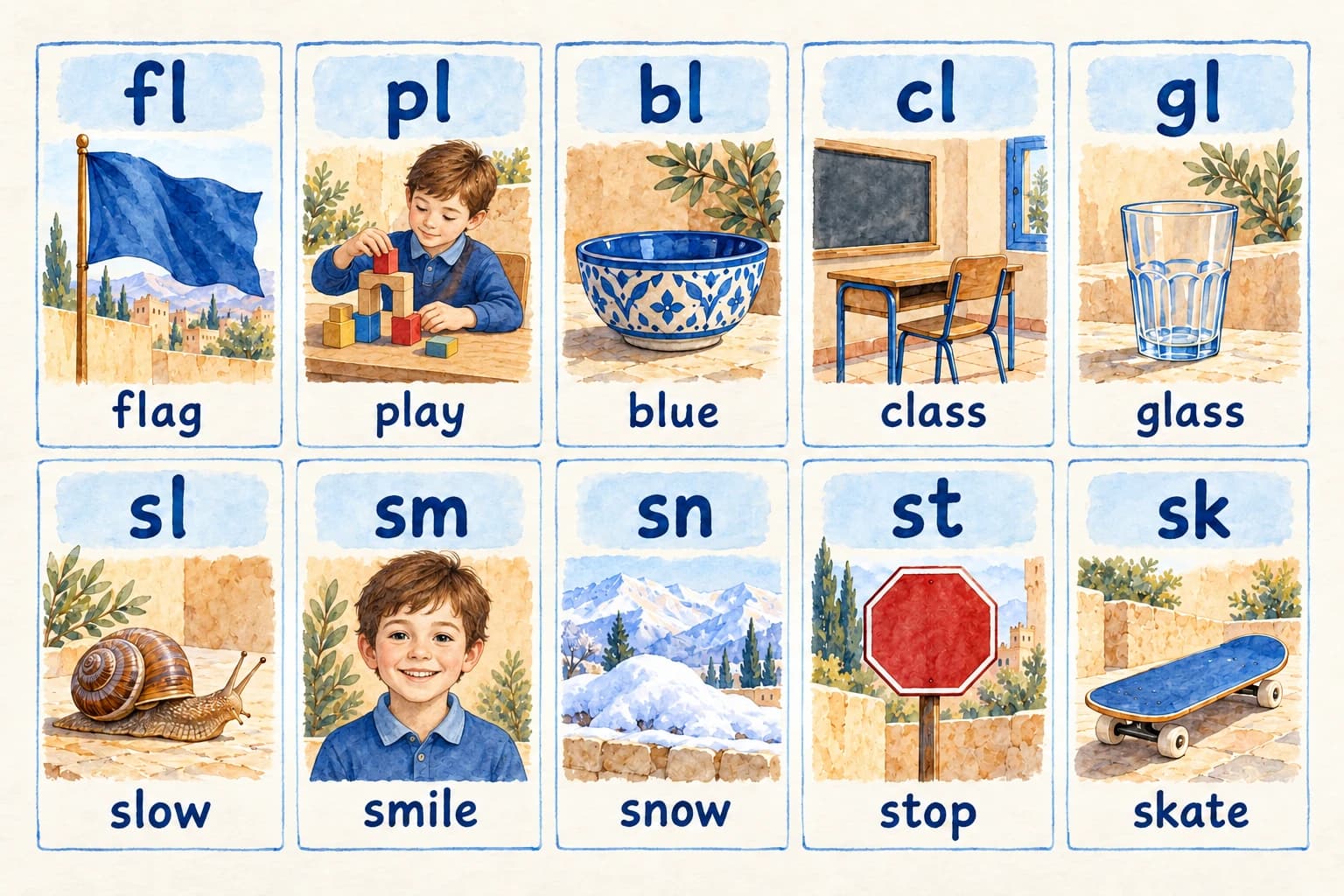
Keep both consonants in a blend: fl in flag, pl in play, bl in blue, cl in class, gl in glass, sl in slow, sm in smile, sn in snow, st in stop and sk in skate. Do not add a vowel between the first two consonants.
In the common a-consonant-e pattern, cap becomes cape and tap becomes tape. The final e is silent and a has its long sound. In the i-consonant-e pattern, kit becomes kite and pin becomes pine. These are useful patterns, but English has exceptions; have is not pronounced like a regular long-a example.
Compare short vowels with silent-e pairs
| Pattern | Examples | Reading clue |
|---|---|---|
| fl / pl / bl | flag / play / blue | Keep f+l, p+l, b+l. |
| cl / gl / sl | class / glass / slow | Keep the first two sounds. |
| sm / sn / st / sk | smile / snow / stop / skate | Start with s plus the next sound. |
| a…e / i…e | cap–cape / kit–kite | Final e is silent in these pairs. |
Practise words in a connected sentence
Read and explain this example
A club makes a blue flag. The class plays a game. Read cap, then cape. Read kit, then kite. Notice the changed vowel and the silent final e. Read the sentence again at a natural pace.
Use the pattern without treating it as universal
Cap and cape differ by one written letter, but the change affects how you say the vowel earlier in the word. The same happens in kit and kite. Read each pair next to its picture so that you connect a sound with the correct meaning. The pattern is useful, but not every final e behaves this way: have is an exception. A written rule supports practice; it does not replace hearing the word.
Remember
This page offers written practice, not audio. Ask a teacher to model each pair. Silent e is a common pattern, not a rule that works for every English word.
Step by step
Put the idea into practice
- Read the shorter word and identify its middle vowel.
- Notice the added e and compare the new word with a spoken model.
- Read the pair again without giving the final e a separate syllable.
Frequently asked questions
How does silent e change cap into cape and kit into kite?
Is have a regular magic-e example?
Does every final e make a long vowel?
Quiz: 1 questions
1 questions are randomly selected from this lesson’s 1-question bank. Choose one answer for each question and get an immediate explanation.
Q1Which word illustrates the i…e pattern?
Incorrect answer
Kite has a long i sound and a silent final e.
Correct answer: kite
Kite has a long i sound and a silent final e.
Your score
0/1
Start with the worked examples
Read the lesson in small sections. Write your own example for each rule and try the Easy exercises before returning to the quiz.
Review: 1 missed question
Which word illustrates the i…e pattern?
Correct answerkite
Kite has a long i sound and a silent final e.
Exercises with answers
4 exercises, from easy practice to challenges. Try each one yourself, then reveal the answer and explanation.
Exercise 1
EasySort blue, class, snow and flag by initial blend.
Answer and explanation
Blue: bl; class: cl; snow: sn; flag: fl.
Exercise 2
IntermediateAdd e to cap, tap, kit and pin. Write the new words.
Answer and explanation
Cape, tape, kite and pine. In these pairs, final e changes the earlier vowel sound.
Exercise 3
ChallengeRead cap/cape and kit/kite to a partner; explain what changes.
Answer and explanation
The earlier vowel changes from its short sound to its long sound; the final e is silent. Have a teacher check the spoken contrast.
Exercise 4
IntermediateAdd e to pin and tap. Name the new words and explain what changes in these examples.
Answer and explanation
Pin becomes pine; tap becomes tape. The final e is silent, while the earlier vowel changes to its long sound in these pairs.