



Speaking: requests, invitations and mini-interviews
A short conversation works best when speakers respond to each other. Practise a polite classroom request, an invitation after school and a mini-interview about a routine. Use the written models, then change the details with a partner.

Ta fiche PDF illustrée
Le support, la méthode et les exercices corrigés à imprimer.
By the end of this lesson, you can
- Decide what your conversation should achieve
- Requests, invitations and useful replies
- Listen to the answer before asking a follow-up
Before you startRead simple English sentences; use the starter lesson if you need help with names or numbers.
Un bon cours, ça se partage.
How do I make a polite request or invite someone in English?
Use Can I… please? to ask permission and Would you like to…? to invite someone. Use Let's followed by a base verb for a suggestion. Respond to the invitation, then ask a useful follow-up about the time or place rather than starting an unrelated question.

Decide what your conversation should achieve
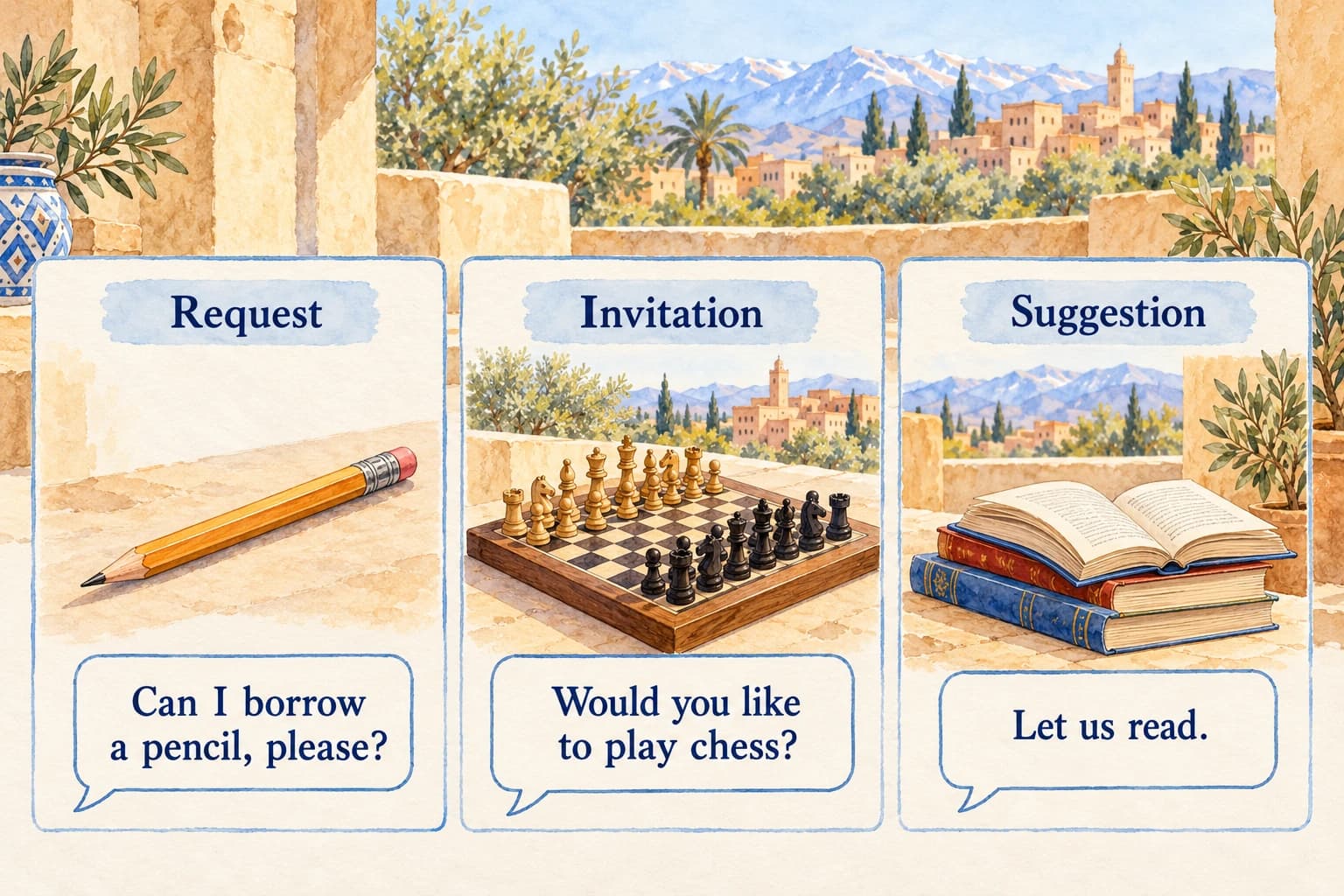
Can I…? asks for permission: Can I open the window, please? Let's + base verb makes a suggestion: Let's play chess. Would you like to…? makes an invitation. Accept with Yes, I'd love to or decline politely with Sorry, I can't.
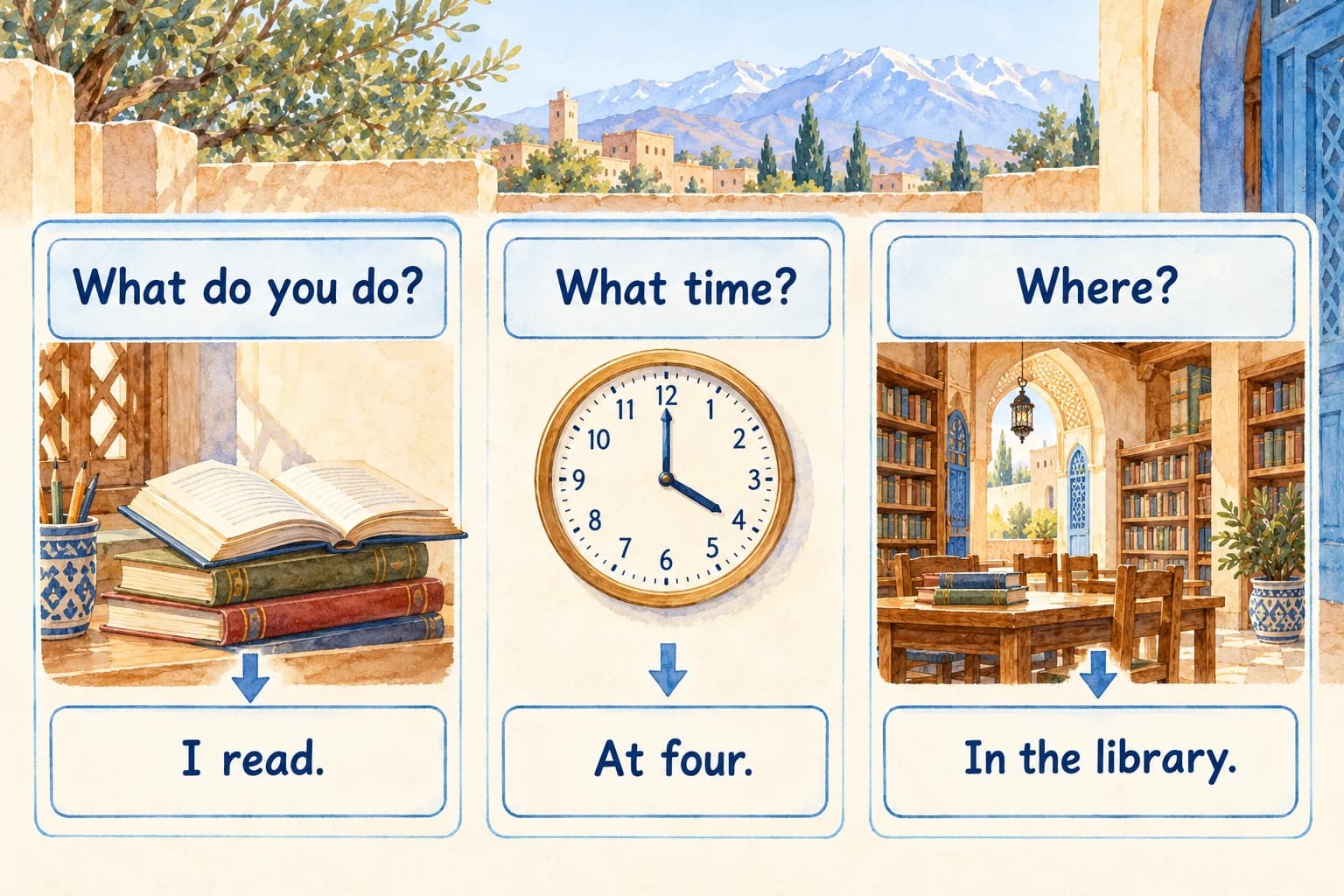
In an interview, ask one question at a time and listen to the answer before continuing. Use What time…? for a clock time, Where…? for a place and What…? for an activity. A follow-up such as And on Sunday? shows that the next turn connects to what the partner said.
Requests, invitations and useful replies
| Purpose | Question or suggestion | Possible reply |
|---|---|---|
| Request | Can I borrow a pencil, please? | Yes, here you are. |
| Invitation | Would you like to play chess? | Yes, I'd love to. |
| Routine | What do you do after school? | I read at home. |
A complete reading-club conversation
Read and explain this example
A: Would you like to visit the reading club? B: Yes, I'd love to. What time does it start? A: At four on Wednesday. B: Where does it meet? A: In the school library. B: Great. Let's meet near the door.
Listen to the answer before asking a follow-up
A dialogue is an exchange, not two memorised lists. If a partner says the club starts at four, asking What time does it start? immediately afterwards shows that you did not use the answer. Ask where it meets instead. A polite refusal can stay brief: Sorry, I can't. Learners do not have to invent personal explanations. When rehearsing, keep the purpose of the conversation and change the details so that the language remains useful beyond one script.
Remember
This activity provides dialogue scripts and speaking prompts without an audio file. Practise first while reading, then cover the script and keep the same purpose with new details.
Step by step
Put the idea into practice
- Choose a purpose: permission, invitation or an interview detail.
- Practise the model with a partner, making each reply answer the previous turn.
- Cover the script and repeat with a different activity, time or place.
Frequently asked questions
How do I make a polite request or invite someone in English?
What comes after Let's?
How can I practise speaking without an audio file?
Quiz: 1 questions
1 questions are randomly selected from this lesson’s 1-question bank. Choose one answer for each question and get an immediate explanation.
Q1Which expression makes a suggestion?
Incorrect answer
Let's takes the base verb read.
Correct answer: Let's read.
Let's takes the base verb read.
Your score
0/1
Start with the worked examples
Read the lesson in small sections. Write your own example for each rule and try the Easy exercises before returning to the quiz.
Review: 1 missed question
Which expression makes a suggestion?
Correct answerLet's read.
Let's takes the base verb read.
Exercises with answers
4 exercises, from easy practice to challenges. Try each one yourself, then reveal the answer and explanation.
Exercise 1
EasyIdentify request, invitation or suggestion: Let's read. Can I sit here? Would you like to come?
Answer and explanation
Suggestion; request; invitation. The opening pattern signals the purpose.
Exercise 2
IntermediateCorrect: Let's to play. Can I borrows a pen?
Answer and explanation
Let's play. Can I borrow a pen? Both patterns take a base verb.
Exercise 3
ChallengeMake a four-turn invitation dialogue with a time and a place.
Answer and explanation
Example: Would you like to play chess? Yes, when? At five in the library. Great, see you there. Check that the reply responds to the question.
Exercise 4
IntermediateA partner says Yes, I'd like to. It starts at four. Add a suitable follow-up and a possible reply.
Answer and explanation
Example: Where does it meet? In the school library. The follow-up asks for missing information instead of asking the already supplied time again.