



Unit 7 · Let's buy presents!
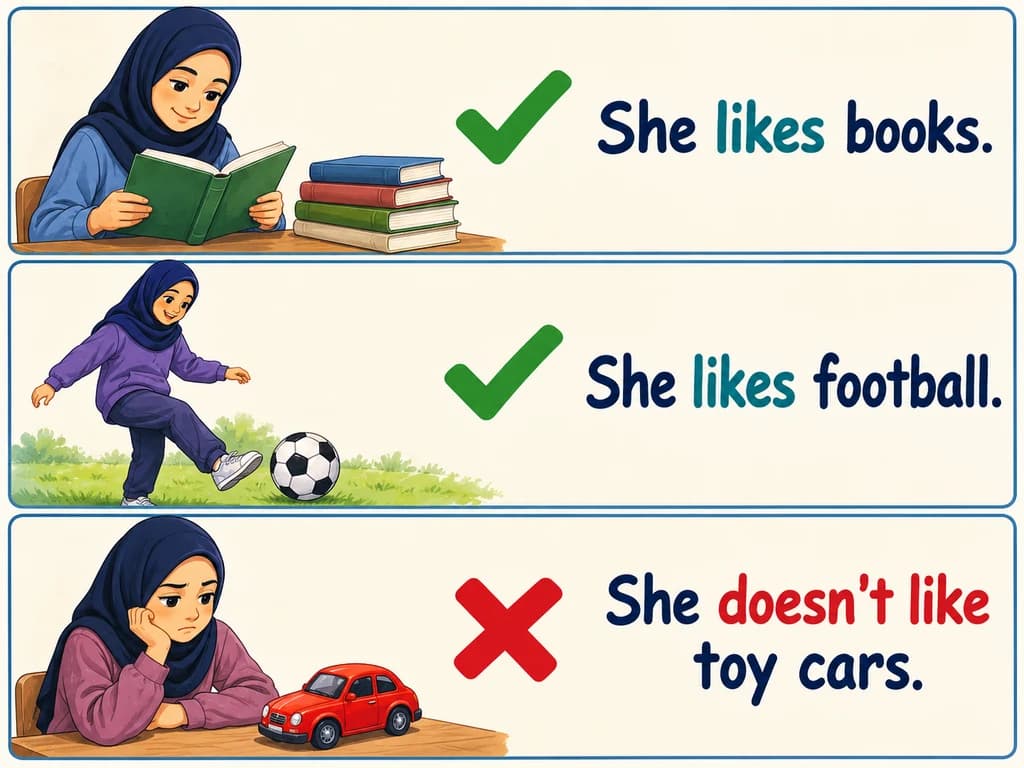
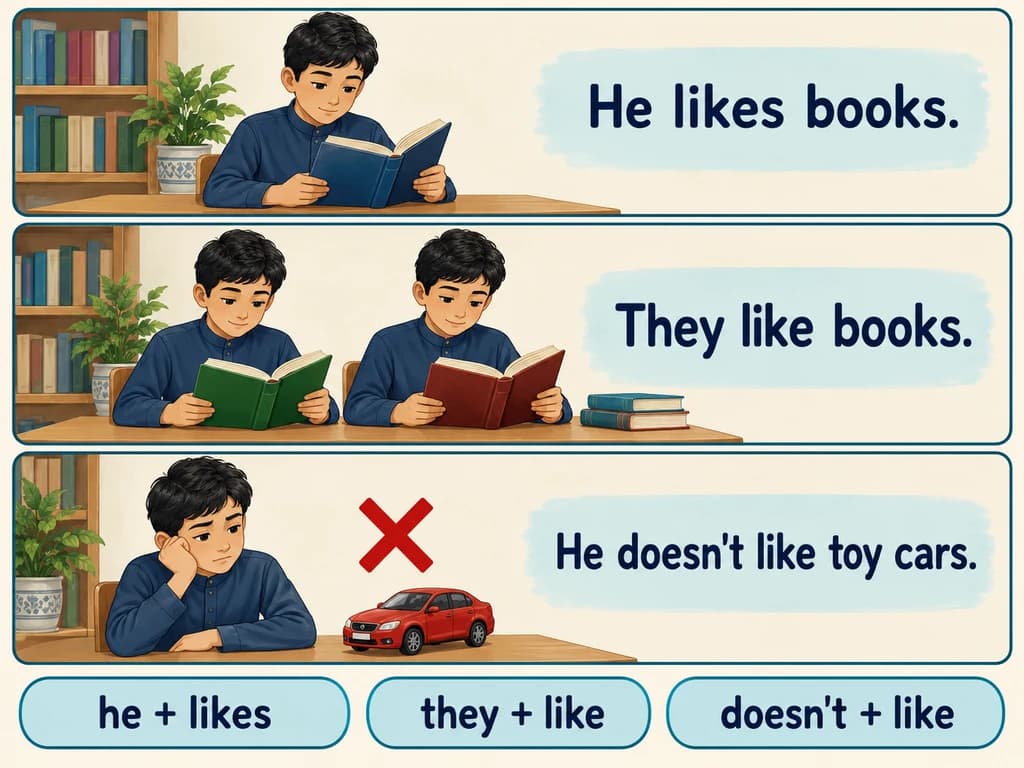
What does he like? He likes books. He doesn't like toy cars. To talk about another person's preferences, add s to like in a positive statement, but keep like after does or doesn't. English 1AC Unit 7, Let's buy presents!, helps you choose a thoughtful gift, follow card-making instructions and write about someone you care about.

Ta fiche PDF illustrée
Le cours, les exemples et les exercices corrigés à imprimer.
By the end of this lesson, you can
- Name gifts and simple special-day expressions
- Use like, likes, don't like and doesn't like
- Ask What does he or she like?
- Expand and contract do not and does not
- Follow short imperative instructions to make a card
- Practise the consonant blends cl, gl and sl
- Write a short gift paragraph using a preference and a reason
Before you startPresent simple negatives with don't · He, she, my, his and her · Common objects, colours and family words
Un bon cours, ça se partage.
What can you give someone on a special day?
A present is something you give someone. In this lesson, present means gift; it does not name a verb tense. A special day might be a birthday, a family celebration or a day when you want to say thank you. People celebrate in different ways. A handmade card or a kind message can be a thoughtful present.
| Word or phrase | Meaning or use | Example |
|---|---|---|
| a present / a gift | Something given to someone | This book is a present for my sister. |
| a card | A written message on paper | I make a card for Mum. |
| a book | Pages to read | My brother likes storybooks. |
| a toy car | A small car for playing | My cousin likes toy cars. |
| a football | A ball used for football | This football is for Adam. |
| flowers | Plants often given as a gift | My aunt likes flowers. |
| a birthday | The anniversary of someone's birth | Happy birthday, Lina! |
| a thank-you message | Words that express thanks | Thank you for your help. |
Use for to name the person receiving the gift: a card for my mum. Use my, his or her to show the relationship: my mum, his sister, her friend. You can describe an imaginary family if you prefer.
How do you say what someone likes?
Definition
Like and likes : Use like with I, you, we and they: I like books. Use likes with he, she or one person's name: She likes books. A plural object does not change the verb: She likes flowers.
| Subject | Positive | Negative |
|---|---|---|
| I / you / we / they | They like games. | They don't like games. |
| he / she | He likes games. | He doesn't like games. |
| one person's name | Lina likes flowers. | Lina doesn't like flowers. |
Find the subject before choosing the verb. In My sister likes books, the subject is my sister, one person. Books is the object, so its plural s does not tell you which form of like to choose. In My sisters like books, the subject itself is plural.
Read a preference clue
Youssef likes football. He doesn't like toy cars. We choose a football for him.
- Youssef can be replaced by he, so use likes.
- Doesn't already carries the third-person form: the next verb is like.
- The gift follows the information given, rather than a guess about what all boys like.
Remember
Say She doesn't like flowers, not She doesn't likes flowers. The s appears in likes only in a positive statement. Do not write She is like flowers when you mean she enjoys receiving flowers.
How do you ask What does he like?
| Purpose | Question | Possible answer |
|---|---|---|
| Ask for a boy's preferences | What does he like? | He likes books. |
| Ask for a girl's preferences | What does she like? | She likes chess. |
| Check one preference | Does Salma like flowers? | Yes, she does. |
| Check another preference | Does Adam like toy cars? | No, he doesn't. |
| Ask two people | What do they like? | They like games. |
Step by step
Choose like or likes
- Find the subject: he, she, one name, or a plural group.
- Check whether the sentence is positive, negative or a question.
- In a positive sentence with he or she, use likes.
- After does or doesn't, use like.
- Read the complete sentence aloud: Does she like books? Yes, she does.
Can I use love and hate too?
Love expresses a stronger positive feeling than like; hate expresses a strong negative feeling. The same pattern applies: She loves music. She doesn't love every song. He hates noise. At this level, practise with a noun after these verbs. Don't like usually sounds less strong than hate, so choose the phrase that matches your meaning.
What are the long and short forms?
| Long form | Short form | Example |
|---|---|---|
| do not | don't | I don't like noisy toys. |
| does not | doesn't | She doesn't like noisy toys. |
| let us | let's | Let's make a card. |
The apostrophe shows that letters are missing. In doesn't, the missing letter is o from not. Keep the apostrophe when you write a paragraph or a card message. Both long and short forms are correct; contractions are common in friendly conversations and informal writing.
Reading: how do you make a thank-you card?
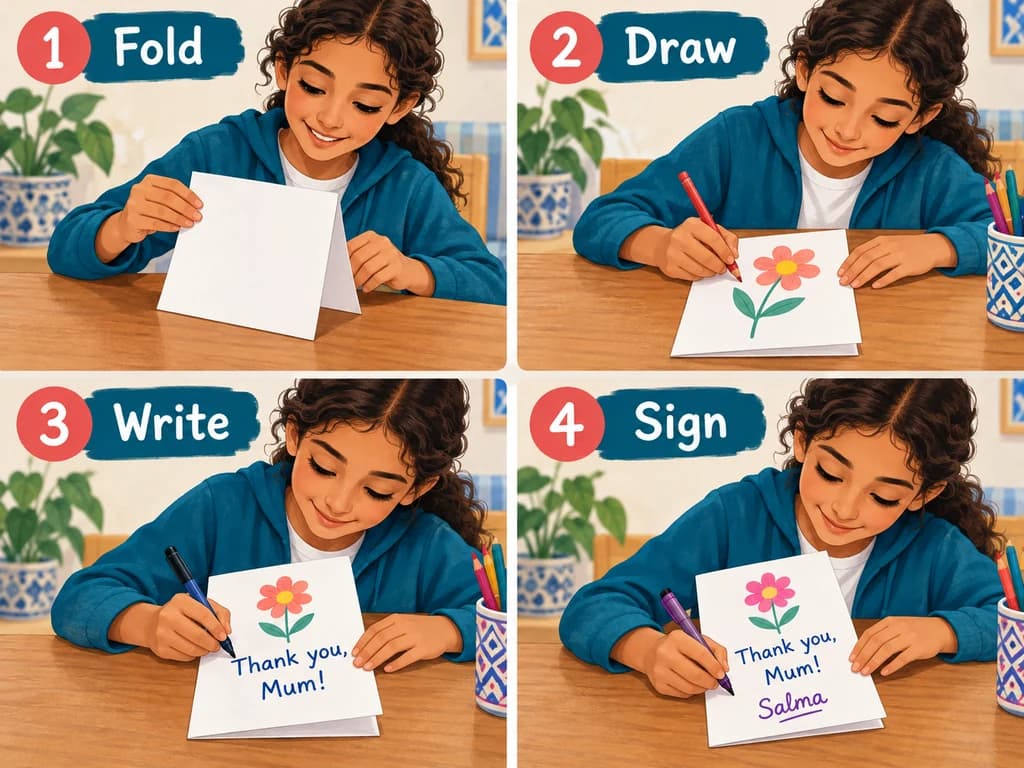
MAKE A THANK-YOU CARD. You need a sheet of paper and coloured pencils. First, fold the paper in half. Next, draw a flower on the front. Under the flower, write a short message: Thank you, Mum! Then write your name under the message. Finally, give the card to your mum, or change the message for another person you want to thank.
Definition
Instruction verb : An instruction often starts with a base verb and leaves out you: Fold the paper. Draw a flower. Write your name. The reader is the person who performs the action.
The text has a purpose: it tells you how to make something. Read the materials before the steps. First, next, then and finally help you follow the order. The verb fold means bend the paper so that one part covers another; it does not mean cut it.
Remember
Write your message before giving away the card. In a set of instructions, changing the order can make the task harder. Use the steps in the text rather than adding materials that are not mentioned.
Phonics: how do you recognise cl, gl and sl?
| Blend | Word examples | Phrase |
|---|---|---|
| cl | clock, clap, clean | a clean card |
| gl | glass, glue, globe | a glass of water |
| sl | sleep, slide, slow | a slow walk |
Say both beginning consonants without adding a separate vowel: cl in clap, gl in glue and sl in slow. Use a mirror to notice your mouth move into l. Practise clap, glue and slow in a different order so that you recognise the sounds rather than remember the table position.
Writing: how do you describe a present for your mum?
Step by step
Use a preference to choose a gift
- Name the person you are writing about.
- Give one positive preference with likes.
- Add one negative preference with doesn't like.
- Name a suitable present using for.
- Add a reason with because and check the apostrophes.
A gift paragraph
My mum likes flowers and blue things. She doesn't like noisy toys. I make a blue card for her. I draw a flower on the front because she likes flowers. Inside, I write, Thank you for your help.
- She refers to my mum, so use likes in positive statements.
- The card is personal because its colour and picture follow her preferences.
- You can change the recipient and the message to suit your own situation.
Speaking task: tell a partner two preferences about a fictional friend. The partner asks Does your friend like books? and suggests a gift. Explain your choice using one clue. You have understood the lesson when the gift, the pronoun and the verb form all match the same person.
Frequently asked questions
What is the grammar in English 1AC Unit 7?
Why do we say doesn't like instead of doesn't likes?
How do I write about presents for my mum?
What is the difference between do not and don't?
What pronunciation and reading skills does this unit practise?
Quiz: 20 questions
20 questions are randomly selected from this lesson’s 24-question bank. Choose one answer for each question and get an immediate explanation.
Q1In this unit, a present means…
Incorrect answer
A present is something given to another person in this context.
Correct answer: a gift.
A present is something given to another person in this context.
Q2Complete: She … flowers.
Incorrect answer
A positive statement with she takes likes.
Correct answer: likes
A positive statement with she takes likes.
Q3Complete: They … books.
Incorrect answer
They is plural and takes the base form like.
Correct answer: like
They is plural and takes the base form like.
Q4Choose a correct negative.
Incorrect answer
Use doesn't + base form like with he.
Correct answer: He doesn't like cars.
Use doesn't + base form like with he.
Q5Complete: What … Salma like?
Incorrect answer
Salma is one person, so ask What does Salma like?
Correct answer: does
Salma is one person, so ask What does Salma like?
Q6Does he like chess? Yes, …
Incorrect answer
The short answer repeats does from the question.
Correct answer: he does.
The short answer repeats does from the question.
Q7Doesn't means…
Incorrect answer
The contraction doesn't is the short form of does not.
Correct answer: does not.
The contraction doesn't is the short form of does not.
Q8Complete: This card is … my mum.
Incorrect answer
For identifies the person who receives the card.
Correct answer: for
For identifies the person who receives the card.
Q9Which sentence is correct?
Incorrect answer
My sister can be replaced by she, so the positive verb is likes.
Correct answer: My sister likes books.
My sister can be replaced by she, so the positive verb is likes.
Q10Choose the correctly written contraction.
Incorrect answer
Doesn't places the apostrophe where the o of not is omitted.
Correct answer: doesn't
Doesn't places the apostrophe where the o of not is omitted.
Q11What do you do first in the card text?
Incorrect answer
The first instruction says to fold the paper in half.
Correct answer: Fold the paper
The first instruction says to fold the paper in half.
Q12Where is the flower drawn in the reading?
Incorrect answer
The reading places the flower on the front of the card.
Correct answer: On the front of the card
The reading places the flower on the front of the card.
Q13Which is an instruction?
Incorrect answer
An imperative starts with the base verb and tells the reader what to do.
Correct answer: Write your name.
An imperative starts with the base verb and tells the reader what to do.
Q14Which word begins with gl?
Incorrect answer
Glue begins with the two consonant sounds g and l.
Correct answer: glue
Glue begins with the two consonant sounds g and l.
Q15Which word begins with sl?
Incorrect answer
Sleep starts with s followed by l.
Correct answer: sleep
Sleep starts with s followed by l.
Q16Which word begins with cl?
Incorrect answer
Clap begins with the consonant blend cl.
Correct answer: clap
Clap begins with the consonant blend cl.
Q17Lina likes stories. Which gift fits that clue?
Incorrect answer
A storybook matches her stated interest in stories.
Correct answer: A storybook
A storybook matches her stated interest in stories.
Q18Which word introduces a reason?
Incorrect answer
Because connects a choice to the reason for it.
Correct answer: Because
Because connects a choice to the reason for it.
Q19Which sentence talks about a plural subject?
Incorrect answer
My sisters names more than one person and takes like.
Correct answer: My sisters like games.
My sisters names more than one person and takes like.
Q20Which phrase is a friendly birthday message?
Incorrect answer
Happy birthday! is used to wish someone well on their birthday.
Correct answer: Happy birthday!
Happy birthday! is used to wish someone well on their birthday.
Q21Complete: She … music very much.
Incorrect answer
Love follows the same third-person positive pattern: she loves.
Correct answer: loves
Love follows the same third-person positive pattern: she loves.
Q22Which expression is less strong than hate?
Incorrect answer
Don't like expresses dislike without the stronger meaning of hate.
Correct answer: Don't like
Don't like expresses dislike without the stronger meaning of hate.
Q23Which sequence word introduces the last step?
Incorrect answer
Finally indicates the last action in a sequence.
Correct answer: Finally
Finally indicates the last action in a sequence.
Q24Choose the correct question.
Incorrect answer
With he, use does and keep like in its base form.
Correct answer: What does he like?
With he, use does and keep like in its base form.
Your score
0/20
Start with the worked examples
Read the lesson in small sections. Write your own example for each rule and try the Easy exercises before returning to the quiz.
Review: 20 missed questions
In this unit, a present means…
Correct answera gift.
A present is something given to another person in this context.
Complete: She … flowers.
Correct answerlikes
A positive statement with she takes likes.
Complete: They … books.
Correct answerlike
They is plural and takes the base form like.
Choose a correct negative.
Correct answerHe doesn't like cars.
Use doesn't + base form like with he.
Complete: What … Salma like?
Correct answerdoes
Salma is one person, so ask What does Salma like?
Does he like chess? Yes, …
Correct answerhe does.
The short answer repeats does from the question.
Doesn't means…
Correct answerdoes not.
The contraction doesn't is the short form of does not.
Complete: This card is … my mum.
Correct answerfor
For identifies the person who receives the card.
Which sentence is correct?
Correct answerMy sister likes books.
My sister can be replaced by she, so the positive verb is likes.
Choose the correctly written contraction.
Correct answerdoesn't
Doesn't places the apostrophe where the o of not is omitted.
What do you do first in the card text?
Correct answerFold the paper
The first instruction says to fold the paper in half.
Where is the flower drawn in the reading?
Correct answerOn the front of the card
The reading places the flower on the front of the card.
Which is an instruction?
Correct answerWrite your name.
An imperative starts with the base verb and tells the reader what to do.
Which word begins with gl?
Correct answerglue
Glue begins with the two consonant sounds g and l.
Which word begins with sl?
Correct answersleep
Sleep starts with s followed by l.
Which word begins with cl?
Correct answerclap
Clap begins with the consonant blend cl.
Lina likes stories. Which gift fits that clue?
Correct answerA storybook
A storybook matches her stated interest in stories.
Which word introduces a reason?
Correct answerBecause
Because connects a choice to the reason for it.
Which sentence talks about a plural subject?
Correct answerMy sisters like games.
My sisters names more than one person and takes like.
Which phrase is a friendly birthday message?
Correct answerHappy birthday!
Happy birthday! is used to wish someone well on their birthday.
Exercises with answers
14 exercises, from easy practice to challenges. Try each one yourself, then reveal the answer and explanation.
Exercise 1
EasyChoose the word for each clue: pages to read; a short paper message; a small car for playing. Use card, book and toy car.
Answer and explanation
A book has pages to read. A card carries a short paper message. A toy car is a small car for playing. Each clue describes the object, not the person receiving it.
Exercise 2
EasyComplete: I … books. She … flowers. My cousins … games. Adam … football.
Answer and explanation
I like books. She likes flowers. My cousins like games. Adam likes football. She and Adam refer to one person; my cousins is a plural subject.
Exercise 3
EasyMake negative sentences: He likes toy cars. They like noisy games. Salma likes flowers.
Answer and explanation
He doesn't like toy cars. They don't like noisy games. Salma doesn't like flowers. Use doesn't with one person and keep like in the base form.
Exercise 4
EasyExpand: I don't like red. She doesn't like toy cars. Let's make a card.
Answer and explanation
I do not like red. She does not like toy cars. Let us make a card. The apostrophe in each short form replaces omitted letters.
Exercise 5
IntermediateWrite a question asking what Lina likes. Then ask whether Adam likes books.
Answer and explanation
What does Lina like? Does Adam like books? Both subjects refer to one person, so use does and the base form like. The first question asks for information; the second can take a yes/no answer.
Exercise 6
EasyGive short answers: Does she like flowers? (yes). Does he like toy cars? (no). Do they like chess? (yes).
Answer and explanation
Yes, she does. No, he doesn't. Yes, they do. Match the helper verb in the answer to the helper in the question.
Exercise 7
IntermediateLina likes stories and blue things. She doesn't like football. Suggest two suitable presents and explain one choice.
Answer and explanation
Possible choices: a storybook and a blue card. I choose a storybook because Lina likes stories. A football does not match the preference clue given in this task.
Exercise 8
IntermediateName the materials in the reading, the first action and the place where the message is written.
Answer and explanation
Materials: a sheet of paper and coloured pencils. First action: fold the paper in half. Write the message under the flower on the front of the card. Sign your name below the message.
Exercise 9
IntermediateOrder these actions from the reading: give the card; fold the paper; sign your name; draw a flower; write the message.
Answer and explanation
Fold the paper, draw a flower, write the message, sign your name, then give the card. Signing comes after the message so the recipient knows who wrote it.
Exercise 10
EasySort clock, slide, glass, clean, glue and sleep into their beginning blends.
Answer and explanation
cl: clock, clean. gl: glass, glue. sl: slide, sleep. Read both beginning sounds in each word rather than adding a vowel between them.
Exercise 11
IntermediateRepair: My sister like books. She doesn't likes cars. This present is to her.
Answer and explanation
My sister likes books. She doesn't like cars. This present is for her. Add s only in the positive statement with a singular subject; use for to name the recipient.
Exercise 12
IntermediateA partner reads twice: My uncle likes chess. He doesn't like noisy games. I make a chess card for him. Without looking, name his like, dislike and present.
Answer and explanation
He likes chess. He doesn't like noisy games. The present is a chess card. Listen for doesn't because it reverses the preference; this is a partner-read script.
Exercise 13
ChallengeWrite five sentences about a real or fictional mum, relative or trusted adult. Include likes, doesn't like, a gift and because.
Answer and explanation
Model: My aunt likes green things. She doesn't like noisy toys. I make a green card for her. I draw a tree because she likes nature. Inside, I write a thank-you message. Other recipients and preferences are valid if the grammar and reason match.
Exercise 14
ChallengeWrite four instructions for a card using First, Next, Then and Finally. Begin each instruction with a base verb after the sequence word.
Answer and explanation
Model: First, fold the paper. Next, draw a star. Then, write a kind message. Finally, sign your name. The drawing can change, but the steps must stay practical and use instruction verbs.