



Writing: my town or neighbourhood
A town paragraph introduces a place, locates a few buildings and explains what you do there. Use there is or there are and clear prepositions such as next to and opposite. This English 2AC writing lesson includes a complete original handwritten model about an invented neighbourhood in Meknes, a planning table and guided corrections.

English 2AC · S2
Your illustrated PDF
The plan, the complete model and corrected exercises to print. The quiz stays online.
By the end of this lesson, you can
- Describe a neighbourhood in a logical order
- Use there is/are and location expressions
- Connect places with personal activities
Before you startRead short English sentences and familiar school vocabulary
Un bon cours, ça se partage.
Understand the writing task
Describe a neighbourhood in a logical order. Use there is/are and location expressions. Connect places with personal activities.

My neighbourhood
I live in a quiet neighbourhood in Meknes. Near my home, there is a small library and a school. The library is next to the school. Opposite the library, there is a bakery. There are two shops near the bus stop. After school, I sometimes go to the library to read. On Saturday mornings, I buy bread with my brother. I like my neighbourhood because useful places are close to my home. My favourite place is the library because it is calm and welcoming.
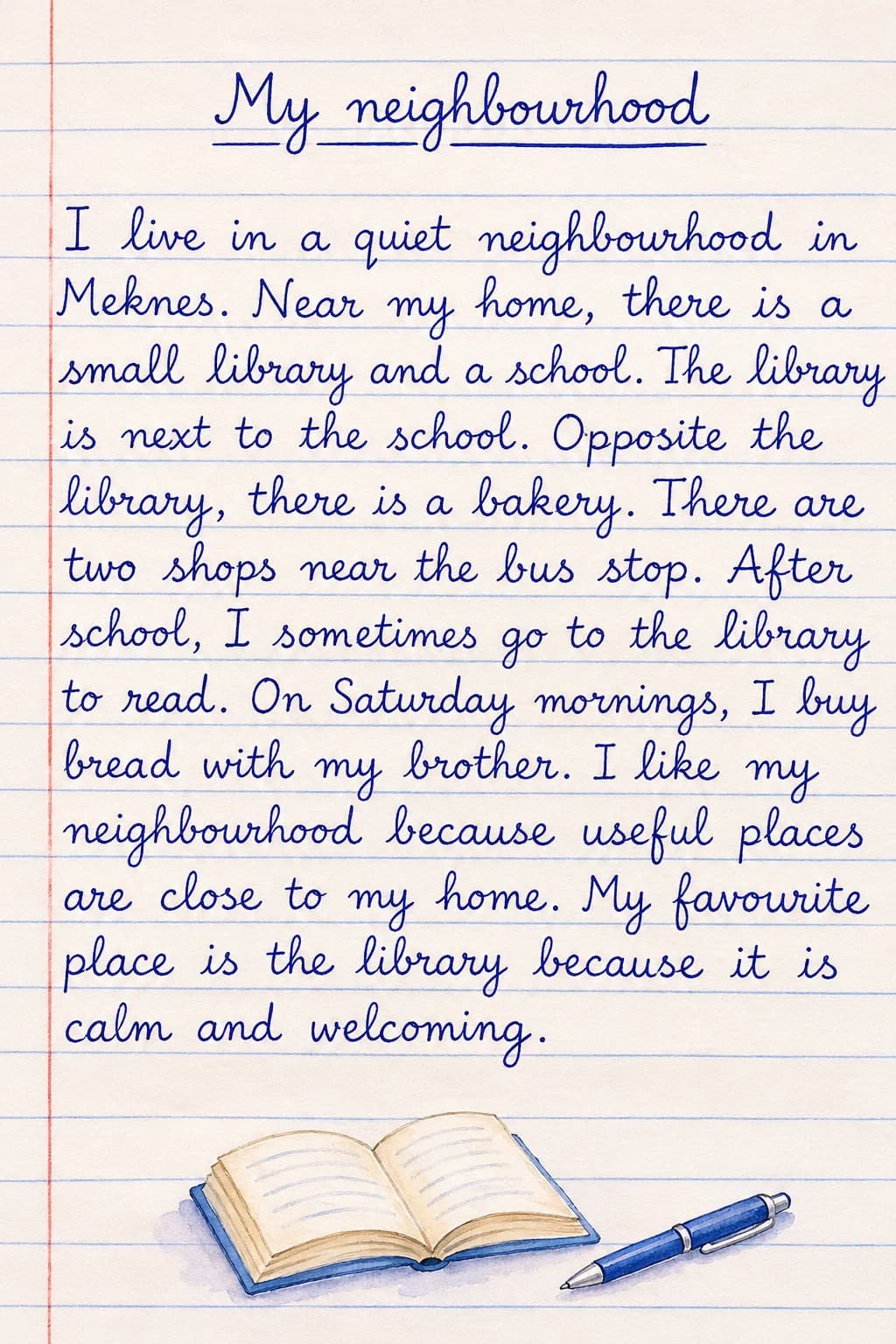
This notebook contains the complete example written above. It is one possible original answer. Use its structure to plan your own text and change the details to match the task.
What should you include in a neighbourhood description?
Write about a small area that a reader can picture. For this practice, use about 70–100 words and include three places, two location expressions and a reason for liking one place. Your teacher may set a different length or number of details. You may describe an imagined neighbourhood instead of sharing your own address or daily movements.
The model uses a real Moroccan city name but an invented arrangement of buildings. It is a language example, not directions to actual businesses in Meknes. Introduce the neighbourhood broadly, then describe nearby places in a consistent order. A paragraph usually becomes clearer when it focuses on a small area rather than jumping between landmarks across an entire city.
How does the model connect buildings and activities?
There is introduces a singular building, while there are introduces two shops. Next to links the library and school; opposite places the bakery across from the library. These relations should remain consistent if you sketch them. Two location sentences can be grammatically correct yet contradict each other, so draw a quick plan before writing.
After school and on Saturday mornings connect the setting with activities. The writer reads at the library and buys bread with a brother. Because provides a reason for the overall preference and for the favourite place. These details give the paragraph a purpose beyond naming buildings. They also practise routines in the present simple without turning the description into an unrelated daily schedule.
| Part | What to plan |
|---|---|
| Opening | town or neighbourhood, general impression |
| Places | library, school, bakery, shops |
| Positions | next to, opposite, near |
| Activities | read, buy bread |
| Ending | favourite place and reason |
Link a place to its use
There is a library near my home. I sometimes go there after school because I enjoy reading.
- The second sentence explains why the place matters to the writer.
How do you check the finished paragraph?
Underline each place name and draw arrows for the location expressions. Check that a reader could make a simple plan without guessing. Then circle is and are to compare them with singular and plural nouns. A small library takes is; two shops takes are. Keep on Saturday mornings and after school in their usual forms.
Finally, read your reasons. Useful places are close explains convenience, while calm and welcoming describes a personal impression of the library. Avoid claiming that a whole city is the biggest or best without evidence; a personal sentence beginning I like is enough for this task. Revise spelling and punctuation after checking meaning, and keep your own details when adapting the model.
A method you can reuse
Step by step
Work step by step
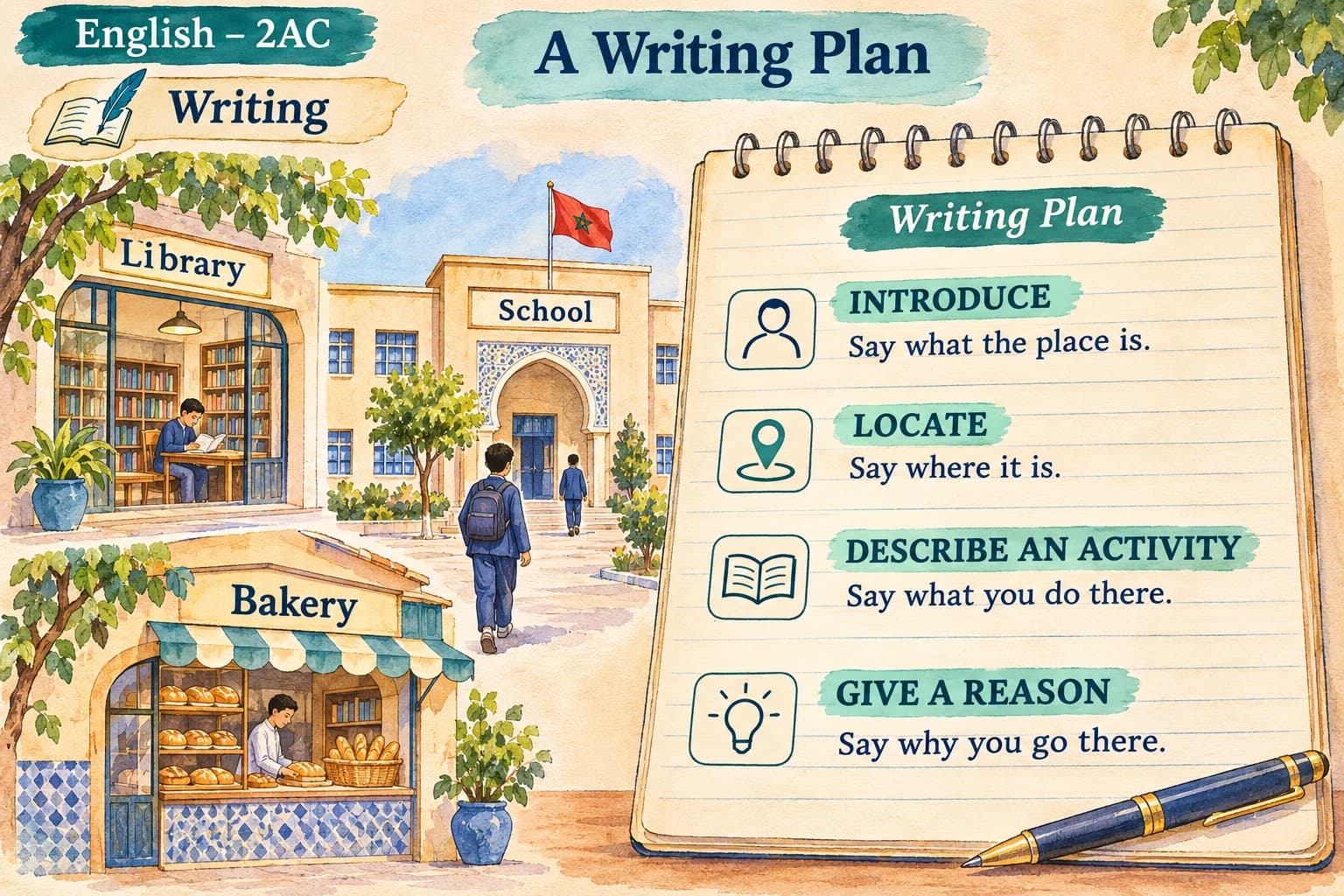
- Sketch a small real or imagined area.
- Select three places and two clear location relations.
- Add an activity and a reason.
- Check the sketch, singular/plural verbs and sentence links.
Remember
Write There are two shops, rather than There is two shops. Keep the locations consistent. The model is an invented neighbourhood, rather than a real street guide.
Frequently asked questions
How do I write My town in anglais 2AC?
Can I describe an imaginary neighbourhood?
Which expressions are useful?
Quiz: 2 questions
2 questions are randomly selected from this lesson’s 2-question bank. Choose one answer for each question and get an immediate explanation.
Q1There … two shops.
Incorrect answer
Two shops is plural.
Correct answer: are
Two shops is plural.
Q2What should a location sentence match?
Incorrect answer
A simple sketch checks that the relations make sense.
Correct answer: A consistent sketch
A simple sketch checks that the relations make sense.
Your score
0/2
Start with the worked examples
Read the lesson in small sections. Write your own example for each rule and try the Easy exercises before returning to the quiz.
Review: 2 missed questions
There … two shops.
Correct answerare
Two shops is plural.
What should a location sentence match?
Correct answerA consistent sketch
A simple sketch checks that the relations make sense.
Exercises with answers
6 exercises, from easy practice to challenges. Try each one yourself, then reveal the answer and explanation.
Exercise 1
EasyWhich expressions connect the library, school and bakery?
Answer and explanation
The library is next to the school. The bakery is opposite the library. Both relations are explicitly stated.
Exercise 2
EasyWhat does the writer do on Saturday mornings?
Answer and explanation
The writer buys bread with a brother. This connects an activity with the neighbourhood.
Exercise 3
IntermediateCorrect: There is two shops near my home.
Answer and explanation
There are two shops near my home. Two shops is plural, so use are.
Exercise 4
IntermediateComplete: My favourite place is the library because …
Answer and explanation
One possible ending: it is quiet and I enjoy reading there. Choose a reason relevant to your own place.
Exercise 5
IntermediateChoose three buildings and write two consistent location sentences before drafting.
Answer and explanation
One possible plan: school next to library; bakery opposite library. Sketch the positions to make sure the sentences agree.
Exercise 6
ChallengeWrite 70–100 words about a real or invented neighbourhood with three places, two location expressions and one reason.
Answer and explanation
Use the model as an organisational guide. Accept a coherent paragraph that locates buildings consistently, uses singular/plural forms accurately and explains a preference. Keep any private address details out if you prefer.