



Reading: an animal information card
An animal information card groups facts by topic: appearance, habitat, food and abilities. To answer its questions, locate the relevant category and identify what pronouns refer to. This original English 2AC reading uses a fictional wildlife-park card about a zebra so you can practise comprehension without confusing details from the passage with outside assumptions.

English 2AC · S2
Your illustrated PDF
The text, the reading method and corrected exercises to print. The quiz stays online.
By the end of this lesson, you can
- Read a description by topic
- Find the reference of it and they
- Justify answers and recognise missing information
Before you startRead short English sentences and familiar school vocabulary
Un bon cours, ça se partage.
Start with the situation
Read a description by topic. Find the reference of it and they. Justify answers and recognise missing information.
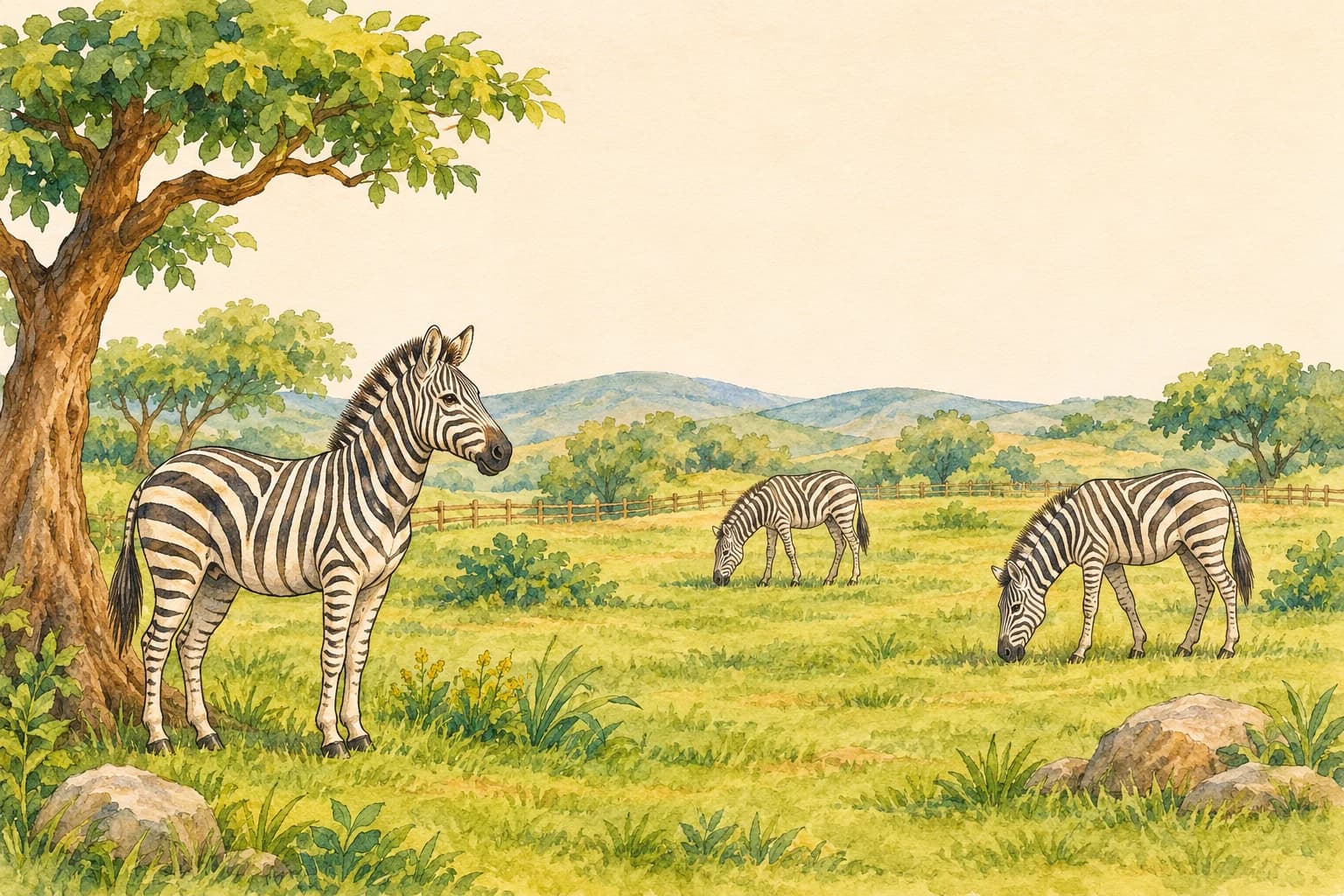
A card at the imaginary Cedar Wildlife Park
Zina is a zebra at Cedar Wildlife Park. The park and its information card are invented for this reading. Zina has black and white stripes, four legs and a short mane. She lives in a large grassy area with two other zebras. They eat grass, and they can move around the enclosure. Every morning, a keeper checks their water. Today Zina is standing near a tree while the other zebras are eating. Visitors must stay on the marked path and must not feed the animals. The card does not give Zina’s age or weight. Before leaving, visitors can read a second card about how the park cares for its animals.
How is descriptive information organised?
Find the animal’s name first, then sort the information into appearance, setting and activity. Black and white stripes, four legs and a short mane describe appearance. A grassy area describes Zina’s setting within this invented park. Eating grass describes food, while standing near a tree describes an action today. Each category answers a different kind of question.
The card is a reading exercise about a fictional setting, rather than a source for every fact about wild zebras. A statement about where Zina lives at the park does not describe the natural range of all zebras. Keep the scope of the sentence when you answer: She lives in a grassy area at Cedar Wildlife Park is more precise than All zebras live in parks.
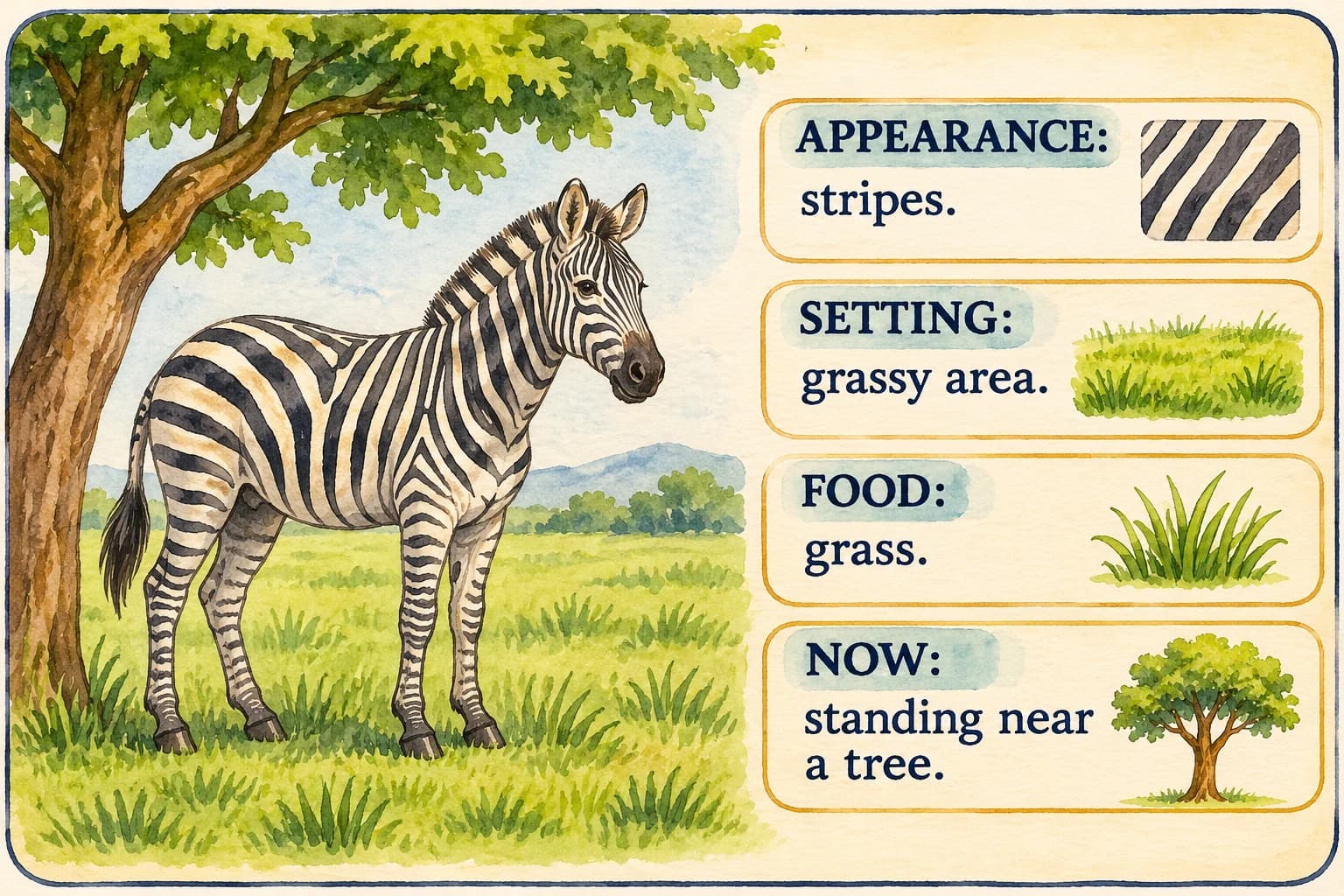
How do you follow pronouns and time clues?
She refers to Zina. They refers to Zina and the two other zebras when the text discusses the group. Their water also belongs to that group. Read the previous sentence to find the noun a pronoun replaces. Avoid answering a question about the other zebras with Zina’s individual action today.
Every morning introduces the keeper’s routine, so checks is in the present simple. Today introduces actions in progress: is standing and are eating. Zina is near the tree while the others are eating. While connects simultaneous situations here; it does not mean one happens after the other. These clues allow you to explain a verb choice using the meaning of the passage.
| Category | Clue |
|---|---|
| Appearance | black and white stripes |
| Setting | a large grassy area |
| Routine | Every morning, a keeper checks their water |
| Now | Zina is standing near a tree |
| Missing information | age and weight |
Count with care
How many zebras are in the described group? There are three: Zina and two other zebras.
- Two other zebras means two in addition to Zina, rather than two including her.
What can and cannot be concluded?
The group has three zebras because Zina lives with two others. The card does not state her age or weight, so there is no supported numerical answer for those questions. Write The card does not say rather than guessing from a drawing. It is useful to recognise missing information as well as to retrieve facts that are present.
The visitor rules use must and must not. Visitors must stay on the path and must not feed the animals. The text gives the rules, but it does not report a visitor breaking one. Distinguish an instruction from an event. To justify a true-or-false answer, correct the exact claim with a phrase from the card instead of adding an imagined incident.
A method you can reuse
Step by step
Work step by step
- Identify the animal and the setting.
- Sort appearance, food, routine and current actions.
- Resolve each pronoun from its context.
- Answer only from the card and say when a detail is missing.
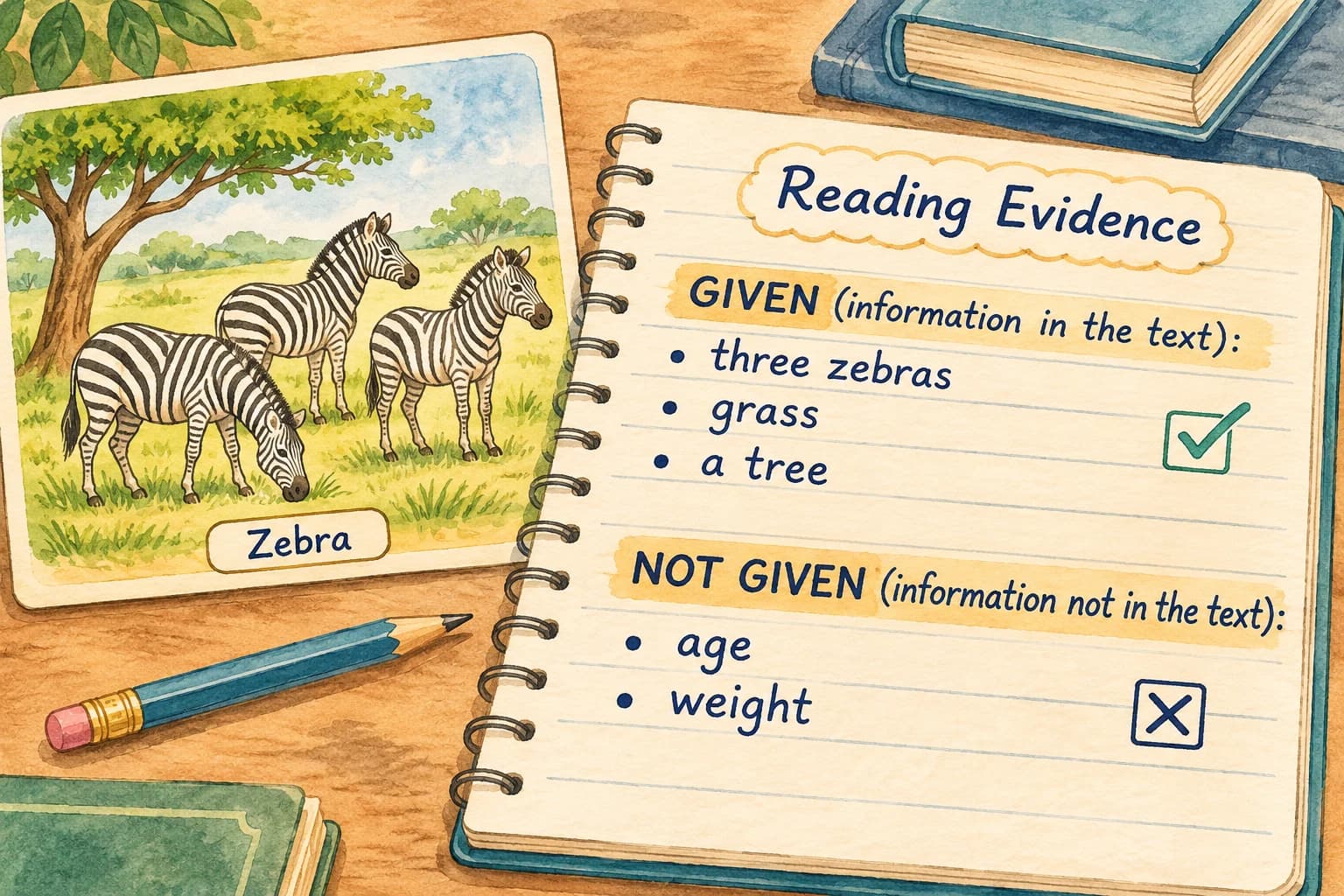
Remember
An illustration does not supply an exact age or weight. A fictional park description must not be turned into a claim about all wild animals.
Frequently asked questions
How do I read an animal description in 2AC?
What should I write if a detail is missing?
Is Cedar Wildlife Park real?
Quiz: 2 questions
2 questions are randomly selected from this lesson’s 2-question bank. Choose one answer for each question and get an immediate explanation.
Q1They refers to …
Incorrect answer
The previous sentence introduces the three zebras.
Correct answer: Zina and two other zebras
The previous sentence introduces the three zebras.
Q2The card gives Zina’s …
Incorrect answer
It describes stripes, legs and a mane, but omits age and weight.
Correct answer: appearance
It describes stripes, legs and a mane, but omits age and weight.
Your score
0/2
Start with the worked examples
Read the lesson in small sections. Write your own example for each rule and try the Easy exercises before returning to the quiz.
Review: 2 missed questions
They refers to …
Correct answerZina and two other zebras
The previous sentence introduces the three zebras.
The card gives Zina’s …
Correct answerappearance
It describes stripes, legs and a mane, but omits age and weight.
Exercises with answers
7 exercises, from easy practice to challenges. Try each one yourself, then reveal the answer and explanation.
Exercise 1
EasyGive two appearance details about Zina.
Answer and explanation
She has black and white stripes and a short mane. Four legs is another detail explicitly given.
Exercise 2
EasyHow many zebras are mentioned in the group?
Answer and explanation
Three: Zina and two other zebras. The word other adds two to the named animal.
Exercise 3
IntermediateWho does They refer to in They eat grass?
Answer and explanation
Zina and the two other zebras. The previous sentence introduces this group.
Exercise 4
IntermediateWhat is Zina doing, and what are the others doing?
Answer and explanation
Zina is standing near a tree. The others are eating. Both are actions in progress today.
Exercise 5
IntermediateHow old is Zina? How much does she weigh?
Answer and explanation
The card does not give her age or weight. A guessed number would not be supported.
Exercise 6
IntermediateTrue or false: Visitors may feed the zebras.
Answer and explanation
False. Visitors must not feed the animals. Must not expresses a prohibition.
Exercise 7
ChallengeWrite four sentences about an invented animal character, including appearance and an action now.
Answer and explanation
One possible answer: Badi is a bird in an imaginary story. He has blue feathers. He usually sits on a garden wall. Today he is flying over a tree. Make clear which details are invented.