



Can, should and must: abilities, advice and rules
Can expresses an ability, should gives advice, and must expresses a strong rule or obligation. Must not means something is forbidden; do not have to means it is not necessary. This English 2AC lesson uses classroom and sports-club situations to explain the differences and help you build short, accurate sentences.

English 2AC · S1
The lesson as a PDF
The illustrated lesson and corrected exercises to print. The quiz stays online.
By the end of this lesson, you can
- Choose an ability, advice or rule expression
- Use a modal followed by a base verb
- Distinguish a prohibition from the absence of an obligation
Before you startRead short English sentences and familiar school vocabulary
Un bon cours, ça se partage.
Start with the situation
Choose an ability, advice or rule expression. Use a modal followed by a base verb. Distinguish a prohibition from the absence of an obligation.

How do you describe what someone can do?
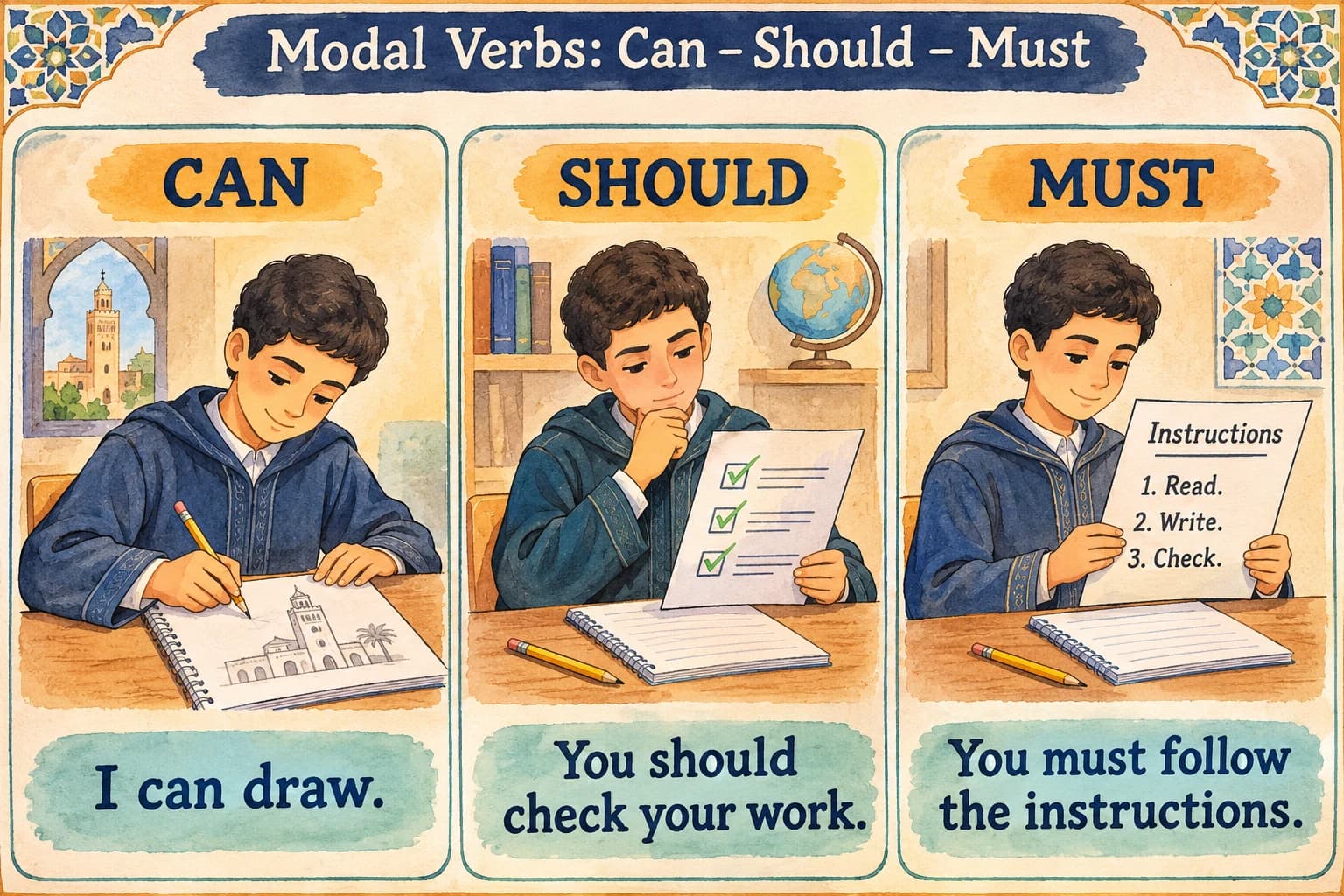
Use can before the base verb: I can draw. He can swim. The form stays the same with every subject, so do not add s to can or to the following verb. Make a negative with cannot or can’t: He cannot ride a bike. For a question, put can first: Can he ride a bike? A short answer repeats it: Yes, he can. No, he can’t.
An ability sentence tells us what a person is able to do. It does not describe their appearance. For a simple character description, use be with an adjective, have got for a feature and can for an ability: He is tall. He has got short dark hair. He can play basketball. Choose neutral, respectful descriptions; physical appearance does not tell you someone’s character or worth.
How do advice and rules differ?
Should suggests a sensible action rather than an absolute rule: You should organise your bag before school. Should not or shouldn’t advises against an action: You shouldn’t interrupt a speaker. Use the base verb after should. A question such as Should I bring my notebook? asks for advice about what would be useful.
Must expresses a strong obligation in the rule or situation being discussed: You must follow the teacher’s safety instructions. Must not or mustn’t expresses a prohibition: You mustn’t push other pupils. These are example school-club rules, rather than a statement of rules at every school. Always read a real club’s instructions when taking part in its activities.
| Meaning | Expression | Example |
|---|---|---|
| Ability | can | He can draw a map. |
| Advice | should | You should check the spelling. |
| Strong obligation | must | You must follow the instructions. |
| Prohibition | must not | You must not push. |
| No obligation | do not have to | You do not have to bring paint. |
An art-club notice
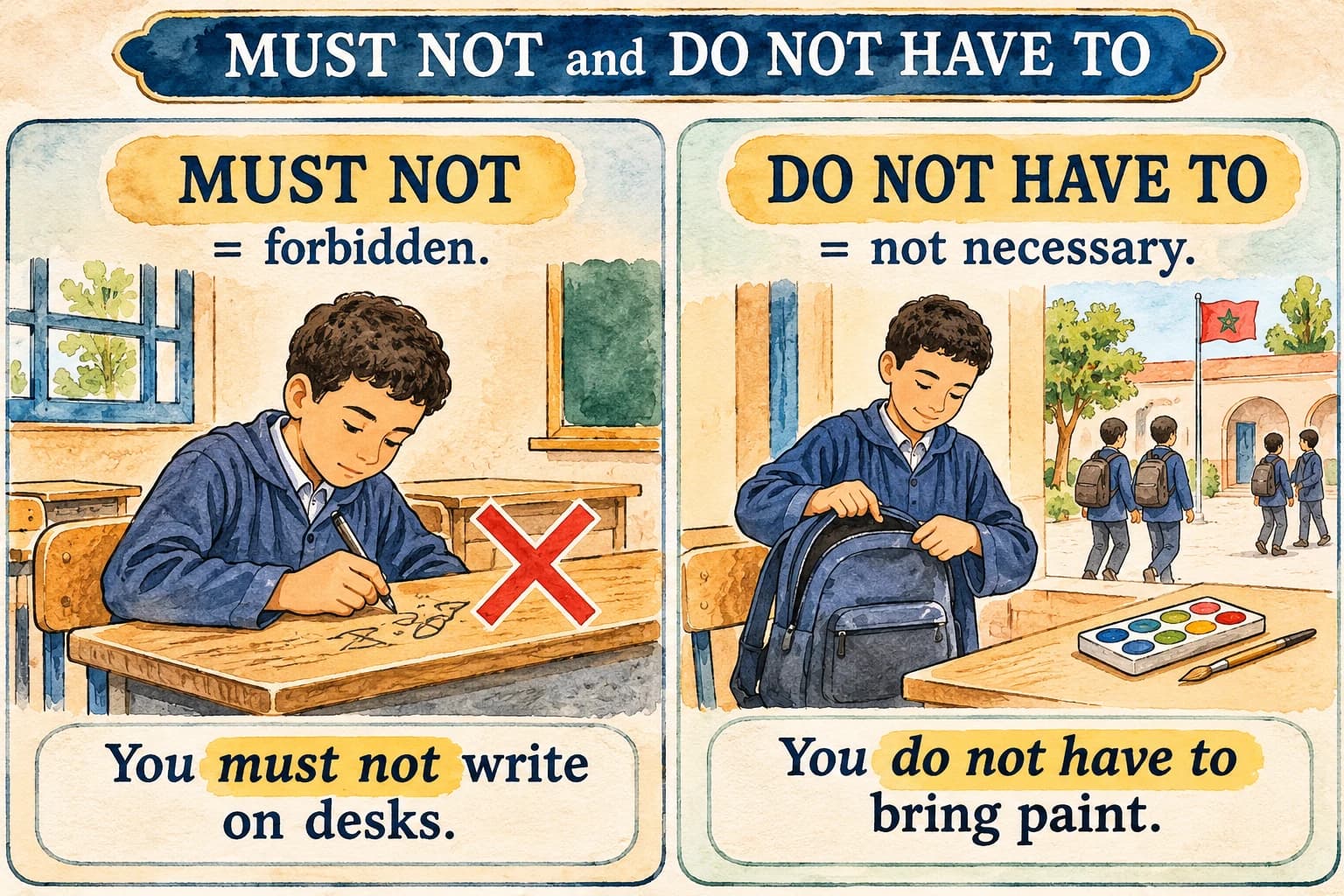
You must bring a notebook. You mustn’t write on the desks. You don’t have to bring paint because it is provided. You should label your work.
- The notebook is required; writing on desks is forbidden; paint is optional; labelling is recommended.
Why is mustn’t different from don’t have to?
If something is forbidden, you must not do it: You mustn’t write on a library book. If something is optional, you do not have to do it: You don’t have to bring coloured paper because the club provides it. In the second situation you may bring paper if you want. Replacing one expression with the other completely changes the message.
Read the reason after because when choosing an answer. The teacher provides pencils, so you don’t have to bring one expresses no necessity. The equipment is fragile, so you mustn’t touch it expresses a prohibition. Have to changes with the subject: He has to bring a notebook; he doesn’t have to bring paint. Must, can and should do not take a third-person s.
A method you can reuse
Step by step
Work step by step
- Identify the message: ability, advice, obligation or prohibition.
- Choose the expression with that meaning.
- Put a base verb after can, should or must.
- Check whether not necessary has been confused with forbidden.
Remember
Do not write He cans draw or He must to go. Use He can draw and He must go. Mustn’t means forbidden; don’t have to means optional.
Frequently asked questions
What follows can, should and must?
Does mustn’t mean don’t have to?
How do I describe someone in The amazing body?
Quiz: 2 questions
2 questions are randomly selected from this lesson’s 2-question bank. Choose one answer for each question and get an immediate explanation.
Q1He … draw a map.
Incorrect answer
Can stays unchanged and takes the base verb draw.
Correct answer: can
Can stays unchanged and takes the base verb draw.
Q2The club provides paint. You … bring paint.
Incorrect answer
Provided materials make bringing paint unnecessary, rather than forbidden.
Correct answer: don’t have to
Provided materials make bringing paint unnecessary, rather than forbidden.
Your score
0/2
Start with the worked examples
Read the lesson in small sections. Write your own example for each rule and try the Easy exercises before returning to the quiz.
Review: 2 missed questions
He … draw a map.
Correct answercan
Can stays unchanged and takes the base verb draw.
The club provides paint. You … bring paint.
Correct answerdon’t have to
Provided materials make bringing paint unnecessary, rather than forbidden.
Exercises with answers
6 exercises, from easy practice to challenges. Try each one yourself, then reveal the answer and explanation.
Exercise 1
EasyComplete: He … draw, but he … play the piano. Use can and cannot.
Answer and explanation
He can draw, but he cannot play the piano. Both expressions are followed by base verbs.
Exercise 2
EasyMake a question: The boys can swim.
Answer and explanation
Can the boys swim? Move can before the subject; do not add do.
Exercise 3
IntermediateUse should: It is a good idea to check your spelling.
Answer and explanation
You should check your spelling. Should presents the action as advice.
Exercise 4
IntermediateThe club provides paper. You … bring your own. Choose mustn’t or don’t have to.
Answer and explanation
You don’t have to bring your own. It is unnecessary, but bringing paper is not forbidden.
Exercise 5
IntermediateCorrect: He cans run. You must to listen.
Answer and explanation
He can run. You must listen. Modal verbs use no third-person s and are followed by the base verb without to.
Exercise 6
ChallengeWrite one obligation, one prohibition and one optional action for an imaginary club.
Answer and explanation
One possible notice: You must bring a notebook. You mustn’t write on the tables. You don’t have to bring pencils. Each sentence has a different purpose.