



Present simple or present continuous?
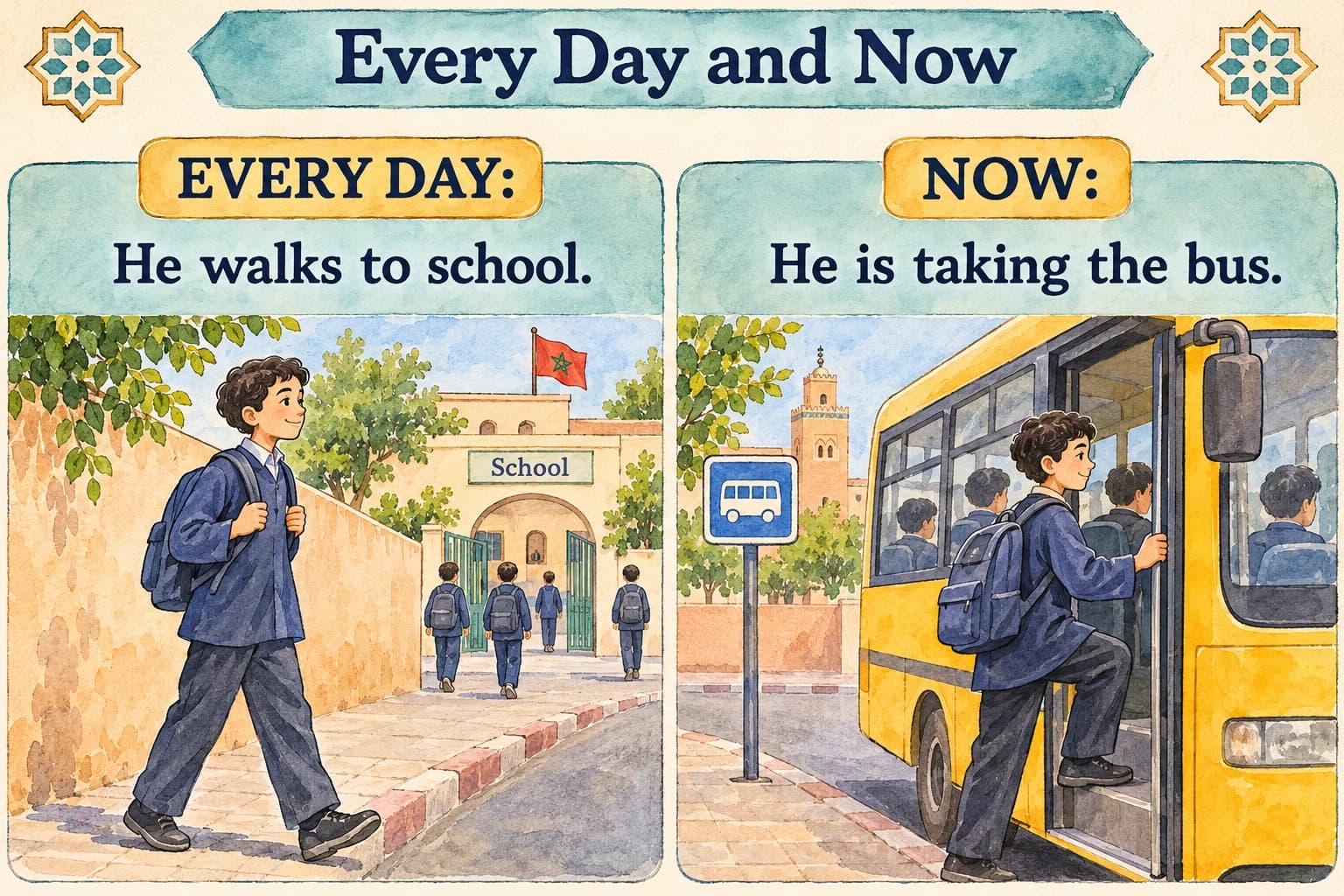
Use the present simple for habits and general facts, and am, is or are + verb-ing for an action happening now. Compare: Youssef walks to school every day. Today he is taking the bus. This English 2AC lesson helps you choose a tense from the meaning, build questions and avoid the mistakes that often appear in School day exercises.
English 2AC · S1
The lesson as a PDF
The illustrated lesson and corrected exercises to print. The quiz stays online.
By the end of this lesson, you can
- Choose a tense from the situation
- Make affirmative, negative and question forms
- Explain a correction instead of guessing from one keyword
Before you startRead short English sentences and familiar school vocabulary
Un bon cours, ça se partage.
Start with the situation
Choose a tense from the situation. Make affirmative, negative and question forms. Explain a correction instead of guessing from one keyword.

What changes between a habit and an action now?
A habit repeats. Every morning, on Mondays and usually can help you recognise it: I read before school. A general fact also uses the simple form: A school library lends books. An action in progress is happening around the moment of speaking: I am reading the last page now. A temporary change can use the continuous too: This week we are studying in another room. The important difference is the situation, rather than how long the action lasts.
Picture a pupil describing two journeys. He usually walks with his cousin, so he says We walk to school. This morning it is raining and they are on a bus, so he says We are taking the bus today. Both statements can be true. The first describes their normal routine; the second describes this particular morning.
How do you build the two tenses?
With I, you, we and they, use the base verb in a simple statement. With he, she or it, add s or the appropriate spelling ending: plays, watches, studies. For negatives and questions, use do or does + the base verb: He does not study art. Does he study English? The s belongs to does, so the following verb stays study.
For the continuous, choose am, is or are from the subject, then add the ing form: I am writing; he is reading; they are sitting. Make a negative by adding not after be. Make a question by moving be before the subject: Are they sitting? Drop the final silent e in writing, and double the last consonant in running. Do not leave out be: He reading is incomplete.
| Purpose | Present simple | Present continuous |
|---|---|---|
| Statement | He reads every day. | He is reading now. |
| Negative | He does not read at break. | He is not reading now. |
| Question | Does he read at break? | Is he reading now? |
A normal day and a change
I usually study in the library. Today the library is closed, so I am studying at home. My brother studies maths on Tuesdays. At the moment he is drawing a map.
- Usually study and studies describe routines. Am studying and is drawing describe the current situations.
Can a time word always tell you the answer?
A time expression is a useful clue, but read the whole sentence. I know the answer now uses the simple because know describes a state here. I like English is natural; I am liking English is not the form to use for an ordinary preference in this exercise. Likewise, every day tells you about repetition, but you must still choose the correct subject and verb form.
When you check your answer, ask three questions. Is this a habit, a state or an action in progress? Which subject controls the verb? Does my question or negative already contain an auxiliary? This small routine prevents both She does not walks and Is she walks. Read the corrected sentence aloud to notice whether it has a complete verb group.
A method you can reuse
Step by step
Work step by step
- Decide whether the situation repeats or is happening now.
- Choose the simple form or be + ing.
- Check the subject and any auxiliary.
- Read the complete sentence to check its meaning.
Remember
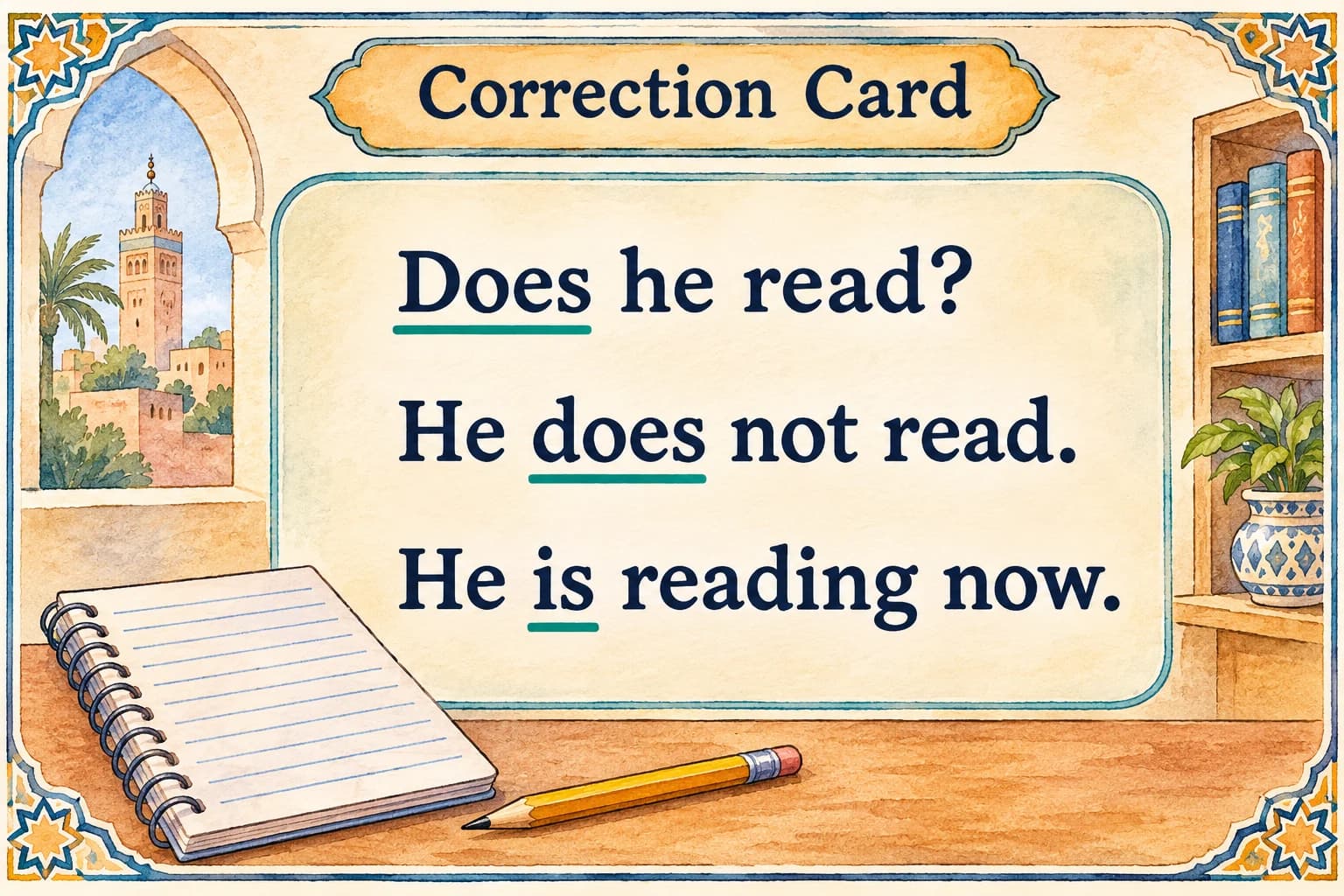
After does or does not, use the base verb. For the continuous, keep am, is or are. The forms Does he plays? and He playing are incomplete or incorrect.
Frequently asked questions
What is the difference between present simple and continuous in 2AC?
Do I add s after does?
Is present progressive the same as present continuous?
Quiz: 2 questions
2 questions are randomly selected from this lesson’s 2-question bank. Choose one answer for each question and get an immediate explanation.
Q1Look! The boys … a map.
Incorrect answer
Look introduces an action now; the plural subject takes are drawing.
Correct answer: are drawing
Look introduces an action now; the plural subject takes are drawing.
Q2Which question is correct?
Incorrect answer
He takes does followed by the base verb read.
Correct answer: Does he read?
He takes does followed by the base verb read.
Your score
0/2
Start with the worked examples
Read the lesson in small sections. Write your own example for each rule and try the Easy exercises before returning to the quiz.
Review: 2 missed questions
Look! The boys … a map.
Correct answerare drawing
Look introduces an action now; the plural subject takes are drawing.
Which question is correct?
Correct answerDoes he read?
He takes does followed by the base verb read.
Exercises with answers
6 exercises, from easy practice to challenges. Try each one yourself, then reveal the answer and explanation.
Exercise 1
EasyComplete: Every Friday, Anas … a book. (read) Look! He … a poster. (make)
Answer and explanation
Anas reads a book. He is making a poster. Every Friday marks a habit; Look directs attention to an action now.
Exercise 2
EasyTurn He studies English on Monday into a yes/no question.
Answer and explanation
Does he study English on Monday? Does carries the third-person ending, so study has no s.
Exercise 3
IntermediateMake negative: The boys are running. Salim walks to school.
Answer and explanation
The boys are not running. Salim does not walk to school. The first keeps are; the second needs does not and the base verb.
Exercise 4
IntermediateCorrect: Does he reads at break? He writing now.
Answer and explanation
Does he read at break? He is writing now. Remove the s after does and add is before writing.
Exercise 5
IntermediateChoose: I know / am knowing the answer now. Explain.
Answer and explanation
I know the answer now. Know describes a state in this sentence, so now does not require the continuous.
Exercise 6
ChallengeWrite two connected sentences about your normal school journey and a change today.
Answer and explanation
One possible answer: I usually walk to school. Today it is raining, so I am taking the bus. Other accurate habits and present changes are possible.