



Countable nouns, some, any, much and many
Use how many with plural countable nouns, such as apples, and how much with uncountable nouns, such as milk. Some is common in positive statements; any is common in questions and negatives. This English 2AC supermarket lesson explains the patterns, useful exceptions and containers so you can ask for quantities accurately.

English 2AC · S1
The lesson as a PDF
The illustrated lesson and corrected exercises to print. The quiz stays online.
By the end of this lesson, you can
- Distinguish countable and uncountable uses
- Choose some or any from the sentence meaning
- Ask quantity and price questions
Before you startRead short English sentences and familiar school vocabulary
Un bon cours, ça se partage.
Start with the situation
Distinguish countable and uncountable uses. Choose some or any from the sentence meaning. Ask quantity and price questions.
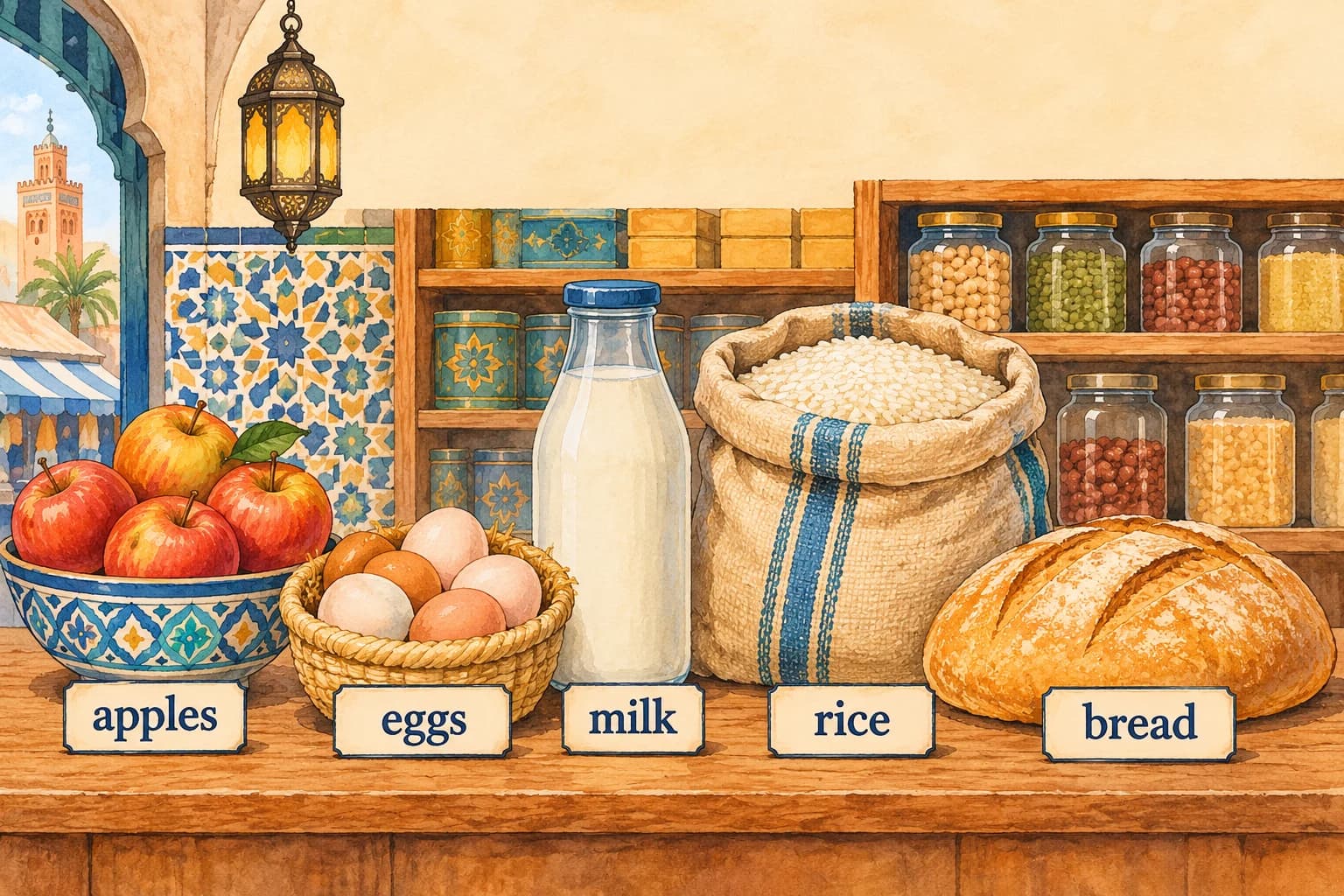
What can you count directly?
A countable noun can have a singular and plural form: an apple, two apples; an egg, six eggs. An uncountable noun names a substance or quantity without counting separate items in this use: milk, rice, bread, water. Say some bread rather than a bread in the ordinary food meaning. The category describes how a word is being used, so context matters.
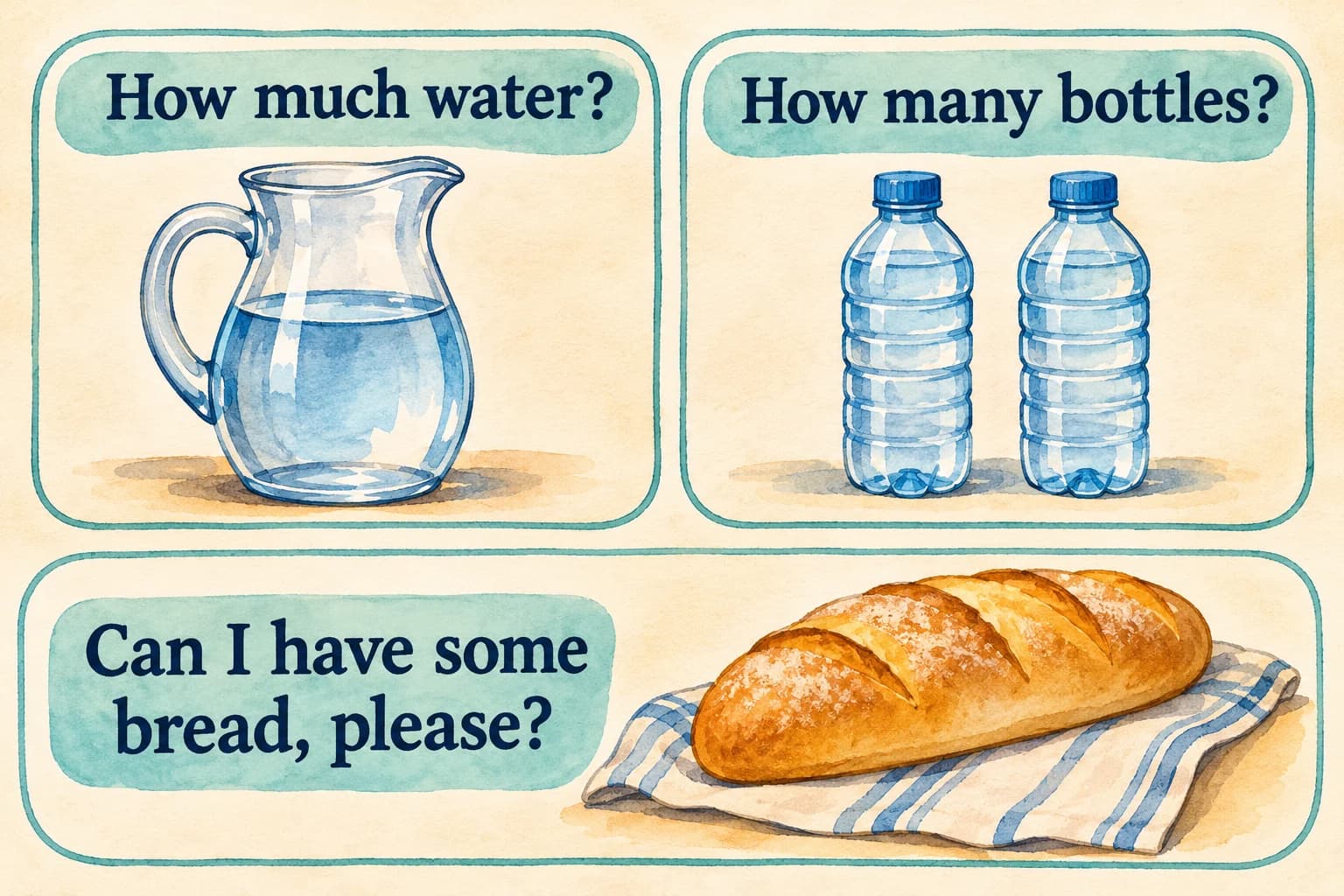
A container or measure lets you count amounts of an uncountable food. Say two bottles of water, a bag of rice or three slices of bread. Bottles, bags and slices are countable, while water, rice and bread keep their uncountable use. Compare How much water do we need? with How many bottles of water do we need? The noun immediately being counted changes the question.
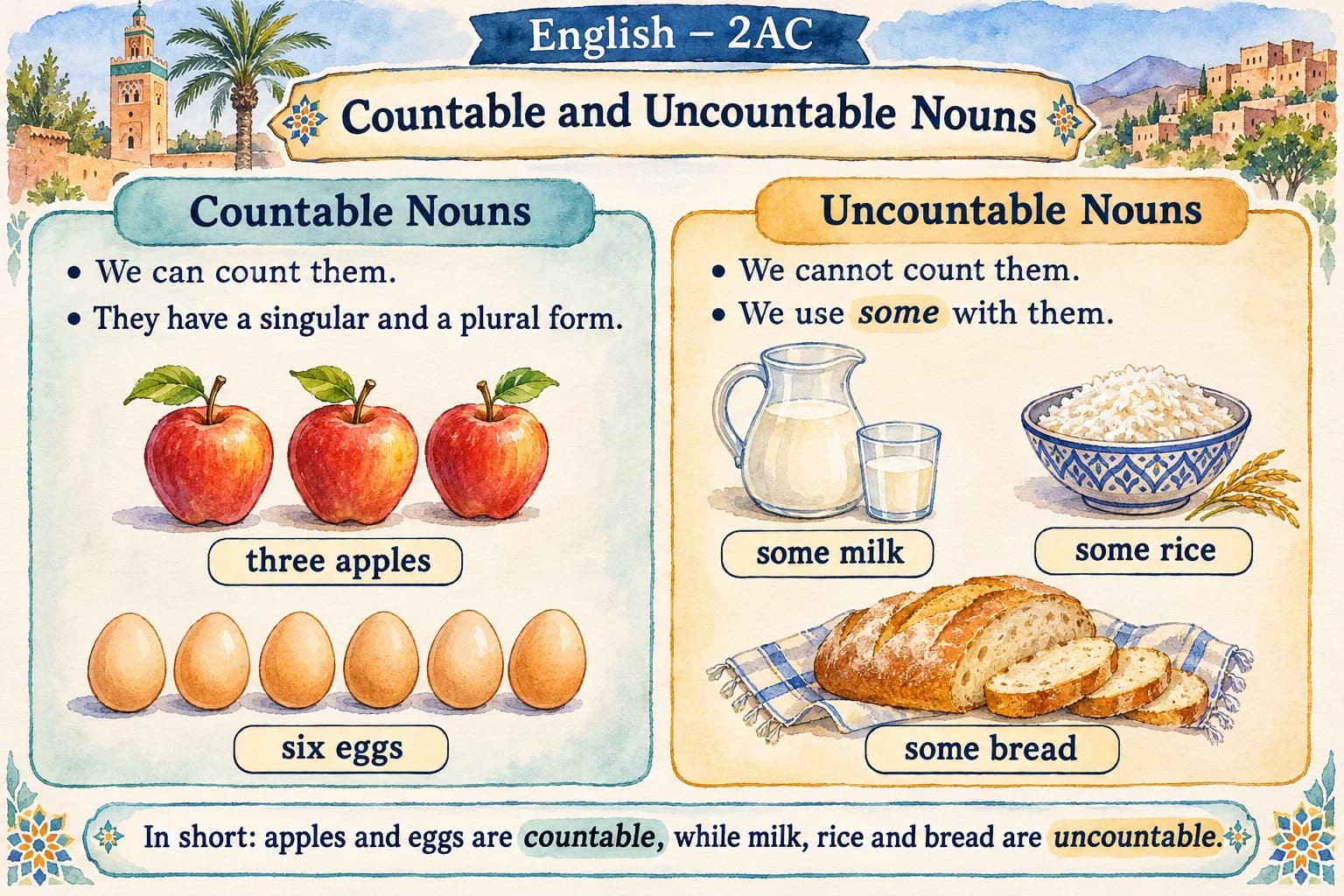
How do some and any work?
In a positive statement, use some for an unspecified amount or number: We have some rice. There are some apples. In a negative statement, any commonly means none at all: We don’t have any rice. There aren’t any apples. In a neutral question, any asks whether something is available: Have we got any eggs?
Some also appears in offers and polite requests, where the speaker offers or asks for an expected amount: Would you like some water? Can I have some bread, please? Do not turn this into a mechanical positive-versus-question rule. Read the purpose of the question. An offer is different from asking whether there is any food left.
| Food | Useful quantity | Question |
|---|---|---|
| apples | three apples | How many apples? |
| milk | a litre of milk | How much milk? |
| water | two bottles of water | How many bottles? |
| bread | three slices of bread | How much bread? |
Check a shopping bag
There are some apples and a bottle of milk. There isn’t any bread. We need two loaves of bread and a bag of rice.
- Apples and loaves are plural counts. Milk, bread and rice name food quantities. Loaf changes to loaves in the plural.
When do you choose much or many?
Use many with a plural countable noun: How many oranges are there? Use much with an uncountable noun: How much milk is there? A lot of works with both in ordinary positive statements: a lot of oranges, a lot of milk. It is often more natural than much in a simple positive food sentence.
How much can also ask a price: How much are these apples? This asks their cost, not their number. How many apples are there? asks the count. Use the answer to check the question: a quantity may be three apples or one litre; a price is an amount of money. Any prices in this practice are invented, rather than current supermarket prices.
A method you can reuse
Step by step
Work step by step
- Find the noun being counted or measured.
- Decide whether it is countable in this sentence.
- Choose many or much, or use a container.
- Read whether some/any belongs to a statement, availability question, offer or request.
Remember
Bread is uncountable in its ordinary food meaning. Use a loaf of bread, two loaves or some bread. How much can ask a price even when the item itself is countable.
Frequently asked questions
When do I use how much and how many?
Can some appear in a question?
Is bread countable?
Quiz: 2 questions
2 questions are randomly selected from this lesson’s 2-question bank. Choose one answer for each question and get an immediate explanation.
Q1How … bottles of water?
Incorrect answer
The question counts plural bottles.
Correct answer: many
The question counts plural bottles.
Q2Can I have … rice, please?
Incorrect answer
Some is natural for a polite request involving uncountable rice.
Correct answer: some
Some is natural for a polite request involving uncountable rice.
Your score
0/2
Start with the worked examples
Read the lesson in small sections. Write your own example for each rule and try the Easy exercises before returning to the quiz.
Review: 2 missed questions
How … bottles of water?
Correct answermany
The question counts plural bottles.
Can I have … rice, please?
Correct answersome
Some is natural for a polite request involving uncountable rice.
Exercises with answers
6 exercises, from easy practice to challenges. Try each one yourself, then reveal the answer and explanation.
Exercise 1
EasyClassify apples, milk, rice, eggs and bread in their usual food meanings.
Answer and explanation
Countable: apples and eggs. Uncountable: milk, rice and bread. A container can express a countable quantity of milk or rice.
Exercise 2
EasyComplete: How … eggs? How … water? How … bottles of water?
Answer and explanation
How many eggs? How much water? How many bottles of water? The third question counts bottles.
Exercise 3
IntermediateComplete: We have … rice. We don’t have … eggs. Have we got … apples?
Answer and explanation
Some rice; any eggs; any apples. These are a positive statement, negative statement and availability question.
Exercise 4
IntermediateComplete: Can I have … bread, please? Explain your choice.
Answer and explanation
Can I have some bread, please? Some is natural in a polite request for an amount of food.
Exercise 5
IntermediateWhat do these ask: How many apples are there? How much are the apples?
Answer and explanation
The first asks for their number. The second asks for their price. An answer to the second question needs money, rather than a count.
Exercise 6
ChallengeWrite a sentence with two countable foods and two measured uncountable foods.
Answer and explanation
One possible answer: We need six eggs, four apples, a bottle of milk and a bag of rice. Containers make the last two quantities clear.