



Telling the time and reading a timetable
At 8:15, say quarter past eight; at 8:45, say quarter to nine. Past counts minutes after the hour, while to counts minutes before the next hour. In this English 2AC lesson you practise digital and traditional clock expressions, read a school timetable and use at, on and in to describe a day clearly.

English 2AC · S1
The lesson as a PDF
The illustrated lesson and corrected exercises to print. The quiz stays online.
By the end of this lesson, you can
- Read common digital time expressions
- Distinguish past from to
- Ask when a lesson begins and use time prepositions
Before you startRead short English sentences and familiar school vocabulary
Un bon cours, ça se partage.
Start with the situation
Read common digital time expressions. Distinguish past from to. Ask when a lesson begins and use time prepositions.
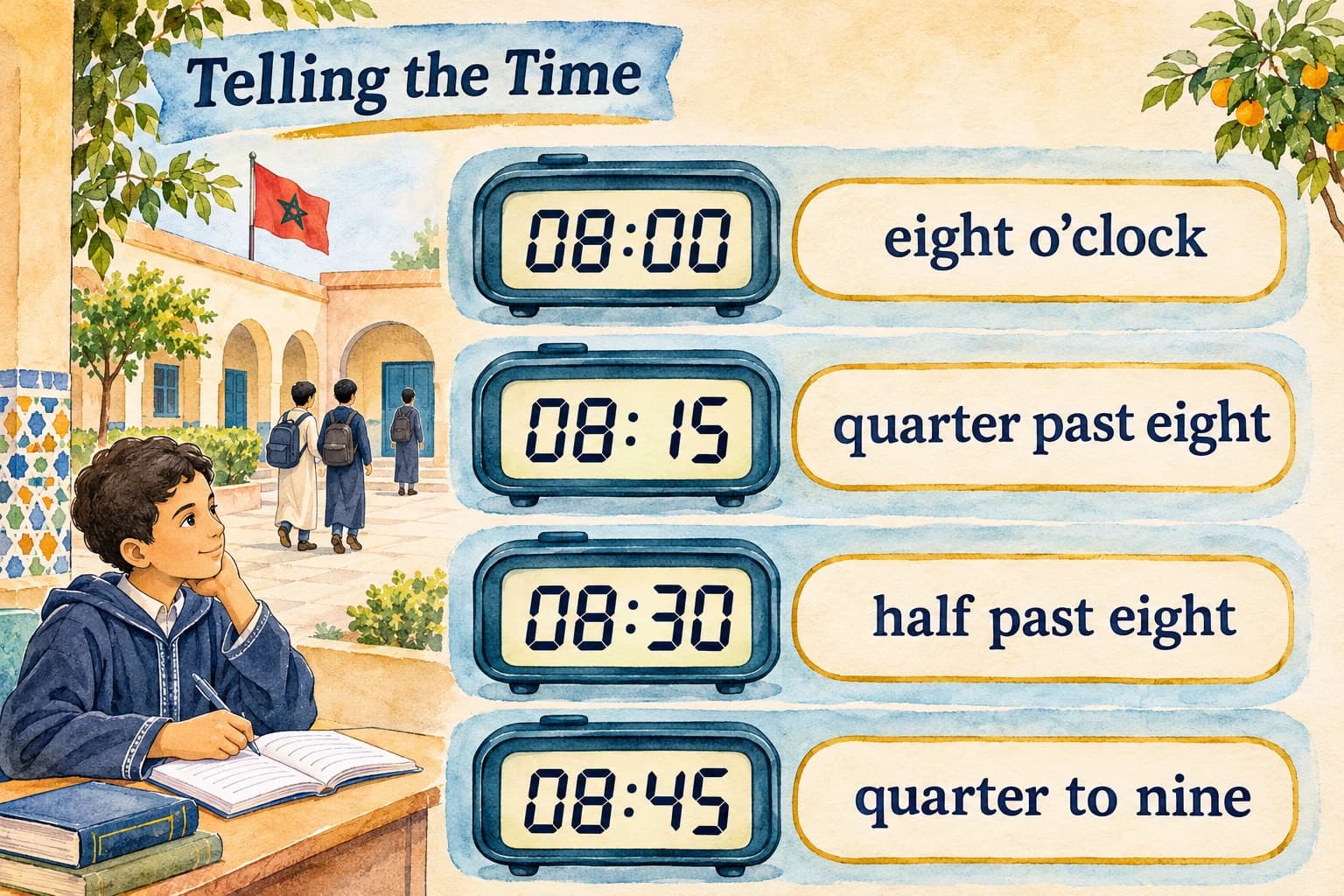
How do past and to work?
For the first half of an hour, count forward from that hour: 8:10 is ten past eight and 8:20 is twenty past eight. Fifteen minutes is a quarter of an hour, so 8:15 is quarter past eight. Thirty minutes is half an hour, so 8:30 is half past eight. O’clock is for an exact hour, such as eight o’clock, rather than eight fifteen o’clock.
After half past, count the minutes left until the next hour: 8:40 is twenty to nine; 8:45 is quarter to nine; 8:50 is ten to nine. The hour after to is the coming hour. That is why 8:45 cannot mean quarter to eight. Digital speech is also correct: eight forty-five. Learn both forms so you can understand a classmate or a timetable.
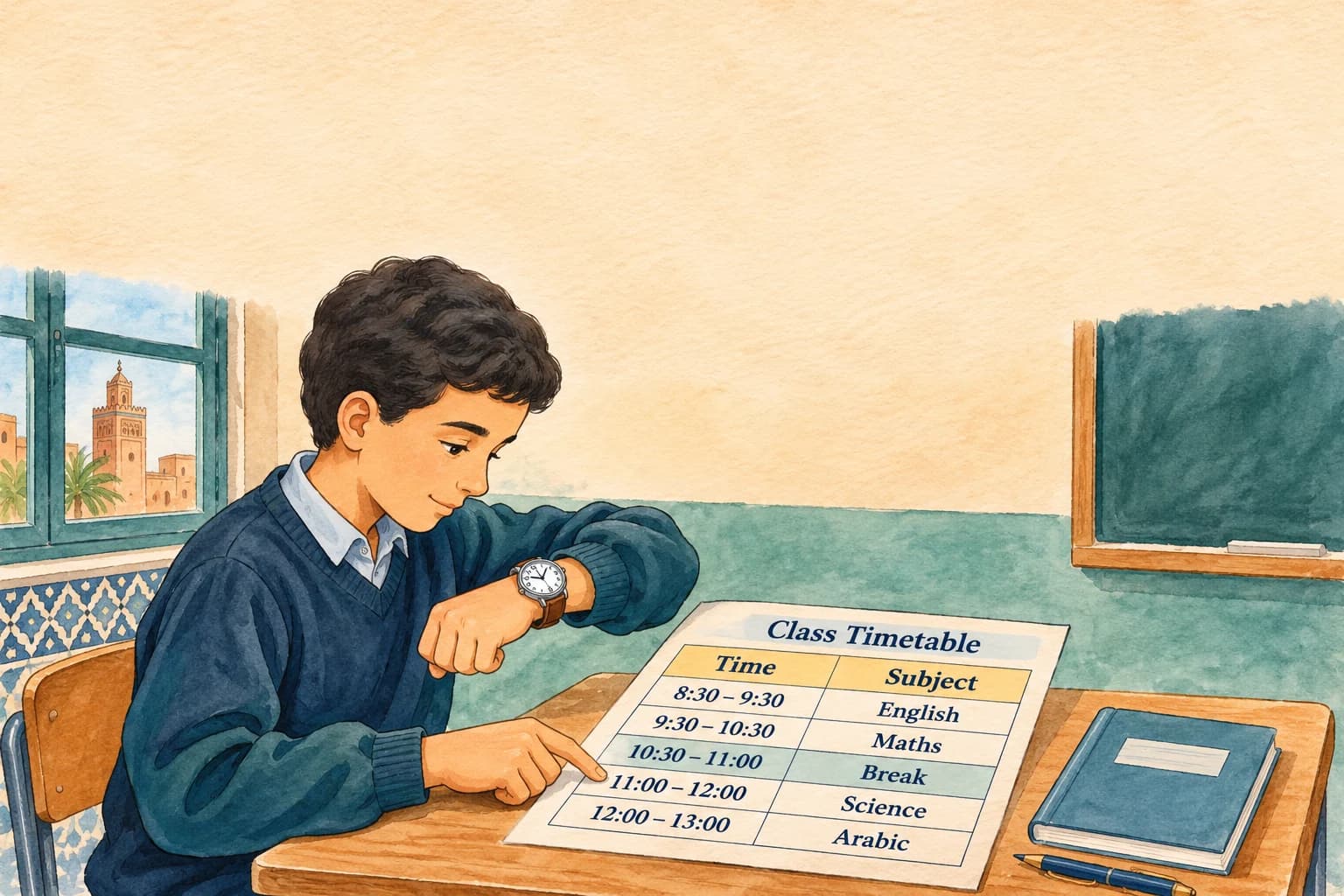
How do you find information in a timetable?
Read the day heading and the time heading together. If English appears on Monday at 09:00, answer We have English on Monday at nine. A starting time is different from a finishing time: a lesson from 09:00 to 10:00 begins at nine and ends at ten. Check which one the question asks for before writing a number.
Ask What time does English start? for a clock time and When do we have English? for a day or a fuller schedule answer. With does, keep start in the base form. You can say It starts at nine or English starts at nine. The practice schedule on this page is invented for language learning and does not state the timetable of Moroccan schools.
| Day | 08:00–09:00 | 09:00–10:00 | 10:15–11:15 |
|---|---|---|---|
| Monday | Maths | English | Science |
| Tuesday | English | History | Art |
| Wednesday | Science | Maths | English |
Read one row carefully
On Wednesday, English starts at quarter past ten and ends at quarter past eleven.
- The English cell is in the 10:15–11:15 column. Both times use past; the lesson starts in the morning.
When do you use at, on and in?
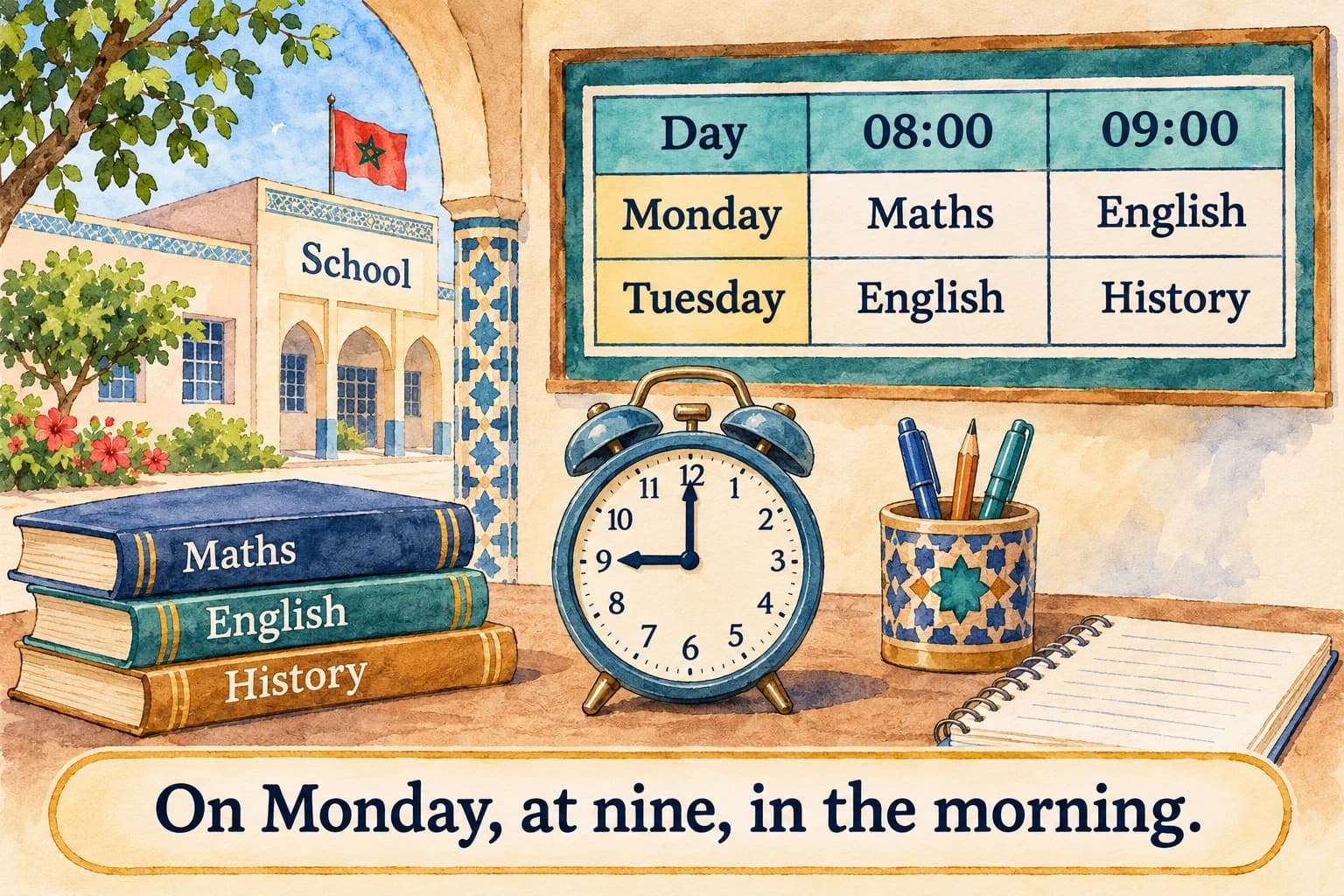
Use at before a clock time: at eight, at half past seven. Use on with a day: on Tuesday, on Friday morning. Use in with a general part of a day: in the morning, in the afternoon, in the evening. At night is a common exception. A specific day takes on even when morning follows it: on Monday morning.
To describe your day, combine one time expression with one useful action. I leave home at quarter past seven is clearer than a list of times alone. Connect the events with then and after school. Before handing in your paragraph, compare every written time with the schedule and check whether you have named the day as well as the hour.
A method you can reuse
Step by step
Work step by step
- Read the hour and the minutes.
- Choose a digital form or count with past/to.
- For to, use the next hour.
- Read the day and the start or end time requested.
Remember
8:45 is quarter to nine. Write on Monday morning but in the morning. These examples do not prescribe your own school hours.
Frequently asked questions
What does quarter to nine mean?
Can I say eight thirty?
Do we say at or on Monday?
Quiz: 2 questions
2 questions are randomly selected from this lesson’s 2-question bank. Choose one answer for each question and get an immediate explanation.
Q108:45 is …
Incorrect answer
There are fifteen minutes until nine.
Correct answer: quarter to nine
There are fifteen minutes until nine.
Q2We have English … Tuesday … nine.
Incorrect answer
Use on with a day and at with a clock time.
Correct answer: on / at
Use on with a day and at with a clock time.
Your score
0/2
Start with the worked examples
Read the lesson in small sections. Write your own example for each rule and try the Easy exercises before returning to the quiz.
Review: 2 missed questions
08:45 is …
Correct answerquarter to nine
There are fifteen minutes until nine.
We have English … Tuesday … nine.
Correct answeron / at
Use on with a day and at with a clock time.
Exercises with answers
6 exercises, from easy practice to challenges. Try each one yourself, then reveal the answer and explanation.
Exercise 1
EasyWrite 07:15, 07:30 and 07:45 with past or to.
Answer and explanation
Quarter past seven; half past seven; quarter to eight. At 07:45, eight is the next hour.
Exercise 2
EasyWrite 08:20 and 09:50 as digital spoken expressions.
Answer and explanation
Eight twenty and nine fifty. Twenty past eight and ten to ten are also valid traditional forms.
Exercise 3
IntermediateUse the table. Which subject starts at 08:00 on Tuesday?
Answer and explanation
English starts at eight on Tuesday. Read the Tuesday row and the first time column.
Exercise 4
IntermediateWhen does English end on Wednesday?
Answer and explanation
It ends at 11:15, or quarter past eleven. The question asks for the end rather than the start.
Exercise 5
IntermediateComplete: … Monday; … nine o’clock; … the afternoon; … Friday morning.
Answer and explanation
On Monday; at nine o’clock; in the afternoon; on Friday morning. A named day takes on.
Exercise 6
ChallengeWrite three connected sentences using 07:30, 08:00 and on Tuesday.
Answer and explanation
One possible answer: On Tuesday, I leave home at half past seven. I start school at eight. Then I have English. Use your actual schedule when writing about yourself.