



Writing: my school day
A school-day paragraph presents a routine in a clear time order. Use the present simple, give useful times and connect events with then, after school and because. This English 2AC writing lesson includes a complete original example in a handwritten notebook image, a plan and guided corrections so you can write your own version.

English 2AC · S1
Your illustrated PDF
The plan, the complete model and corrected exercises to print. The quiz stays online.
By the end of this lesson, you can
- Plan a short routine paragraph
- Use present-simple verbs and time expressions
- Revise a model without copying its personal details
Before you startRead short English sentences and familiar school vocabulary
Un bon cours, ça se partage.
Understand the writing task
Plan a short routine paragraph. Use present-simple verbs and time expressions. Revise a model without copying its personal details.

My school day
My name is Anas and I am thirteen. On school days, I get up at seven and have breakfast. I usually walk to school with my cousin. Lessons start at eight. My favourite subject is English because I enjoy reading short stories. At midday, I have lunch at home. In the afternoon, I return to school. After school, I do my homework and prepare my bag. In the evening, I read for a few minutes. I go to bed at half past nine.
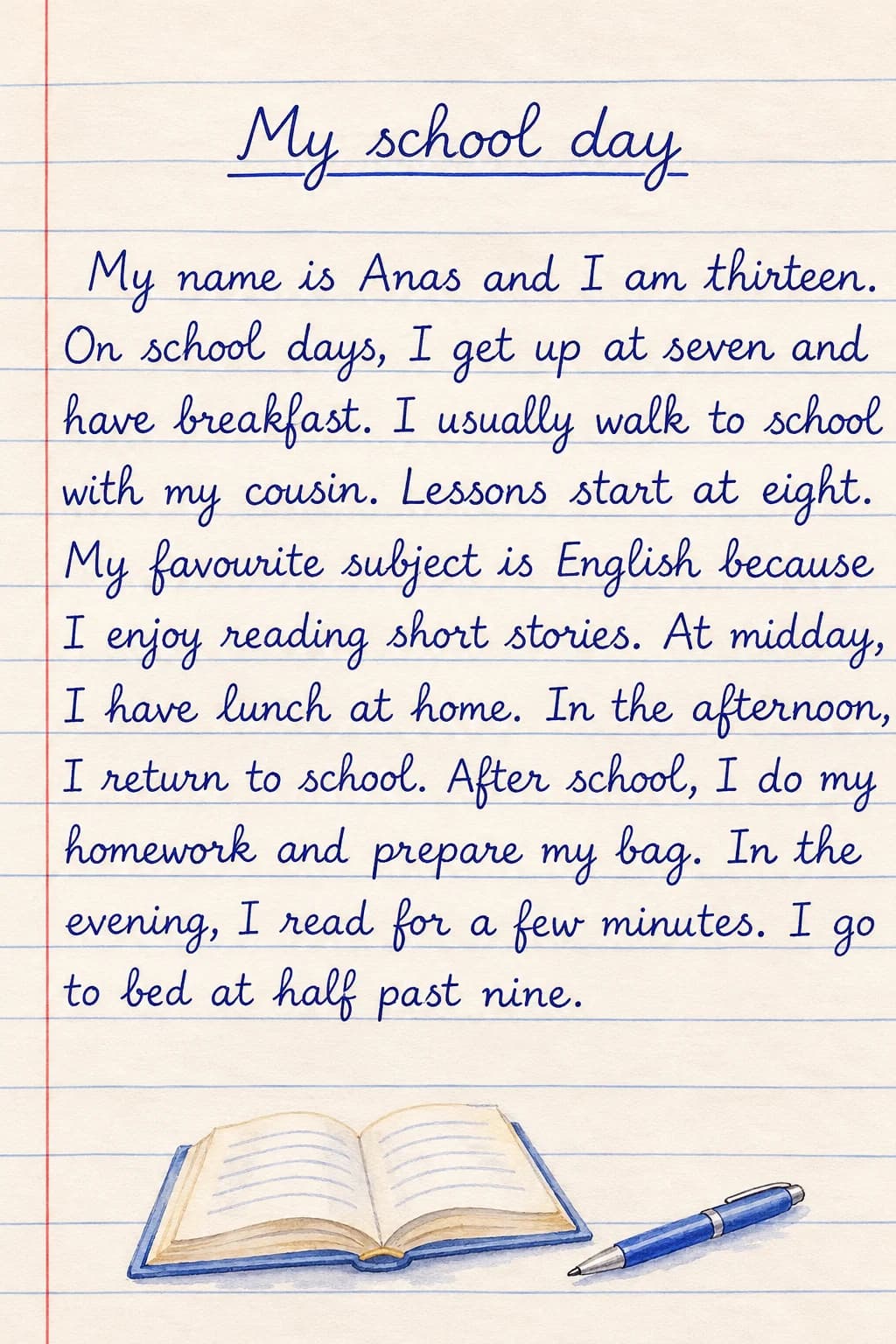
This notebook contains the complete example written above. It is one possible original answer. Use its structure to plan your own text and change the details to match the task.
What does the writing task ask for?
Write a short paragraph about a usual school day. Introduce yourself briefly, describe the morning, mention school, and finish with after-school or evening activities. For this practice task, aim for about 70–100 words, but follow your teacher’s required length if it differs. You may use an imaginary pupil if you prefer not to share personal details.
A good paragraph helps a reader follow the day. It does not need every minute or every school subject. Select a few useful events and one personal detail, such as a favourite subject with a reason. The model’s timetable is invented. Change its hours and activities when you describe your own routine rather than treating it as a national school schedule.
How is the model organised?
The opening identifies the speaker. On school days establishes that the paragraph describes a repeated routine. The morning moves from getting up to travelling and starting lessons. At midday, in the afternoon, after school and in the evening guide the reader through the rest of the day. The closing gives a clear final event instead of ending suddenly.
Because adds a reason for liking English. Usually gives information about frequency. The text mainly uses I + base verb: I get, I walk, I read. Lessons start takes the plural subject lessons. My favourite subject is uses be rather than an ordinary action verb. These choices matter more than adding difficult vocabulary that you cannot use accurately.
| Part | Useful notes | Link |
|---|---|---|
| Opening | name and school-day context | On school days |
| Morning | get up, breakfast, travel | at seven |
| School | lessons and one preference | because |
| Ending | homework and evening | After school / In the evening |
Improve a list
I get up at seven. School starts at eight. I like English because I enjoy stories.
- Times order the events, and because explains the preference. These three sentences communicate more than a list of isolated verbs.
How can you improve your own paragraph?
Write notes first: wake-up time, travel, one school detail, lunch, homework and evening. Turn them into full sentences and join only ideas that belong together. Avoid starting every sentence with then. Use a mix of time expressions, and keep the same person throughout. A paragraph about I should not suddenly change into he without introducing a different person.
Read once for meaning: can someone follow your day? Read again for verbs and time expressions: at seven, in the afternoon, on school days. Finally, check capital I, the capital in English and full stops. If the task asks about a routine, keep the present simple. Today I am taking the bus belongs to a separate change or comparison, so use it only when the task asks for that contrast.
A method you can reuse
Step by step
Work step by step
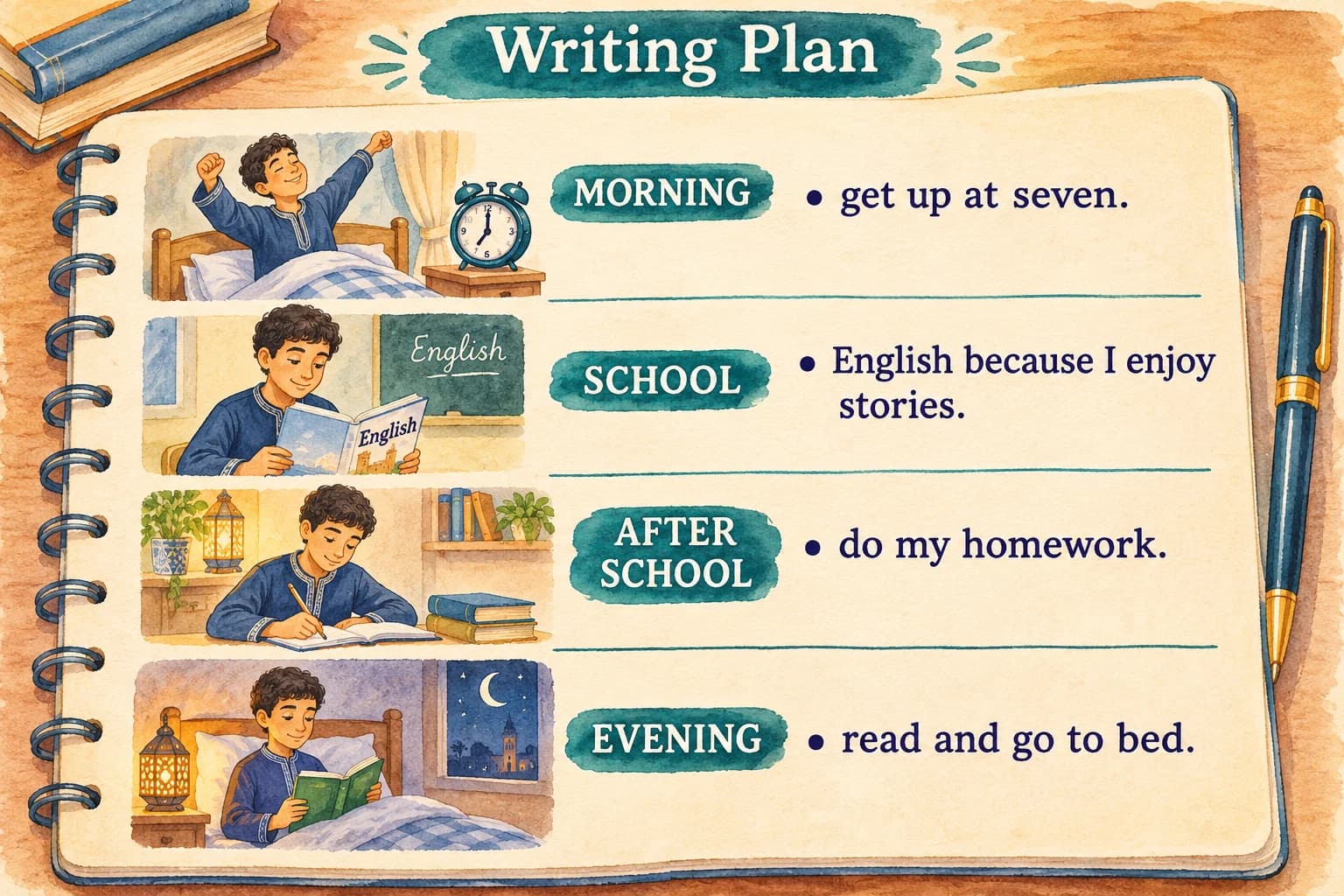
- Choose true or invented details and make brief notes.
- Order the morning, school and evening events.
- Write full present-simple sentences with two or three time expressions.
- Check meaning, verbs, capital letters and punctuation.
Remember
Use I go to school and I do my homework. Do not write I am go or I make my homework. Keep personal details your own when adapting the example.
Frequently asked questions
How do I write My school day in anglais 2AC?
How long should the paragraph be?
Is there a complete example image?
Quiz: 2 questions
2 questions are randomly selected from this lesson’s 2-question bank. Choose one answer for each question and get an immediate explanation.
Q1Which tense describes a usual school day?
Incorrect answer
A usual repeated routine uses the present simple.
Correct answer: Present simple
A usual repeated routine uses the present simple.
Q2Which phrase gives a reason?
Incorrect answer
Because introduces a reason.
Correct answer: Because I enjoy stories
Because introduces a reason.
Your score
0/2
Start with the worked examples
Read the lesson in small sections. Write your own example for each rule and try the Easy exercises before returning to the quiz.
Review: 2 missed questions
Which tense describes a usual school day?
Correct answerPresent simple
A usual repeated routine uses the present simple.
Which phrase gives a reason?
Correct answerBecause I enjoy stories
Because introduces a reason.
Exercises with answers
6 exercises, from easy practice to challenges. Try each one yourself, then reveal the answer and explanation.
Exercise 1
EasyWhich sentence introduces the writer?
Answer and explanation
My name is Anas and I am thirteen. It gives only the brief identity needed for this personal paragraph.
Exercise 2
EasyName four expressions that organise the model.
Answer and explanation
On school days, at midday, in the afternoon, after school and in the evening are possible answers. They help the reader follow the day.
Exercise 3
IntermediateWhy is English the writer’s favourite subject?
Answer and explanation
He enjoys reading short stories. The word because links his preference and reason.
Exercise 4
IntermediateCorrect: i am go to school at eight i like english.
Answer and explanation
I go to school at eight. I like English. Remove am before go, capitalise I and English, and use a full stop.
Exercise 5
IntermediateWrite notes for morning, school and evening, with one time and one reason.
Answer and explanation
One possible plan: morning: get up at 7:00; school: walk, English, enjoy stories; evening: homework, reading. Notes may be fragments; the finished paragraph needs full sentences.
Exercise 6
ChallengeWrite 70–100 words about a usual school day. Include two times, a frequency adverb and because.
Answer and explanation
Use the illustrated model to check structure, then change the details. Accept any coherent routine with accurate present-simple verbs, the requested features and clear punctuation. A shorter corrected start could be: I usually get up at seven. I walk to school because it is near my home.