



Present simple or continuous? English 3AC
Compare present simple and present continuous in English 3AC. Describe routines and actions happening now, with illustrated examples and answers.

Download and study offline
By the end of this lesson, you can
- Describe a habit with the present simple.
- Describe an action happening now.
- Use the correct auxiliary in a question.
Before you startRead short English sentences and identify the subject and verb.
Un bon cours, ça se partage.
When do you use the present simple?
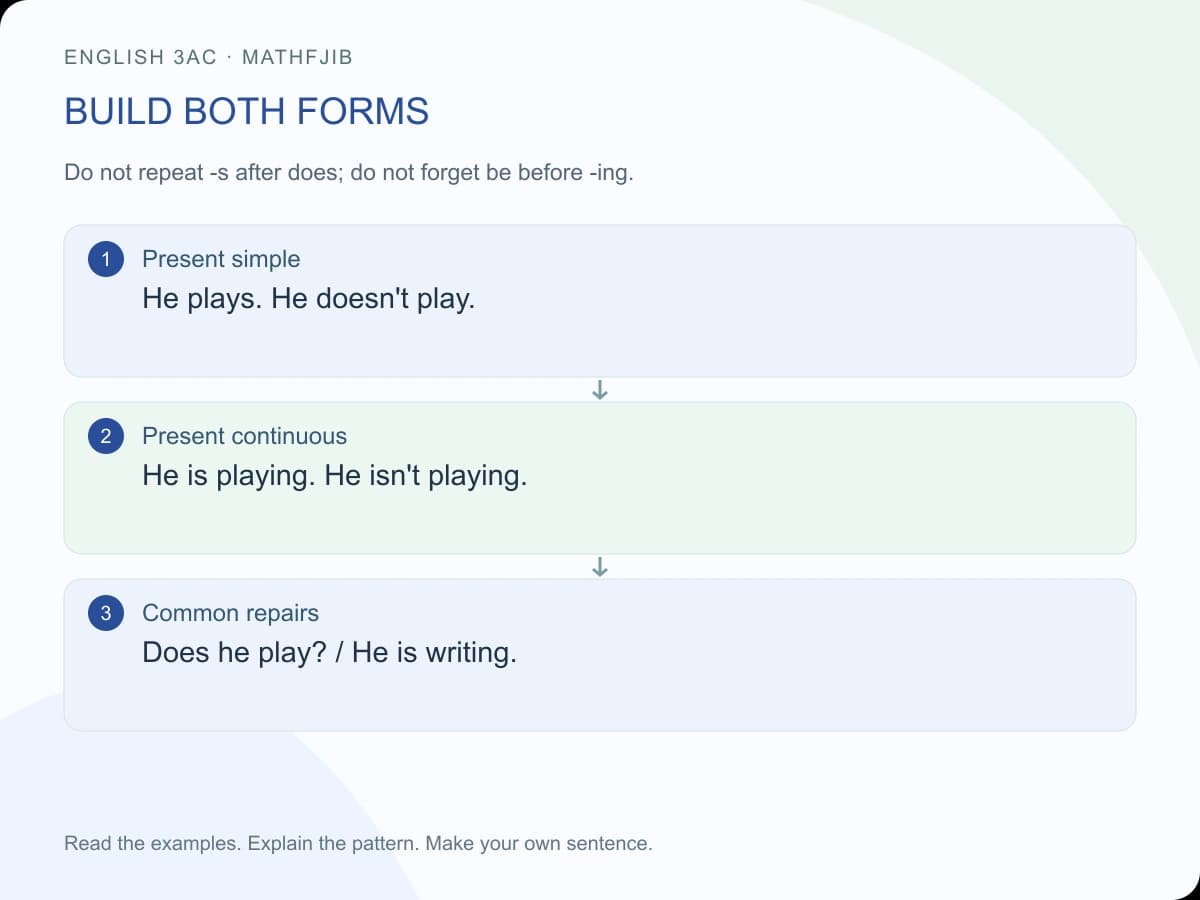
Use the present simple for routines, repeated actions and general facts. I walk to school every day describes a routine. My brother plays chess on Saturdays describes a repeated activity. With he, she or it, an affirmative verb usually takes -s or -es: reads, goes, watches.
Use do or does for questions and negatives with most verbs: Do you walk to school? He doesn't walk to school. After does or doesn't, use the base verb. Does he walks? has two marks for the same present-simple form and is incorrect. The verb be has its own forms: Are you ready?

How do you form the present continuous?
Use am, is or are followed by a verb ending in -ing: I am reading; he is writing; they are playing. In a negative, add not after be: They aren't playing. In a question, move be before the subject: Are they playing? Do not forget be.
For most verbs, add -ing. Drop the final silent e in write: writing. In a short stressed verb such as run, double the final consonant: running. Learn these common forms through short sentences. This lesson uses actions happening now; other uses can be studied later.
How do you choose between the two tenses?
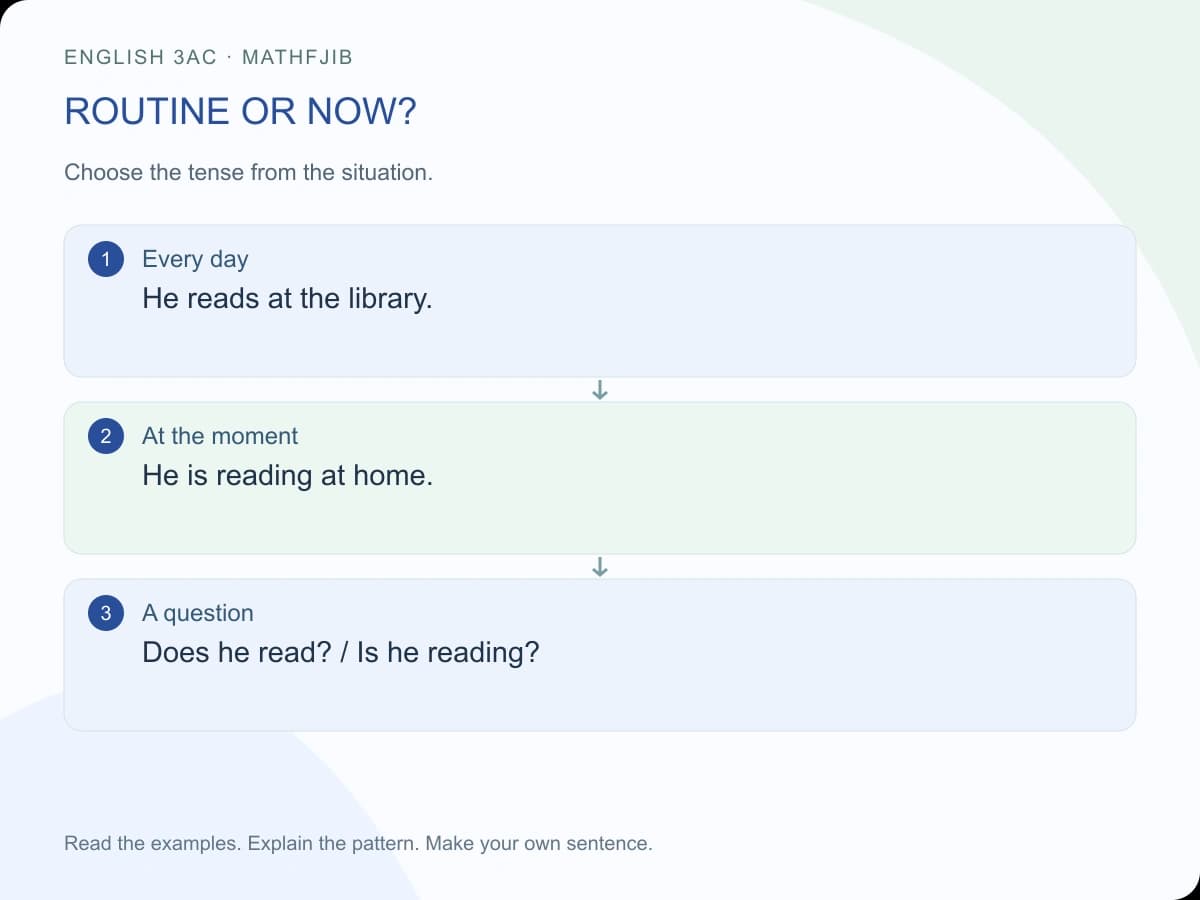
Read the whole situation. Every day and usually often describe habits; now and at the moment often point to current actions. They help, but meaning decides the tense. Compare I usually cycle to school with Today I am walking because my bicycle needs a repair. Common state verbs such as know and like normally use the simple form in these beginner contexts: I like English, not I am liking English.
A worked example
A usual day and a change today
Yassine usually studies at the library after school. Today, he is studying at home because the library is closed. His brother is helping him now.
- Usually studies describes a repeated habit.
- Is studying describes today's current activity.
- Is helping contains be and an -ing form.
How should I use this English 3AC lesson?
- Try the exercises before reading the answers.
- Explain a correction in your own words.
- Return to the examples when two structures look similar.
Frequently asked questions
What is the difference between present simple and present continuous?
Do I write does he plays or does he play?
Can I leave out am, is or are?
Quiz: 6 questions
6 questions are randomly selected from this lesson’s 6-question bank. Choose one answer for each question and get an immediate explanation.
Q1He usually ___ chess.
Incorrect answer
A present-simple verb takes -s after he.
Correct answer: plays
A present-simple verb takes -s after he.
Q2They ___ a story now.
Incorrect answer
Now describes the action in progress.
Correct answer: are reading
Now describes the action in progress.
Q3Does your brother ___ English?
Incorrect answer
Use the base verb after does.
Correct answer: speak
Use the base verb after does.
Q4Which sentence is correct?
Incorrect answer
The present continuous needs be and an -ing form.
Correct answer: He is writing now.
The present continuous needs be and an -ing form.
Q5Choose the usual beginner form.
Incorrect answer
Like usually describes a state and uses the simple form here.
Correct answer: I like science.
Like usually describes a state and uses the simple form here.
Q6The -ing form of run is...
Incorrect answer
Double the final n in running.
Correct answer: running
Double the final n in running.
Your score
0/6
Start with the worked examples
Read the lesson in small sections. Write your own example for each rule and try the Easy exercises before returning to the quiz.
Review: 6 missed questions
He usually ___ chess.
Correct answerplays
A present-simple verb takes -s after he.
They ___ a story now.
Correct answerare reading
Now describes the action in progress.
Does your brother ___ English?
Correct answerspeak
Use the base verb after does.
Which sentence is correct?
Correct answerHe is writing now.
The present continuous needs be and an -ing form.
Choose the usual beginner form.
Correct answerI like science.
Like usually describes a state and uses the simple form here.
The -ing form of run is...
Correct answerrunning
Double the final n in running.
Exercises with answers
6 exercises, from easy practice to challenges. Try each one yourself, then reveal the answer and explanation.
Exercise 1
EasyComplete: He usually ___ (walk) to school.
Answer and explanation
Walks. The subject he needs the present-simple -s.
Exercise 2
EasyComplete: Listen! The boys ___ (sing).
Answer and explanation
Are singing. Use are with boys and the -ing form.
Exercise 3
IntermediateCorrect: Does she reads every day?
Answer and explanation
Does she read every day? Use read after does.
Exercise 4
IntermediateMake negative: Sami is running.
Answer and explanation
Sami isn't running. Put not after is.
Exercise 5
ChallengeComplete: I usually cycle, but today I ___ (walk).
Answer and explanation
Am walking. Today describes the current change in this situation.
Exercise 6
ChallengeWrite a sentence about a usual activity and a different activity now.
Answer and explanation
Possible answer: I usually read after lunch, but now I am drawing a map. The first clause is a habit and the second describes now.