



Unit 3 (Family)
English 3AC Unit 3 (Family) teaches you to name family members, explain whose things they are and describe everyday activities. You use my, your, his, her, its, our and their, the possessive apostrophe and the present simple. A small family diagram makes the vocabulary easier to follow.

Download and study offline
By the end of this lesson, you can
- Identify family vocabulary without guessing from appearances.
- Choose a possessive adjective for the owner.
- Use apostrophe s with a singular name.
- Form positive present simple sentences.
- Describe a job and a routine.
- Write a respectful, factual family profile.
Before you startChoose subject pronouns and forms of be. · Recognise singular and plural nouns.
Un bon cours, ça se partage.
Communication: talking about family
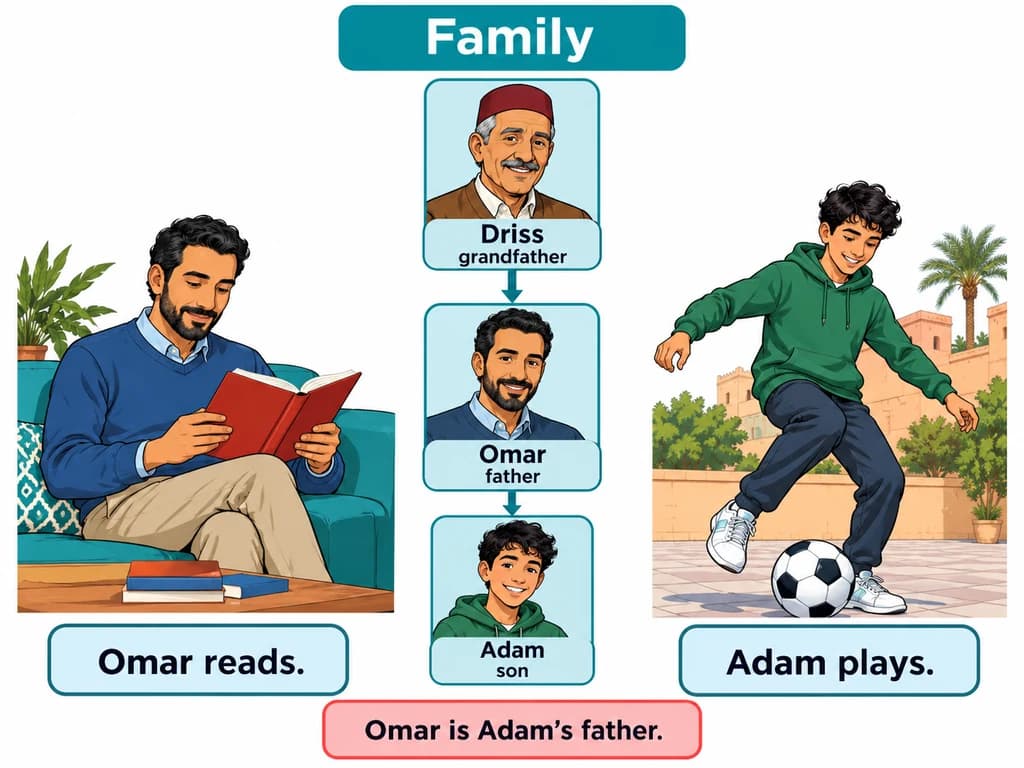
You can introduce a family member with This is my grandfather. Add a name or an activity only when it is relevant: His name is Driss. He reads every evening. You may describe an invented family for class practice; personal information is not necessary.
A family diagram
Adam: This is my father, Omar. This is my grandfather, Driss. Bilal: Does the diagram show three generations? Adam: Yes. Driss is Omar's father, and Omar is my father.
Vocabulary: read relationships, not appearances
| Word | Meaning | Example |
|---|---|---|
| father / mother | A male / female parent | Omar is Adam's father. |
| grandfather / grandmother | A parent of a parent | Driss is Adam's grandfather. |
| son / daughter | A male / female child in relation to a parent | Adam is Omar's son. |
| brother / sister | A male / female sibling | My brother is a pupil. |
| uncle / aunt | A male / female relative in the parent generation | My aunt is a teacher. |
| cousin | A child of an uncle or aunt | My cousin lives in another city. |
A diagram tells you how people are connected. Age, clothes and height cannot tell you whether someone is a father or a grandfather. In our picture, read the labelled line from Driss to Omar and then to Adam. There is no need to invent extra family members.
Grammar: possessive adjectives
Definition
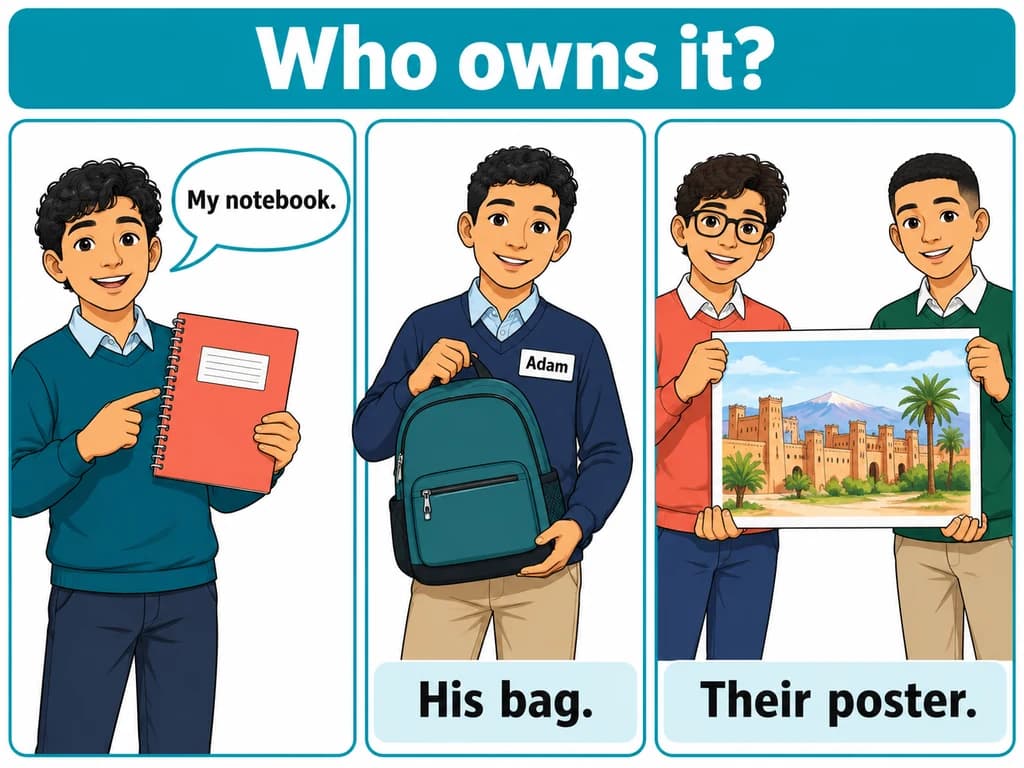
Possessive adjective : A possessive adjective comes before a noun to show who it belongs to: my notebook, his bag, their classroom. Choose it according to the owner, not the object.
| Owner | Possessive adjective | Example |
|---|---|---|
| I | my | my notebook |
| you | your | your pencil |
| he | his | his coat |
| she | her | her book |
| it | its | its name |
| we | our | our school |
| they | their | their garden |
If Salma owns a notebook, it is her notebook. The noun notebook does not decide between his and her. If two pupils share a poster, it is their poster. A possessive adjective replaces the article here: say my bag, not the my bag.
Remember
Its means belonging to it: The cat lifts its paw. It's means it is or it has. In this lesson, compare Its name is Nori with It's a cat. The apostrophe changes the meaning.
Grammar: apostrophe s and whose
Add apostrophe s after a singular name or noun: Adam's notebook, my grandfather's garden. The owner comes first. Whose notebook is this? asks about ownership. A useful reply is It is Adam's notebook. Do not confuse whose with who, which asks about identity.
One notebook, one owner
This notebook belongs to Bilal. → This is Bilal's notebook.
- Write the owner, Bilal, before the object.
- Add apostrophe s to the owner, not to notebook.
Grammar: positive present simple
Definition
Present simple : The present simple describes a routine or a general fact: I read after school. Omar works in a shop. With he, she or it, a positive sentence usually adds s or es to the verb.
| Subject | Verb pattern | Example |
|---|---|---|
| I / You / We / They | base verb | They live in Meknes. |
| He / She / It | verb + s | He reads every evening. |
| He / She / It with watch / go | watches / goes | She watches a programme. |
| He / She / It with study | studies | He studies English. |
| He / She / It with have | has | She has a notebook. |
For a consonant followed by y, change y to ies: study becomes studies. After a vowel followed by y, add s: play becomes plays. Common es endings include watches and teaches. Have changes to has. Learn these as complete example sentences rather than isolated endings.
Step by step
Describe a person’s routine
- Choose the person and replace the name with a pronoun if useful.
- Use a base verb for I/you/we/they.
- Add the correct third-person ending for he/she/it.
- Include a time phrase such as every evening to make the routine clear.
Study skills: a word map and the final s sound
Draw a small diagram with only the relatives you need for the task. Write one possessive phrase beside each name. Read plays, works and watches aloud with a teacher or partner: the endings are pronounced differently, but all three mark the third person in these examples. Do not drop the final sound when speaking.
Skills work: reading Adam’s profile
My name is Adam. My father, Omar, works in a bookshop in Meknes. He opens the shop at nine. My grandfather, Driss, has a small garden. He waters the plants in the morning. I help in the garden on Saturday. My notebook is on the kitchen shelf. Its cover is yellow. These notes are for my family project.
Find the job before answering a question about work. Find the time phrase before answering when. Nine describes the shop’s opening time; Saturday describes Adam’s help in the garden. The yellow cover belongs to the notebook, so its is the correct possessive.
Skills work: listening and writing
A partner reads twice: “My grandfather is Driss. His garden is small. He waters the plants in the morning.” Listen for the name, the description and the time. Then write three sentences about an invented relative. Keep a job, a possession and a routine separate so the reader can follow them.
Cultural studies: describe people with respect
Families have different arrangements. A language exercise should practise vocabulary without judging someone’s home life or assuming a job from a person’s appearance. Use known facts, neutral descriptions and invented names whenever that makes the activity more comfortable.
Review: ownership and routines
- Say whose notebook it is using apostrophe s.
- Choose his, her or their by checking the owner.
- Explain the difference between play and plays.
- Describe one relative’s routine in two sentences.
Frequently asked questions
What do I learn in English 3AC Unit 3 Family?
How do I choose his, her or their?
What is the difference between its and it’s?
When do I add s to a present simple verb?
How do I use apostrophe s in a family exercise?
Quiz: 18 questions
18 questions are randomly selected from this lesson’s 18-question bank. Choose one answer for each question and get an immediate explanation.
Q1In the diagram, Driss is Adam’s …
Incorrect answer
Driss is the father of Omar, who is Adam’s father, so he is Adam’s grandfather.
Correct answer: grandfather
Driss is the father of Omar, who is Adam’s father, so he is Adam’s grandfather.
Q2Complete: I own this notebook. It is … notebook.
Incorrect answer
I names the owner, so the correct possessive adjective is my.
Correct answer: my
I names the owner, so the correct possessive adjective is my.
Q3Complete: Salma owns the bag. It is … bag.
Incorrect answer
The stated owner is Salma, so use her; the object does not determine the possessive.
Correct answer: her
The stated owner is Salma, so use her; the object does not determine the possessive.
Q4Two pupils share a poster. It is … poster.
Incorrect answer
The pupils are described as they, so their identifies them as the owners.
Correct answer: their
The pupils are described as they, so their identifies them as the owners.
Q5Which phrase shows Adam owns the pencil?
Incorrect answer
Put the owner before the object and add apostrophe s to the singular name.
Correct answer: Adam's pencil
Put the owner before the object and add apostrophe s to the singular name.
Q6Choose the correct possession sentence about a cat.
Incorrect answer
Its is the possessive form. It's would expand to it is and would not fit before paw.
Correct answer: Its paw is white.
Its is the possessive form. It's would expand to it is and would not fit before paw.
Q7Complete: Omar … in a bookshop.
Incorrect answer
Omar is a singular third-person subject, so a positive present simple sentence uses works.
Correct answer: works
Omar is a singular third-person subject, so a positive present simple sentence uses works.
Q8Complete: They … in Meknes.
Incorrect answer
They takes the base verb live in a positive present simple sentence.
Correct answer: live
They takes the base verb live in a positive present simple sentence.
Q9What is the third-person form of study?
Incorrect answer
Change consonant + y to ies when adding the third-person ending.
Correct answer: studies
Change consonant + y to ies when adding the third-person ending.
Q10What is the third-person form of play?
Incorrect answer
Play has a vowel before y, so keep y and add s.
Correct answer: plays
Play has a vowel before y, so keep y and add s.
Q11Complete: Driss … a small garden.
Incorrect answer
Have has the irregular third-person form has.
Correct answer: has
Have has the irregular third-person form has.
Q12Which question asks about the owner of a notebook?
Incorrect answer
Whose introduces an ownership question and is followed here by the noun notebook.
Correct answer: Whose notebook is this?
Whose introduces an ownership question and is followed here by the noun notebook.
Q13Where does Omar work in the reading?
Incorrect answer
The passage says Omar works in a bookshop in Meknes.
Correct answer: In a bookshop
The passage says Omar works in a bookshop in Meknes.
Q14At what time does Omar open his shop?
Incorrect answer
Nine is the opening time; Saturday describes Adam’s help in the garden.
Correct answer: Nine
Nine is the opening time; Saturday describes Adam’s help in the garden.
Q15When does Adam help in the garden?
Incorrect answer
The reading explicitly assigns the garden help to Saturday.
Correct answer: On Saturday
The reading explicitly assigns the garden help to Saturday.
Q16What is yellow in Adam’s profile?
Incorrect answer
The colour yellow describes the notebook’s cover, not the room or garden.
Correct answer: The notebook cover
The colour yellow describes the notebook’s cover, not the room or garden.
Q17Which phrase is grammatical?
Incorrect answer
A possessive adjective occupies the determiner position; do not add the before my here.
Correct answer: my school
A possessive adjective occupies the determiner position; do not add the before my here.
Q18What identifies a family relationship in the illustration?
Incorrect answer
A family diagram states the connections; appearance alone cannot establish a relationship.
Correct answer: The labelled connections
A family diagram states the connections; appearance alone cannot establish a relationship.
Your score
0/18
Start with the worked examples
Read the lesson in small sections. Write your own example for each rule and try the Easy exercises before returning to the quiz.
Review: 18 missed questions
In the diagram, Driss is Adam’s …
Correct answergrandfather
Driss is the father of Omar, who is Adam’s father, so he is Adam’s grandfather.
Complete: I own this notebook. It is … notebook.
Correct answermy
I names the owner, so the correct possessive adjective is my.
Complete: Salma owns the bag. It is … bag.
Correct answerher
The stated owner is Salma, so use her; the object does not determine the possessive.
Two pupils share a poster. It is … poster.
Correct answertheir
The pupils are described as they, so their identifies them as the owners.
Which phrase shows Adam owns the pencil?
Correct answerAdam's pencil
Put the owner before the object and add apostrophe s to the singular name.
Choose the correct possession sentence about a cat.
Correct answerIts paw is white.
Its is the possessive form. It's would expand to it is and would not fit before paw.
Complete: Omar … in a bookshop.
Correct answerworks
Omar is a singular third-person subject, so a positive present simple sentence uses works.
Complete: They … in Meknes.
Correct answerlive
They takes the base verb live in a positive present simple sentence.
What is the third-person form of study?
Correct answerstudies
Change consonant + y to ies when adding the third-person ending.
What is the third-person form of play?
Correct answerplays
Play has a vowel before y, so keep y and add s.
Complete: Driss … a small garden.
Correct answerhas
Have has the irregular third-person form has.
Which question asks about the owner of a notebook?
Correct answerWhose notebook is this?
Whose introduces an ownership question and is followed here by the noun notebook.
Where does Omar work in the reading?
Correct answerIn a bookshop
The passage says Omar works in a bookshop in Meknes.
At what time does Omar open his shop?
Correct answerNine
Nine is the opening time; Saturday describes Adam’s help in the garden.
When does Adam help in the garden?
Correct answerOn Saturday
The reading explicitly assigns the garden help to Saturday.
What is yellow in Adam’s profile?
Correct answerThe notebook cover
The colour yellow describes the notebook’s cover, not the room or garden.
Which phrase is grammatical?
Correct answermy school
A possessive adjective occupies the determiner position; do not add the before my here.
What identifies a family relationship in the illustration?
Correct answerThe labelled connections
A family diagram states the connections; appearance alone cannot establish a relationship.
Exercises with answers
12 exercises, from easy practice to challenges. Try each one yourself, then reveal the answer and explanation.
Exercise 1
EasyDriss is Omar’s father. Omar is Adam’s father. What is Driss to Adam? What is Adam to Omar?
Answer and explanation
Driss is Adam's grandfather. Adam is Omar's son. Follow the two stated relationships instead of guessing from a portrait.
Exercise 2
EasyComplete: I have a bag. It is … bag. He has a pencil. It is … pencil. We have a classroom. It is … classroom.
Answer and explanation
My bag, his pencil, our classroom. The pronoun naming the owner decides the possessive adjective.
Exercise 3
EasyRewrite: the notebook belonging to Bilal; the garden belonging to Driss; the coat belonging to the teacher.
Answer and explanation
Bilal's notebook; Driss's garden; the teacher's coat. The owner comes first and receives apostrophe s.
Exercise 4
EasyComplete: He … (read). They … (work). She … (study). My cat … (play).
Answer and explanation
He reads. They work. She studies. My cat plays. They uses the base verb; the three singular third-person subjects need an ending.
Exercise 5
IntermediateSalma owns a book. Two pupils own a poster. Omar owns a coat. Write a possessive phrase for each object.
Answer and explanation
Her book; their poster; his coat. Do not choose the possessive from the gender or number of the object.
Exercise 6
IntermediateComplete: The notebook is new. … cover is yellow. … on the shelf. The cat is small. … name is Nori.
Answer and explanation
Its cover is yellow. It's on the shelf. Its name is Nori. Expand it's to it is to check the sentence; a possessive its has no apostrophe.
Exercise 7
IntermediateWrite the he form of go, watch, study, play and have.
Answer and explanation
He goes, watches, studies, plays and has. Study changes consonant + y to ies, whereas play keeps y because it follows a vowel.
Exercise 8
IntermediateWhere does Omar work? When does he open the shop? When does Adam help in the garden? What colour is the notebook cover?
Answer and explanation
Omar works in a bookshop in Meknes. He opens it at nine. Adam helps on Saturday. The notebook cover is yellow. Each answer comes from a separate detail in the reading.
Exercise 9
IntermediateThe notebook belongs to Adam. Write a question beginning with Whose and a complete answer.
Answer and explanation
Whose notebook is this? It is Adam's notebook. Whose asks about ownership, while Who is Adam? would ask about identity.
Exercise 10
ChallengeCorrect: He work in a shop. Salma has his notebook. The cat lifts it’s paw. Salma is the notebook’s owner.
Answer and explanation
He works in a shop. Salma has her notebook. The cat lifts its paw. Use works for he, her for the stated female owner and its for possession.
Exercise 11
ChallengeHave a partner read the listening script without showing it. Record the relative’s name, garden description and watering time.
Answer and explanation
The name is Driss. His garden is small. He waters the plants in the morning. Keep the facts in their correct categories: name, description and routine.
Exercise 12
ChallengeWrite 50–70 words about an invented father, grandfather or another relative. Include a name, a job or activity, a possession and two routines.
Answer and explanation
Model: My grandfather is called Hassan. He lives in a small town near Meknes. He has a garden, and his tools are in a wooden box. He waters the plants every morning. He reads a book after lunch. I help in the garden on Saturday. Hassan's garden is my favourite place to practise new plant words.
Check possessives, apostrophe s and the third-person verb endings. Different invented details are acceptable.