



My daily routine: English 3AC writing
Write about your daily routine in English 3AC. Use present simple, time expressions and sequence words with a complete illustrated model and practice.

Download and study offline
By the end of this lesson, you can
- Order a school day from morning to evening.
- Use present simple and exact times.
- Connect activities with sequence words.
Before you startRead short English sentences and identify the subject and verb.
Un bon cours, ça se partage.
How do I describe my daily routine?
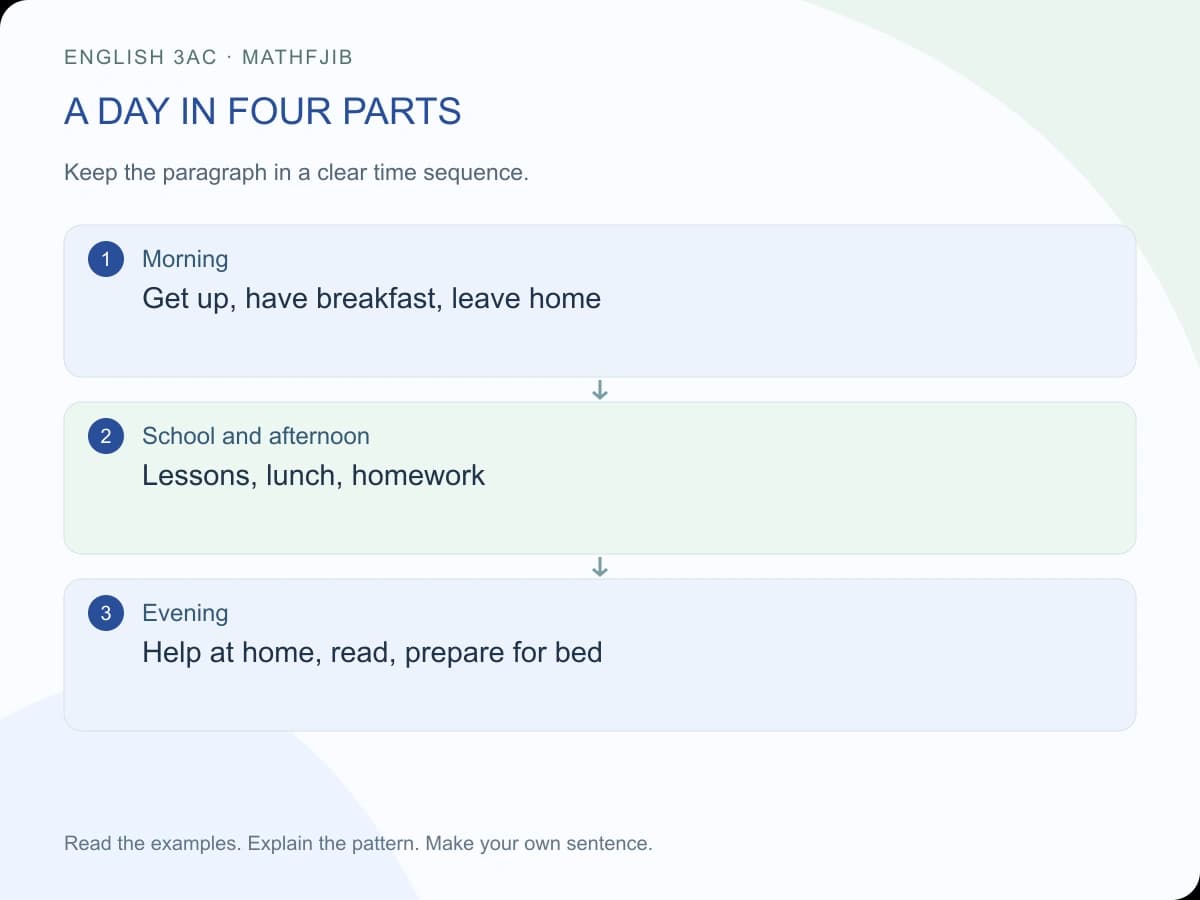
Write about what normally happens on a school day. Start in the morning, continue with school and the afternoon, then finish in the evening. Use the present simple because a routine repeats. A paragraph about yesterday would need different tense choices.
Practice task: Describe a normal school day. Give at least two times, a school activity, a helpful action at home and a relaxing activity. Keep the order easy to follow. The model uses one pupil's timetable; your own timetable may be different.

How do time words connect the activities?
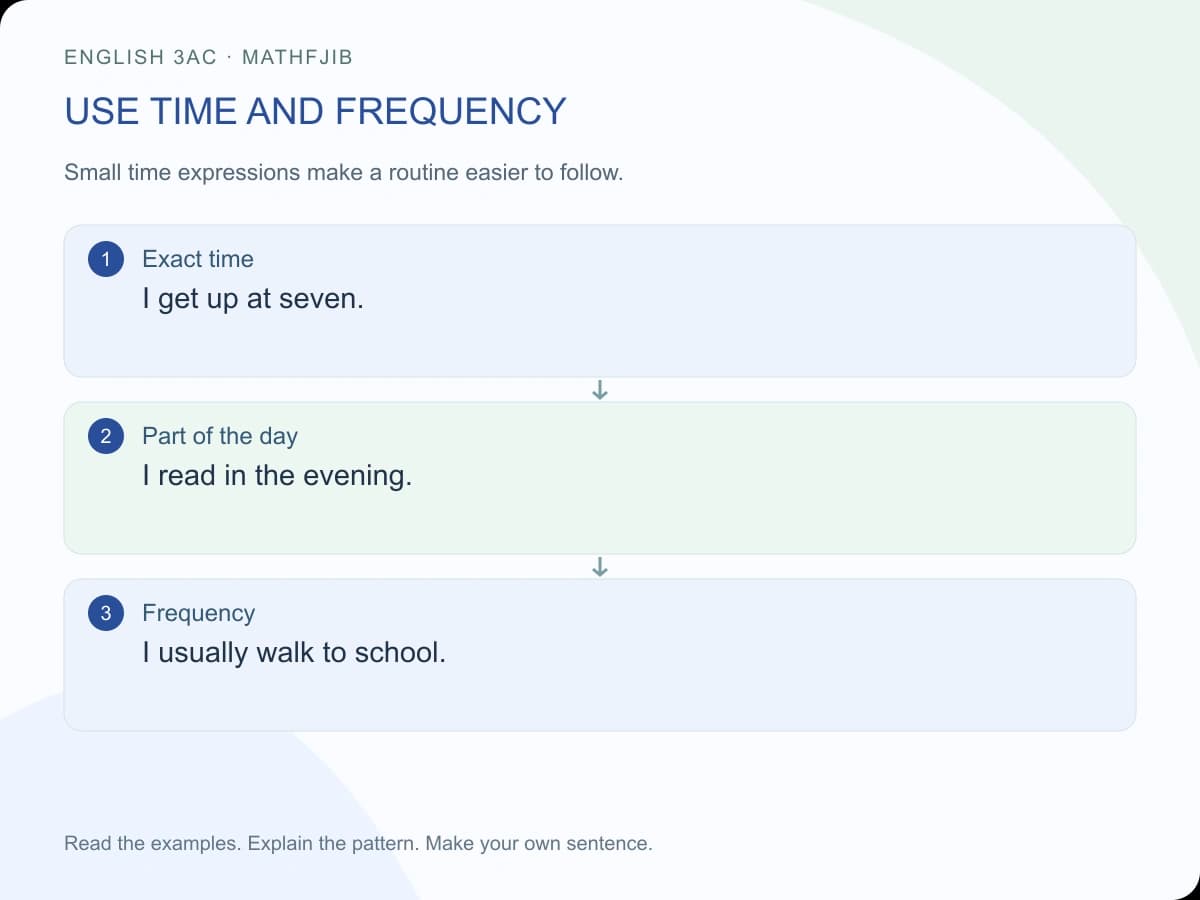
Use at seven o'clock or at half past seven for an exact time. Use in the morning, in the afternoon and in the evening for parts of a day. Write on Monday when you name a day. Before and after can link activities: After breakfast, I pack my bag.
Use then or after that to move forward. Do not begin every sentence with then. Some sentences can share a subject: I wash my face and get dressed. Adverbs such as usually and sometimes show how often an activity happens.
How can I check the routine paragraph?
Read the times in order. Make sure the activities can happen in that sequence. Check present-simple verbs and the spelling of breakfast, homework and evening. Homework is normally uncountable: I do my homework, not my homeworks. A final bedtime sentence gives the paragraph a natural ending.
Complete original writing model
Complete model: a normal school day
On school days, I usually get up at seven o'clock. First, I wash my face, get dressed and have breakfast with my family. I check my schoolbag before I leave home. Lessons begin at eight, so I walk to school at half past seven. At midday, I have lunch and rest for a short time. After my afternoon lessons, I go home and do my homework. I also help put the books and dishes away. In the evening, I sometimes read a short story or play a quiet board game with my brother. Finally, I prepare my clothes for the next day and go to bed at ten.
- The paragraph follows the day in time order.
- Usually and sometimes describe frequency.
- The verbs describe a routine, so they use the present simple.
How should I use this English 3AC lesson?
- Try the exercises before reading the answers.
- Explain a correction in your own words.
- Return to the examples when two structures look similar.
Frequently asked questions
How do I write my daily routine in English 3AC?
Should I use the past tense for a routine?
Is homework plural?
Quiz: 3 questions
3 questions are randomly selected from this lesson’s 3-question bank. Choose one answer for each question and get an immediate explanation.
Q1A normal routine usually uses...
Incorrect answer
The present simple describes repeated daily activities.
Correct answer: present simple
The present simple describes repeated daily activities.
Q2Which phrase is correct?
Incorrect answer
Use at for an exact time.
Correct answer: at eight o'clock
Use at for an exact time.
Q3Which word can introduce the last activity?
Incorrect answer
Finally marks the end of a sequence.
Correct answer: Finally
Finally marks the end of a sequence.
Your score
0/3
Start with the worked examples
Read the lesson in small sections. Write your own example for each rule and try the Easy exercises before returning to the quiz.
Review: 3 missed questions
A normal routine usually uses...
Correct answerpresent simple
The present simple describes repeated daily activities.
Which phrase is correct?
Correct answerat eight o'clock
Use at for an exact time.
Which word can introduce the last activity?
Correct answerFinally
Finally marks the end of a sequence.
Exercises with answers
4 exercises, from easy practice to challenges. Try each one yourself, then reveal the answer and explanation.
Exercise 1
EasyComplete: I get up ___ seven o'clock.
Answer and explanation
At. Use at before an exact clock time.
Exercise 2
EasyJoin: I have breakfast. I leave home. Use after.
Answer and explanation
After breakfast, I leave home. This keeps the activities in order.
Exercise 3
IntermediateCorrect: I do my homeworks in the evening.
Answer and explanation
I do my homework in the evening. Homework is normally uncountable.
Exercise 4
IntermediateWrite your own school-day paragraph in time order.
Answer and explanation
Include morning, school, afternoon and evening. Check at least two time expressions and use present simple for repeated activities. Your routine can differ from the model.