



A weekend visit: English 3AC reading and listening
Practise English 3AC past-simple listening with an original weekend story, audio, transcript, travel illustrations and comprehension questions with answers.

Download and study offline
By the end of this lesson, you can
- Follow a short past story in time order.
- Identify travel, place and activity details.
- Separate what people wanted to do from what they did.
Before you startRead short English sentences and identify the subject and verb.
Un bon cours, ça se partage.
Listen to the text
Listen before opening the transcript. This original English practice text is read by a synthetic voice.
Show the transcript
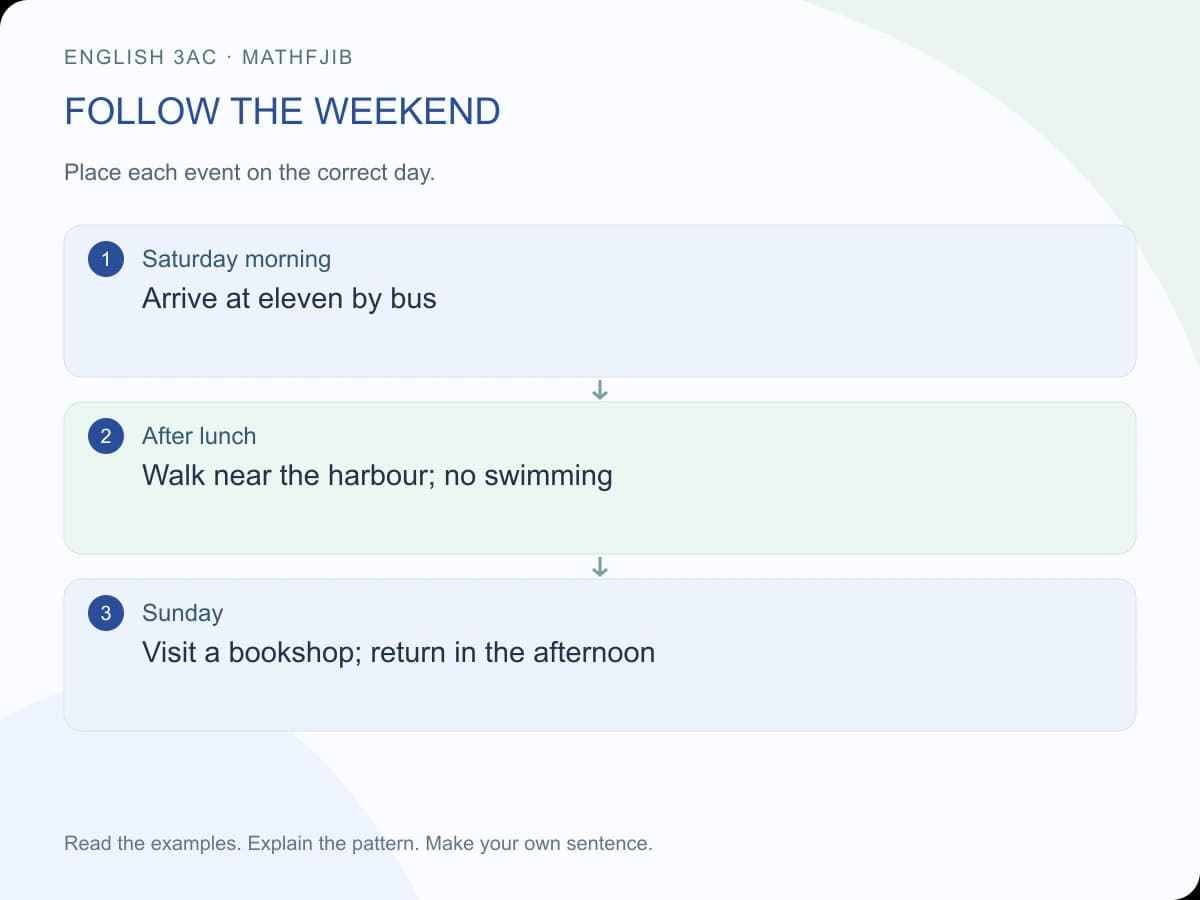
Last Saturday, I visited my aunt in Essaouira with my sister. We travelled by bus and arrived at eleven in the morning. My aunt met us at the bus station. After lunch, we walked near the harbour and took some photographs. We wanted to swim, but the wind was strong, so we stayed on the beach. In the evening, we helped my aunt prepare dinner. On Sunday, we visited a small bookshop. I bought a story for my little brother. We returned home in the afternoon. I was tired, but I was happy to see my family.
How do I follow this past-weekend story?
Listen first for where the narrator goes and why. The story describes a family visit to Essaouira. On the second listening, note the transport, arrival time and main activities. Put Saturday and Sunday on separate lines so the arrival and return do not become confused.
For reading practice, read the transcript after answering from the audio. Highlight past-simple verbs such as visited, travelled, arrived, walked, took and bought. Some verbs are regular and some are irregular, but all help tell the finished events.

Which people and actions should I keep separate?
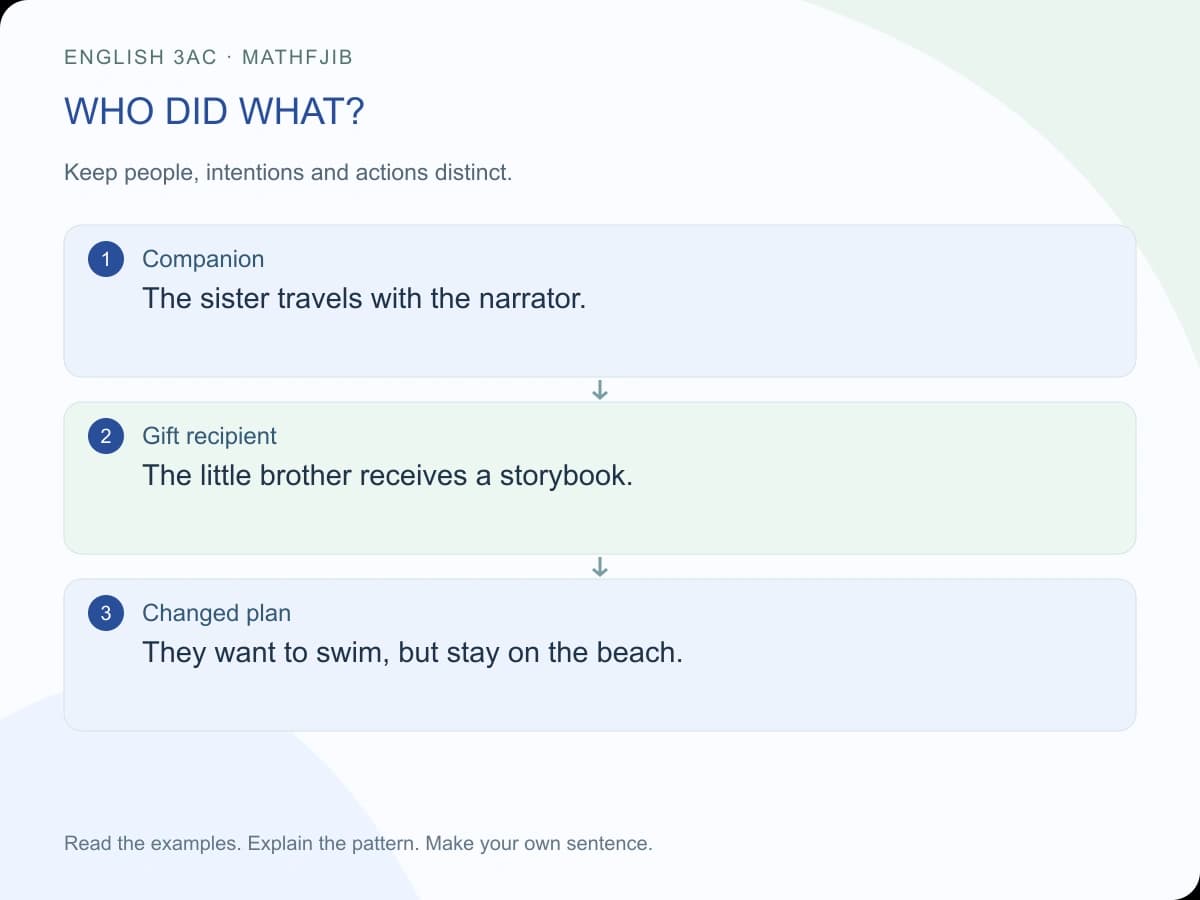
The narrator travels with a sister and visits an aunt. A little brother receives a book bought during the visit; the text does not say that the little brother travels. A correct answer keeps each person with the right role.
The visitors want to swim, but the strong wind changes their plan. They stay on the beach. Do not turn wanted to swim into swam. An intention is different from a completed action. Because gives the reason when you explain why they do not swim.
How can I justify an answer?
A short answer is enough if it includes the necessary detail. By bus answers the transport question. At eleven on Saturday morning answers the arrival question. Tired but happy includes both feelings at the end, not just one.
After correction, retell the story in five sentences without adding new events. Then change the town and two activities to create your own short account. The audio is an original text read by a synthetic English voice, suitable for reading and listening practice.
A worked example
An intention is not a completed action
Question: Why did the visitors not swim? Answer: Because the wind was strong. The story says they wanted to swim, but stayed on the beach. It does not say that rain stopped them.
- Find the actual reason in the text.
- Do not replace a stated reason with a possible one.
- Keep wanted to do and did separate.
How should I use this English 3AC lesson?
- Try the exercises before reading the answers.
- Explain a correction in your own words.
- Return to the examples when two structures look similar.
Frequently asked questions
How do I improve past-simple listening in English 3AC?
Can I infer extra events from a travel story?
How can I use this text for writing practice?
Quiz: 3 questions
3 questions are randomly selected from this lesson’s 3-question bank. Choose one answer for each question and get an immediate explanation.
Q1The visitors travel by...
Incorrect answer
The narrator says that they travelled by bus.
Correct answer: bus
The narrator says that they travelled by bus.
Q2They do not swim because...
Incorrect answer
Strong wind is the reason stated in the story.
Correct answer: the wind is strong
Strong wind is the reason stated in the story.
Q3Which statement is supported by the text?
Incorrect answer
The book is a gift for the little brother; that does not make him a travelling companion.
Correct answer: The narrator buys a book for the little brother.
The book is a gift for the little brother; that does not make him a travelling companion.
Your score
0/3
Start with the worked examples
Read the lesson in small sections. Write your own example for each rule and try the Easy exercises before returning to the quiz.
Review: 3 missed questions
The visitors travel by...
Correct answerbus
The narrator says that they travelled by bus.
They do not swim because...
Correct answerthe wind is strong
Strong wind is the reason stated in the story.
Which statement is supported by the text?
Correct answerThe narrator buys a book for the little brother.
The book is a gift for the little brother; that does not make him a travelling companion.
Exercises with answers
6 exercises, from easy practice to challenges. Try each one yourself, then reveal the answer and explanation.
Exercise 1
EasyWho travels with the narrator?
Answer and explanation
The narrator's sister. The little brother receives a book but is not described as a traveller.
Exercise 2
EasyHow do they travel?
Answer and explanation
By bus. No train or car journey is stated.
Exercise 3
IntermediateWhen do they arrive?
Answer and explanation
At eleven on Saturday morning. The return is on Sunday afternoon.
Exercise 4
IntermediateWhy do they not swim?
Answer and explanation
Because the wind was strong. The text does not mention rain as the reason.
Exercise 5
ChallengeWho is the storybook for?
Answer and explanation
The narrator's little brother. It is bought in a small bookshop.
Exercise 6
ChallengeHow does the narrator feel at the end?
Answer and explanation
Tired but happy. Both adjectives belong in the answer.