



Past simple or present perfect? English 3AC
Choose past simple or present perfect in English 3AC. Compare finished past times and experience, with timelines, clear examples and practice answers.

Download and study offline
By the end of this lesson, you can
- Describe a finished event at a stated past time.
- Ask about an experience without a finished time.
- Use a correct past participle after have or has.
Before you startRead short English sentences and identify the subject and verb.
Un bon cours, ça se partage.
When should you use the past simple?
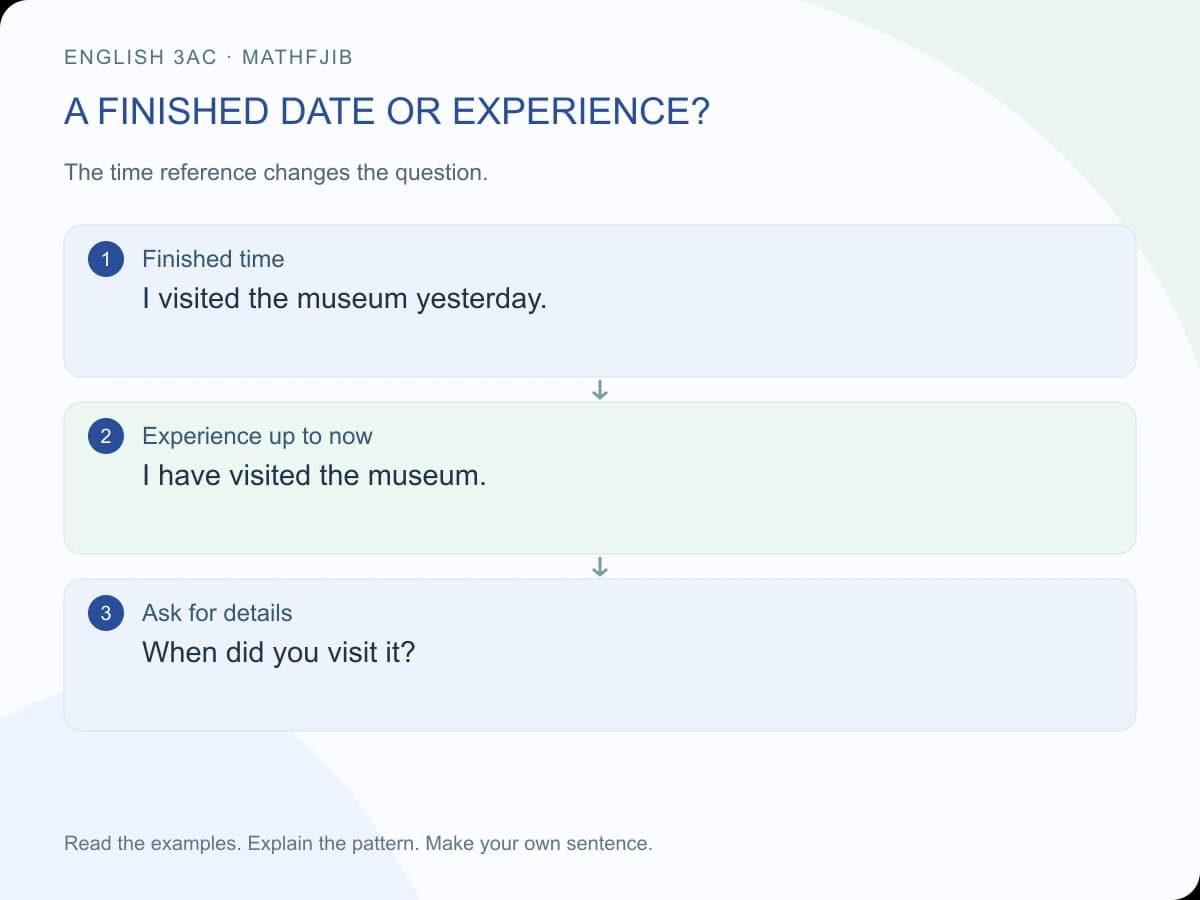
Use the past simple for a finished event in a finished past time. I visited the museum yesterday tells us when the visit happened. Last week, in 2024 and two days ago are common finished-time expressions. Regular verbs often end in -ed; irregular verbs have special forms, such as went and saw.
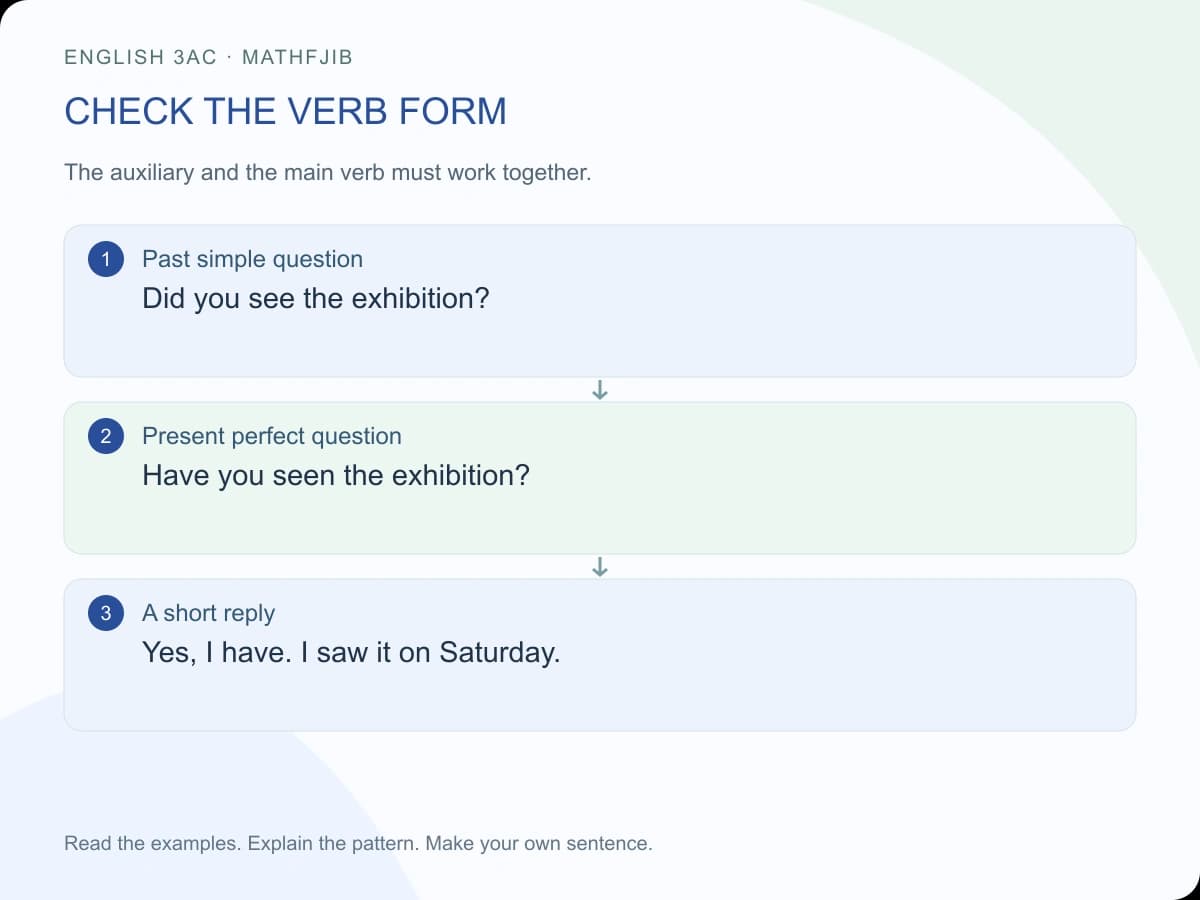
A past-simple question uses did with a base verb: Did you visit the museum yesterday? A negative uses didn't: I didn't visit it. The verb be is different: Was the museum open? Keep the question structure as well as the time expression in mind.

When should you use the present perfect?
Form the present perfect with have or has plus a past participle: I have visited the museum. He has written a report. This form can connect a past action to the present. For 3AC practice, start with life experience when no finished date is given: Have you ever visited a museum? Yes, I have.
Ever means at any time up to now in this kind of question. Never gives a negative experience: I have never visited that museum. Do not add not as well: I haven't never... is not the standard pattern. When you give a finished date, switch to the past simple: I visited it last year.
How can two tenses appear in one conversation?
A conversation often starts with experience and then asks for details. Have you ever joined a school club? Yes, I have. When did you join? I joined last September. The first question asks whether the experience exists; the next question locates it in a finished past time. Do not choose a tense only because a sentence contains the word past. Use the situation and the time reference.
A worked example
Experience first, a date second
Sami: Have you ever visited the science museum? Nabil: Yes, I have. Sami: When did you go? Nabil: I went last Saturday and saw a water-pump model.
- Have you ever visited...? asks about experience up to now.
- When did you go? asks for a finished past time.
- Went and saw belong to the finished visit last Saturday.
How should I use this English 3AC lesson?
- Try the exercises before reading the answers.
- Explain a correction in your own words.
- Return to the examples when two structures look similar.
Frequently asked questions
What is the difference between past simple and present perfect in 3AC?
Can I say I have visited it yesterday?
What verb form comes after have or has?
Quiz: 6 questions
6 questions are randomly selected from this lesson’s 6-question bank. Choose one answer for each question and get an immediate explanation.
Q1I ___ the exhibition yesterday.
Incorrect answer
Yesterday calls for a finished past event.
Correct answer: visited
Yesterday calls for a finished past event.
Q2Have you ever ___ this book?
Incorrect answer
Read is also the spelling of the past participle.
Correct answer: read
Read is also the spelling of the past participle.
Q3When ___ you visit the museum last year?
Incorrect answer
A finished past time uses did in this question.
Correct answer: did
A finished past time uses did in this question.
Q4He has ___ a report.
Incorrect answer
Has takes the participle written.
Correct answer: written
Has takes the participle written.
Q5Which is correct?
Incorrect answer
Never gives a negative meaning and been is the participle.
Correct answer: I have never been there.
Never gives a negative meaning and been is the participle.
Q6A natural follow-up to Have you ever been to Rabat? is...
Incorrect answer
The follow-up can ask when the experience happened.
Correct answer: When did you go?
The follow-up can ask when the experience happened.
Your score
0/6
Start with the worked examples
Read the lesson in small sections. Write your own example for each rule and try the Easy exercises before returning to the quiz.
Review: 6 missed questions
I ___ the exhibition yesterday.
Correct answervisited
Yesterday calls for a finished past event.
Have you ever ___ this book?
Correct answerread
Read is also the spelling of the past participle.
When ___ you visit the museum last year?
Correct answerdid
A finished past time uses did in this question.
He has ___ a report.
Correct answerwritten
Has takes the participle written.
Which is correct?
Correct answerI have never been there.
Never gives a negative meaning and been is the participle.
A natural follow-up to Have you ever been to Rabat? is...
Correct answerWhen did you go?
The follow-up can ask when the experience happened.
Exercises with answers
6 exercises, from easy practice to challenges. Try each one yourself, then reveal the answer and explanation.
Exercise 1
EasyComplete: I ___ (visit) the library yesterday.
Answer and explanation
Visited. Yesterday is a finished past time.
Exercise 2
EasyComplete: Have you ever ___ (see) a windmill?
Answer and explanation
Seen. Have is followed by a past participle.
Exercise 3
IntermediateCorrect: When have you visit the museum yesterday?
Answer and explanation
When did you visit the museum? Yesterday already supplies a finished time; use did + visit.
Exercise 4
IntermediateRewrite without a double negative: I haven't never joined a club.
Answer and explanation
I have never joined a club. Never already gives the negative meaning.
Exercise 5
ChallengeAsk for the date after a friend says: I have visited Rabat.
Answer and explanation
When did you visit Rabat? Ask for the finished date with the past simple.
Exercise 6
ChallengeWrite one experience question and one question about a visit last week.
Answer and explanation
Have you ever visited a museum? Did you visit the museum last week? The first asks about experience; the second names a finished time.