



Will, going to and might: English 3AC
Talk about future plans in English 3AC with will, going to and might. Compare decisions, intentions and possibilities with examples and answers.

Download and study offline
By the end of this lesson, you can
- Describe a plan made before speaking.
- Make a simple offer or prediction with will.
- Express an uncertain possibility with might.
Before you startRead short English sentences and identify the subject and verb.
Un bon cours, ça se partage.
When do you use going to for a future plan?
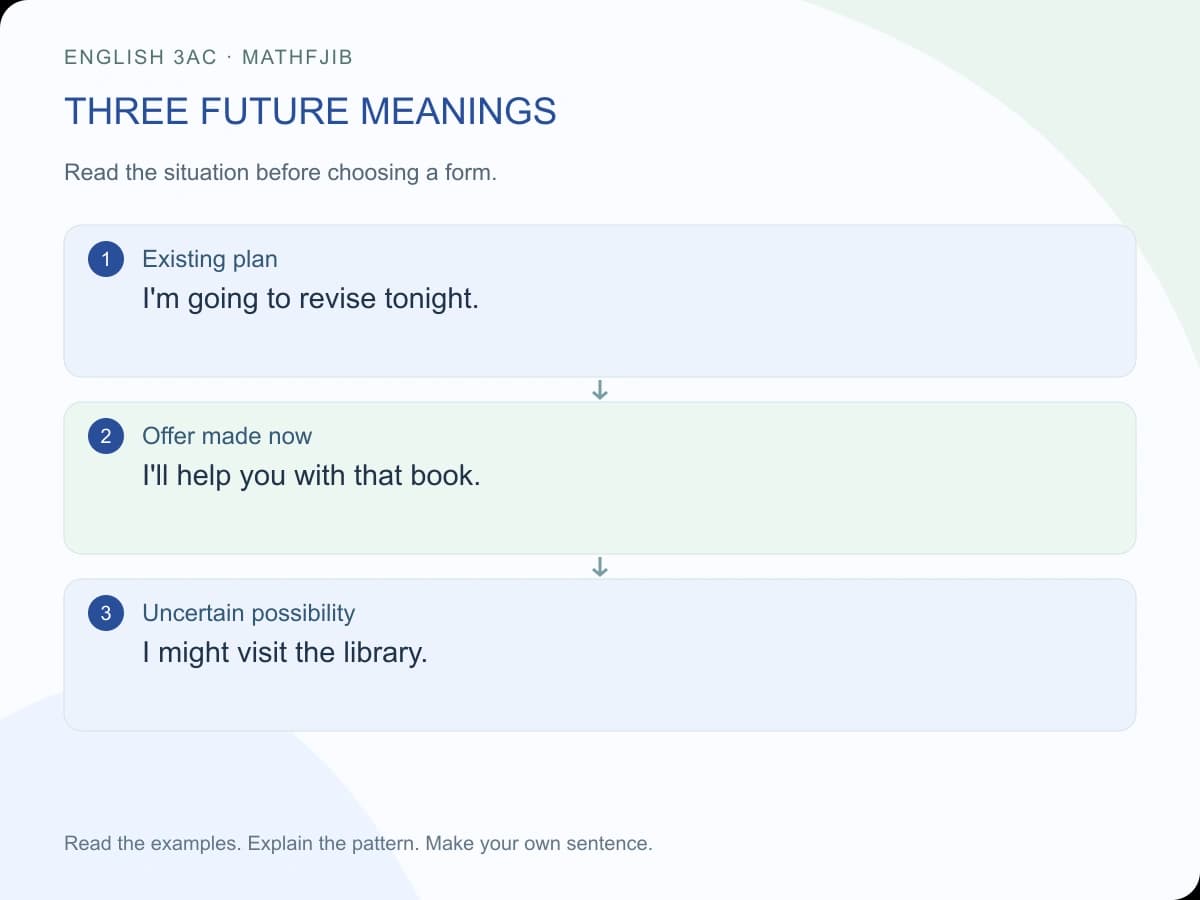
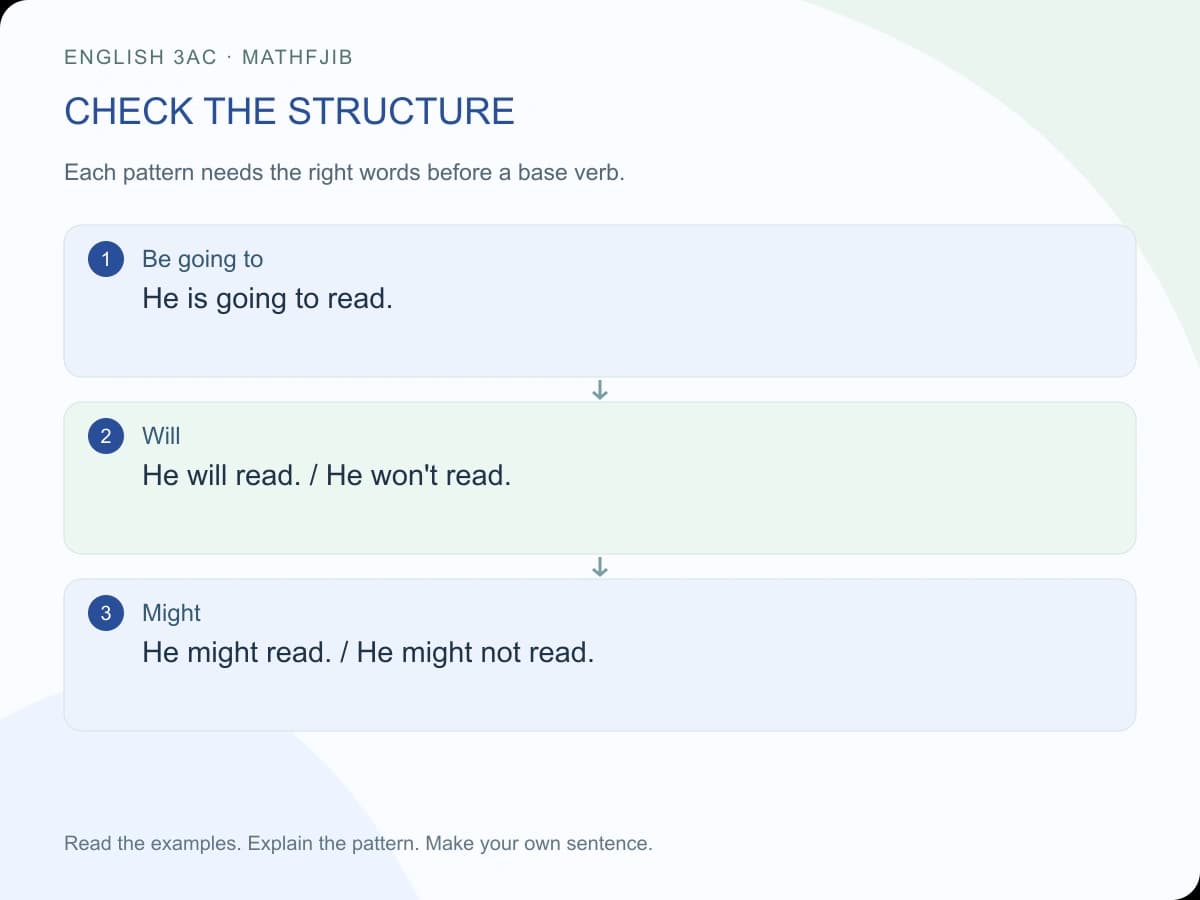
Use am, is or are going to followed by a base verb for a plan or intention you already have. I am going to revise English this evening means that this is already my plan. He is going to join the reading club. They are going to make a poster.
Keep the form of be. I going to revise is incomplete. For a question, put be before the subject: Are you going to revise tonight? For a negative, add not after be: I'm not going to watch television this evening. Choose realistic plans that you can explain in simple language.

When do you use will?
Will can express a decision made as you speak or an offer: Your books look heavy. I'll help you carry them. It can also express a prediction or belief: I think our class will enjoy the exhibition. The main verb stays in its base form.
The negative form is will not or won't: I won't be late. A question begins with will: Will you help with the poster? These uses are useful starting points, not a rule that every future sentence has only one possible form. Context can allow more than one correct choice.
What does might mean about the future?
Might expresses a possibility: I might join the club, but I haven't decided yet. It is less certain than saying I am going to join when you already have that intention. Use a base verb after might: might visit, not might to visit or might visits. Compare the speaker's meaning, not a memorised percentage. Might does not have one fixed numerical probability.
A worked example
Planning an afternoon
I am going to revise English after lunch; that is my plan. If my brother needs help, I'll explain the exercise. I might visit the library later, but I haven't decided yet.
- Am going to revise gives an existing intention.
- I'll explain offers help in the situation.
- Might visit keeps the later activity uncertain.
How should I use this English 3AC lesson?
- Try the exercises before reading the answers.
- Explain a correction in your own words.
- Return to the examples when two structures look similar.
Frequently asked questions
What is the difference between will, going to and might in 3AC?
Do I put to after might?
Is I going to revise correct?
Quiz: 6 questions
6 questions are randomly selected from this lesson’s 6-question bank. Choose one answer for each question and get an immediate explanation.
Q1She ___ going to read tonight.
Incorrect answer
She takes is in be going to.
Correct answer: is
She takes is in be going to.
Q2I might ___ the library.
Incorrect answer
Might is followed by a base verb.
Correct answer: visit
Might is followed by a base verb.
Q3Which sentence is an offer?
Incorrect answer
Will can express help offered as the speaker talks.
Correct answer: I'll help you carry that.
Will can express help offered as the speaker talks.
Q4The negative of will is...
Incorrect answer
Won't is the contracted form of will not.
Correct answer: won't
Won't is the contracted form of will not.
Q5Which sentence gives an existing plan?
Incorrect answer
Going to presents the speaker's current intention.
Correct answer: I'm going to revise after lunch.
Going to presents the speaker's current intention.
Q6Might always means exactly a 50 percent chance.
Incorrect answer
Modal meaning depends on context; there is no fixed numerical probability.
Correct answer: No, it expresses possibility without a fixed percentage.
Modal meaning depends on context; there is no fixed numerical probability.
Your score
0/6
Start with the worked examples
Read the lesson in small sections. Write your own example for each rule and try the Easy exercises before returning to the quiz.
Review: 6 missed questions
She ___ going to read tonight.
Correct answeris
She takes is in be going to.
I might ___ the library.
Correct answervisit
Might is followed by a base verb.
Which sentence is an offer?
Correct answerI'll help you carry that.
Will can express help offered as the speaker talks.
The negative of will is...
Correct answerwon't
Won't is the contracted form of will not.
Which sentence gives an existing plan?
Correct answerI'm going to revise after lunch.
Going to presents the speaker's current intention.
Might always means exactly a 50 percent chance.
Correct answerNo, it expresses possibility without a fixed percentage.
Modal meaning depends on context; there is no fixed numerical probability.
Exercises with answers
6 exercises, from easy practice to challenges. Try each one yourself, then reveal the answer and explanation.
Exercise 1
EasyComplete: We ___ going to make a poster tomorrow.
Answer and explanation
Are. We needs are in be going to.
Exercise 2
EasyYour classmate cannot carry all his books. Offer help with will.
Answer and explanation
I'll help you carry the books. Will can express an offer.
Exercise 3
IntermediateCorrect: I might to join the club.
Answer and explanation
I might join the club. Use the base verb without to.
Exercise 4
IntermediateMake negative: He will be late.
Answer and explanation
He won't be late, or He will not be late.
Exercise 5
ChallengeAsk whether your friend plans to revise tonight using going to.
Answer and explanation
Are you going to revise tonight? Put are before the subject.
Exercise 6
ChallengeExplain the difference between I'm going to visit the library and I might visit the library.
Answer and explanation
The first expresses an existing intention. The second presents a possibility; the speaker may not have decided.