



20 irregular verbs: English 3AC practice
Learn 20 useful irregular verbs for English 3AC: base forms, past simple and past participles, with short stories, illustrated practice and answers.

Download and study offline
By the end of this lesson, you can
- Recognise twenty frequent irregular verbs.
- Choose the past simple or past participle.
- Use a base verb after did and didn't.
Before you startRead short English sentences and identify the subject and verb.
Un bon cours, ça se partage.
Which irregular verbs are useful in English 3AC?
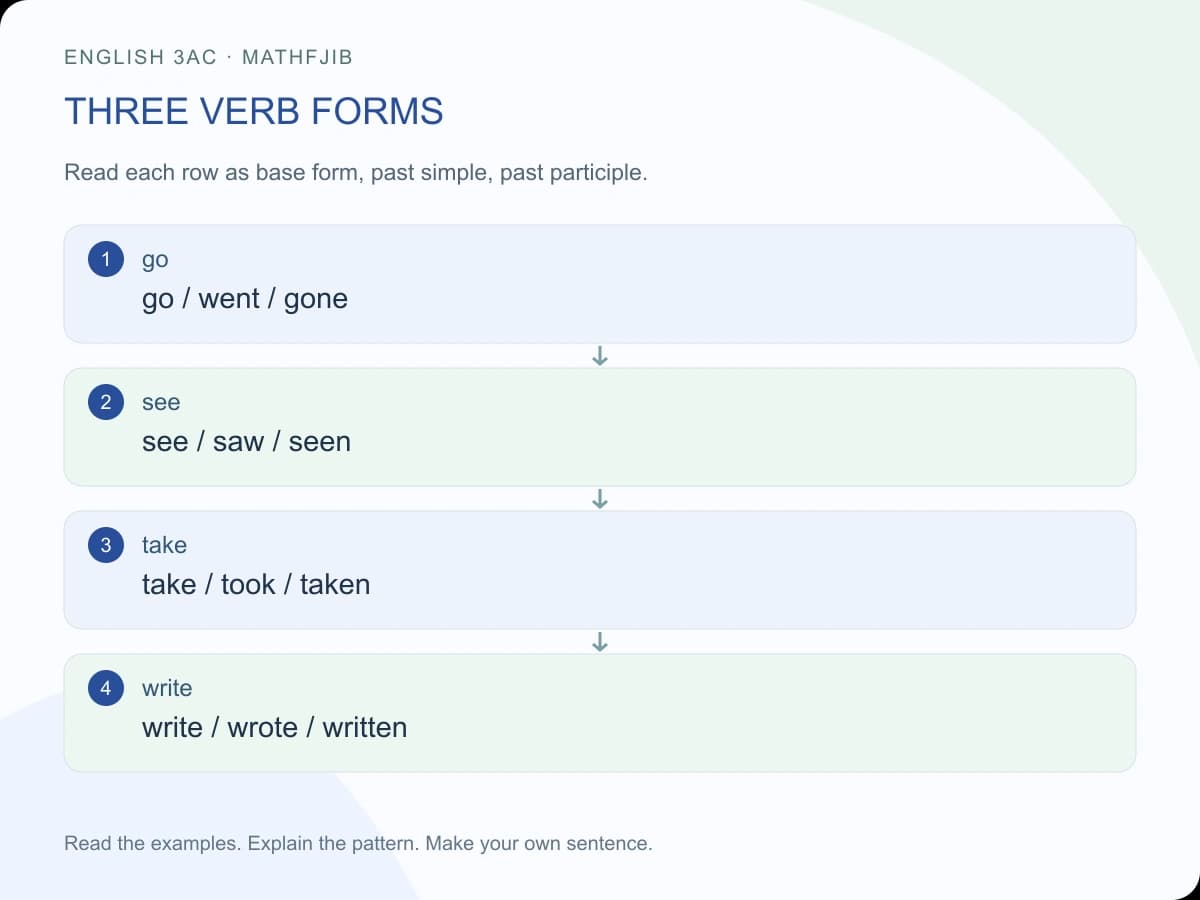
Start with verbs you can use in school and daily-life sentences. The table gives twenty useful verbs. Read each row from the base form to the past simple and then the past participle.
Got is the common British past participle used in this table; learners may also meet gotten in American English. Read keeps its spelling, but its past and participle forms have a different pronunciation from the present form.
| Base form | Past simple | Past participle |
|---|---|---|
| be | was / were | been |
| become | became | become |
| begin | began | begun |
| bring | brought | brought |
| buy | bought | bought |
| come | came | come |
| do | did | done |
| drink | drank | drunk |
| eat | ate | eaten |
| find | found | found |
| get | got | got |
| give | gave | given |
| go | went | gone |
| have | had | had |
| make | made | made |
| read | read | read |
| see | saw | seen |
| speak | spoke | spoken |
| take | took | taken |
| write | wrote | written |

How do you use the past simple form?
Use the past simple for a finished past event: We went to the museum yesterday. I bought a notebook on Saturday. In a question or negative, did carries the past meaning: Did you go? I didn't buy a notebook. Do not write Did you went? or didn't bought.
Learn verbs in useful pairs and short sentences instead of copying a long list without meaning. For example: I see the board every day. I saw the exhibition yesterday. Read has the same spelling in three forms, but the present sound is different from the past and participle sound.
When do you need a past participle?
Use a past participle after have or has in the present perfect: I have written a paragraph. He has taken the book. Do not confuse wrote with written or went with gone. This lesson practises the forms needed for 3AC topics; the full choice between present perfect and past simple has its own lesson. Test yourself by covering one column, then writing a complete sentence with the form you remember.
A worked example
A short museum visit
Last Saturday, we went to a museum. I saw an old water pump and took notes. Back at school, I wrote a paragraph about it. I have kept my notes for the project.
- Went, saw, took and wrote tell finished events.
- Have kept shows the pattern have + past participle; keep is an extra useful verb.
- A question about the visit uses Did you go?, not Did you went?

How should I use this English 3AC lesson?
- Try the exercises before reading the answers.
- Explain a correction in your own words.
- Return to the examples when two structures look similar.
Frequently asked questions
How can I learn irregular verbs for English 3AC?
Do I use went after did?
What is the difference between wrote and written?
Quiz: 6 questions
6 questions are randomly selected from this lesson’s 6-question bank. Choose one answer for each question and get an immediate explanation.
Q1The past simple of go is...
Incorrect answer
Went is the irregular past simple form.
Correct answer: went
Went is the irregular past simple form.
Q2The participle of write is...
Incorrect answer
Use written after have or has.
Correct answer: written
Use written after have or has.
Q3Did you ___ the book?
Incorrect answer
Did takes a base verb.
Correct answer: take
Did takes a base verb.
Q4She has ___ her lunch.
Incorrect answer
Eaten is the past participle of eat.
Correct answer: eaten
Eaten is the past participle of eat.
Q5Which group is correct?
Incorrect answer
The order is base form, past simple, past participle.
Correct answer: see / saw / seen
The order is base form, past simple, past participle.
Q6The spelling of read in the past simple...
Incorrect answer
Read keeps its spelling, although its pronunciation changes.
Correct answer: stays read
Read keeps its spelling, although its pronunciation changes.
Your score
0/6
Start with the worked examples
Read the lesson in small sections. Write your own example for each rule and try the Easy exercises before returning to the quiz.
Review: 6 missed questions
The past simple of go is...
Correct answerwent
Went is the irregular past simple form.
The participle of write is...
Correct answerwritten
Use written after have or has.
Did you ___ the book?
Correct answertake
Did takes a base verb.
She has ___ her lunch.
Correct answereaten
Eaten is the past participle of eat.
Which group is correct?
Correct answersee / saw / seen
The order is base form, past simple, past participle.
The spelling of read in the past simple...
Correct answerstays read
Read keeps its spelling, although its pronunciation changes.
Exercises with answers
6 exercises, from easy practice to challenges. Try each one yourself, then reveal the answer and explanation.
Exercise 1
EasyWrite the past simple of go, see and take.
Answer and explanation
Went, saw and took.
Exercise 2
EasyWrite the past participles of write, eat and give.
Answer and explanation
Written, eaten and given.
Exercise 3
IntermediateCorrect: Did you bought a notebook?
Answer and explanation
Did you buy a notebook? Use the base form after did.
Exercise 4
IntermediateComplete: I have ___ (see) the poster.
Answer and explanation
Seen. Have takes the past participle.
Exercise 5
ChallengeComplete: Yesterday I ___ (go) to the library and ___ (take) a book home.
Answer and explanation
Went and took. Yesterday gives a finished past time.
Exercise 6
ChallengeWrite two sentences with different irregular verbs, one in the past simple and one with have or has.
Answer and explanation
Possible answer: I wrote a paragraph yesterday. I have written three paragraphs this week. Wrote is past simple; written is a participle.