



Unit 12 (Health)
English 3AC Unit 12 (Health) helps you name a feeling or a problem, ask for help and distinguish advice from rules. Should gives a recommendation, must expresses an obligation and mustn't expresses a prohibition. The examples teach language through school situations.

Download and study offline
By the end of this lesson, you can
- Use be with feelings and have with common problem nouns.
- Ask for help politely.
- Distinguish advice, obligation and prohibition.
- Use a base verb after a modal.
- Contrast mustn't with don't have to.
- Read a short school rule message.
Before you startRecognise adjectives and noun phrases. · Use base action verbs such as ask, eat and wash.
Un bon cours, ça se partage.
Communication: saying how you feel
A short clear sentence is useful when asking an adult for help: I am tired. I do not feel well. Can you help me, please? The task is to communicate the problem rather than diagnose it. In a classroom role-play, invented situations are sufficient.
A pupil asks his teacher
Hamza: I do not feel well. Can you help me, please? Teacher: You should tell the school office. Hamza: May I leave the activity? Teacher: Yes. I will help you ask.
Vocabulary: be or have?
| Pattern | Words | Example |
|---|---|---|
| Be + adjective | tired, cold, worried, unwell | I am tired. |
| Have + problem noun | a headache, a toothache, a cold | I have a headache. |
| Ask for help | help, school office, adult | Can you help me, please? |
I am cold describes a feeling or temperature sensation. I have a cold names an illness in everyday vocabulary. The small article a changes the construction. Learning the complete phrase helps prevent I have tired or I am a headache.
Grammar: should for advice
Definition
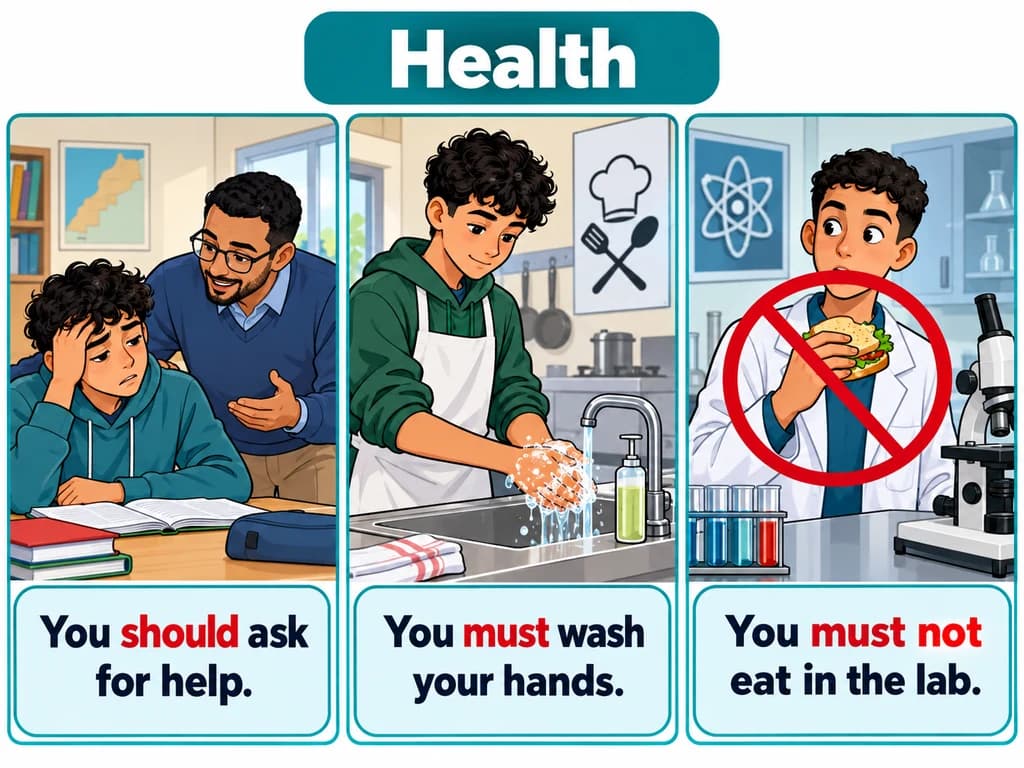
Should : Should + base verb gives advice or a recommendation: You should ask for help. Should not, usually shouldn't, advises against an action.
A suggestion is not automatically a compulsory rule. In You should speak clearly, the speaker recommends a useful action. A rule requiring a particular action needs an obligation form or clear rule context.
Grammar: must and mustn’t
Definition
Must : Must + base verb expresses an obligation in the named context: The cooking club requires handwashing. You must wash your hands before the activity.
Definition
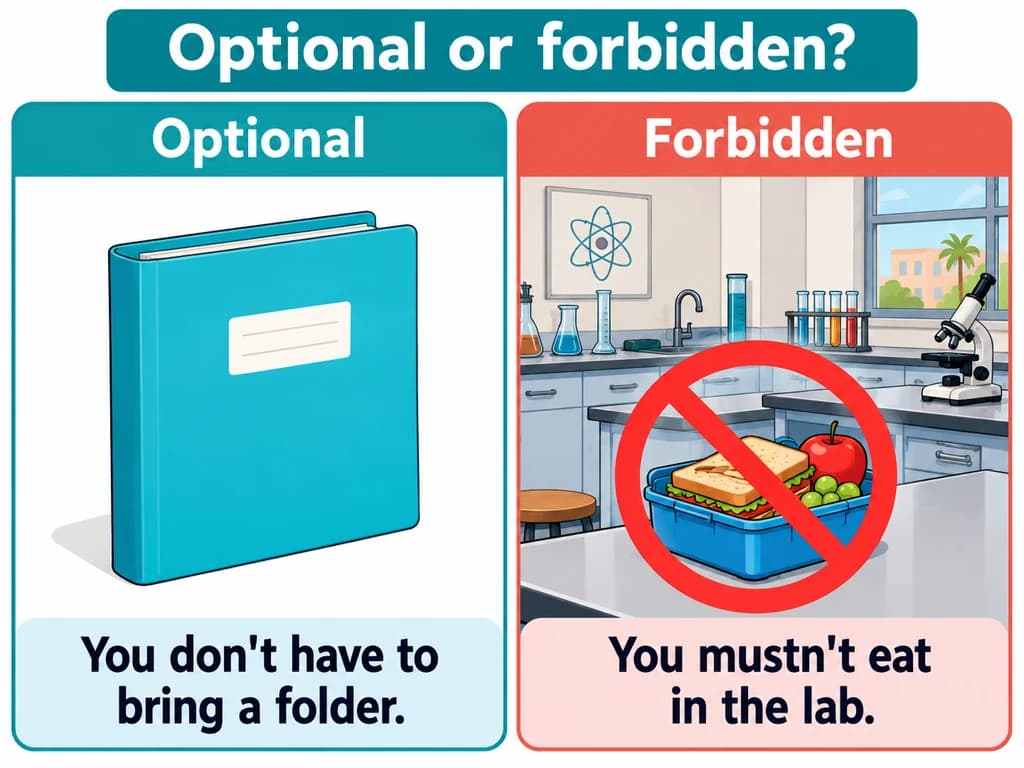
Mustn’t : Must not, or mustn't, states a prohibition: The laboratory rule forbids eating. You mustn't eat in the lab.
| Meaning | Modal | Example |
|---|---|---|
| Recommendation | should | You should ask for help. |
| Requirement | must | You must follow the club rule. |
| Prohibition | mustn't | You mustn't eat in the lab. |
| No requirement | don't have to | You don't have to bring a coloured folder. |
Remember
Mustn't means forbidden. Don't have to means optional or not necessary. If a folder is optional, You mustn't bring it wrongly forbids it. Say You don't have to bring it.
Grammar: the verb after a modal
Should and must stay the same with I, he, she, we and they. The main verb is a base form: He should ask, not He should asks. Do not put to after these modals: must wash, not must to wash. Questions can begin with the modal: Should I tell the office?
Step by step
Choose the modal from the meaning
- Decide whether the action is advised, required, forbidden or optional.
- Choose should, must, mustn't or don't have to accordingly.
- Use a base verb after should/must.
- Read the situation again to check that your sentence expresses its stated rule.
One action, different meanings
You should bring a notebook suggests it. You must bring a notebook requires it. You mustn't bring a notebook forbids it. You don't have to bring a notebook makes it optional.
- The modal changes the instruction even when the noun and action are identical.
Study skills: annotate the reason
Draw four columns labelled advice, required, forbidden and optional. Before filling a modal gap, underline the phrase establishing the meaning: a club rule, a prohibition sign or optional. Do not choose must solely because it sounds stronger; choose it because the situation requires that meaning.
Skills work: reading the school activity notice
Before the boys’ cooking club begins, pupils must wash their hands. They must follow the club leader’s instructions. Food is forbidden in the science laboratory, so they mustn't eat there. A coloured folder is optional; pupils do not have to bring one. If a pupil feels unwell, he should ask the responsible adult for help. This notice is a language practice example.
The notice distinguishes four meanings explicitly. The folder is optional, not forbidden. Eating is forbidden in the laboratory, not in every room mentioned. Read the location and reason alongside the modal.
Skills work: listening and writing a rule card
A partner reads twice: “You must wash your hands before the club. You must not eat in the lab. You do not have to bring a coloured folder.” Sort each instruction by meaning. Then write a brief invented club rule card with one recommendation, one requirement, one prohibition and one optional item.
Review: use the meaning to choose
- Say a feeling with be and a problem noun with have.
- Explain the difference between should and must.
- Distinguish forbidden from optional.
- Check a base verb after every should or must.
Frequently asked questions
What grammar do I revise in English 3AC Unit 12 Health?
What is the difference between must and should?
What is the difference between mustn’t and don’t have to?
Which verb form follows should or must?
How do I politely ask for help in English?
Quiz: 18 questions
18 questions are randomly selected from this lesson’s 18-question bank. Choose one answer for each question and get an immediate explanation.
Q1Which phrase correctly names a feeling?
Incorrect answer
Tired is an adjective and follows be in this sentence.
Correct answer: I am tired.
Tired is an adjective and follows be in this sentence.
Q2Which phrase correctly names a headache?
Incorrect answer
The noun phrase a headache follows have.
Correct answer: I have a headache.
The noun phrase a headache follows have.
Q3Which modal gives advice?
Incorrect answer
Should introduces a recommendation rather than a prohibition.
Correct answer: Should
Should introduces a recommendation rather than a prohibition.
Q4Which modal expresses a stated obligation?
Incorrect answer
Must marks the action as required in the given context.
Correct answer: Must
Must marks the action as required in the given context.
Q5Which expression means an action is forbidden?
Incorrect answer
Must not expresses prohibition.
Correct answer: Mustn't
Must not expresses prohibition.
Q6Which expression means an item is not required?
Incorrect answer
Don't have to removes the requirement without forbidding the action.
Correct answer: Don't have to bring it
Don't have to removes the requirement without forbidding the action.
Q7Complete: He should … an adult.
Incorrect answer
A base verb follows should regardless of the subject.
Correct answer: ask
A base verb follows should regardless of the subject.
Q8Complete: We must … the instructions.
Incorrect answer
Must takes a base verb without to or ing.
Correct answer: follow
Must takes a base verb without to or ing.
Q9Choose a question with should.
Incorrect answer
The modal comes before I and is followed by base tell.
Correct answer: Should I tell the office?
The modal comes before I and is followed by base tell.
Q10What does I am cold describe here?
Incorrect answer
Be plus cold is an adjective construction, unlike have a cold.
Correct answer: A feeling or temperature sensation
Be plus cold is an adjective construction, unlike have a cold.
Q11What does I have a cold name?
Incorrect answer
Have a cold uses a noun phrase to name the problem.
Correct answer: An illness in everyday vocabulary
Have a cold uses a noun phrase to name the problem.
Q12What preparation does the cooking notice require?
Incorrect answer
The notice explicitly requires handwashing before the activity.
Correct answer: Washing hands
The notice explicitly requires handwashing before the activity.
Q13Where is eating forbidden in the notice?
Incorrect answer
The scope of the prohibition is the science laboratory.
Correct answer: The science laboratory
The scope of the prohibition is the science laboratory.
Q14What is optional in the notice?
Incorrect answer
The notice identifies the coloured folder as optional.
Correct answer: A coloured folder
The notice identifies the coloured folder as optional.
Q15What does the notice recommend if a pupil feels unwell?
Incorrect answer
The recommendation is to communicate with the responsible adult.
Correct answer: Ask the responsible adult for help
The recommendation is to communicate with the responsible adult.
Q16Choose the sentence that forbids bringing food.
Incorrect answer
Mustn't states prohibition; the other sentences do not.
Correct answer: You mustn't bring food.
Mustn't states prohibition; the other sentences do not.
Q17Which sentence is grammatically correct for he?
Incorrect answer
Must does not change with he, and follow remains a base verb.
Correct answer: He must follow the rule.
Must does not change with he, and follow remains a base verb.
Q18How should you choose a modal in a gap?
Incorrect answer
The stated meaning determines the modal, not an arbitrary strength preference.
Correct answer: Read whether the action is advised, required, forbidden or optional.
The stated meaning determines the modal, not an arbitrary strength preference.
Your score
0/18
Start with the worked examples
Read the lesson in small sections. Write your own example for each rule and try the Easy exercises before returning to the quiz.
Review: 18 missed questions
Which phrase correctly names a feeling?
Correct answerI am tired.
Tired is an adjective and follows be in this sentence.
Which phrase correctly names a headache?
Correct answerI have a headache.
The noun phrase a headache follows have.
Which modal gives advice?
Correct answerShould
Should introduces a recommendation rather than a prohibition.
Which modal expresses a stated obligation?
Correct answerMust
Must marks the action as required in the given context.
Which expression means an action is forbidden?
Correct answerMustn't
Must not expresses prohibition.
Which expression means an item is not required?
Correct answerDon't have to bring it
Don't have to removes the requirement without forbidding the action.
Complete: He should … an adult.
Correct answerask
A base verb follows should regardless of the subject.
Complete: We must … the instructions.
Correct answerfollow
Must takes a base verb without to or ing.
Choose a question with should.
Correct answerShould I tell the office?
The modal comes before I and is followed by base tell.
What does I am cold describe here?
Correct answerA feeling or temperature sensation
Be plus cold is an adjective construction, unlike have a cold.
What does I have a cold name?
Correct answerAn illness in everyday vocabulary
Have a cold uses a noun phrase to name the problem.
What preparation does the cooking notice require?
Correct answerWashing hands
The notice explicitly requires handwashing before the activity.
Where is eating forbidden in the notice?
Correct answerThe science laboratory
The scope of the prohibition is the science laboratory.
What is optional in the notice?
Correct answerA coloured folder
The notice identifies the coloured folder as optional.
What does the notice recommend if a pupil feels unwell?
Correct answerAsk the responsible adult for help
The recommendation is to communicate with the responsible adult.
Choose the sentence that forbids bringing food.
Correct answerYou mustn't bring food.
Mustn't states prohibition; the other sentences do not.
Which sentence is grammatically correct for he?
Correct answerHe must follow the rule.
Must does not change with he, and follow remains a base verb.
How should you choose a modal in a gap?
Correct answerRead whether the action is advised, required, forbidden or optional.
The stated meaning determines the modal, not an arbitrary strength preference.
Exercises with answers
12 exercises, from easy practice to challenges. Try each one yourself, then reveal the answer and explanation.
Exercise 1
EasyComplete: I … tired. I … a headache. I … cold. I … a cold.
Answer and explanation
I am tired. I have a headache. I am cold. I have a cold. Adjectives follow be, while these problem noun phrases follow have.
Exercise 2
EasyA suggestion recommends asking for help. A club rule requires washing hands. Choose should or must.
Answer and explanation
You should ask for help. You must wash your hands. The first recommends; the second states the supplied requirement.
Exercise 3
EasyThe science laboratory forbids eating. Complete: You … eat in the lab.
Answer and explanation
You mustn't eat in the lab. Must not expresses the prohibition stated in the question.
Exercise 4
EasyChoose ask/asks and wash/to wash: He should … for help. We must … our hands.
Answer and explanation
He should ask for help. We must wash our hands. Should and must take a base verb without s or to.
Exercise 5
IntermediateA coloured folder is optional. Write a sentence with don’t have to.
Answer and explanation
You don't have to bring a coloured folder. This means it is not required, rather than prohibited.
Exercise 6
IntermediateWrite a polite two-sentence request from a fictional pupil who feels unwell.
Answer and explanation
I do not feel well. Can you help me, please? The response communicates the problem without inventing a diagnosis.
Exercise 7
IntermediateExplain the difference: You mustn't bring food. You don't have to bring food.
Answer and explanation
The first forbids bringing food. The second says bringing food is not required. It does not itself forbid the action.
Exercise 8
IntermediateName the required preparation, the forbidden action and the optional object.
Answer and explanation
Wash hands before the club; do not eat in the science laboratory; a coloured folder is optional. Preserve the named locations and context.
Exercise 9
IntermediateDoes the notice forbid eating in every school room? Explain from the reading.
Answer and explanation
No. It states a prohibition in the science laboratory. The passage does not establish the same rule for every room.
Exercise 10
ChallengeCorrect: He should asks. We must to wash. The optional folder means you mustn't bring it. I have tired.
Answer and explanation
He should ask. We must wash. You don't have to bring the optional folder. I am tired. Fix the base verbs, optional meaning and adjective construction.
Exercise 11
ChallengeHave a partner read the listening script. Mark each action as required, forbidden or optional.
Answer and explanation
Washing hands is required. Eating in the lab is forbidden. Bringing a coloured folder is optional. Record meaning as well as vocabulary.
Exercise 12
ChallengeWrite 45–65 words for an invented school club. Include advice, a requirement, a prohibition and an optional item.
Answer and explanation
Model: Welcome to our boys' cooking club. You must wash your hands before the activity and follow the leader’s instructions. You mustn't eat in the science laboratory. You should ask an adult for help if you feel unwell. You don't have to bring a coloured folder because it is optional.
Check that each rule’s meaning matches its modal and that every modal is followed by a base verb.