



Reading: a lunch story in captions
Captions are short pieces of text that explain moments in a sequence. This original lunch story uses four numbered captions. Read them in order and connect the people, objects and events before answering the questions.

Ta fiche PDF illustrée
Le support, la méthode et les exercices corrigés à imprimer.
By the end of this lesson, you can
- Connect captions into one story
- Sequence words and the changing situation
- Distinguish the beginning from the outcome
Before you startRead simple English sentences; use the starter lesson if you need help with names or numbers.
Un bon cours, ça se partage.
How do I follow a story told in short captions?
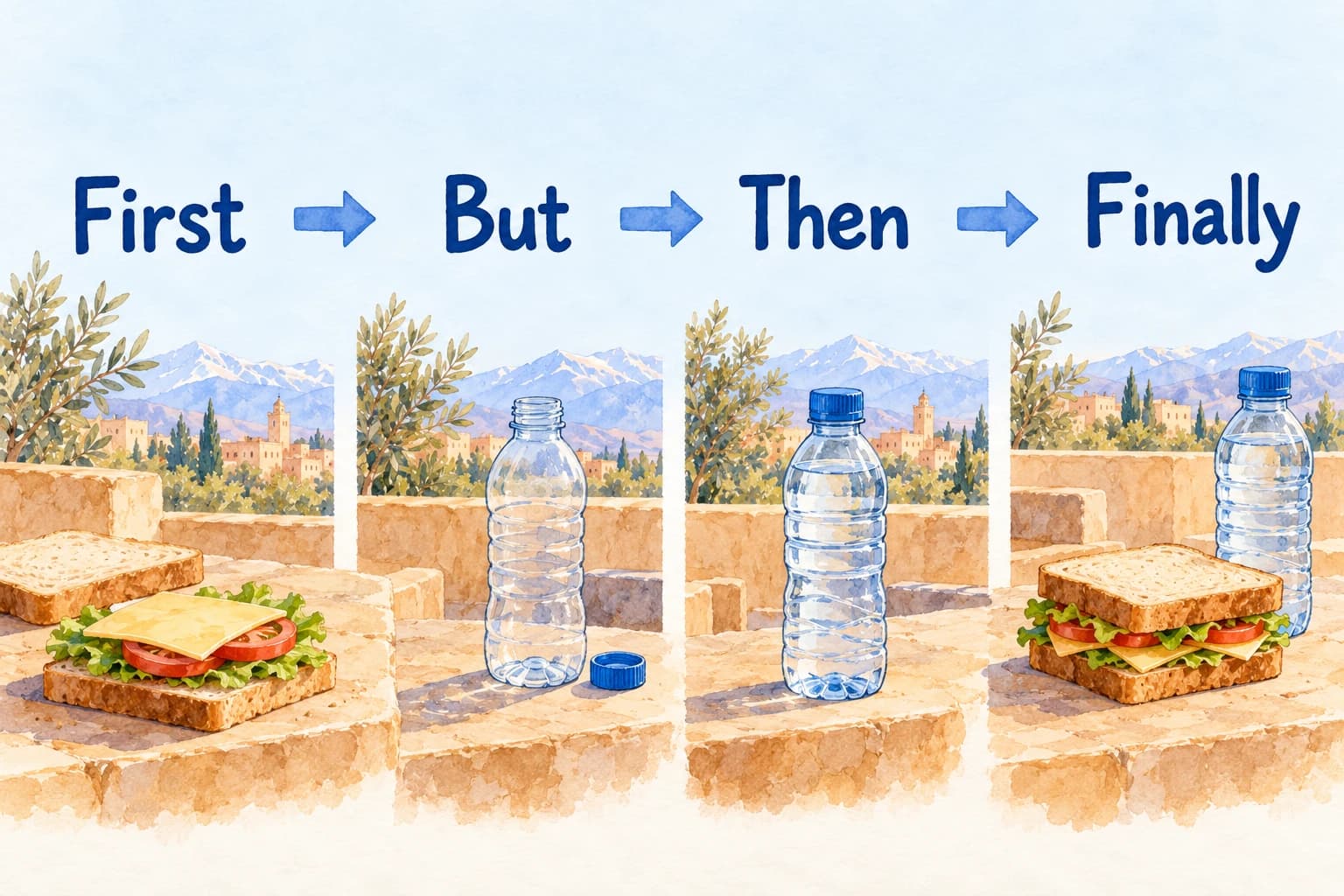
Read the captions in their numbered order and notice what changes. First introduces the beginning, but signals a problem or contrast, then moves the action forward, and finally marks the outcome. Nora starts with an empty bottle and finishes with water for lunch.

Connect captions into one story
Sequence words help you follow time: first, then and finally. But introduces a contrast: I've got an apple, but I haven't got water. A pronoun can replace a repeated name, so identify who she or he refers to before answering.
A story gives events in a sequence, while a shopping list groups items. Read all four captions before deciding how the problem is solved. The last event may explain why an earlier problem no longer matters. Use the text's words for possessions and distinguish offering from taking.
Sequence words and the changing situation
| Caption | Link | Event |
|---|---|---|
| 1 | First | Nora opens her lunch bag. |
| 2 | But | She notices a missing drink. |
| 3 | Then | A teacher helps. |
| 4 | Finally | Nora fills her bottle. |
Read Nora's four-caption lunch story
Read and explain this example
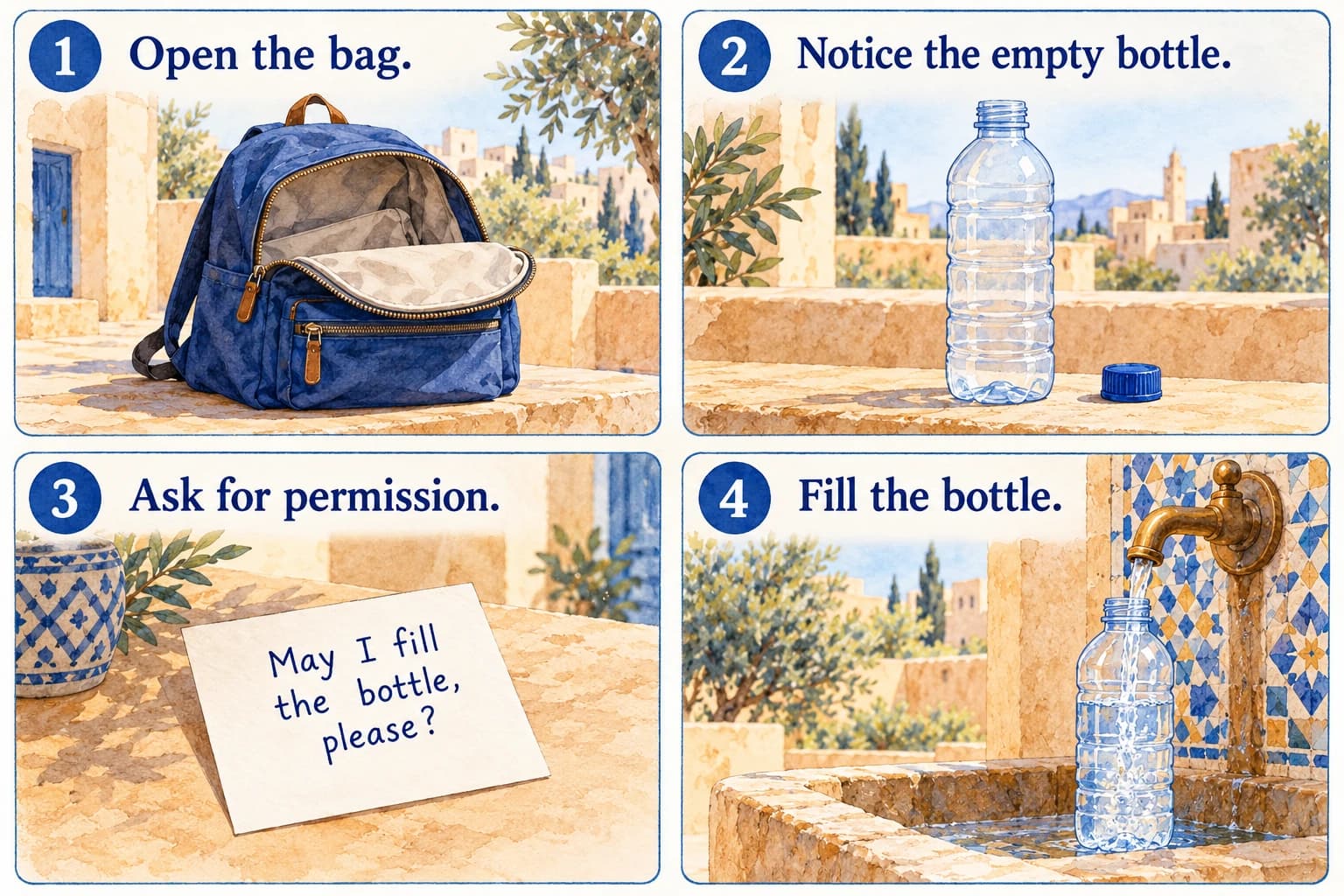
1. First, Nora opens her lunch bag. She's got a cheese sandwich and an apple. 2. But she hasn't got a drink. Her empty bottle is in her school bag. 3. Then she asks the teacher, Can I fill my bottle, please? The teacher says yes and points to the drinking-water tap. 4. Finally, Nora fills her bottle and sits with her friends. Now she's got water with her lunch.
Distinguish the beginning from the outcome
A detail can be true at one moment and false later. At first, Nora has no drink because her bottle is empty. After she asks permission and fills it, she has water. If a question includes at the beginning or at the end, use that time clue. It tells you which caption supplies the answer. The action of asking also matters: she does not simply leave the room without permission in this story.
Remember
The story has written captions without accompanying pictures. Answer from the words you can read. Hasn't got a drink at first does not mean she never gets a drink.
Step by step
Put the idea into practice
- Name the person and the problem in the opening captions.
- Find the action that changes the situation.
- Answer using the caption that matches the time named in the question.
Frequently asked questions
How do I follow a story told in short captions?
Does every caption have to begin with a sequence word?
What does a caption do?
Quiz: 1 questions
1 questions are randomly selected from this lesson’s 1-question bank. Choose one answer for each question and get an immediate explanation.
Q1Why does Nora ask the teacher?
Incorrect answer
Her question is Can I fill my bottle, please?
Correct answer: To get permission to fill her bottle
Her question is Can I fill my bottle, please?
Your score
0/1
Start with the worked examples
Read the lesson in small sections. Write your own example for each rule and try the Easy exercises before returning to the quiz.
Review: 1 missed question
Why does Nora ask the teacher?
Correct answerTo get permission to fill her bottle
Her question is Can I fill my bottle, please?
Exercises with answers
4 exercises, from easy practice to challenges. Try each one yourself, then reveal the answer and explanation.
Exercise 1
EasyWhat has Nora got at the beginning?
Answer and explanation
She has got a cheese sandwich and an apple. Her bottle is empty, so it is not yet a drink.
Exercise 2
IntermediateHow does Nora get water?
Answer and explanation
She asks permission, then fills her bottle at the drinking-water tap.
Exercise 3
ChallengePut these in order: fills the bottle; opens the lunch bag; asks the teacher.
Answer and explanation
Opens the lunch bag → asks the teacher → fills the bottle. The captions show this sequence.
Exercise 4
IntermediateWhy can Nora say she has water at the end although she had no drink at first?
Answer and explanation
She asks permission and fills her empty bottle at the drinking-water tap. The events change what she has; the opening and closing details are not contradictory.