
Unit 2: This is our school! School objects and places
This is my book. There are two windows. The first sentence identifies an object; the second tells us what is in a room. In English 1AC Unit 2, This is our school!, learn school vocabulary, demonstratives and there is/there are. You will describe a classroom, read a timetable and use helpful classroom expressions.
By the end of this lesson, you can
- Name school objects, places and subjects
- Choose this, that, these or those by number and distance
- Describe a classroom with there is and there are
- Read a simple timetable and ask classroom questions
- Write a short description of a school
Before you startAm, is, are, have and has · Days, numbers and the possessive adjectives my and your
What are common school objects in English?
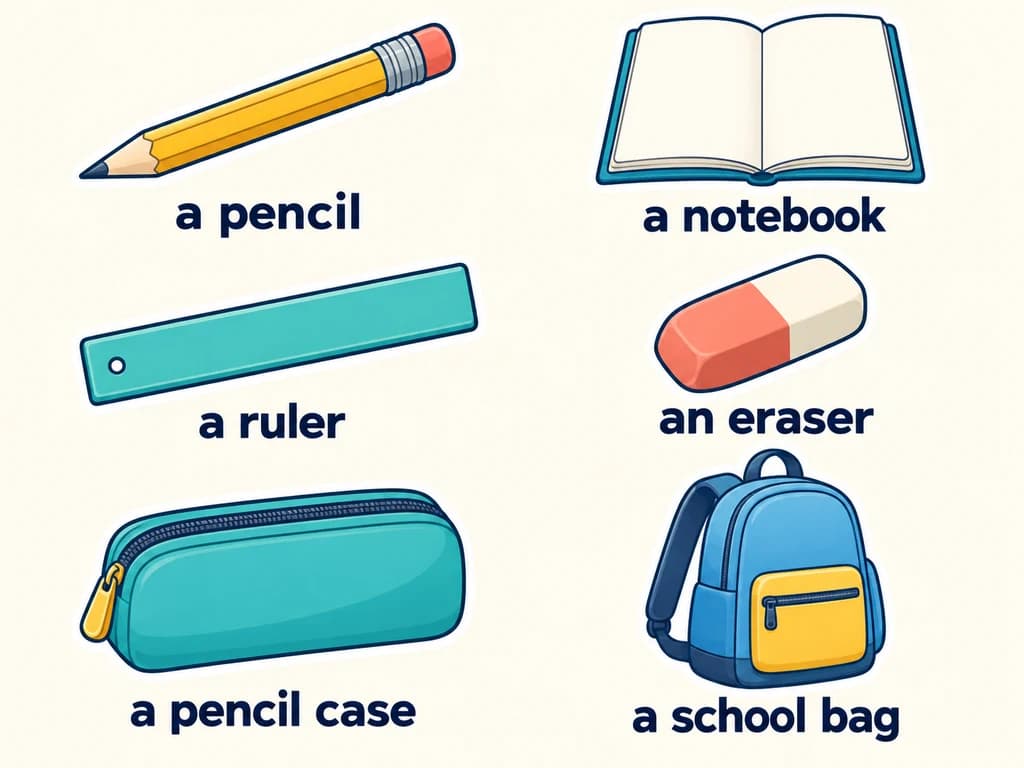
| Object | What you use it for | Example |
|---|---|---|
| a book | Reading | This is my book. |
| a notebook | Writing notes | I have a notebook. |
| a pen / a pencil | Writing or drawing | This is a pencil. |
| an eraser | Removing pencil marks | I have an eraser. |
| a ruler | Drawing straight lines | My ruler is blue. |
| a pencil case | Keeping pens and pencils | This is my pencil case. |
| a backpack / school bag | Carrying your things | My backpack is green. |
| a desk / a chair | Working / sitting | There is a chair. |
| a board | Showing words to the class | Look at the board. |
| a pencil sharpener | Making a pencil sharp | I have a pencil sharpener. |
You usually read printed text in a book and write your own work in a notebook. Eraser is also called rubber in British English. For more than one object, usually add s: one book, two books. Use a or an with a singular countable noun: a pencil, an eraser. Do not put a before a plural noun.
How do you choose this, that, these or those?
Definition
Demonstratives : This, that, these and those identify people or things. Choose by number, one or more than one, and distance from the speaker, near or far.
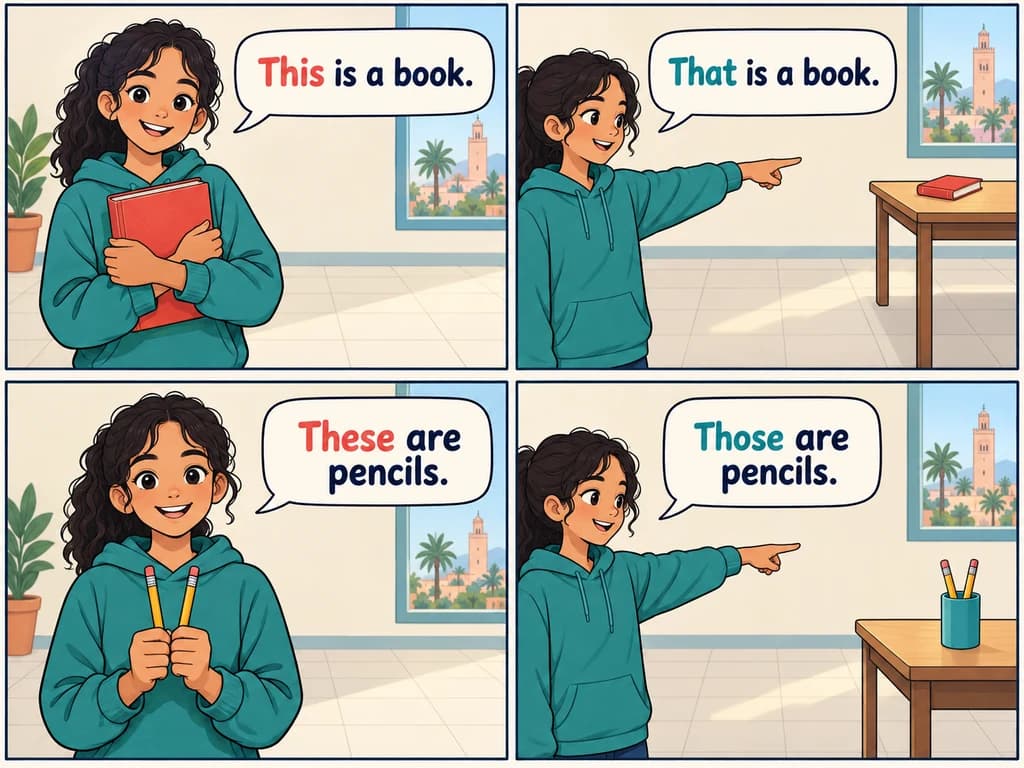
| Distance from the speaker | One object | More than one object |
|---|---|---|
| Near | This is a book. | These are pencils. |
| Far | That is a book. | Those are pencils. |
Step by step
Choose a demonstrative
- Count the objects: one or several?
- Check their distance from the person speaking.
- Use this or that for one object; these or those for several.
- Match the verb and noun: This is a pen. These are pens.
One distant notebook becomes two
That is a red notebook. Now there are two notebooks in the same distant place.
- Change that to those.
- Change is to are and make notebook plural.
- Say Those are two red notebooks. The adjective red stays the same.
Remember
Distance depends on the speaker. A book can be near your partner but far from you. This is identifies something; there is tells us that something is present.
To check ownership, ask Is this your pen? Answer Yes, it is or No, it isn’t. For several objects, ask Are these your books? Answer Yes, they are or No, they aren’t.
What is the difference between there is and there are?
Definition
There is / There are : Use these expressions to say what is present in a place. In these examples, there is introduces one thing and there are introduces more than one.
| Form | Singular | Plural |
|---|---|---|
| Statement | There is a board. | There are three windows. |
| Negative | There isn’t a computer. | There aren’t any computers. |
| Question | Is there a computer? | Are there any computers? |
| Positive answer | Yes, there is. | Yes, there are. |
| Negative answer | No, there isn’t. | No, there aren’t. |
Any often appears with plural nouns in questions and negatives: Are there any books? There aren’t any books. To ask for a number, use How many plus a plural noun: How many chairs are there? There are twelve chairs.
What places can you find in a school?
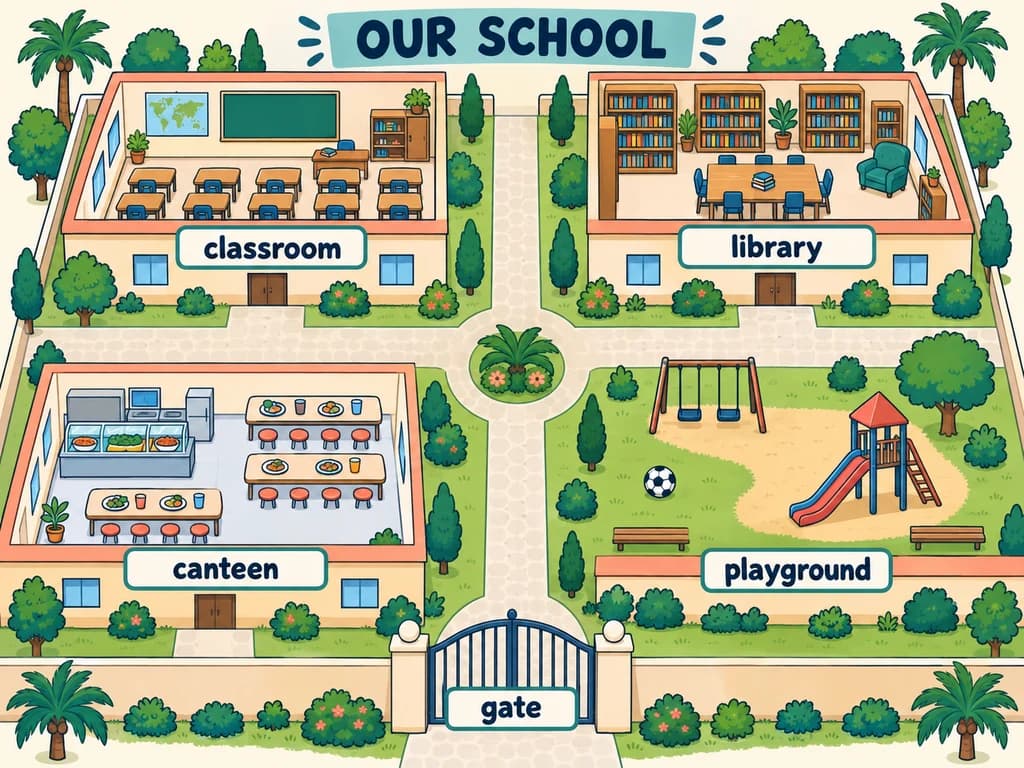
| Place | An activity or purpose |
|---|---|
| classroom | We study in the classroom. |
| library | We read and borrow books. |
| science lab | We study science. |
| computer room | We use computers. |
| playground / courtyard | We meet and play during breaks. |
| gym | We do indoor sports. |
| school office | School staff work here. |
| canteen / cafeteria | We eat lunch here. |
| gate | We enter and leave the school here. |
The picture shows an imaginary school. Find the classroom, library, canteen, playground and gate. Not every school has all these places. Describe the places that your own school has, or say that you are describing an imaginary school. A library lends books; a bookshop sells them.
How do you name school subjects in English?
| Subject | What you might study |
|---|---|
| English / Arabic / French | A language |
| maths | Numbers, shapes and calculations |
| science | Living things, matter and experiments |
| history | The past |
| geography | Places and environments |
| computer science | Computers and programming |
| art | Drawing and creating |
| PE: physical education | Movement and sport |
Language names begin with capitals: English, Arabic, French. Other subject names such as maths do not usually need capitals in a sentence. Maths is common in British English; math is common in American English. Ask What’s your favourite subject? Answer My favourite subject is science.
How do you read a school timetable?
| Day | 9:00 | 10:00 |
|---|---|---|
| Monday | English | maths |
| Tuesday | Arabic | science |
| Thursday | French | PE |
When do we have English? We have English on Monday at nine. What do we have on Tuesday at ten? We have science. Use on before a day and at before a time. The next unit explains more ways to tell the time.
Use I, you, we or they plus a base verb for regular school activities: We read. We write. We study English. Learn listen to the teacher, speak English, draw a picture and use a computer as complete phrases. Keep to in listen to the teacher.
Which classroom expressions help you learn?
| Situation | Useful expression |
|---|---|
| You do not understand | I don’t understand. |
| You need repetition | Can you repeat, please? |
| You need a word explained | What does this word mean? |
| You want to borrow a ruler | Can I borrow your ruler, please? |
| The teacher asks you to get a book | Take out your book. |
| The teacher asks you to return a notebook to your bag | Put away your notebook. |
| The teacher asks you to submit your work | Hand in your work. |
An instruction can start with a verb: Open your book. A negative instruction starts with Don’t plus a base verb: Don’t run in the classroom. Say please when making a polite request and thank someone who helps you.
Mini-project: give a short school tour
Step by step
Prepare your tour
- Start with This is our school.
- Name two places and two classroom objects.
- Use there is and there are to describe what is present.
- Add one activity and one subject with a day.
- Show a simple drawing. Let your partner ask Is there…? or How many…?
Model: This is our school. There is a library. There are twelve desks in our classroom. We read in the library. We have English on Monday. Replace the details with your own. Check singular and plural forms before presenting.
Frequently asked questions
What does English 1AC Unit 2 cover?
What is the difference between this and these?
When do I use there is and there are?
How do I describe my classroom in English?
Do I say on Monday or in Monday?
Quiz: 20 questions
20 questions are randomly selected from this lesson’s 24-question bank. Choose one answer for each question and get an immediate explanation.
Q1Which object removes pencil marks?
Incorrect answer
An eraser removes marks made by a pencil.
Correct answer: An eraser
An eraser removes marks made by a pencil.
Q2Choose the correct phrase.
Incorrect answer
Use an before the vowel sound at the start of eraser.
Correct answer: an eraser
Use an before the vowel sound at the start of eraser.
Q3One book is in your hand. Say…
Incorrect answer
This identifies one object near the speaker.
Correct answer: This is a book.
This identifies one object near the speaker.
Q4Two pencils are near you. Say…
Incorrect answer
These is for plural objects near the speaker.
Correct answer: These are pencils.
These is for plural objects near the speaker.
Q5One bag is far from you. Say…
Incorrect answer
That identifies one object far from the speaker.
Correct answer: That is a bag.
That identifies one object far from the speaker.
Q6Several chairs are far away. Choose…
Incorrect answer
Those identifies several distant things.
Correct answer: those
Those identifies several distant things.
Q7Complete: These … my books.
Incorrect answer
These is plural and takes are.
Correct answer: are
These is plural and takes are.
Q8Complete: There … a board.
Incorrect answer
A board is singular, so use there is.
Correct answer: is
A board is singular, so use there is.
Q9Complete: There … four windows.
Incorrect answer
Four windows is plural, so use there are.
Correct answer: are
Four windows is plural, so use there are.
Q10Choose a correct question.
Incorrect answer
Use Is there with the singular noun a library.
Correct answer: Is there a library?
Use Is there with the singular noun a library.
Q11Are there any computers? No, …
Incorrect answer
Match the plural question with No, there aren’t.
Correct answer: there aren’t.
Match the plural question with No, there aren’t.
Q12Complete: How many … are there?
Incorrect answer
How many is followed by a plural countable noun.
Correct answer: chairs
How many is followed by a plural countable noun.
Q13Where can you borrow books?
Incorrect answer
A library provides books to read or borrow.
Correct answer: In a library
A library provides books to read or borrow.
Q14Which subject is about numbers and shapes?
Incorrect answer
Maths includes numbers, shapes and calculations.
Correct answer: Maths
Maths includes numbers, shapes and calculations.
Q15Complete: We have English … Monday.
Incorrect answer
Use on before a day of the week.
Correct answer: on
Use on before a day of the week.
Q16Complete: We start … nine o’clock.
Incorrect answer
Use at before a clock time.
Correct answer: at
Use at before a clock time.
Q17Which phrase correctly uses listen?
Incorrect answer
Learn listen to as a phrase before the person speaking.
Correct answer: listen to the teacher
Learn listen to as a phrase before the person speaking.
Q18Which is a polite request?
Incorrect answer
Can I… please? politely asks for permission.
Correct answer: Can I borrow your ruler, please?
Can I… please? politely asks for permission.
Q19Hand in your work means…
Incorrect answer
Hand in means submit work to the teacher.
Correct answer: give it to the teacher.
Hand in means submit work to the teacher.
Q20Choose the negative instruction.
Incorrect answer
A negative instruction uses Don’t plus a base verb.
Correct answer: Don’t run!
A negative instruction uses Don’t plus a base verb.
Q21Is this your pen? Yes, …
Incorrect answer
It refers to the single pen identified by this.
Correct answer: it is.
It refers to the single pen identified by this.
Q22Which word needs a capital in a sentence?
Incorrect answer
Language names such as English begin with capitals.
Correct answer: English
Language names such as English begin with capitals.
Q23What is the plural of That is a book?
Incorrect answer
That changes to those and is changes to are.
Correct answer: Those are books.
That changes to those and is changes to are.
Q24Where do students eat in the pictured school?
Incorrect answer
The school map shows tables and meals in the canteen.
Correct answer: In the canteen
The school map shows tables and meals in the canteen.
Your score
0/20
Start with the worked examples
Read the lesson in small sections. Write your own example for each rule and try the Easy exercises before returning to the quiz.
Review: 20 missed questions
Which object removes pencil marks?
Correct answerAn eraser
An eraser removes marks made by a pencil.
Choose the correct phrase.
Correct answeran eraser
Use an before the vowel sound at the start of eraser.
One book is in your hand. Say…
Correct answerThis is a book.
This identifies one object near the speaker.
Two pencils are near you. Say…
Correct answerThese are pencils.
These is for plural objects near the speaker.
One bag is far from you. Say…
Correct answerThat is a bag.
That identifies one object far from the speaker.
Several chairs are far away. Choose…
Correct answerthose
Those identifies several distant things.
Complete: These … my books.
Correct answerare
These is plural and takes are.
Complete: There … a board.
Correct answeris
A board is singular, so use there is.
Complete: There … four windows.
Correct answerare
Four windows is plural, so use there are.
Choose a correct question.
Correct answerIs there a library?
Use Is there with the singular noun a library.
Are there any computers? No, …
Correct answerthere aren’t.
Match the plural question with No, there aren’t.
Complete: How many … are there?
Correct answerchairs
How many is followed by a plural countable noun.
Where can you borrow books?
Correct answerIn a library
A library provides books to read or borrow.
Which subject is about numbers and shapes?
Correct answerMaths
Maths includes numbers, shapes and calculations.
Complete: We have English … Monday.
Correct answeron
Use on before a day of the week.
Complete: We start … nine o’clock.
Correct answerat
Use at before a clock time.
Which phrase correctly uses listen?
Correct answerlisten to the teacher
Learn listen to as a phrase before the person speaking.
Which is a polite request?
Correct answerCan I borrow your ruler, please?
Can I… please? politely asks for permission.
Hand in your work means…
Correct answergive it to the teacher.
Hand in means submit work to the teacher.
Choose the negative instruction.
Correct answerDon’t run!
A negative instruction uses Don’t plus a base verb.
Exercises with answers
14 exercises, from easy practice to challenges. Try each one yourself, then reveal the answer and explanation.
Exercise 1
EasyWhat do you use to remove pencil marks, draw straight lines and carry your school things?
Answer and explanation
An eraser, a ruler and a school bag or backpack. Use an before eraser because it starts with a vowel sound.
Exercise 2
EasyChoose this, that, these or those: one book in your hand; two pencils in your hand; one distant bag; three distant chairs.
Answer and explanation
This; these; that; those. Check the number first, then the distance from you, the speaker.
Exercise 3
EasyComplete: This … a pen. These … books. There … a board. There … five chairs.
Answer and explanation
Is; are; is; are. One pen and one board are singular; books and five chairs are plural.
Exercise 4
EasyWhere can you borrow books, study science experiments and eat lunch? Use library, canteen and science lab.
Answer and explanation
In the library; in the science lab; in the canteen. Match each place to its main purpose in these examples.
Exercise 5
EasyWhich instruction means get your book from your bag, return your notebook to your bag and give your work to the teacher?
Answer and explanation
Take out your book. Put away your notebook. Hand in your work. Learn each phrase with its action.
Exercise 6
IntermediateKeep the same distance and make plural: This is a book. That is a pencil. This is a red bag.
Answer and explanation
These are books. Those are pencils. These are red bags. The adjective red does not change.
Exercise 7
IntermediateA classroom has one board, ten desks and two windows. It has no computers. Write four sentences with there is/are.
Answer and explanation
There is a board. There are ten desks. There are two windows. There aren’t any computers. Use any in the last negative sentence.
Exercise 8
IntermediateAsk about a library and any computers. Answer yes for the library and no for computers.
Answer and explanation
Is there a library? Yes, there is. Are there any computers? No, there aren’t. Library is singular and computers is plural.
Exercise 9
IntermediateAsk how many chairs are in a room. There are twelve. Write the question and answer.
Answer and explanation
How many chairs are there? There are twelve chairs. The noun after How many is plural.
Exercise 10
IntermediateUse the lesson timetable. When do we have English? What do we have on Tuesday at ten? When do we have PE?
Answer and explanation
English is on Monday at nine. We have science on Tuesday at ten. PE is on Thursday at ten. Use on with the day and at with the time.
Exercise 11
IntermediateCorrect: These is my books. There are a board. We listen the teacher. We have english in Monday.
Answer and explanation
These are my books. There is a board. We listen to the teacher. We have English on Monday. Check number, listen to, capitals and on.
Exercise 12
IntermediateAsk a partner to read: There is a desk. There are two books on the desk. There is a chair. Hide the text and draw what you hear.
Answer and explanation
Your drawing should show one desk, two books on it and one chair. The colours and the chair’s position are not specified, so those details are free.
Exercise 13
ChallengeWrite five sentences about a real or imaginary school. Include a place, two quantities and an activity.
Answer and explanation
Model: This is our school. There is a library. There are ten desks in our classroom. There are two windows. We read in the library. Your details may be different.
Exercise 14
ChallengeYou hold one pen. Your partner’s two books are on a distant desk. Ask if the pen is theirs, identify the books and ask to borrow a ruler.
Answer and explanation
Is this your pen? Those are your books. Can I borrow your ruler, please? This refers to the nearby pen; those refers to the distant books.