



English 1AC entrance test: a beginner self-check
This short entrance self-check helps you choose a starting lesson. Try the reading and language tasks before opening the answers. It is original practice for beginners and does not provide an official level certificate or a school placement result.

Ta fiche PDF illustrée
Le support, la méthode et les exercices corrigés à imprimer.
By the end of this lesson, you can
- Use a diagnostic to choose where to start
- Match a difficulty with a useful next step
- Learn more from the mistake than from a score
Before you startRead simple English sentences; use the starter lesson if you need help with names or numbers.
Un bon cours, ça se partage.
How can I check my starting skills in English 1AC?
Try a short reading, a language task and a personal writing task before opening the answers. Group mistakes by skill, then choose a lesson that addresses them. This entrance self-check supports revision; it does not certify an A1 level or assign an official school placement.

Use a diagnostic to choose where to start
A diagnostic task finds what you already know and what needs work. Read the instructions, answer without help on the first attempt and note the type of mistake. A wrong answer is useful if it tells you which skill to practise next.
Use three stages: read a simple profile, complete basic language and write a few sentences. If names and numbers are difficult, start with Welcome to English. If be and possessives cause mistakes, review the introductions unit. If reading details is difficult, practise finding evidence in the classroom text.
Match a difficulty with a useful next step
| Skill to review | Suggested starting point | Next action |
|---|---|---|
| Names, spelling, numbers | Welcome to English | Read and spell a name. |
| Be and possessions | Introductions and family | Choose am/is/are and my/her. |
| Reading evidence | Classroom reading | Find one sentence supporting an answer. |
Read Sami's short profile
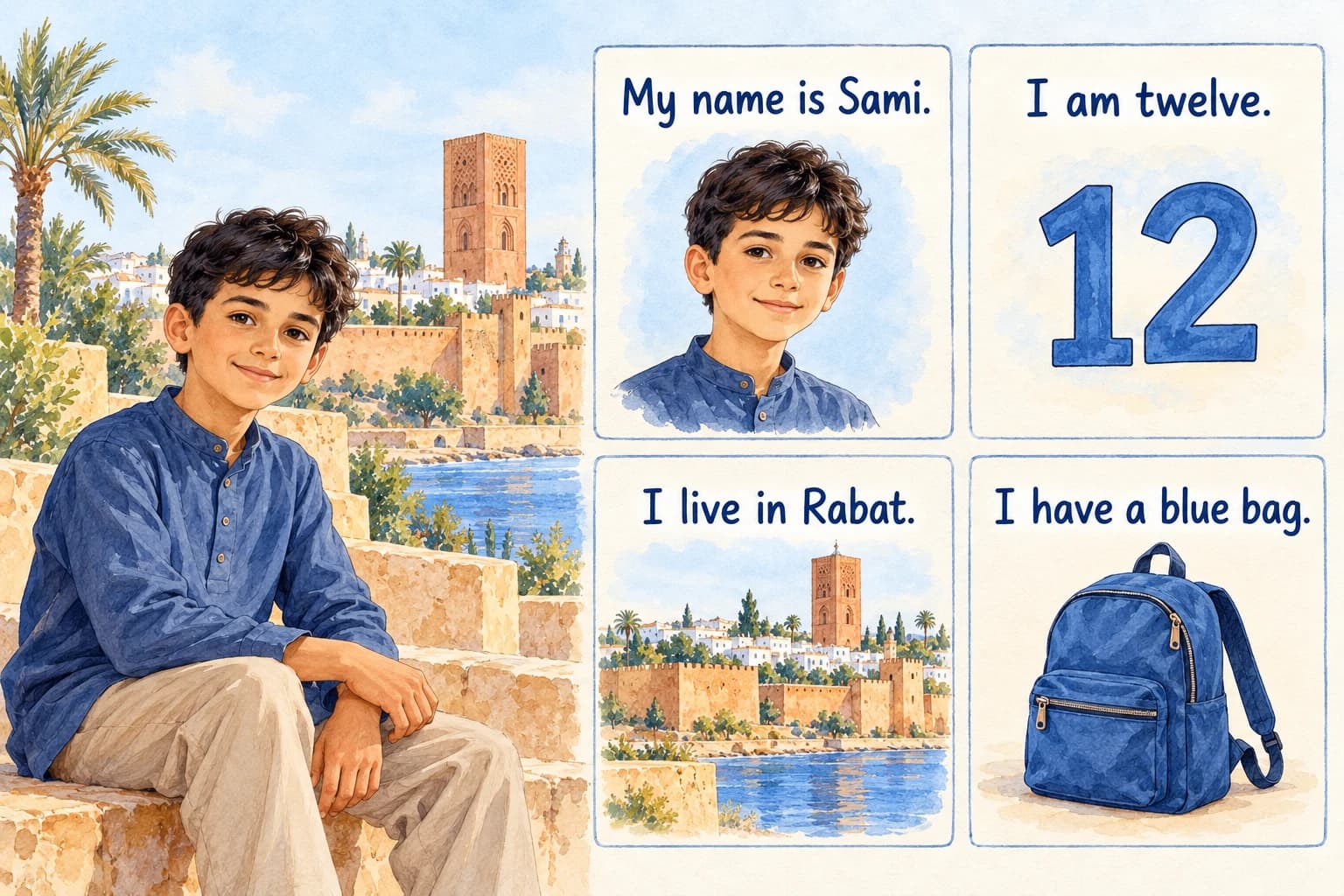
Read and explain this example
Read: My name is Sami. I am twelve. My sister is Aya. She is ten. We live in Rabat. I have a blue bag and two green notebooks. Our school starts at eight. On Friday, I play chess after school.
Learn more from the mistake than from a score
Two learners can get the same number of answers wrong for different reasons. One may read the text accurately but confuse am and has; another may know the grammar but miss names and ages in the profile. A single total hides that difference. After checking, label the kind of error and choose one practical action. For example, revisit age with be, or practise locating a number next to the correct person's name.

Remember
Answer using this text rather than your own life. For the personal writing task, use your own details or an invented student. There is no official pass mark for this self-check.
Step by step
Put the idea into practice
- Attempt each task without looking at the corrections first.
- Mark the detail or rule that explains each changed answer.
- Choose one starting lesson and retry a similar question after studying it.
Frequently asked questions
How can I check my starting skills in English 1AC?
What is the pass mark for this entrance self-check?
Does this test certify an A1 level?
Quiz: 1 questions
1 questions are randomly selected from this lesson’s 1-question bank. Choose one answer for each question and get an immediate explanation.
Q1Which sentence gives an age correctly?
Incorrect answer
English uses be for age.
Correct answer: I am twelve.
English uses be for age.
Your score
0/1
Start with the worked examples
Read the lesson in small sections. Write your own example for each rule and try the Easy exercises before returning to the quiz.
Review: 1 missed question
Which sentence gives an age correctly?
Correct answerI am twelve.
English uses be for age.
Exercises with answers
4 exercises, from easy practice to challenges. Try each one yourself, then reveal the answer and explanation.
Exercise 1
EasyHow old is Sami? Who is Aya? What colour is his bag? When does school start?
Answer and explanation
Sami is twelve. Aya is his sister. His bag is blue. School starts at eight. Each detail is stated in the profile.
Exercise 2
IntermediateComplete: I … twelve. She … a sister. These … my books. Aya is his sister: … name is Aya.
Answer and explanation
Am; has; are; her. Use be for age, has for she, are for plural books and her for Aya.
Exercise 3
ChallengeWrite four sentences about a student: name, age, possession and routine.
Answer and explanation
Example: My name is Nour. I am twelve. I have a green bag. I read after school. Check be for age, capital I, complete sentences and an ordinary verb for a routine.
Exercise 4
IntermediateA learner understands Sami's age but writes I have twelve years. What should they review first?
Answer and explanation
Review the use of be for age: I am twelve or I am twelve years old. The reading detail was understood; the difficulty is the English sentence pattern.