
Welcome to English: greetings, alphabet and classroom language
Hello! My name is Lina. Can you repeat, please? These short sentences help you join your first English lesson. In this English 1AC semester 1 lesson, learn to greet someone, spell your name, use numbers from 0 to 20, name the days and follow classroom instructions. Read each example aloud, then try it with a partner.
By the end of this lesson, you can
- Greet someone and introduce yourself
- Spell a name using the English alphabet
- Say numbers from 0 to 20 and the days of the week
- Follow classroom instructions and ask for help politely
Before you startNo previous English lesson is needed · Bring a notebook and be ready to practise aloud
How do you greet someone in English?
Use Hello or Hi when you meet someone. Use Goodbye or See you when you leave. A greeting is a small sentence that starts a conversation.
| Situation | What you can say |
|---|---|
| You meet a classmate | Hello! / Hi! |
| You arrive in the morning | Good morning! |
| You arrive in the afternoon | Good afternoon! |
| You meet someone in the evening | Good evening! |
| You leave | Goodbye! / See you! |
| You go to bed | Good night! |
Remember
Good evening is a greeting. Good night is usually a goodbye at night or something you say before going to bed.
What is your name?
A first conversation
Aya: Hello! My name is Aya. What’s your name? Adam: I’m Adam. Nice to meet you! Aya: Nice to meet you too!
- My name is Aya and I’m Aya both introduce Aya.
- What’s means What is. I’m means I am.
- Ask How are you? to find out how someone feels. A simple answer is I’m fine, thank you.
What do common classroom instructions mean?
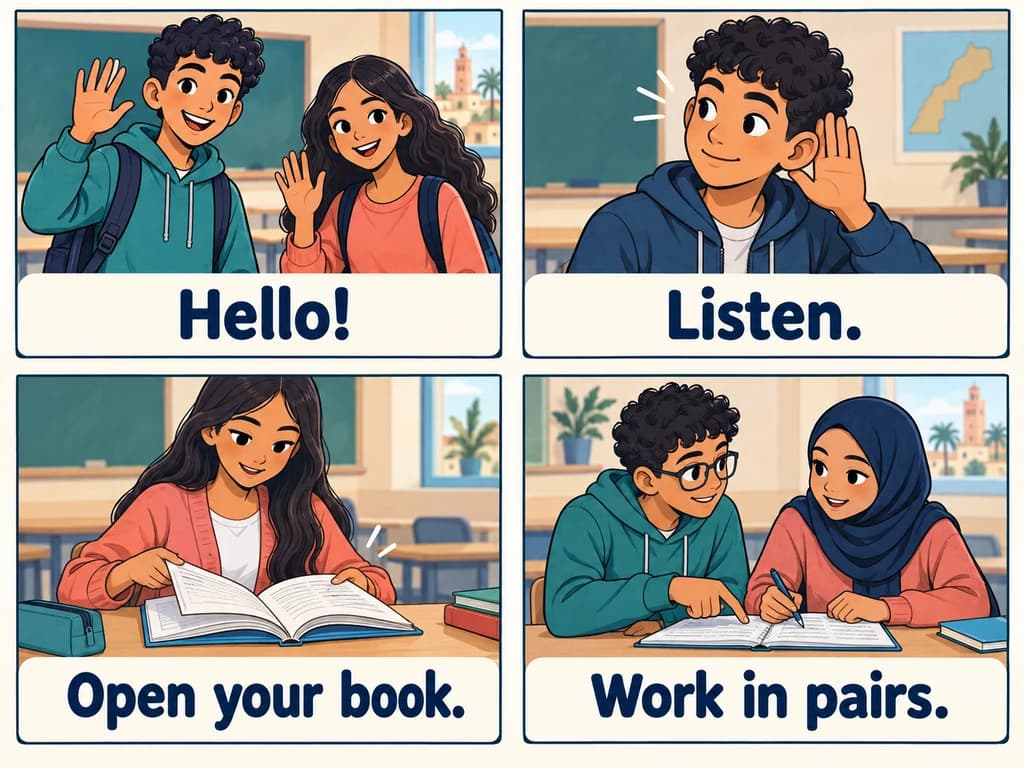
| Instruction | What to do |
|---|---|
| Listen | Use your ears and pay attention |
| Look | Use your eyes |
| Read | Look at the words and understand them |
| Write | Put words on paper |
| Repeat | Say the words again |
| Open your book | Open the pages of your book |
| Close your book | Shut your book |
| Stand up | Get on your feet |
| Sit down | Take your seat |
| Work in pairs | Work with one partner |
Try an action game. One partner says an instruction and the other does the action. Change roles after four instructions. You do not need to shout: speak clearly and listen carefully.
How can you ask for help in English?
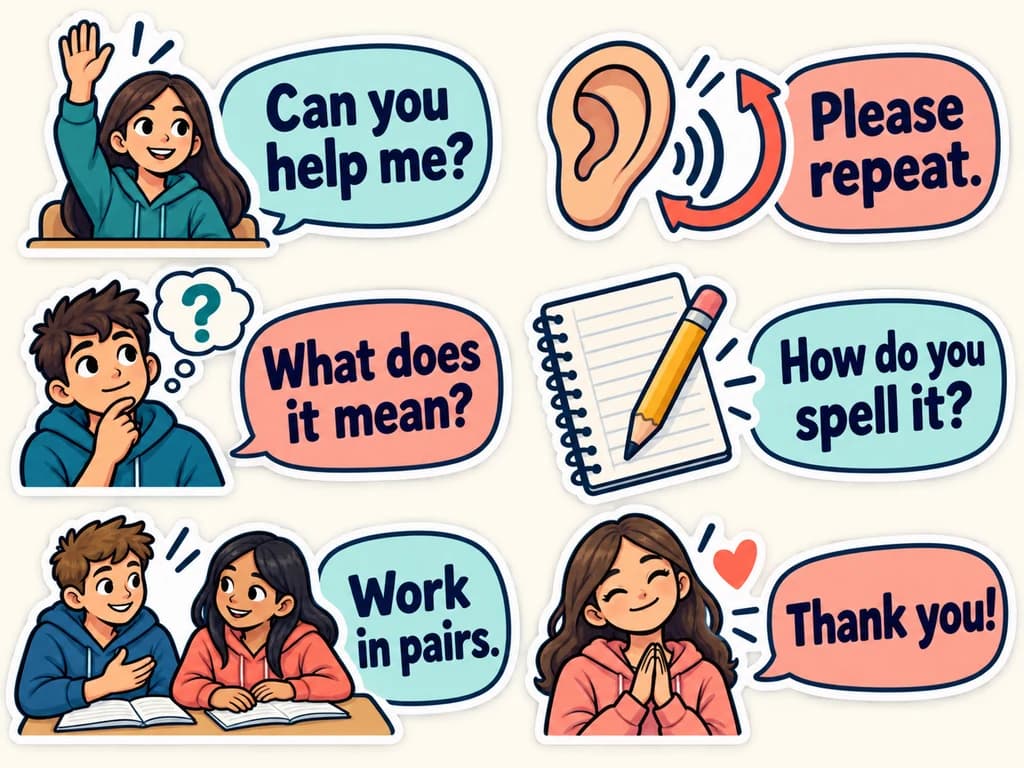
| You need to… | Useful sentence |
|---|---|
| Hear something again | Can you repeat, please? |
| Hear slower speech | Can you speak slowly, please? |
| Ask about a word | What does this word mean? |
| Ask for help | Can you help me, please? |
| Explain a problem | I don’t understand. |
| Thank someone | Thank you! |
Step by step
Practise one useful phrase
- Choose one phrase from the picture.
- Read it slowly, then say it without looking.
- Use it during a short conversation with your partner.
How do you spell your name with the English alphabet?
The English alphabet has 26 letters. To spell a name, say its letters one by one. How do you spell your name? S-A-L-M-A. Write a capital letter at the start of a name: Salma.
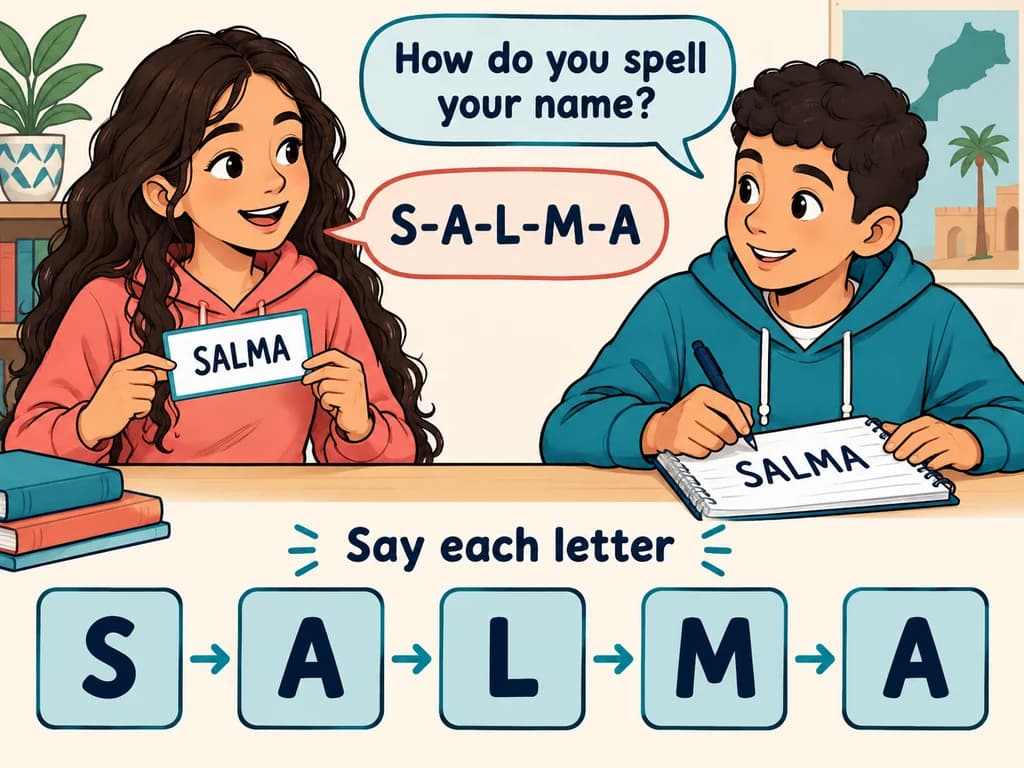
| Letter group | Letters to practise |
|---|---|
| Start here | A B C D E F G |
| Next group | H I J K L M N |
| Next group | O P Q R S T U |
| Last group | V W X Y Z |
Listen to your teacher’s letter names and repeat them. Practise E and I separately, then G and J. They can sound confusing at first. You may hear Z called zed in British English or zee in American English; both are English letter names.
Check a spelling
A: What’s your name? B: My name is Omar. A: How do you spell it? B: O-M-A-R.
- The listener writes the letters.
- Both partners check the written name together.
What are the English numbers from 0 to 20?
| Number | Word | Number | Word |
|---|---|---|---|
| 0 | zero | 11 | eleven |
| 1 | one | 12 | twelve |
| 2 | two | 13 | thirteen |
| 3 | three | 14 | fourteen |
| 4 | four | 15 | fifteen |
| 5 | five | 16 | sixteen |
| 6 | six | 17 | seventeen |
| 7 | seven | 18 | eighteen |
| 8 | eight | 19 | nineteen |
| 9 | nine | 20 | twenty |
| 10 | ten |
Cover the word column and name each number. Then ask a partner to say five numbers while you write the digits. Check twelve, thirteen and fifteen carefully: their spelling needs practice.
What are the days of the week in English?
Learn this order: Monday, Tuesday, Wednesday, Thursday, Friday, Saturday, Sunday. Every day name starts with a capital letter. Ask What day is it today? Answer It’s Monday. Use the actual day when you practise.
Remember
Tuesday and Thursday are different days. Tuesday comes after Monday. Thursday comes after Wednesday. Write both words and point to them as your partner reads.
Reading and speaking: a first day at school
Lina: Hello! I’m Lina. I’m twelve. It’s Monday. This is my English class. Teacher: Good morning! Open your book, please. Lina, read with Adam. Lina: Can you repeat, please? Teacher: Read with Adam. Work in pairs.
Check your understanding: What is the student’s name? Lina. How old is she? Twelve. Who is her partner? Adam. Find the words that support each answer. For listening practice, let a partner read the dialogue while you close your notebook, then answer again.
Mini-project: make your first English introduction card
Step by step
Make and use your card
- Write a greeting: Hello!
- Add your name: My name is…
- Add your age: I’m… years old.
- Write today’s day: It’s…
- Read your card to a partner. Ask their name and how to spell it.
Before you finish, check the capital I, the first letter of your name and the day name. Practise the exercises below, then try the quiz. Each attempt selects 20 questions from the 24-question bank.
Frequently asked questions
What do I learn in the first English 1AC lesson?
What is the difference between Good evening and Good night?
How do I spell my name in English?
How do I ask for help in English class?
How can I practise the alphabet at home?
Quiz: 20 questions
20 questions are randomly selected from this lesson’s 24-question bank. Choose one answer for each question and get an immediate explanation.
Q1You meet a classmate. What can you say?
Incorrect answer
Hello is a greeting for meeting someone.
Correct answer: Hello!
Hello is a greeting for meeting someone.
Q2What does What’s your name? ask for?
Incorrect answer
Answer with My name is… or I’m… and your name.
Correct answer: Your name
Answer with My name is… or I’m… and your name.
Q3Choose an answer to How are you?
Incorrect answer
How are you? asks how someone feels.
Correct answer: I’m fine, thank you.
How are you? asks how someone feels.
Q4You leave a friend. What can you say?
Incorrect answer
See you is a friendly way to say goodbye.
Correct answer: See you!
See you is a friendly way to say goodbye.
Q5You arrive in the evening. Choose a greeting.
Incorrect answer
Good evening welcomes someone in the evening.
Correct answer: Good evening!
Good evening welcomes someone in the evening.
Q6Which action goes with Listen?
Incorrect answer
Listen means pay attention to what you hear.
Correct answer: Use your ears
Listen means pay attention to what you hear.
Q7Work in pairs means work with…
Incorrect answer
A pair has two people: you and one partner.
Correct answer: one partner.
A pair has two people: you and one partner.
Q8You want to hear a sentence again. Say…
Incorrect answer
Repeat means say something again.
Correct answer: Can you repeat, please?
Repeat means say something again.
Q9How many letters are in the English alphabet?
Incorrect answer
The English alphabet has 26 letters, from A to Z.
Correct answer: 26
The English alphabet has 26 letters, from A to Z.
Q10How do you spell Omar?
Incorrect answer
Omar has four letters in this order: O, M, A, R.
Correct answer: O-M-A-R
Omar has four letters in this order: O, M, A, R.
Q11Which number is twelve?
Incorrect answer
Twelve is 12; twenty is 20 and two is 2.
Correct answer: 12
Twelve is 12; twenty is 20 and two is 2.
Q12Which word means 15?
Incorrect answer
Fifteen is the word for the number 15.
Correct answer: Fifteen
Fifteen is the word for the number 15.
Q13Which number is eighteen?
Incorrect answer
Eighteen is 18. Eight is only 8.
Correct answer: 18
Eighteen is 18. Eight is only 8.
Q14Which day comes after Monday?
Incorrect answer
Monday is followed by Tuesday.
Correct answer: Tuesday
Monday is followed by Tuesday.
Q15Which day comes after Wednesday?
Incorrect answer
Thursday comes between Wednesday and Friday.
Correct answer: Thursday
Thursday comes between Wednesday and Friday.
Q16Which sentence uses capitals correctly?
Incorrect answer
Both the word I and the name Lina need capitals.
Correct answer: I’m Lina.
Both the word I and the name Lina need capitals.
Q17Choose the correct spelling of the day.
Incorrect answer
Day names begin with a capital letter: Monday.
Correct answer: Monday
Day names begin with a capital letter: Monday.
Q18Which instruction asks you to open pages?
Incorrect answer
Open your book asks you to open its pages.
Correct answer: Open your book
Open your book asks you to open its pages.
Q19Which word makes a request polite?
Incorrect answer
Add please to a request such as Repeat, please.
Correct answer: Please
Add please to a request such as Repeat, please.
Q20Which question asks for the letters in a name?
Incorrect answer
Spelling means giving the letters in order.
Correct answer: How do you spell it?
Spelling means giving the letters in order.
Q21What is the full form of I’m?
Incorrect answer
I’m is the short form of I am.
Correct answer: I am
I’m is the short form of I am.
Q22Which day follows Saturday?
Incorrect answer
Sunday comes immediately after Saturday.
Correct answer: Sunday
Sunday comes immediately after Saturday.
Q23Choose an answer to What day is it?
Incorrect answer
It’s Friday gives the name of a day.
Correct answer: It’s Friday.
It’s Friday gives the name of a day.
Q24Someone helps you. What can you say?
Incorrect answer
Thank you politely shows that you appreciate help.
Correct answer: Thank you!
Thank you politely shows that you appreciate help.
Your score
0/20
Start with the worked examples
Read the lesson in small sections. Write your own example for each rule and try the Easy exercises before returning to the quiz.
Review: 20 missed questions
You meet a classmate. What can you say?
Correct answerHello!
Hello is a greeting for meeting someone.
What does What’s your name? ask for?
Correct answerYour name
Answer with My name is… or I’m… and your name.
Choose an answer to How are you?
Correct answerI’m fine, thank you.
How are you? asks how someone feels.
You leave a friend. What can you say?
Correct answerSee you!
See you is a friendly way to say goodbye.
You arrive in the evening. Choose a greeting.
Correct answerGood evening!
Good evening welcomes someone in the evening.
Which action goes with Listen?
Correct answerUse your ears
Listen means pay attention to what you hear.
Work in pairs means work with…
Correct answerone partner.
A pair has two people: you and one partner.
You want to hear a sentence again. Say…
Correct answerCan you repeat, please?
Repeat means say something again.
How many letters are in the English alphabet?
Correct answer26
The English alphabet has 26 letters, from A to Z.
How do you spell Omar?
Correct answerO-M-A-R
Omar has four letters in this order: O, M, A, R.
Which number is twelve?
Correct answer12
Twelve is 12; twenty is 20 and two is 2.
Which word means 15?
Correct answerFifteen
Fifteen is the word for the number 15.
Which number is eighteen?
Correct answer18
Eighteen is 18. Eight is only 8.
Which day comes after Monday?
Correct answerTuesday
Monday is followed by Tuesday.
Which day comes after Wednesday?
Correct answerThursday
Thursday comes between Wednesday and Friday.
Which sentence uses capitals correctly?
Correct answerI’m Lina.
Both the word I and the name Lina need capitals.
Choose the correct spelling of the day.
Correct answerMonday
Day names begin with a capital letter: Monday.
Which instruction asks you to open pages?
Correct answerOpen your book
Open your book asks you to open its pages.
Which word makes a request polite?
Correct answerPlease
Add please to a request such as Repeat, please.
Which question asks for the letters in a name?
Correct answerHow do you spell it?
Spelling means giving the letters in order.
Exercises with answers
14 exercises, from easy practice to challenges. Try each one yourself, then reveal the answer and explanation.
Exercise 1
EasyWhat can you say when you arrive in the morning, meet a classmate and leave school?
Answer and explanation
Good morning! Hello! Goodbye! These fit the three situations. Hi and See you are also suitable for the last two situations.
Exercise 2
EasyMatch: What’s your name? / How are you? / What day is it? Answers: I’m fine. / It’s Monday. / I’m Aya.
Answer and explanation
What’s your name? I’m Aya. How are you? I’m fine. What day is it? It’s Monday. Each answer gives the information requested.
Exercise 3
EasyWhich instruction means use your ears, put words on paper and work with one partner?
Answer and explanation
Listen; Write; Work in pairs. A pair is a group of two people, so you work with one other student.
Exercise 4
EasyWrite 3, 8, 11, 12, 15, 18 and 20 in words.
Answer and explanation
Three, eight, eleven, twelve, fifteen, eighteen, twenty. Check fifteen and eighteen against the number table.
Exercise 5
EasyPut these days in order, starting with Monday: Friday, Wednesday, Monday, Sunday, Tuesday, Saturday, Thursday.
Answer and explanation
Monday, Tuesday, Wednesday, Thursday, Friday, Saturday, Sunday. Remember that Thursday comes just before Friday.
Exercise 6
IntermediateCorrect: hello! my name is lina. i’m twelve. it’s monday.
Answer and explanation
Hello! My name is Lina. I’m twelve. It’s Monday. Sentences, names, the word I and day names need capital letters.
Exercise 7
IntermediateOrder: your / what’s / name? ; are / how / you? ; spell / how / you / do / it?
Answer and explanation
What’s your name? How are you? How do you spell it? Read each question aloud and notice the word order.
Exercise 8
IntermediateA asks How are you? B answers My name is Sami. Give a suitable answer for B, then write the question that matches My name is Sami.
Answer and explanation
B can say I’m fine, thank you. The question for My name is Sami is What’s your name? Name and feelings are different kinds of information.
Exercise 9
IntermediateWrite the separate letters in Yasmine and Omar. Ask a partner to read them and write the names.
Answer and explanation
Y-A-S-M-I-N-E and O-M-A-R. Compare your partner’s spelling with the original names and repeat any unclear letter.
Exercise 10
IntermediateRead: Hi! I’m Ines. I’m thirteen. It’s Friday. What is her name? How old is she? What day is it?
Answer and explanation
Her name is Ines. She is thirteen. It is Friday. All three answers come directly from the card.
Exercise 11
IntermediateAsk a partner to read this twice while you look away: My name is Omar. I’m fourteen. It’s Thursday. Write the name, age and day.
Answer and explanation
Omar; fourteen or 14; Thursday. The reader should pause between sentences. Swap roles and use a new name, age and day.
Exercise 12
ChallengeWrite six short turns. Include a greeting, a name question, an answer and a polite ending.
Answer and explanation
One possible dialogue: A: Hello! B: Hi! A: What’s your name? B: I’m Nour. And you? A: I’m Adam. Nice to meet you! B: Nice to meet you too! Other logical dialogues are possible.
Exercise 13
ChallengeWrite five lines: a greeting, your name, your age, today’s day and a goodbye. You may invent the details.
Answer and explanation
Model: Hello! My name is Salma. I’m twelve. It’s Tuesday. See you! Change the details for your own card and check the capitals.
Exercise 14
ChallengeComplete: Good …! (morning greeting); What’s your …?; Can you …, please? (say it again); 16 = …; the day after Monday = …; the day after Wednesday = ….
Answer and explanation
Morning; name; repeat; sixteen; Tuesday; Thursday. Say all six answers aloud, then practise any item you missed.