



Reading: a description of our classroom
Read an original classroom description, then answer questions using evidence. A description tells you what a place is like. Look for objects, numbers, colours and prepositions before you decide on an answer.

Ta fiche PDF illustrée
Le support, la méthode et les exercices corrigés à imprimer.
By the end of this lesson, you can
- Find objects, quantities and positions
- Match each question to a reading clue
- Decide whether a statement is false or not stated
Before you startRead simple English sentences; use the starter lesson if you need help with names or numbers.
Un bon cours, ça se partage.
How do I answer questions about a classroom description?
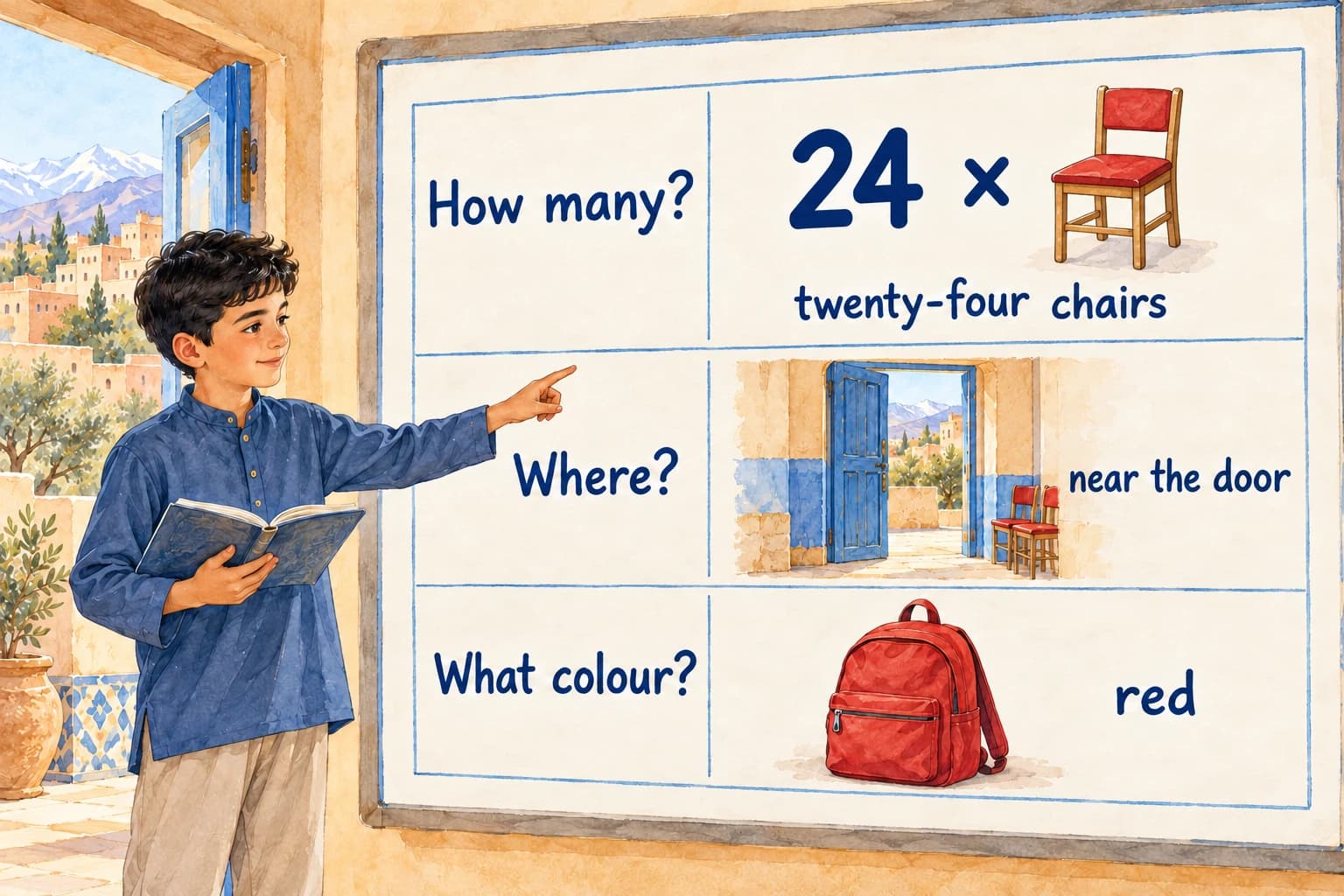
Find the detail requested by the question, then support your answer with the text. Look for numbers after how many, a position after where, and a colour after what colour. For a pronoun such as it, identify the object named earlier before answering.
Find objects, quantities and positions
Use there is for one thing and there are for several things. A place phrase tells you where: near the door, on a desk or under a chair. A pronoun such as it can refer back to an object already named. Find its noun before interpreting the sentence.
Read once for the general topic, then a second time for details. Underline the part that supports each answer. If the text does not give a detail, say it is not stated. A classroom description does not tell you automatically what the writer's favourite subject is.
Match each question to a reading clue
| Question | Reading action | Possible evidence |
|---|---|---|
| What? | Look for an object. | a map |
| Where? | Look for a place phrase. | near the door |
| How many? | Look for a number. | twelve desks |
Read: our bright classroom
Read and explain this example
Our classroom is small and bright. There are twelve desks and twenty-four chairs. A map is near the door. It is blue and green. Our teacher's desk is next to the board. There are three dictionaries on it. My red bag is under my chair. We keep the room tidy after each lesson.
Decide whether a statement is false or not stated
False and not stated mean different things. If a text says the bag is red, the claim that it is blue is false because the text contradicts it. If the text never names a favourite subject, the claim that the writer loves maths is not stated. Knowing something about a typical classroom does not make it evidence in this particular description. Return to the relevant sentence instead of adding a detail from your own classroom.
Remember
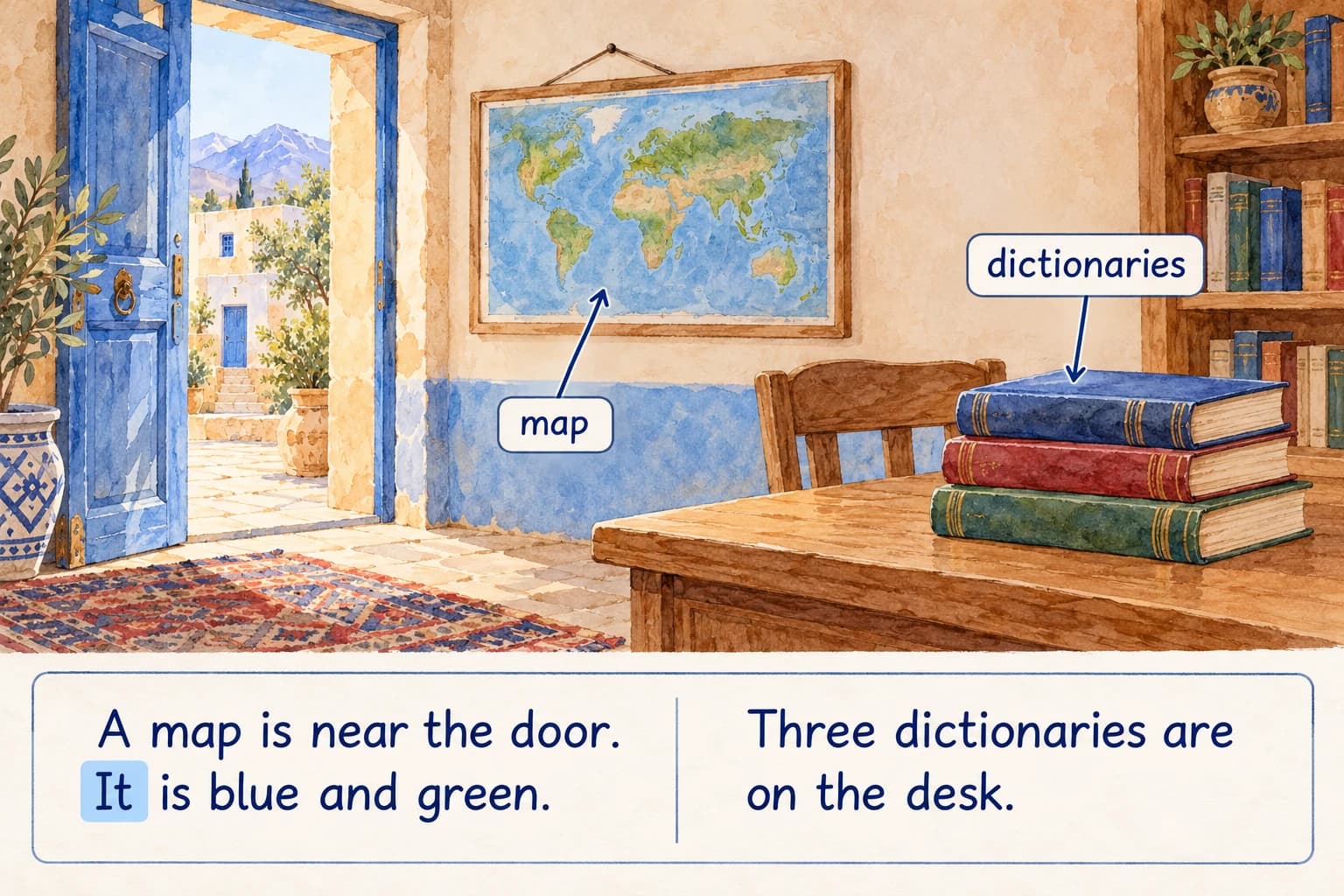
The two uses of it have different references: the first is the map; the second is the teacher's desk. Read the nearest relevant noun and check that the meaning fits.
Step by step
Put the idea into practice
- Read the complete description once to understand the place.
- Underline the number, object or position that answers the question.
- Write the answer and check it against the exact detail rather than a guess.
Frequently asked questions
How do I answer questions about a classroom description?
Can the same pronoun it refer to different objects in a paragraph?
Can I answer from my own classroom?
Quiz: 1 questions
1 questions are randomly selected from this lesson’s 1-question bank. Choose one answer for each question and get an immediate explanation.
Q1Where is the red bag?
Incorrect answer
The writer says My red bag is under my chair.
Correct answer: Under a chair
The writer says My red bag is under my chair.
Your score
0/1
Start with the worked examples
Read the lesson in small sections. Write your own example for each rule and try the Easy exercises before returning to the quiz.
Review: 1 missed question
Where is the red bag?
Correct answerUnder a chair
The writer says My red bag is under my chair.
Exercises with answers
4 exercises, from easy practice to challenges. Try each one yourself, then reveal the answer and explanation.
Exercise 1
EasyHow many chairs are there? Where is the map?
Answer and explanation
There are twenty-four chairs. The map is near the door. Both details are stated directly.
Exercise 2
IntermediateWhat does it refer to in There are three dictionaries on it?
Answer and explanation
The teacher's desk. The dictionaries are on that desk, not on the map.
Exercise 3
ChallengeTrue, false or not stated: the bag is blue; the room is bright; the writer loves maths.
Answer and explanation
False: the bag is red. True: bright is stated. Not stated: there is no favourite-subject information.
Exercise 4
IntermediateA classmate says The writer sits next to the door. Can you confirm it from this text?
Answer and explanation
No. The description gives the map's position and the bag's position, but it does not say that the writer sits next to the door. This claim is not stated.