



School subjects: what and when have we got English?
We've got English on Monday. When have we got maths? A timetable tells you which subjects you study and when. Use what to ask for a subject and when to ask for a day or time.

Ta fiche PDF illustrée
Le support, la méthode et les exercices corrigés à imprimer.
By the end of this lesson, you can
- Name subjects and ask the right question
- Read a simple school timetable
- Use the row and column together
Before you startRead simple English sentences; use the starter lesson if you need help with names or numbers.
Un bon cours, ça se partage.
How do I ask what subjects we have got and when?
Ask What have we got on Monday? to find a subject. Ask When have we got English? to find a day or time. Answer with on before a day and at before a clock time: We've got English on Monday at nine o'clock.

Name subjects and ask the right question
Useful subjects include English, Arabic, French, maths, science, history, geography, art and PE. In the have got pattern, ask What have we got on Monday? or When have we got English? We have got becomes we've got.
Use on with a day: on Tuesday. Use at with a clock time: at nine o'clock. English, Arabic and French begin with capitals because they are language names. Subject names such as maths and history usually use lowercase in ordinary sentences. A title in a timetable may use capitals.
Read a simple school timetable
| Day | Time | Subject |
|---|---|---|
| Monday | 09:00 | English |
| Monday | 10:00 | maths |
| Tuesday | 09:00 | science |
| Tuesday | 11:00 | PE |
Turn timetable notes into a paragraph
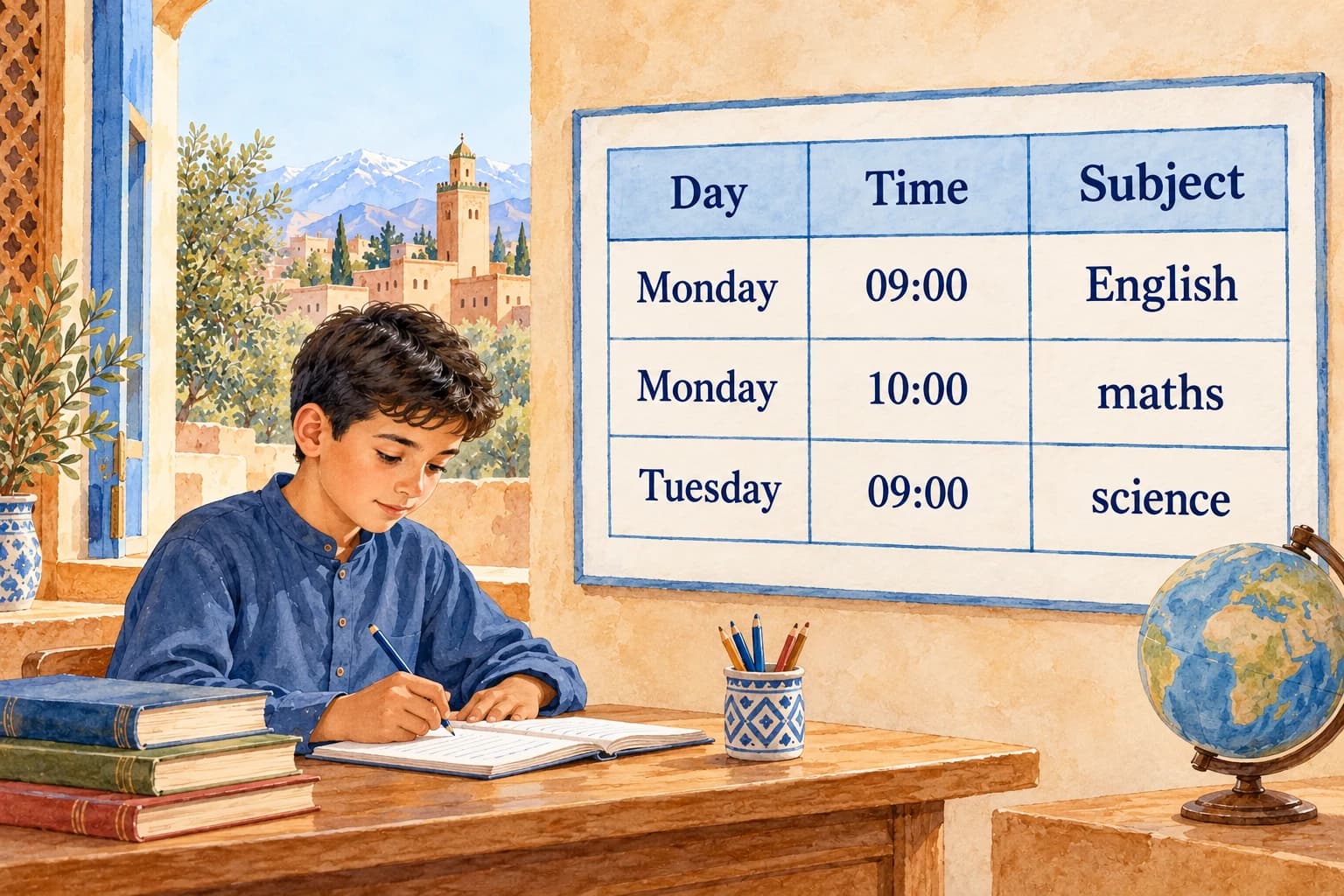
Read and explain this example
We've got English on Monday at nine o'clock. We've got maths at ten. On Tuesday, we've got science and PE. My favourite subject is science because I like experiments.
Use the row and column together
A timetable has two kinds of clues: the heading identifies the category, while the row supplies the detail. If a question asks for Monday at ten, find both before answering maths. Looking only at Monday could lead you to choose English from another row. When you write the answer, turn the note into a sentence rather than copying an isolated box. Language names such as English need capitals.

Remember
Compare What have we got? with When have we got English? The first asks for the subject; the second asks for a time. Read the correct day column before answering.
Step by step
Put the idea into practice
- Underline whether the question asks what, when or a specific time.
- Locate the relevant day and time in the timetable.
- Write a complete answer and check on, at and language-name capitals.
Frequently asked questions
How do I ask what subjects we have got and when?
Do I say on Monday or at Monday?
Should every school subject start with a capital?
Quiz: 1 questions
1 questions are randomly selected from this lesson’s 1-question bank. Choose one answer for each question and get an immediate explanation.
Q1Which word asks for a day?
Incorrect answer
When asks about time, including days and clock times.
Correct answer: When
When asks about time, including days and clock times.
Your score
0/1
Start with the worked examples
Read the lesson in small sections. Write your own example for each rule and try the Easy exercises before returning to the quiz.
Review: 1 missed question
Which word asks for a day?
Correct answerWhen
When asks about time, including days and clock times.
Exercises with answers
4 exercises, from easy practice to challenges. Try each one yourself, then reveal the answer and explanation.
Exercise 1
EasyWhen have we got science? What have we got on Monday at ten?
Answer and explanation
Science is on Tuesday at nine o'clock. We've got maths on Monday at ten.
Exercise 2
IntermediateComplete: English … Monday … nine. PE … Tuesday.
Answer and explanation
On Monday at nine; on Tuesday. Use on for days and at for times.
Exercise 3
ChallengeWrite three sentences about a real or invented school day and name a favourite subject.
Answer and explanation
Example: We've got French on Thursday at ten. We've got art at eleven. My favourite subject is art. Keep language names capitalised.
Exercise 4
IntermediateWrite questions for these answers: We've got PE. We've got PE on Tuesday at eleven.
Answer and explanation
What have we got? When have we got PE? A subject answers what; the day and time answer when.