



Reading: a short poem about feelings
A poem can use short lines, repeated words and sound patterns. Read this original school poem and follow the speaker's feelings from the morning to the end of a performance. Separate the text's evidence from your own reaction.

Ta fiche PDF illustrée
Le support, la méthode et les exercices corrigés à imprimer.
By the end of this lesson, you can
- Find the voice saying I
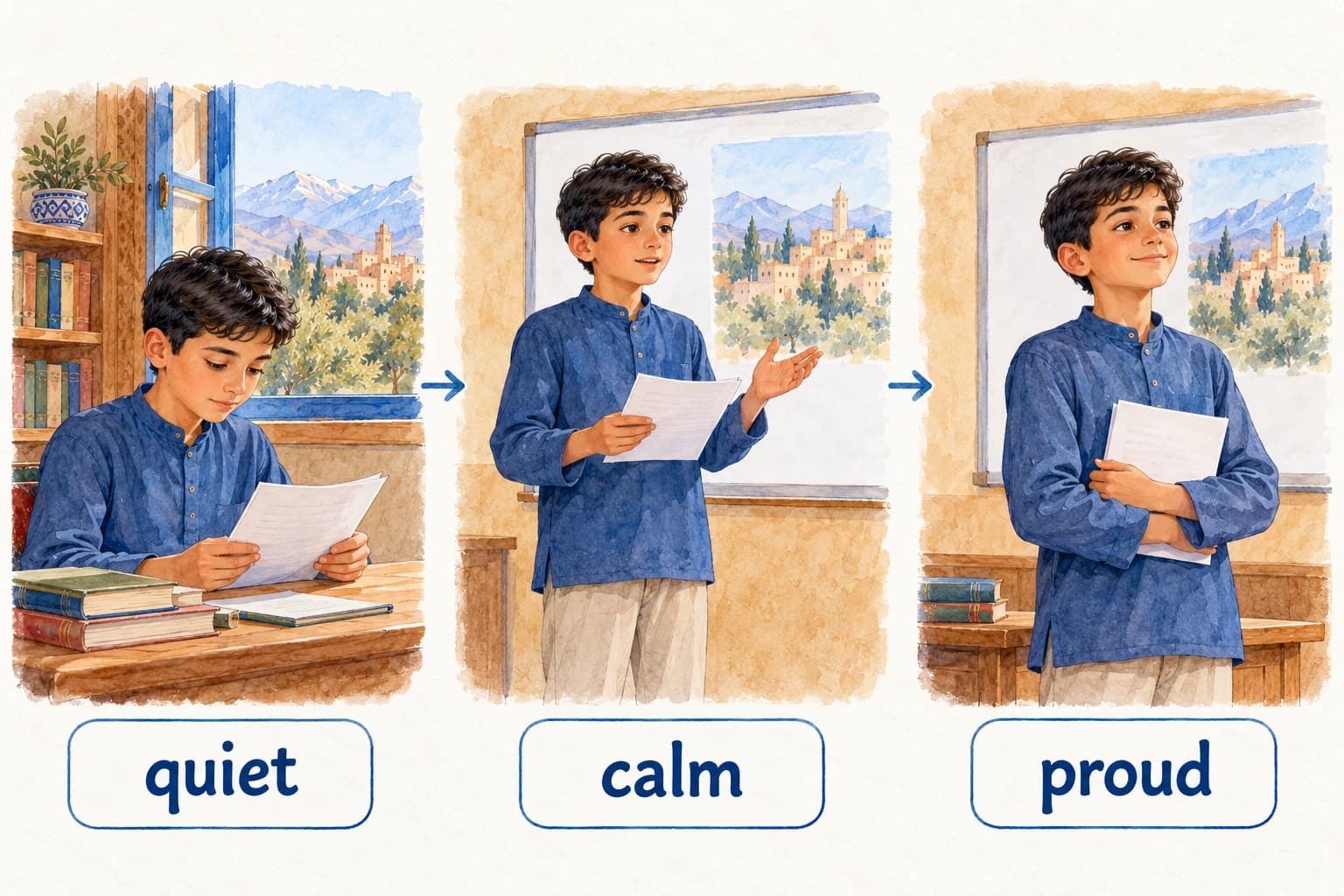
- Follow the change from quiet to proud
- Explain a feeling without inventing a biography
Before you startRead simple English sentences; use the starter lesson if you need help with names or numbers.
Un bon cours, ça se partage.
How do I understand a short poem about feelings?
Identify the speaker, the situation and words that show a change in feeling. In this poem, a quiet speaker prepares to perform, receives encouragement and feels proud afterwards. Explain your answer with a line or detail rather than inventing the speaker's name or age.

Find the voice saying I
The speaker is the voice saying I in a poem; it need not be the real author. Words such as scared, calm and proud help you understand the speaker's state. A repeated line can connect different moments even when the feeling changes.
Read the poem once for its situation and again for its changes. Notice time words such as morning and now. A poem does not need every pair of lines to rhyme. When you explain a feeling, name both the word and the event that helps you understand it.
Follow the change from quiet to proud
| Moment | Feeling clue | Context |
|---|---|---|
| Morning | scared | A voice feels small before the show. |
| A friend's help | calm | The speaker takes a breath. |
| After speaking | proud | The speaker finishes and smiles. |
Read the original school poem
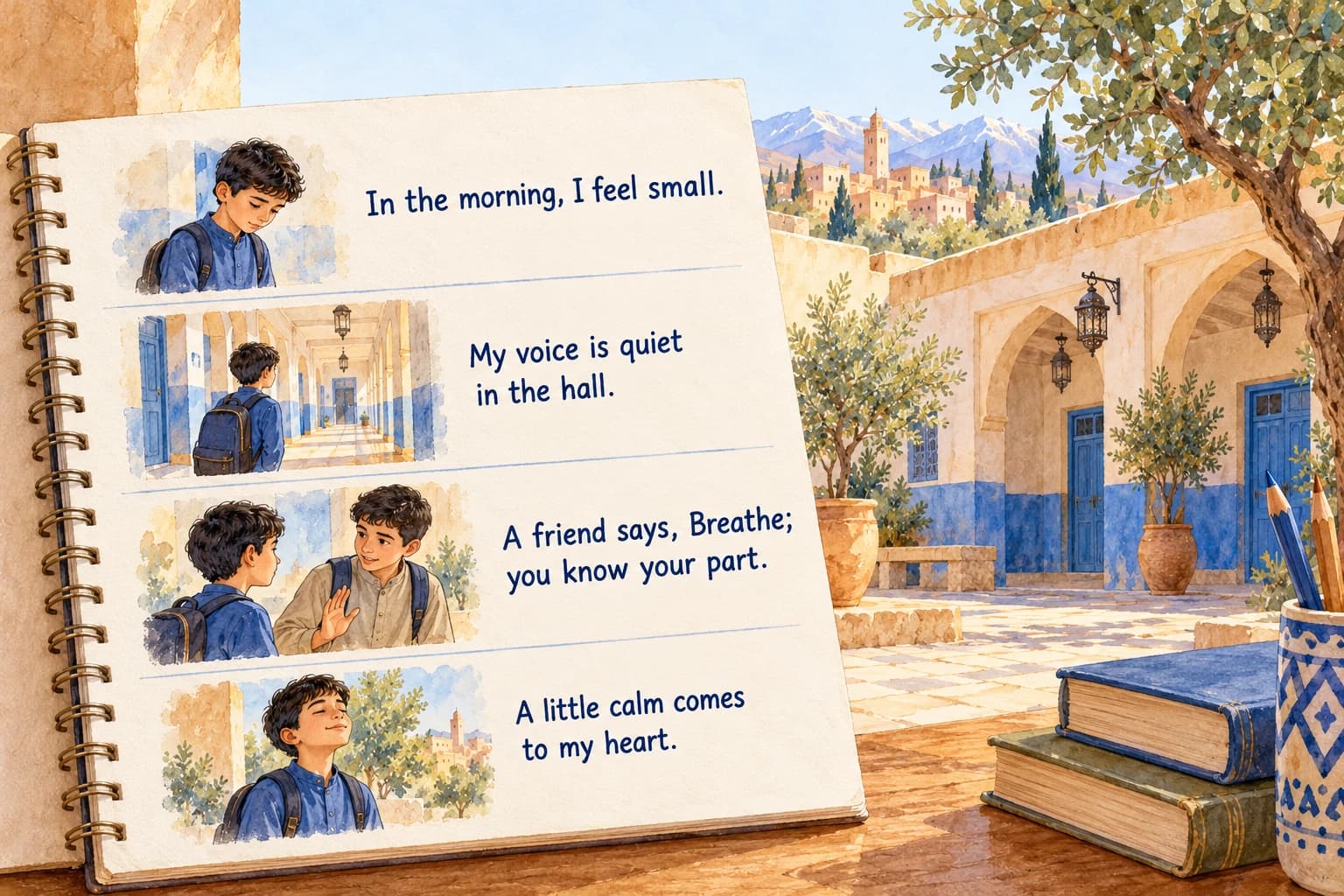
Read and explain this example
In the morning, I feel small. / My voice is quiet in the hall. / A friend says, Breathe; you know your part. / A little calm comes to my heart. / I speak my words; the room is still. / Now I am proud: I found the will. / We stand together, side by side. / My smile is small; my joy is wide.
Explain a feeling without inventing a biography
The speaker says I feel small, but that does not mean the poem gives a measurement of their height. The phrase expresses how the speaker feels before speaking. Later, a small smile describes something visible. Read the surrounding lines to decide which meaning fits. A reader can have a personal reaction to the poem, but comprehension answers should still distinguish a stated detail from an interpretation supported by several lines.
Remember
The slashes show line breaks in this display. Small first describes how the speaker feels, then describes a smile. Do not assume the speaker's age or name: neither is given.
Step by step
Put the idea into practice
- Read the poem once without stopping at every unfamiliar word.
- Mark a word or event from the beginning, middle and end.
- Explain how the speaker changes and quote only the short phrase you need.
Frequently asked questions
How do I understand a short poem about feelings?
Is the speaker always the person who wrote the poem?
Must every poem rhyme?
Quiz: 1 questions
1 questions are randomly selected from this lesson’s 1-question bank. Choose one answer for each question and get an immediate explanation.
Q1Which feeling is directly named after the speech?
Incorrect answer
The speaker says Now I am proud.
Correct answer: Proud
The speaker says Now I am proud.
Your score
0/1
Start with the worked examples
Read the lesson in small sections. Write your own example for each rule and try the Easy exercises before returning to the quiz.
Review: 1 missed question
Which feeling is directly named after the speech?
Correct answerProud
The speaker says Now I am proud.
Exercises with answers
4 exercises, from easy practice to challenges. Try each one yourself, then reveal the answer and explanation.
Exercise 1
EasyWhich word shows that the speaker talks about themself?
Answer and explanation
I shows a first-person speaker. The poem also uses my for the speaker's voice, heart, smile and joy.
Exercise 2
IntermediateHow does the speaker feel before and after speaking?
Answer and explanation
Before speaking, the voice is quiet and the speaker feels small. Afterwards, the speaker says I am proud and describes joy.
Exercise 3
ChallengeName one thing that helps the speaker and explain why.
Answer and explanation
A friend encourages the speaker to breathe and remember the part. This is followed by a little calm; the sequence suggests the encouragement helps.
Exercise 4
IntermediateDoes the poem tell us the speaker's name? What evidence supports a feeling of pride?
Answer and explanation
The name is not stated. Pride is explicit in Now I am proud, and the closing lines describe a smile and joy. Use those details rather than inventing a name.