



Writing: my feelings and what I can do
A short profile can describe both feelings and abilities. Use be to say how you feel and can to say what you are able to do. Write a connected paragraph rather than unrelated answers to a worksheet.

Ta fiche PDF illustrée
Le sujet, un exemple complet rédigé et les exercices corrigés.
By the end of this lesson, you can
- Choose one situation for your profile
- Keep feelings and abilities in different patterns
- Make a contrast sound natural
Before you startRead simple English sentences; use the starter lesson if you need help with names or numbers.
Un bon cours, ça se partage.
How do I write about my feelings and what I can do?
Choose a situation, describe your feeling with be, then give an ability with can. Add a contrast with but if useful: I am excited. I can ride a bike, but I cannot skate yet. Connect the ideas instead of listing unrelated answers.

Choose one situation for your profile
Write I'm happy or I am happy for a feeling. Write I can skate for an ability. Can't means cannot. An apostrophe marks missing letters in I'm, we're, they're and can't. Use a/an before a singular countable noun: a bike, an orange kite.
Choose a situation first, such as an afternoon club. Explain the feeling in that situation, then describe two abilities and one thing you are still learning. And joins similar ideas; but introduces a contrast. Keep a positive short answer in its full form: Yes, I can or Yes, I am.
Keep feelings and abilities in different patterns
| Idea | Sentence | Pattern |
|---|---|---|
| Feeling | I'm excited. | be + adjective |
| Ability | I can ride a bike. | can + base verb |
| Contrast | I can swim, but I can't skate. | but connects different abilities |
A complete club-member writing model
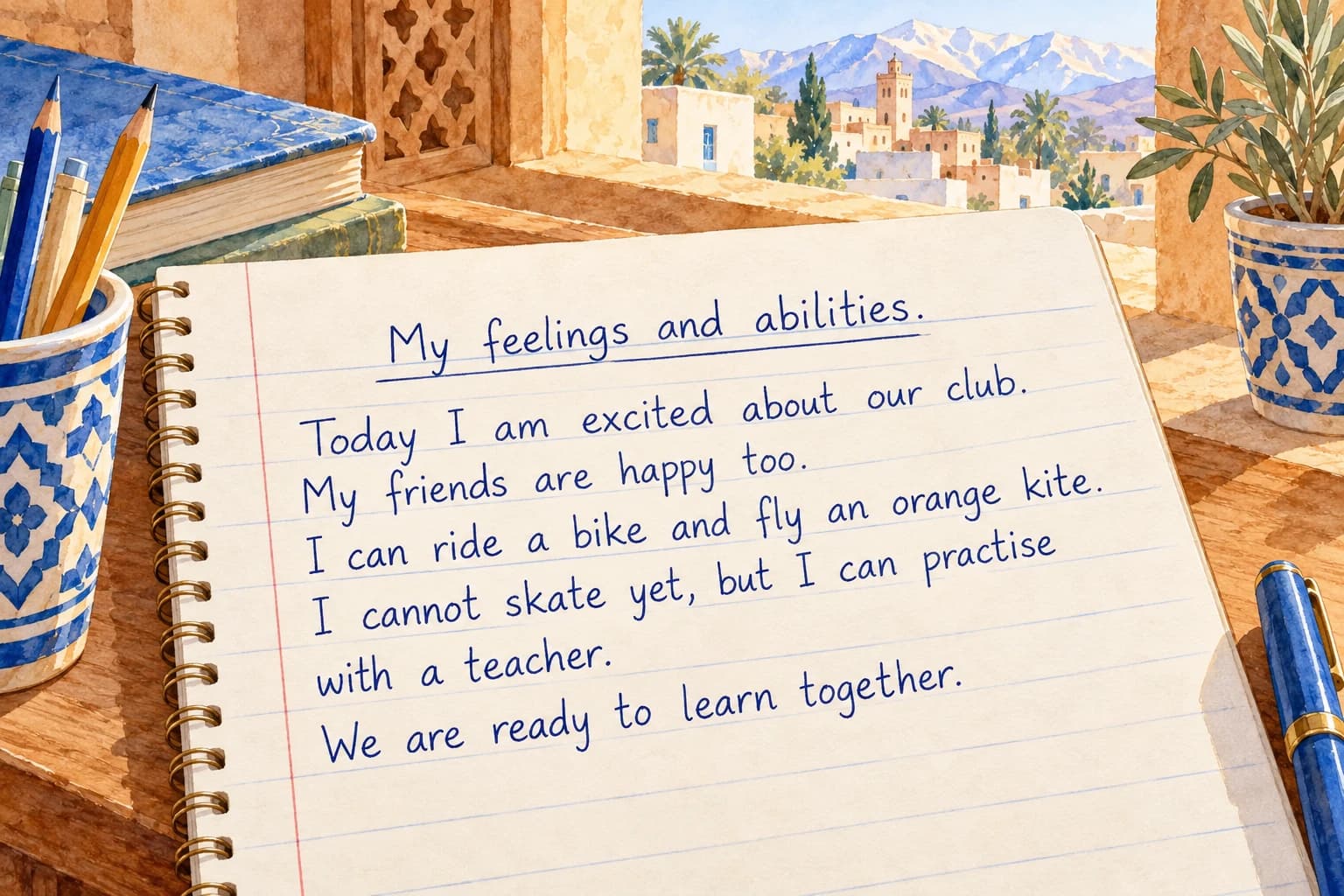
A complete original writing model
Today I am excited about our club. My friends are happy too. I can ride a bike and fly an orange kite. I cannot skate yet, but I can practise with a teacher. We are ready to learn together.
Make a contrast sound natural
The word yet can make a useful difference: I can't skate yet says that the skill is still developing. It does not promise a result or make a judgement about the learner. A short profile becomes more coherent when all its sentences belong to the same situation, such as joining a club. Describe how you feel about it, say what you can already do and name one thing to practise. And adds a similar idea; but introduces a contrast.

Remember
Use respectful, personal descriptions. You may invent a character if you prefer. Do not add an s after can, even when you write about she or he.
Step by step
Put the idea into practice
- Choose a real or invented club member and one situation.
- Write a feeling, two abilities and one useful contrast.
- Check be before adjectives and a base verb after can or can't.
Frequently asked questions
How do I write about my feelings and what I can do?
Can I use full forms instead of contractions in my writing?
Can I use full forms in my writing?
Quiz: 1 questions
1 questions are randomly selected from this lesson’s 1-question bank. Choose one answer for each question and get an immediate explanation.
Q1Which sentence uses can correctly?
Incorrect answer
Can takes the base verb without s or to.
Correct answer: She can skate.
Can takes the base verb without s or to.
Your score
0/1
Start with the worked examples
Read the lesson in small sections. Write your own example for each rule and try the Easy exercises before returning to the quiz.
Review: 1 missed question
Which sentence uses can correctly?
Correct answerShe can skate.
Can takes the base verb without s or to.
Exercises with answers
4 exercises, from easy practice to challenges. Try each one yourself, then reveal the answer and explanation.
Exercise 1
EasyWrite the full forms of I'm, they're and can't.
Answer and explanation
I am; they are; cannot. Cannot is normally written as one word.
Exercise 2
IntermediateCorrect: She can rides a bike. They happy. I have a orange kite.
Answer and explanation
She can ride a bike. They are happy. I have an orange kite. Check the base verb, be and the vowel sound.
Exercise 3
ChallengeWrite five sentences about a club member's feelings and abilities.
Answer and explanation
Example: Aya is happy. She can swim. She can ride a bike. She can't skate yet. She is ready to learn. Your details may differ; include both be and can.
Exercise 4
IntermediateUse: Rami / happy about club / swim / ride bike / not skate yet.
Answer and explanation
Example: Rami is happy about the club. He can swim and ride a bike. He can't skate yet. He is ready to practise. Is describes a feeling; can takes swim, ride and skate without s.