



Writing: my lunch and my school subjects
Practise two everyday writing topics: the food in your lunch bag and the subjects on your timetable. Give precise details, use have got consistently and check questions, full stops and capital letters.

Ta fiche PDF illustrée
Le sujet, un exemple complet rédigé et les exercices corrigés.
By the end of this lesson, you can
- Plan two focused paragraphs
- Check have got, capitals and punctuation
- Add a reason without leaving the topic
Before you startRead simple English sentences; use the starter lesson if you need help with names or numbers.
Un bon cours, ça se partage.
How do I write about my lunch and my school subjects?
Keep the two topics in separate short paragraphs. For lunch, name food and a drink with have got. For school subjects, give a day, time and preference. Use full stops for statements and a question mark for a direct question such as What have you got for lunch?

Plan two focused paragraphs
A statement ends with a full stop; a direct question ends with a question mark. Compare I've got an apple. with Have you got an apple? Use on with days and at with times. English and French take capitals; food words such as rice do not normally need them.
For a lunch paragraph, name the meal, two food items and a drink. For a school paragraph, choose a day, two subjects and one preference. You can add because to give a reason. A model is a possible response; your own meal or timetable may be different.
Check have got, capitals and punctuation
| Topic | Statement | Question or writing tip |
|---|---|---|
| Lunch | I've got a sandwich and water. | What have you got? |
| Subjects | We've got English on Monday. | When have we got English? |
| Preference | I like art because I like drawing. | Give a clear reason. |
Two completed models: lunch and subjects
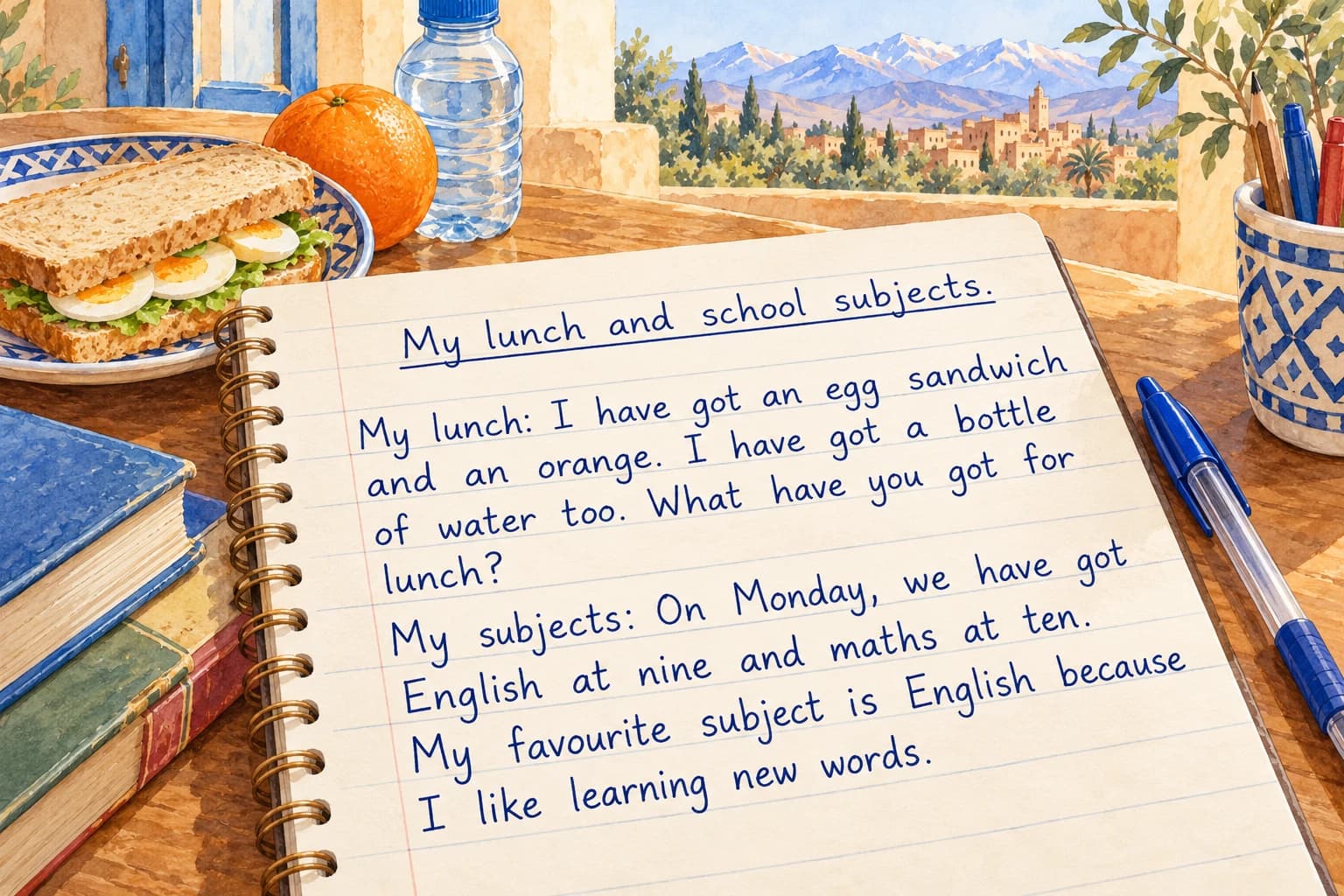
A complete original writing model
My lunch: I have got an egg sandwich and an orange. I have got a bottle of water too. What have you got for lunch? My subjects: On Monday, we have got English at nine and maths at ten. My favourite subject is English because I like learning new words.
Add a reason without leaving the topic
A reason should explain the idea immediately before it. My favourite subject is English because I like learning new words connects a preference with a relevant reason. A lunch paragraph needs food details instead: naming a favourite subject in its middle would distract the reader. When you finish, check the questions separately. Have you got an apple? is a direct question, while I've got an apple is a statement. Their endings should not be interchangeable.

Remember
Keep the two models as separate paragraphs. Do not put a question mark after a statement just because it contains what: I know what I like is a statement.
Step by step
Put the idea into practice
- Make one food-and-drink list and one day-time-subject list.
- Write a separate short paragraph from each set of notes.
- Check language names, days, I and the punctuation of every question.
Frequently asked questions
How do I write about my lunch and my school subjects?
Why should English and Monday have capital letters?
Is there one correct lunch paragraph?
Quiz: 1 questions
1 questions are randomly selected from this lesson’s 1-question bank. Choose one answer for each question and get an immediate explanation.
Q1Which sentence is punctuated correctly?
Incorrect answer
A direct have got question ends with a question mark.
Correct answer: Have you got water?
A direct have got question ends with a question mark.
Your score
0/1
Start with the worked examples
Read the lesson in small sections. Write your own example for each rule and try the Easy exercises before returning to the quiz.
Review: 1 missed question
Which sentence is punctuated correctly?
Correct answerHave you got water?
A direct have got question ends with a question mark.
Exercises with answers
4 exercises, from easy practice to challenges. Try each one yourself, then reveal the answer and explanation.
Exercise 1
EasyPunctuate: Have you got an apple / I've got some water
Answer and explanation
Have you got an apple? I've got some water. The first is a question; the second is a statement.
Exercise 2
IntermediateCorrect: we've got english on tuesday. i like maths.
Answer and explanation
We've got English on Tuesday. I like maths. Capitalise the sentence opening, language, day and pronoun I.
Exercise 3
ChallengeWrite three lunch sentences and three timetable sentences.
Answer and explanation
For lunch, include food, a drink and a question. For school, include a day, a time and a preference. Check have/has got and punctuation; use the two models as a structure.
Exercise 4
IntermediateFinish these paragraphs with one relevant sentence each: I've got a sandwich and water. / We've got science on Tuesday.
Answer and explanation
Possible endings: What have you got for lunch? / I like science because I enjoy experiments. Each ending stays with the paragraph's topic; the first needs a question mark.