



Writing: my classroom and capital letters
Describe a classroom in five or six connected sentences. Start with the place, select a few useful objects and finish with a personal detail. Check capital letters, there is/are and full stops before sharing your paragraph.

Ta fiche PDF illustrée
Le sujet, un exemple complet rédigé et les exercices corrigés.
By the end of this lesson, you can
- Choose details before you start writing
- Build an opening, details and an ending
- Improve a list of objects into a paragraph
Before you startRead simple English sentences; use the starter lesson if you need help with names or numbers.
Un bon cours, ça se partage.
How do I write a paragraph about my classroom in English?
Start by naming the classroom, add two or three details about objects and positions, then finish with a personal sentence. Use there is for one object and there are for several. Begin sentences with capitals, write I with a capital and finish statements with full stops.

Choose details before you start writing
A sentence begins with a capital and ends with suitable punctuation. Write the pronoun I with a capital wherever it appears. Use capitals for people's names, days and languages: Salma, Monday, English. Use there is for one thing and there are for more than one.
Plan three groups of information: the room, objects and positions, then your own place or favourite detail. A reader needs specific details rather than a list of everything. Use near, on or under to show position. Check a pronoun against the noun it replaces so that the description stays clear.
Build an opening, details and an ending
| Part | Writing action | Example |
|---|---|---|
| Opening | Name the place. | This is our classroom. |
| Details | Choose objects and positions. | There is a map near the door. |
| Ending | Add one personal detail. | I sit near the window. |
A complete model: My classroom
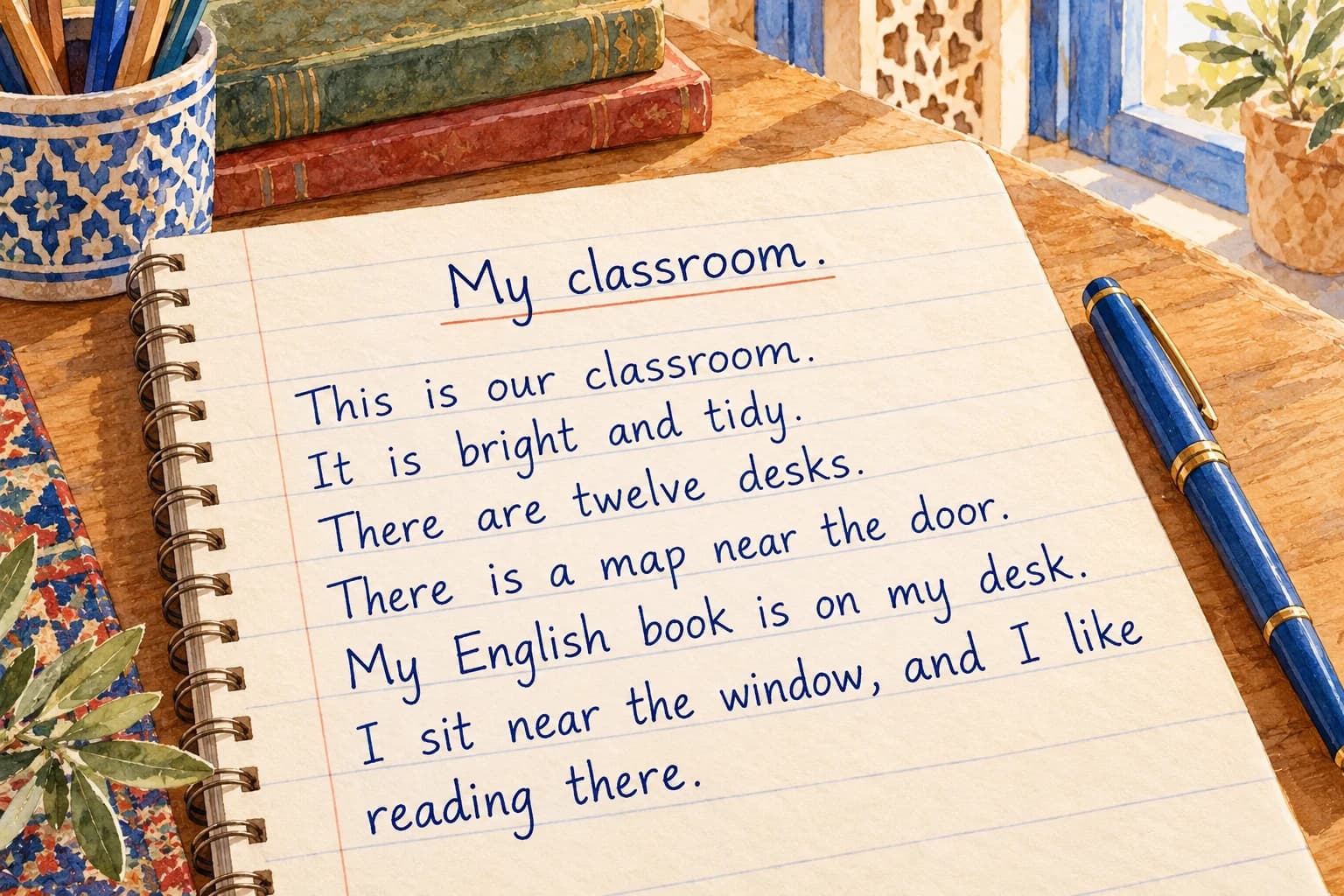
A complete original writing model
This is our classroom. It is bright and tidy. There are twelve desks. There is a map near the door. My English book is on my desk. I sit near the window, and I like reading there.
Improve a list of objects into a paragraph
A list such as desks, map, window tells the reader what you noticed, but it is not yet a paragraph. Add a verb and a relationship: There is a map near the door. Now the reader can picture a position. Choose a few useful details rather than naming everything in the room. The final sentence can describe where you sit or what you enjoy doing there. Change the model's details so the paragraph belongs to your own imagined or real classroom.

Remember
Use the model as a guide, then change the details. The suggested sentence count is an exercise target, not an official exam rule. Avoid starting every sentence with the same phrase.
Step by step
Put the idea into practice
- Make three notes: the place, two objects and one personal detail.
- Turn each note into a full sentence using be, there is/are or a simple action verb.
- Check the meaning first, then agreement, capitals and full stops.
Frequently asked questions
How do I write a paragraph about my classroom in English?
How long should my classroom paragraph be?
Must I copy the model's objects?
Quiz: 1 questions
1 questions are randomly selected from this lesson’s 1-question bank. Choose one answer for each question and get an immediate explanation.
Q1Which word must keep its capital in the middle of a sentence?
Incorrect answer
The English pronoun I always has a capital.
Correct answer: I
The English pronoun I always has a capital.
Your score
0/1
Start with the worked examples
Read the lesson in small sections. Write your own example for each rule and try the Easy exercises before returning to the quiz.
Review: 1 missed question
Which word must keep its capital in the middle of a sentence?
Correct answerI
The English pronoun I always has a capital.
Exercises with answers
4 exercises, from easy practice to challenges. Try each one yourself, then reveal the answer and explanation.
Exercise 1
EasyCorrect: i study english on monday. salma sits near me.
Answer and explanation
I study English on Monday. Salma sits near me. Capitalise I, the language, the day and the name.
Exercise 2
IntermediateCorrect: There is three desks. There are a map.
Answer and explanation
There are three desks. There is a map. Count the objects before choosing is or are.
Exercise 3
ChallengeWrite five or six sentences about a real or invented classroom.
Answer and explanation
Check: an opening sentence; two objects; a place phrase; one personal detail; capital I; sentence punctuation. Many answers are possible; compare the structure with the model.
Exercise 4
IntermediateUse these notes: bright classroom / two windows / blue bag under chair / I read near window.
Answer and explanation
One possible answer: This is our bright classroom. There are two windows. My blue bag is under my chair. I read near the window. The notes become sentences with subjects and verbs.