
Unit 4: Come to my house! Rooms, places and present continuous
The bag is under the table. She is tidying her room. The first sentence locates an object; the second describes an action happening now. In English 1AC Unit 4, Come to my house!, learn rooms and furniture, prepositions of place, frequency words and the present continuous. Then describe a home and the people helping in it.
By the end of this lesson, you can
- Name rooms and everyday household objects
- Locate objects with prepositions of place
- Describe habits with frequency adverbs
- Form the present continuous with am/is/are + verb-ing
- Distinguish a regular habit from an action happening now
- Write a short description of a home scene
Before you startThere is/are and questions with where · Present simple and time expressions · Am, is, are and family vocabulary
What are the rooms in a house called in English?
| Room or place | What you might do there |
|---|---|
| bedroom | Sleep or keep your clothes |
| living room | Sit, talk and relax |
| kitchen | Prepare food and cook |
| bathroom | Wash and brush your teeth |
| dining room | Eat meals |
| hall | Enter the home or reach other rooms |
| garden | Grow plants or play outside |
| study | Read or do desk work |
| laundry room | Wash clothes |
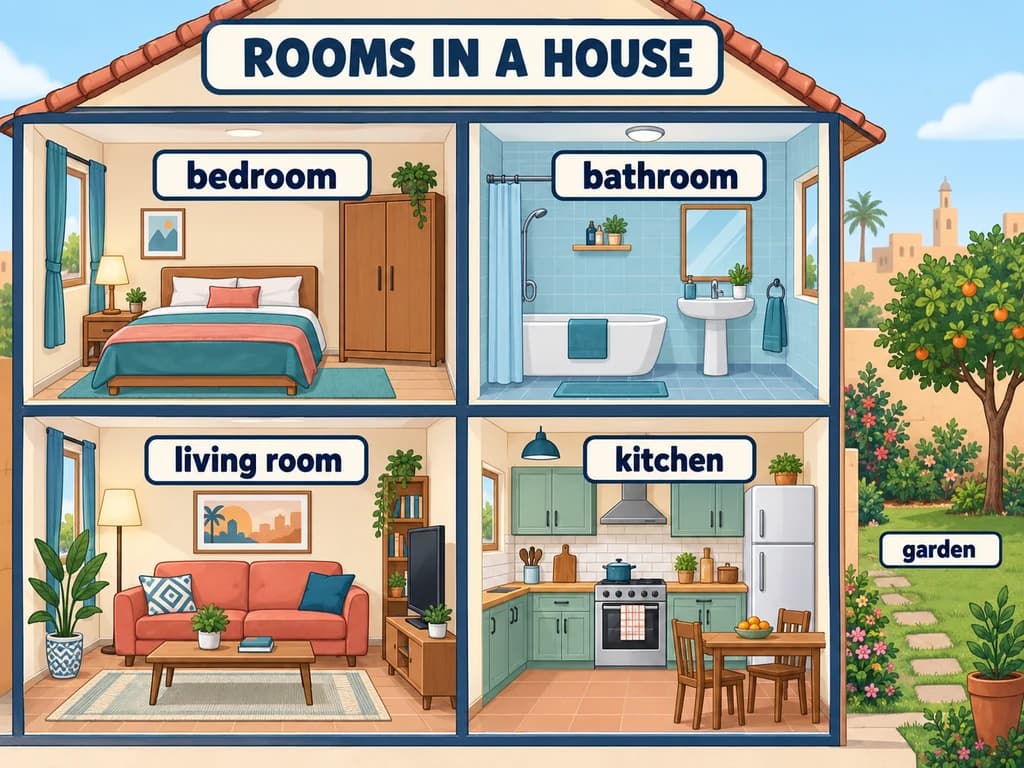
The picture is an imaginary home. Find the bedroom, bathroom, living room, kitchen and garden. Not every home has a garden, study or separate dining room. Use the words you need for your own home, or describe an invented one.
A house is a type of building. A flat or apartment is a home within a larger building. Home means the place where you live: you can say I go home even if you live in a flat.
Describe a flat
I live in a flat. There are two bedrooms. There is a kitchen, a bathroom and a living room. There isn’t a garden.
- Use I live in to introduce the type of home.
- Use there are with two bedrooms.
- Use there isn’t to describe something absent.
What are common furniture and household words?
| Object | A simple description |
|---|---|
| bed / pillow / blanket | Things used for sleeping |
| wardrobe | A cupboard for clothes |
| sofa / armchair | Comfortable seats |
| table / chair / desk | Furniture for sitting, eating or working |
| lamp | A light |
| rug | A covering for part of a floor |
| bookshelf | A shelf for books |
| fridge | Keeps food cold |
| cooker | Used for cooking food |
| sink | A place to wash dishes |
| washing machine | Washes clothes |
Furniture is an uncountable word. Do not add s to make furnitures. To count, name the objects: two chairs, one table and a bed. A desk is a piece of furniture; a study is a room.
How do in, on, under and next to describe a place?
Definition
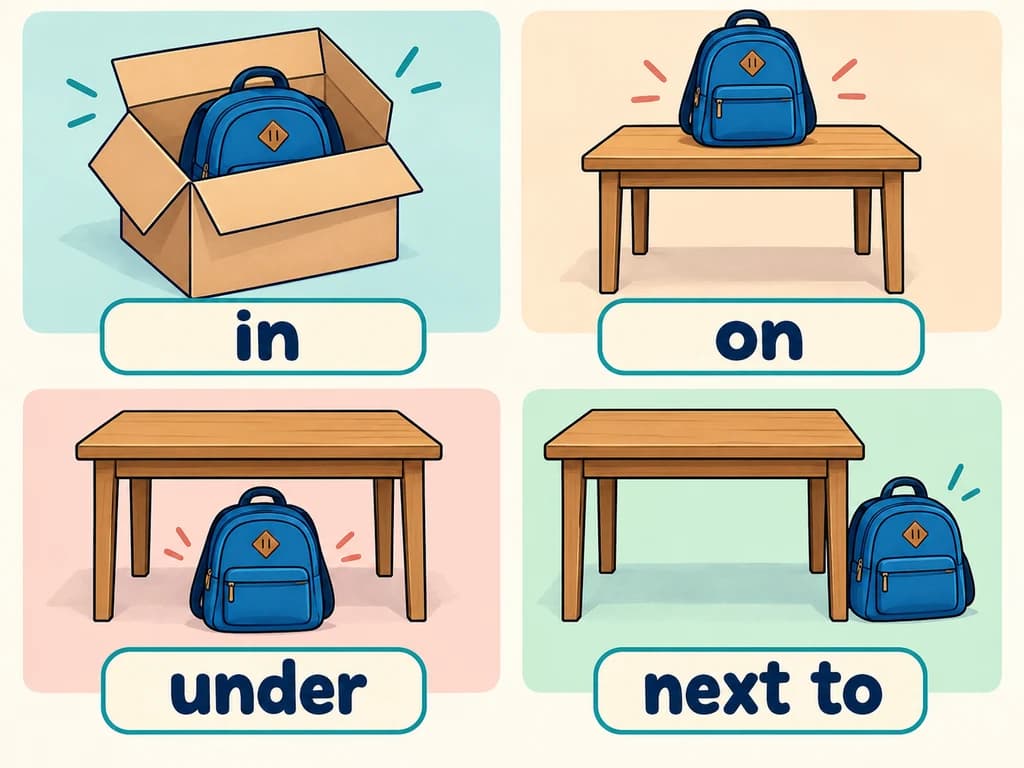
Preposition of place : A preposition of place shows where something is in relation to something else: The bag is under the table.
| Preposition | Meaning | Example |
|---|---|---|
| in | Inside | The bag is in the box. |
| on | Touching a surface above it | The bag is on the table. |
| under | Below | The bag is under the table. |
| next to | Beside | The bag is next to the table. |
| between | In the space separating two things | The lamp is between the bed and the desk. |
| behind | At the back of | The bag is behind the door. |
| in front of | Before the front of | The chair is in front of the desk. |
The same bag changes position in the picture. A box is the reference object in the first scene; a table is the reference in the other three. Ask Where is the bag? Answer It’s under the table. For several objects, ask Where are the books? Answer They’re on the desk.
Step by step
Build a sentence about position
- Choose the object you want to locate.
- Use is for one object or are for several.
- Choose a preposition that matches the picture.
- Name the reference object: The books are on the shelf.
- Check whether your partner can find the object from your description.
Remember
On means touching the surface in these examples; in means inside. With between, name both reference points: between the bed and the desk. Only describe positions that the picture or text actually gives.
How do always, usually, sometimes and never describe habits?
| Frequency word | Meaning | Example |
|---|---|---|
| always | Every time | I always brush my teeth in the morning. |
| usually | Most times | I usually read in my bedroom. |
| often | Many times | We often eat in the kitchen. |
| sometimes | On some occasions | I sometimes watch TV. |
| never | Not at any time | I never leave books on the stairs. |
Ask How often do you tidy your room? Answer I usually tidy my room on Saturday. Frequency words usually go before an ordinary verb: She often reads. They usually go after be: She is often tired. These words describe general frequency, not exact percentages.
Remember
Never already has a negative meaning. Say I never watch TV in the morning. Do not add don’t to make I don’t never watch TV.
How do you talk about household chores?
| Chore | What it involves |
|---|---|
| tidy my room | Put things in their places |
| make my bed | Arrange the blanket and pillows |
| wash the dishes | Clean plates, cups and other dishes |
| set the table | Put out things for a meal |
| sweep the floor | Clean the floor with a broom |
| water the plants | Give plants water |
| cook dinner | Prepare the evening meal |
| take out the rubbish | Move waste to the appropriate bin |
Chores are jobs that help keep a home clean and organised. Describe a routine with the present simple: I make my bed. My brother sets the table. Family members can share age-appropriate tasks. Use a real or imaginary situation for practice.
How do you form the present continuous?
Definition
Present continuous : For an action happening now, use subject + am/is/are + verb-ing: I am reading. She is cooking. They are cleaning. This is also called the present progressive.
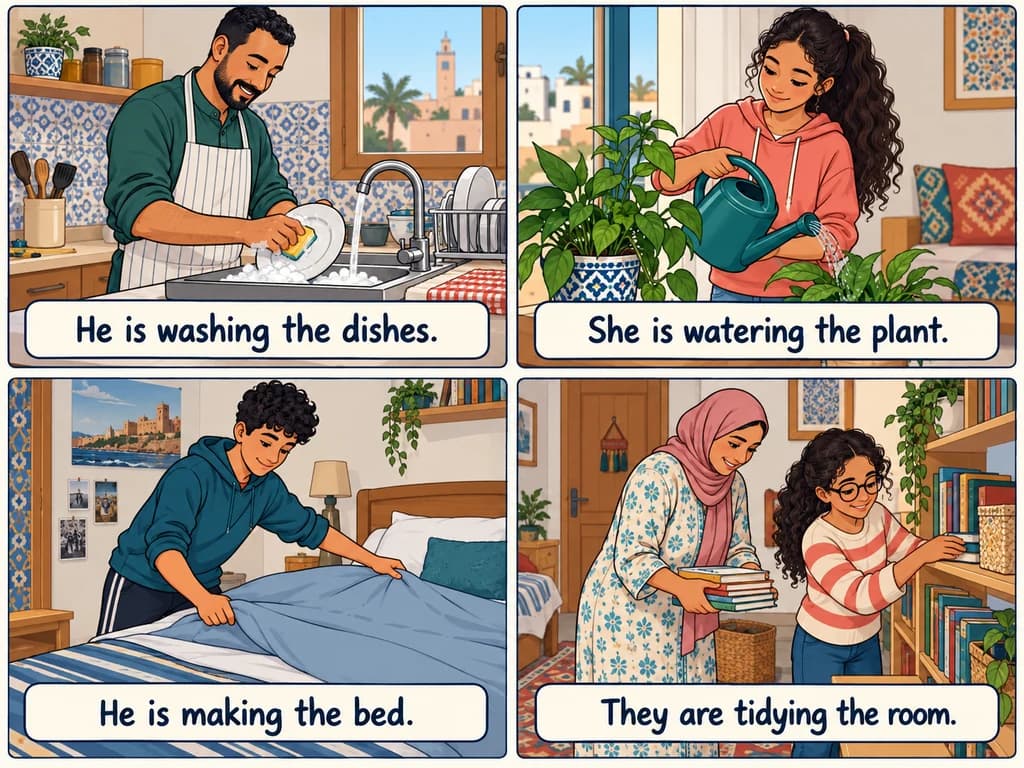
Look at the actions happening in the picture. A father is washing the dishes, a girl is watering a plant, a boy is making the bed and two people are tidying the room. These sentences describe this moment; they do not tell us who always does each job.
| Subject | Statement | Negative | Question |
|---|---|---|---|
| I | I am reading. | I am not reading. | Am I reading? |
| he / she / it | She is cooking. | She isn’t cooking. | Is she cooking? |
| you / we / they | They are cleaning. | They aren’t cleaning. | Are they cleaning? |
Short forms are common: I’m reading, she’s cooking, they’re cleaning. Ask What are you doing? Answer I’m making my bed. For Is he washing the dishes?, answer Yes, he is or No, he isn’t. The short answer uses be, not do.
How do you spell verb-ing forms?
| Base verb | Verb-ing | What changes? |
|---|---|---|
| read | reading | Add ing |
| wash | washing | Add ing |
| play | playing | Keep y |
| tidy | tidying | Keep y |
| make | making | Remove the silent final e |
| write | writing | Remove the silent final e |
| sit | sitting | Double t |
| run | running | Double n |
Remember
Keep the verb be: She is cooking, not She cooking. Do not add s to the -ing form: She is cooking, not She is cookings. Learn the forms in the table; not every final consonant is doubled.
Present simple or present continuous: which one do you need?
| Meaning | Tense | Example |
|---|---|---|
| A regular habit | Present simple | I tidy my room on Saturday. |
| An action happening now | Present continuous | I am tidying my room now. |
| A family member’s habit | Present simple | My father usually cooks dinner. |
| His action at this moment | Present continuous | He is washing the dishes now. |
Ask: Is this a regular habit, or is it happening in the scene now? Usually and every day often signal a habit. Now and at the moment often signal an action in progress. Read the whole situation before choosing a tense.
Reading: an afternoon at home
I’m Imane. I live in a small apartment. My room has a bed, a desk and a bookshelf. My desk is next to the window. I usually do my homework there. Today, I’m tidying my room. My brother is watering the plants. My father is cooking dinner. My mother is reading in the living room. We are helping each other.
Where is Imane’s desk? It’s next to the window. What does she usually do there? She usually does her homework. What is she doing today? She is tidying her room. Notice how the verb changes when the meaning changes from a habit to an action in progress.
Mini-project: describe a room and the people in it
Step by step
Prepare a scene
- Draw a real or invented room with four objects.
- Write two sentences with there is or there are.
- Locate two objects with different prepositions.
- Add one habit with usually or sometimes.
- Add two people doing things and describe them with be + verb-ing.
- Read your sentences to a partner who draws the scene. Compare both drawings.
Check yourself: Can you name four rooms, locate three objects, describe one habit and describe two actions happening now? If you mix the tenses, compare I tidy my room on Saturday with I am tidying my room now. Then change just the action and practise again.
Frequently asked questions
What does English 1AC Unit 4 cover?
How do I form the present continuous?
What is the difference between in, on and under?
What is the difference between present simple and present continuous?
Where do frequency adverbs go in a sentence?
Quiz: 20 questions
20 questions are randomly selected from this lesson’s 24-question bank. Choose one answer for each question and get an immediate explanation.
Q1Which room is usually used for cooking?
Incorrect answer
A kitchen is the room used for preparing and cooking food.
Correct answer: Kitchen
A kitchen is the room used for preparing and cooking food.
Q2Which object keeps food cold?
Incorrect answer
A fridge keeps food at a low temperature.
Correct answer: A fridge
A fridge keeps food at a low temperature.
Q3The bag is inside the box. It is … the box.
Incorrect answer
In means inside a place or container.
Correct answer: in
In means inside a place or container.
Q4The books rest on the desk’s top surface. They are … it.
Incorrect answer
On describes contact with the top surface here.
Correct answer: on
On describes contact with the top surface here.
Q5The bag is below the table. It is … the table.
Incorrect answer
Under describes a lower position than the reference object.
Correct answer: under
Under describes a lower position than the reference object.
Q6Which phrase means beside?
Incorrect answer
Next to means beside another person or thing.
Correct answer: Next to
Next to means beside another person or thing.
Q7Complete: The lamp is between the bed … the desk.
Incorrect answer
Between the bed and the desk names both reference points.
Correct answer: and
Between the bed and the desk names both reference points.
Q8Which word means every time?
Incorrect answer
Always describes something that happens every time.
Correct answer: Always
Always describes something that happens every time.
Q9Which word means not at any time?
Incorrect answer
Never has a negative meaning on its own.
Correct answer: Never
Never has a negative meaning on its own.
Q10Choose the correct word order.
Incorrect answer
Usually normally goes before an ordinary verb such as read.
Correct answer: I usually read.
Usually normally goes before an ordinary verb such as read.
Q11Choose the correct sentence.
Incorrect answer
A frequency adverb usually comes after be.
Correct answer: She is often tired.
A frequency adverb usually comes after be.
Q12Which sentence correctly uses never?
Incorrect answer
Never already makes the meaning negative; no don’t is needed.
Correct answer: I never read at night.
Never already makes the meaning negative; no don’t is needed.
Q13Complete: I … reading now.
Incorrect answer
Use am with I, followed by the verb-ing form.
Correct answer: am
Use am with I, followed by the verb-ing form.
Q14Complete: They … cleaning.
Incorrect answer
Use are with they in the present continuous.
Correct answer: are
Use are with they in the present continuous.
Q15What is the -ing form of make?
Incorrect answer
Remove the silent final e before adding ing.
Correct answer: making
Remove the silent final e before adding ing.
Q16What is the -ing form of tidy?
Incorrect answer
Keep y and add ing: tidying.
Correct answer: tidying
Keep y and add ing: tidying.
Q17What is the -ing form of sit?
Incorrect answer
Double the final t in sit before adding ing.
Correct answer: sitting
Double the final t in sit before adding ing.
Q18Choose the complete sentence.
Incorrect answer
Present continuous needs be and a verb-ing form without s.
Correct answer: She is cooking.
Present continuous needs be and a verb-ing form without s.
Q19Choose the negative of He is reading.
Incorrect answer
Add not after is; is not can be shortened to isn’t.
Correct answer: He isn’t reading.
Add not after is; is not can be shortened to isn’t.
Q20Which question is correct?
Incorrect answer
Move is before she to ask a present continuous question.
Correct answer: Is she cooking?
Move is before she to ask a present continuous question.
Q21Is he washing the dishes? Yes, …
Incorrect answer
The short answer repeats be, not do.
Correct answer: he is.
The short answer repeats be, not do.
Q22Choose the sentence about a habit.
Incorrect answer
The present simple describes the regular Saturday habit.
Correct answer: I tidy my room on Saturday.
The present simple describes the regular Saturday habit.
Q23Choose the sentence about now.
Incorrect answer
At the moment and is reading describe an action in progress.
Correct answer: She is reading at the moment.
At the moment and is reading describe an action in progress.
Q24Which phrase counts furniture correctly?
Incorrect answer
Furniture is uncountable; use object names such as chairs to count.
Correct answer: three chairs
Furniture is uncountable; use object names such as chairs to count.
Your score
0/20
Start with the worked examples
Read the lesson in small sections. Write your own example for each rule and try the Easy exercises before returning to the quiz.
Review: 20 missed questions
Which room is usually used for cooking?
Correct answerKitchen
A kitchen is the room used for preparing and cooking food.
Which object keeps food cold?
Correct answerA fridge
A fridge keeps food at a low temperature.
The bag is inside the box. It is … the box.
Correct answerin
In means inside a place or container.
The books rest on the desk’s top surface. They are … it.
Correct answeron
On describes contact with the top surface here.
The bag is below the table. It is … the table.
Correct answerunder
Under describes a lower position than the reference object.
Which phrase means beside?
Correct answerNext to
Next to means beside another person or thing.
Complete: The lamp is between the bed … the desk.
Correct answerand
Between the bed and the desk names both reference points.
Which word means every time?
Correct answerAlways
Always describes something that happens every time.
Which word means not at any time?
Correct answerNever
Never has a negative meaning on its own.
Choose the correct word order.
Correct answerI usually read.
Usually normally goes before an ordinary verb such as read.
Choose the correct sentence.
Correct answerShe is often tired.
A frequency adverb usually comes after be.
Which sentence correctly uses never?
Correct answerI never read at night.
Never already makes the meaning negative; no don’t is needed.
Complete: I … reading now.
Correct answeram
Use am with I, followed by the verb-ing form.
Complete: They … cleaning.
Correct answerare
Use are with they in the present continuous.
What is the -ing form of make?
Correct answermaking
Remove the silent final e before adding ing.
What is the -ing form of tidy?
Correct answertidying
Keep y and add ing: tidying.
What is the -ing form of sit?
Correct answersitting
Double the final t in sit before adding ing.
Choose the complete sentence.
Correct answerShe is cooking.
Present continuous needs be and a verb-ing form without s.
Choose the negative of He is reading.
Correct answerHe isn’t reading.
Add not after is; is not can be shortened to isn’t.
Which question is correct?
Correct answerIs she cooking?
Move is before she to ask a present continuous question.
Exercises with answers
14 exercises, from easy practice to challenges. Try each one yourself, then reveal the answer and explanation.
Exercise 1
EasyWhere do people usually cook, sleep and brush their teeth?
Answer and explanation
In the kitchen, bedroom and bathroom. These are common uses; a home’s arrangement may be different.
Exercise 2
EasyName the object that keeps food cold, the cupboard for clothes and the shelf for books.
Answer and explanation
A fridge, a wardrobe and a bookshelf. Match each object to the job described in the clue.
Exercise 3
EasyChoose in, on, under or next to: inside a box; resting on the top of a table; below a table; beside a table.
Answer and explanation
In; on; under; next to. The reference object helps you describe the exact position.
Exercise 4
EasyMatch always, usually, sometimes and never to every time, most times, on some occasions and not at any time.
Answer and explanation
Always: every time. Usually: most times. Sometimes: on some occasions. Never: not at any time. These do not require exact percentages.
Exercise 5
EasyComplete: I … reading. She … cooking. They … cleaning. My brother … making his bed.
Answer and explanation
Am; is; are; is. Choose be to match the subject, then keep the verb-ing form.
Exercise 6
IntermediateAdd the correct -ing form: wash, play, tidy, make, write, sit, run.
Answer and explanation
Washing, playing, tidying, making, writing, sitting, running. Keep y in tidying; remove e in making and writing; double the final consonant in sitting and running.
Exercise 7
IntermediateA lamp stands between a bed and a desk. Two books rest on the desk. A bag is below the desk. Write three sentences.
Answer and explanation
The lamp is between the bed and the desk. The books are on the desk. The bag is under the desk. Use are for the two books.
Exercise 8
IntermediateMake each sentence negative, then a question: She is cooking. They are reading.
Answer and explanation
She isn’t cooking. Is she cooking? They aren’t reading. Are they reading? Add not after be or move be before the subject.
Exercise 9
IntermediatePut usually in I make my bed. Put often in She is tired. Correct I don’t never leave books on the stairs.
Answer and explanation
I usually make my bed. She is often tired. I never leave books on the stairs. Frequency words follow be but usually precede other verbs; never needs no extra negative.
Exercise 10
IntermediateChoose: She usually (reads / is reading) in her room. Look! She (reads / is reading) now. They (wash / are washing) the dishes every evening.
Answer and explanation
Reads; is reading; wash. Usually and every evening describe habits here; Look and now describe an action happening at this moment.
Exercise 11
IntermediateUse the reading. Where is her desk? What does she usually do there? What is her brother doing?
Answer and explanation
Her desk is next to the window. She usually does her homework there. Her brother is watering the plants. The last answer describes an action happening now.
Exercise 12
IntermediateAsk a partner to read: The bed is next to the window. The bag is under the desk. Two books are on the desk. Draw and label the objects without looking at the text.
Answer and explanation
Show the bed beside the window, the bag below the desk and two books on the desk. Other positions are not specified. Compare your drawing with the three sentences.
Exercise 13
ChallengeWrite six sentences about an invented home. Include a room, two object positions, a habit and two actions happening now.
Answer and explanation
Model: This is our living room. A lamp is next to the sofa. Two books are on the table. I usually read here. My brother is tidying the room. My mother is watering a plant. Other clear scenes are possible.
Exercise 14
ChallengeCorrect: She usually is read in her room. Now she tidying. Her brother are making his bed. The books is on the desk.
Answer and explanation
She usually reads in her room. Now she is tidying. Her brother is making his bed. The books are on the desk. Check the meaning first, then be and the subject’s number.