
Unit 3: Tell me about your day! Daily routine and telling the time
I get up at seven. I go to school at eight. Use the present simple to describe a regular day, then add times and words such as before, after and then. In English 1AC Unit 3, Tell me about your day!, you will ask about routines, tell the time and invite a friend to an activity after school.
By the end of this lesson, you can
- Describe daily routines in the present simple
- Use do and does in questions and negatives
- Read numbers to 100 and tell the time
- Order activities with before, after and then
- Make and answer a simple invitation
Before you startNumbers 0–20 and the days of the week · Subject pronouns, have/has and school activities
How do you describe your daily routine in English?
| Activity | Example |
|---|---|
| wake up | I wake up at seven. |
| get up | I get up at seven. |
| brush my teeth | I brush my teeth in the morning. |
| take a shower | I take a shower. |
| get dressed | I get dressed before breakfast. |
| have breakfast | I have breakfast at half past seven. |
| go to school | I go to school at eight. |
| have lunch | I have lunch at one. |
| go home | I go home after school. |
| do my homework | I do my homework at five. |
| have dinner | I have dinner in the evening. |
| go to bed | I go to bed at half past nine. |
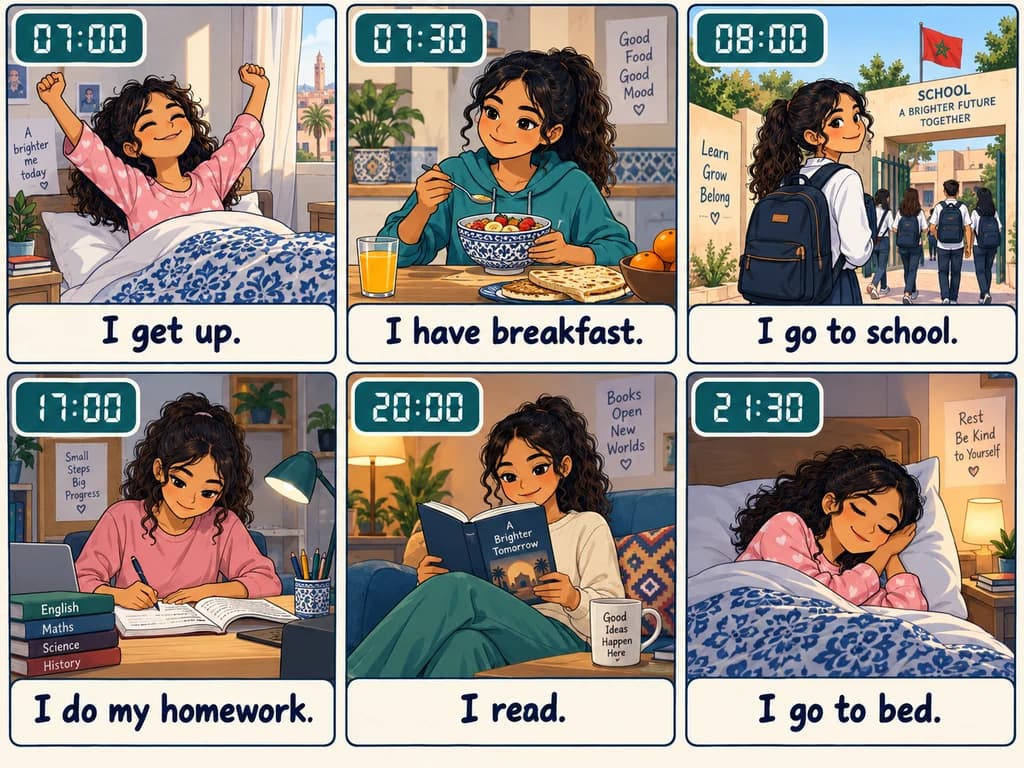
Read the picture from left to right, then continue on the second row. It shows an imaginary day: getting up at 07:00, breakfast at 07:30, school at 08:00, homework at 17:00, reading at 20:00 and bed at 21:30. Your routine may be different. Practise expressing your own times.
Wake up means stop sleeping. Get up means leave your bed. You can wake up before you get up! Learn go home without to, but go to school and go to bed with to.
How do you form the present simple?
Definition
Present simple : Use the present simple for habits and regular actions. With I, you, we and they, use the base verb. With he, she and it, usually add s in a positive statement.
| Base verb | With I | With she | Spelling note |
|---|---|---|---|
| get up | I get up. | She gets up. | Add s |
| play | I play. | She plays. | Keep y after a vowel |
| watch | I watch. | She watches. | Add es after ch |
| brush | I brush my teeth. | She brushes her teeth. | Add es after sh |
| study | I study. | She studies. | Consonant + y changes to ies |
| go | I go. | She goes. | Learn goes |
| have | I have breakfast. | She has breakfast. | Learn has |
When changing I to she, check possessives too: I do my homework becomes She does her homework. Do not add s with they: They play football. Compare He plays football.
How do you use do and does in questions and negatives?
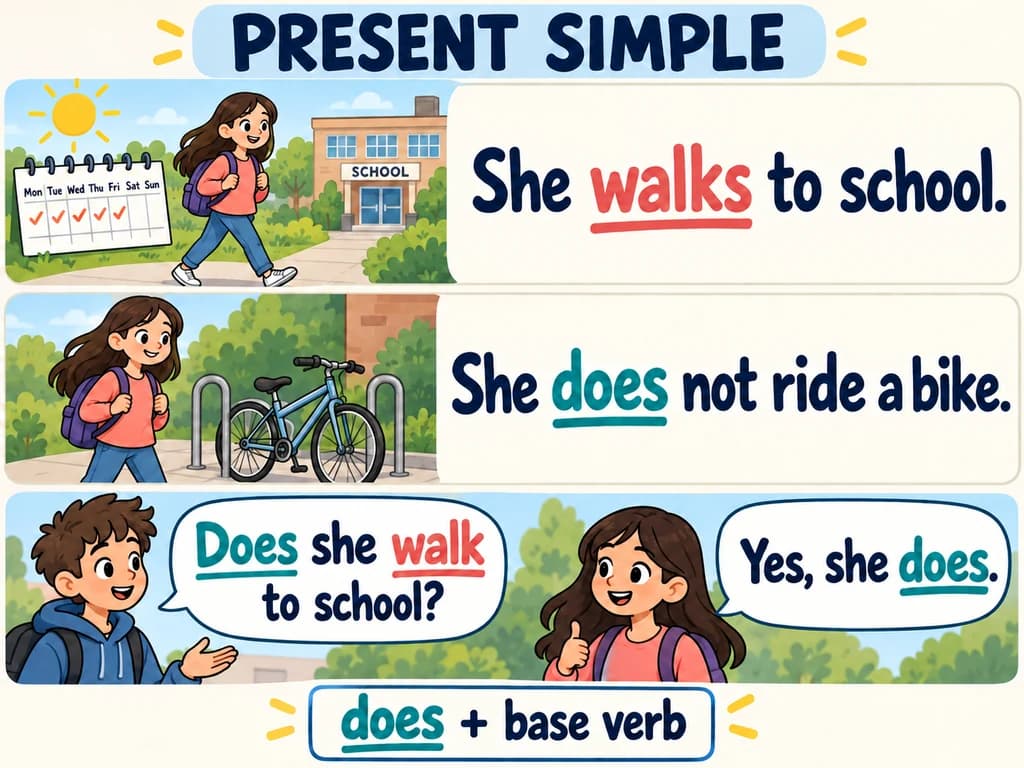
| Subject | Negative | Question | Short answer |
|---|---|---|---|
| I / you / we / they | I don’t watch TV. | Do you read? | Yes, I do. / No, I don’t. |
| he / she / it | She doesn’t watch TV. | Does she read? | Yes, she does. / No, she doesn’t. |
Remember
After does or doesn’t, use the base verb: Does she walk? She doesn’t walk. Do not write Does she walks? Be has its own pattern: She isn’t tired, not She doesn’t be tired.
Questions about an activity, time or place
| Question | Example answer |
|---|---|
| What do you do after school? | I do my homework. |
| What time do you get up? | I get up at seven. |
| When does he read? | He reads in the evening. |
| Where do they play? | They play in the playground. |
Ask about a starting time
She starts school at eight.
- Use does with she in the question.
- Change starts back to the base form start.
- Ask What time does she start school? Answer She starts school at eight.
How do you write numbers from 20 to 100?
| Number | Word | Another example |
|---|---|---|
| 20 | twenty | 21: twenty-one |
| 30 | thirty | 32: thirty-two |
| 40 | forty | 43: forty-three |
| 50 | fifty | 54: fifty-four |
| 60 | sixty | 65: sixty-five |
| 70 | seventy | 76: seventy-six |
| 80 | eighty | 87: eighty-seven |
| 90 | ninety | 98: ninety-eight |
| 100 | one hundred | A hundred is also possible |
Use a hyphen in numbers such as twenty-five and forty-eight. There is no u in forty. Practise the pairs thirteen/thirty and fifteen/fifty with your teacher. When counting separately, the main stress is usually on teen in thirteen and on the first syllable in thirty.
How do you tell the time in English?
Ask What time is it? Start the answer with It’s. You can read the hour and minutes directly: It’s seven thirty. You can also use past and to. A quarter is fifteen minutes; half an hour is thirty minutes.
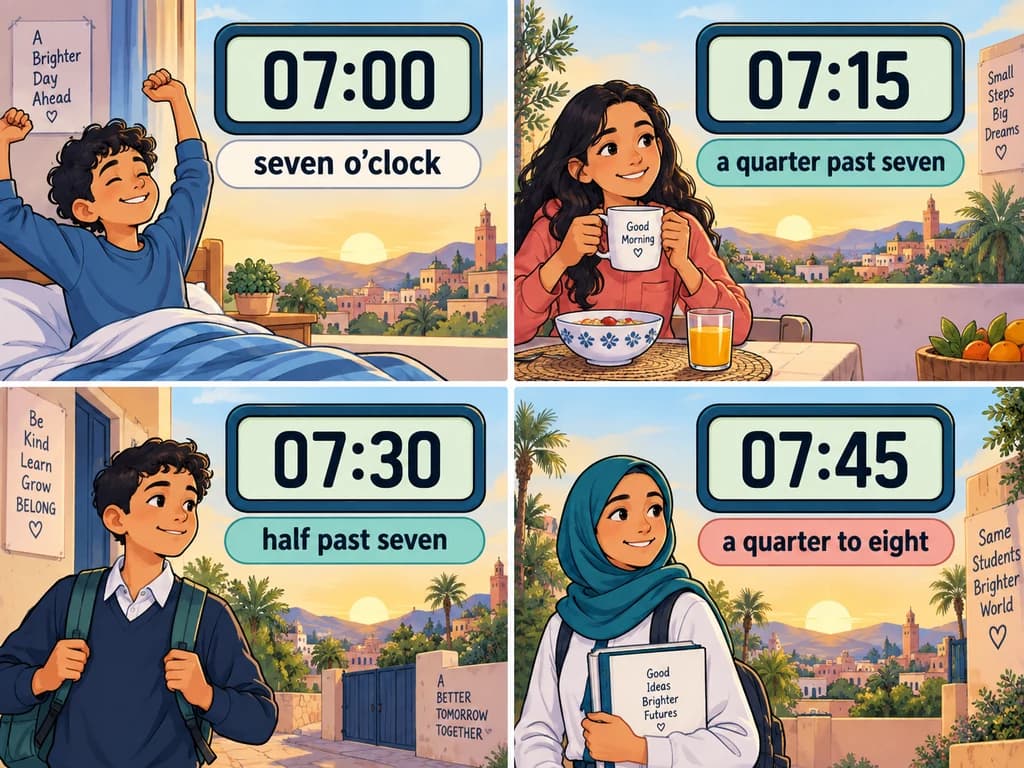
| Time | Direct reading | With past or to |
|---|---|---|
| 07:00 | seven o’clock | seven o’clock |
| 07:15 | seven fifteen | a quarter past seven |
| 07:30 | seven thirty | half past seven |
| 07:45 | seven forty-five | a quarter to eight |
| 08:10 | eight ten | ten past eight |
| 08:50 | eight fifty | ten to nine |
Past counts minutes after the hour. To counts minutes before the next hour. At 07:45, fifteen minutes remain before eight: a quarter to eight. Use o’clock only for an exact hour, such as seven o’clock.
Step by step
Read a time accurately
- Identify the hour and the minutes.
- At :15 use a quarter past; at :30 use half past.
- At :45 use a quarter to and name the next hour.
- If unsure, read the hour and minutes directly: seven forty-five.
- For an activity, add at: I leave at a quarter to eight.
Make the part of the day clear: seven in the morning is 07:00; seven in the evening is 19:00. AM covers the hours from midnight to before noon; PM covers noon to before midnight. For 12:00, noon means midday and midnight means the middle of the night.
How do before, after and then organise a routine?
| Word or phrase | Meaning in the example | Example |
|---|---|---|
| before | Earlier than | I have breakfast before school. |
| after | Later than | I go home after school. |
| first | The starting activity | First, I get up. |
| then | The next activity | Then, I get dressed. |
| in the morning | The first part of the day | I study in the morning. |
| in the evening | The later part of the day | I read in the evening. |
| at night | During the night | I sleep at night. |
Before and after show order, not an exact time. I read after dinner tells us that reading follows dinner. Add a time if needed: I read after dinner, at eight. Remember at seven but in the morning.
How do you invite a friend to an activity?
| Purpose | Useful expression |
|---|---|
| Suggest an activity | Let’s play football. |
| Ask about interest | Do you want to read with me? |
| Ask if someone can come | Can you come to the park? |
| Accept | Sure! / Sounds great! |
| Decline politely | Sorry, I can’t. |
| Give a time | At five, after school. |
Use a base verb after Let’s and can: Let’s play. Can you come? Use to before the verb after want: Do you want to read? Practise a short invitation with a clear activity and time.
Reading: two different routines
My name is Yasmine. On school days, I get up at seven. I have breakfast at half past seven. My brother gets up at a quarter past seven. We go to school at eight. After school, I do my homework. My brother reads a book. In the evening, we have dinner together. I don’t watch TV before school.
Who gets up first? Yasmine, at seven; her brother gets up at 07:15. What does he do after school? He reads a book. What time do they have dinner? The text does not say. Use the information given instead of inventing an answer.
Mini-project: my day and my partner’s day
Step by step
Build a six-sentence routine
- Choose six activities and a time for each.
- Write sentences with I and the present simple.
- Use before, after or then to show the order.
- Ask a partner two questions about their routine.
- Report one of their habits with he or she. Check the verb ending.
- For listening practice, let your partner read three sentences while you note the activities and times.
Frequently asked questions
What does English 1AC Unit 3 cover?
How do I write about my daily routine in English?
What is the difference between do and does?
How do I say 7:45 in English?
Is half past seven 7:30 or 6:30?
Quiz: 20 questions
20 questions are randomly selected from this lesson’s 24-question bank. Choose one answer for each question and get an immediate explanation.
Q1Which tense describes a regular routine here?
Incorrect answer
The present simple describes habits and regular actions.
Correct answer: Present simple
The present simple describes habits and regular actions.
Q2Complete: She … up at seven.
Incorrect answer
Add s to get in a positive statement with she.
Correct answer: gets
Add s to get in a positive statement with she.
Q3Complete: He … English.
Incorrect answer
Consonant plus y changes to ies: study becomes studies.
Correct answer: studies
Consonant plus y changes to ies: study becomes studies.
Q4Complete: She … breakfast at seven.
Incorrect answer
Have changes to has with he, she or it.
Correct answer: has
Have changes to has with he, she or it.
Q5Choose the correct negative.
Incorrect answer
Use doesn’t plus the base verb walk.
Correct answer: She doesn’t walk.
Use doesn’t plus the base verb walk.
Q6Choose the correct question.
Incorrect answer
Does matches he, and read stays in its base form.
Correct answer: Does he read?
Does matches he, and read stays in its base form.
Q7Do you walk to school? Yes, …
Incorrect answer
A do question takes do in the short answer.
Correct answer: I do.
A do question takes do in the short answer.
Q8What time do you get up?
Incorrect answer
What time asks for a time, so At seven fits.
Correct answer: At seven.
What time asks for a time, so At seven fits.
Q9Choose the spelling of 40.
Incorrect answer
Forty is written without a u.
Correct answer: Forty
Forty is written without a u.
Q10Which number is fifty?
Incorrect answer
Fifty is 50; fifteen is 15.
Correct answer: 50
Fifty is 50; fifteen is 15.
Q1107:15 is…
Incorrect answer
Fifteen minutes after seven is a quarter past seven.
Correct answer: a quarter past seven.
Fifteen minutes after seven is a quarter past seven.
Q1207:30 is…
Incorrect answer
Half an hour after seven is half past seven.
Correct answer: half past seven.
Half an hour after seven is half past seven.
Q1307:45 is…
Incorrect answer
At 07:45, fifteen minutes remain before eight.
Correct answer: a quarter to eight.
At 07:45, fifteen minutes remain before eight.
Q1408:50 is…
Incorrect answer
08:50 is ten minutes before nine.
Correct answer: ten to nine.
08:50 is ten minutes before nine.
Q15Complete: I leave … eight o’clock.
Incorrect answer
Use at with a clock time.
Correct answer: at
Use at with a clock time.
Q16Complete: I read … the evening.
Incorrect answer
The phrase is in the evening.
Correct answer: in
The phrase is in the evening.
Q17Before school means…
Incorrect answer
Before shows that one activity comes earlier.
Correct answer: earlier than school.
Before shows that one activity comes earlier.
Q18Choose the correct phrase.
Incorrect answer
Go home does not take to.
Correct answer: go home
Go home does not take to.
Q19Complete: Let’s … football.
Incorrect answer
Let’s is followed by a base verb.
Correct answer: play
Let’s is followed by a base verb.
Q20Choose a polite refusal.
Incorrect answer
Sorry, I can’t politely declines an invitation.
Correct answer: Sorry, I can’t.
Sorry, I can’t politely declines an invitation.
Q21Complete: Do you want … read?
Incorrect answer
Use want to plus the base verb read.
Correct answer: to
Use want to plus the base verb read.
Q22Which word means the next activity?
Incorrect answer
Then helps show the next step in a sequence.
Correct answer: Then
Then helps show the next step in a sequence.
Q23Seven in the evening is…
Incorrect answer
19:00 is seven on a 12-hour clock in the evening.
Correct answer: 19:00.
19:00 is seven on a 12-hour clock in the evening.
Q24Choose the correct sentence.
Incorrect answer
Use the base verb with they in the present simple.
Correct answer: They play football.
Use the base verb with they in the present simple.
Your score
0/20
Start with the worked examples
Read the lesson in small sections. Write your own example for each rule and try the Easy exercises before returning to the quiz.
Review: 20 missed questions
Which tense describes a regular routine here?
Correct answerPresent simple
The present simple describes habits and regular actions.
Complete: She … up at seven.
Correct answergets
Add s to get in a positive statement with she.
Complete: He … English.
Correct answerstudies
Consonant plus y changes to ies: study becomes studies.
Complete: She … breakfast at seven.
Correct answerhas
Have changes to has with he, she or it.
Choose the correct negative.
Correct answerShe doesn’t walk.
Use doesn’t plus the base verb walk.
Choose the correct question.
Correct answerDoes he read?
Does matches he, and read stays in its base form.
Do you walk to school? Yes, …
Correct answerI do.
A do question takes do in the short answer.
What time do you get up?
Correct answerAt seven.
What time asks for a time, so At seven fits.
Choose the spelling of 40.
Correct answerForty
Forty is written without a u.
Which number is fifty?
Correct answer50
Fifty is 50; fifteen is 15.
07:15 is…
Correct answera quarter past seven.
Fifteen minutes after seven is a quarter past seven.
07:30 is…
Correct answerhalf past seven.
Half an hour after seven is half past seven.
07:45 is…
Correct answera quarter to eight.
At 07:45, fifteen minutes remain before eight.
08:50 is…
Correct answerten to nine.
08:50 is ten minutes before nine.
Complete: I leave … eight o’clock.
Correct answerat
Use at with a clock time.
Complete: I read … the evening.
Correct answerin
The phrase is in the evening.
Before school means…
Correct answerearlier than school.
Before shows that one activity comes earlier.
Choose the correct phrase.
Correct answergo home
Go home does not take to.
Complete: Let’s … football.
Correct answerplay
Let’s is followed by a base verb.
Choose a polite refusal.
Correct answerSorry, I can’t.
Sorry, I can’t politely declines an invitation.
Exercises with answers
14 exercises, from easy practice to challenges. Try each one yourself, then reveal the answer and explanation.
Exercise 1
EasyComplete with up, breakfast, school or bed: get …; have …; go to … in the morning; go to … at night.
Answer and explanation
Get up; have breakfast; go to school; go to bed. Learn the small words with the activity.
Exercise 2
EasyChange the subject: I get up. I play. I watch TV. I study. I have breakfast.
Answer and explanation
She gets up. She plays. She watches TV. She studies. She has breakfast. Check s, es, ies and the special form has.
Exercise 3
EasyWrite 30, 40, 50, 75 and 100 in words.
Answer and explanation
Thirty, forty, fifty, seventy-five and one hundred. Forty has no u; seventy-five needs a hyphen.
Exercise 4
EasyMatch 07:00, 07:15, 07:30 and 07:45 with half past seven, seven o’clock, a quarter to eight and a quarter past seven.
Answer and explanation
07:00 is seven o’clock; 07:15 is a quarter past seven; 07:30 is half past seven; 07:45 is a quarter to eight.
Exercise 5
EasyComplete with at, in or on: … seven; … the morning; … Monday; … night.
Answer and explanation
At seven; in the morning; on Monday; at night. Practise each time expression as a complete phrase.
Exercise 6
IntermediateMake negative: I watch TV before school. She walks to school. They play in the morning.
Answer and explanation
I don’t watch TV before school. She doesn’t walk to school. They don’t play in the morning. Use a base verb after don’t or doesn’t.
Exercise 7
IntermediateAsk yes/no questions: You read after school. He gets up at six. They walk home.
Answer and explanation
Do you read after school? Does he get up at six? Do they walk home? Gets becomes get after does.
Exercise 8
IntermediateAnswer: Do you study English? (yes) Does she walk home? (no) Do they read? (no)
Answer and explanation
Yes, I do. No, she doesn’t. No, they don’t. Match do or does and the pronoun to each question.
Exercise 9
IntermediateWrite 08:10, 08:50 and 09:45 using past or to.
Answer and explanation
Ten past eight; ten to nine; a quarter to ten. With to, name the next hour, not the hour already started.
Exercise 10
IntermediateYou get up, get dressed, then have breakfast. Write three sentences with first, then and after.
Answer and explanation
First, I get up. Then, I get dressed. I have breakfast after I get dressed. Other sentences are possible if they keep the same order.
Exercise 11
IntermediateUse the reading. Who gets up at seven? What does her brother do after school? Does Yasmine watch TV before school?
Answer and explanation
Yasmine gets up at seven. Her brother reads a book after school. No, she doesn’t watch TV before school. The text states each answer.
Exercise 12
IntermediateAsk a partner to read: I have breakfast at seven thirty. I start school at eight. I read at eight in the evening. Write the three activities and 24-hour times.
Answer and explanation
Breakfast: 07:30. School: 08:00. Reading: 20:00. The phrase in the evening makes the last time 20:00.
Exercise 13
ChallengeWrite a four-turn conversation inviting a friend to read after school at five. Include an acceptance.
Answer and explanation
Model: A: Do you want to read with me after school? B: Sure! What time? A: At five. B: Sounds great! The activity and time are both clear.
Exercise 14
ChallengeCorrect: She get up at seven. She doesn’t watches TV. She go to school at eight. Add a question about her starting time.
Answer and explanation
She gets up at seven. She doesn’t watch TV. She goes to school at eight. What time does she start school? Positive she forms take an ending; the verb after does or doesn’t does not.