



Comprehension 1 : A football legend
Reading a football biography in English starts with finding what the writer wants you to remember about the player. In this original 2 Bac profile of Larbi Ben Barek, club names and dates help you follow the career. Other details explain why the career mattered.
By the end of this lesson, you can
- Skim a biography for its central idea.
- Find dates, places and names quickly.
- Support an inference with a detail from the text.
Un bon cours, ça se partage.
Reading passage: A career that crossed borders
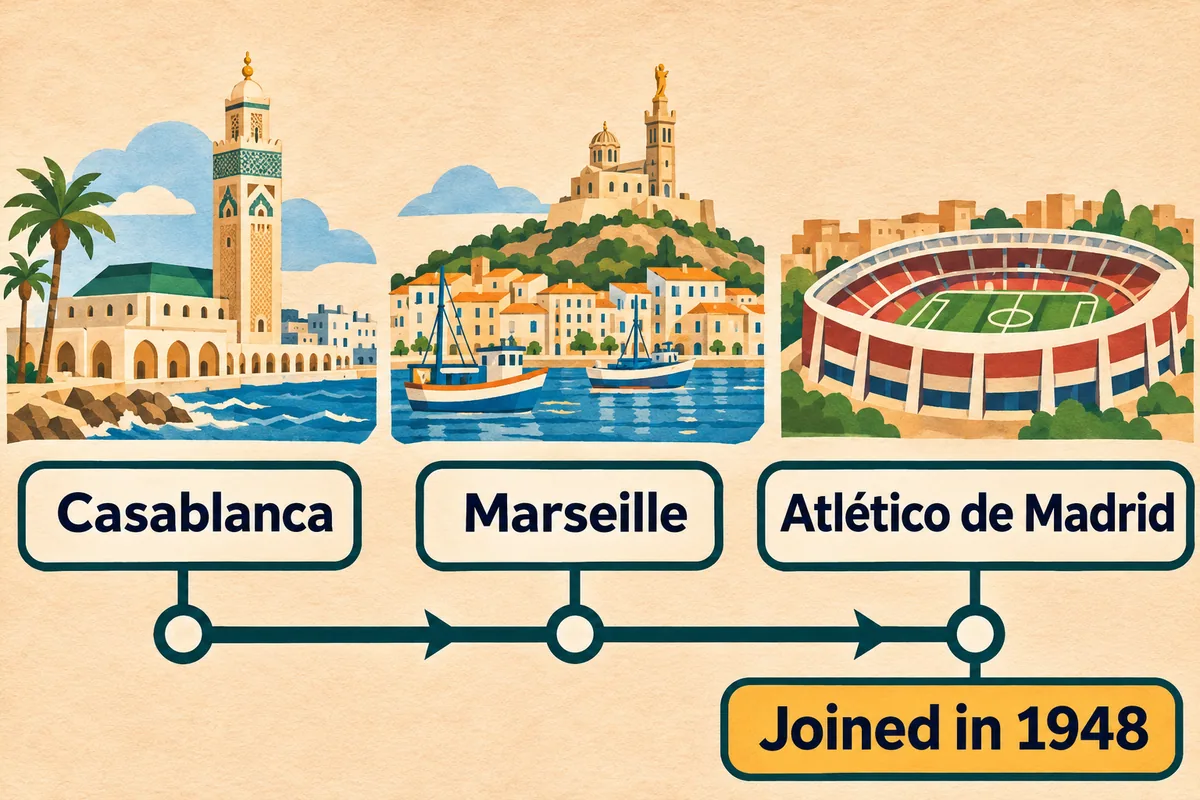
Larbi Ben Barek grew up in Casablanca and began his football career in Morocco. As a young player, he developed the ball control and vision that helped him succeed as a forward. He joined Olympique de Marseille in France in 1938. Moving abroad gave him the chance to test his skills at a new level. He later played for Stade Français before another move took him to Spain.
In 1948, Ben Barek joined Atlético de Madrid. He spent five seasons with the Spanish club and helped it win two league titles. Atlético records 63 goals in his 123 official appearances for the club. He was part of an attacking line that supporters still remember. A forward’s goals are easy to count, but an attack also depends on the players’ ability to read the game and create chances together. Ben Barek’s career is remembered in more than one country because he made his mark in Morocco, France and Spain.
Decades later, Atlético and Morocco paid tribute to him before a Morocco–Peru match in Madrid. The stadium screens showed his photograph and spectators applauded. The ceremony took place before either team had scored, so the first name the crowd celebrated was that of a player from another generation. Young spectators who had never seen him play could still learn something from his story. Talent opened doors, and his ability to adapt allowed him to keep creating opportunities.
How to read a biography quickly
Step by step
Three passes through the text
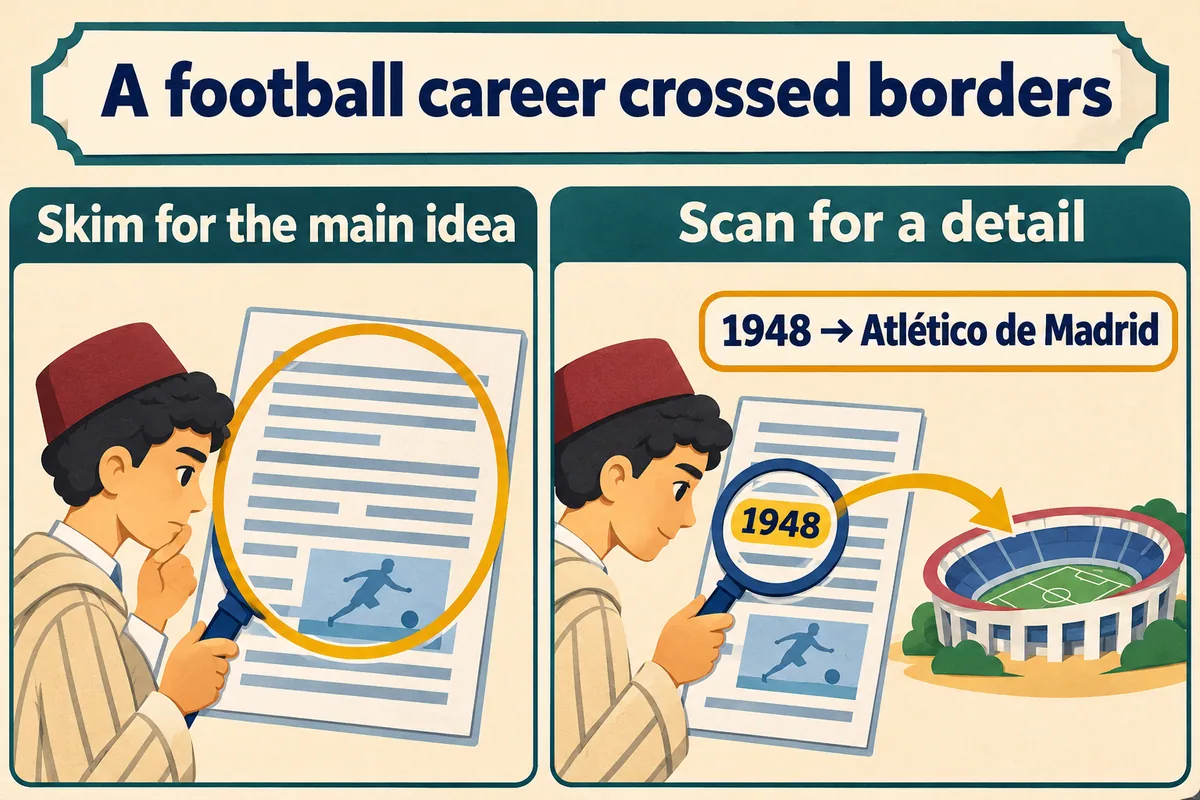
- Read the first sentence of each paragraph. The passage moves from early life to success abroad and then to remembrance.
- Scan for capital letters and numbers when a detail is needed. The year 1948 belongs to his move to Atlético de Madrid.
- Read the full sentence around a detail. The two titles were won with the Spanish club, not with Marseille.
Evidence, reference and meaning from context
| Reading move | A model of the reasoning |
|---|---|
| Identify a reference | In « helped it win two league titles », it refers to Atlético de Madrid, the closest club named in that paragraph. |
| Infer a meaning | The crowd paid tribute to him long after his playing career. The phrase means they publicly showed respect for him. |
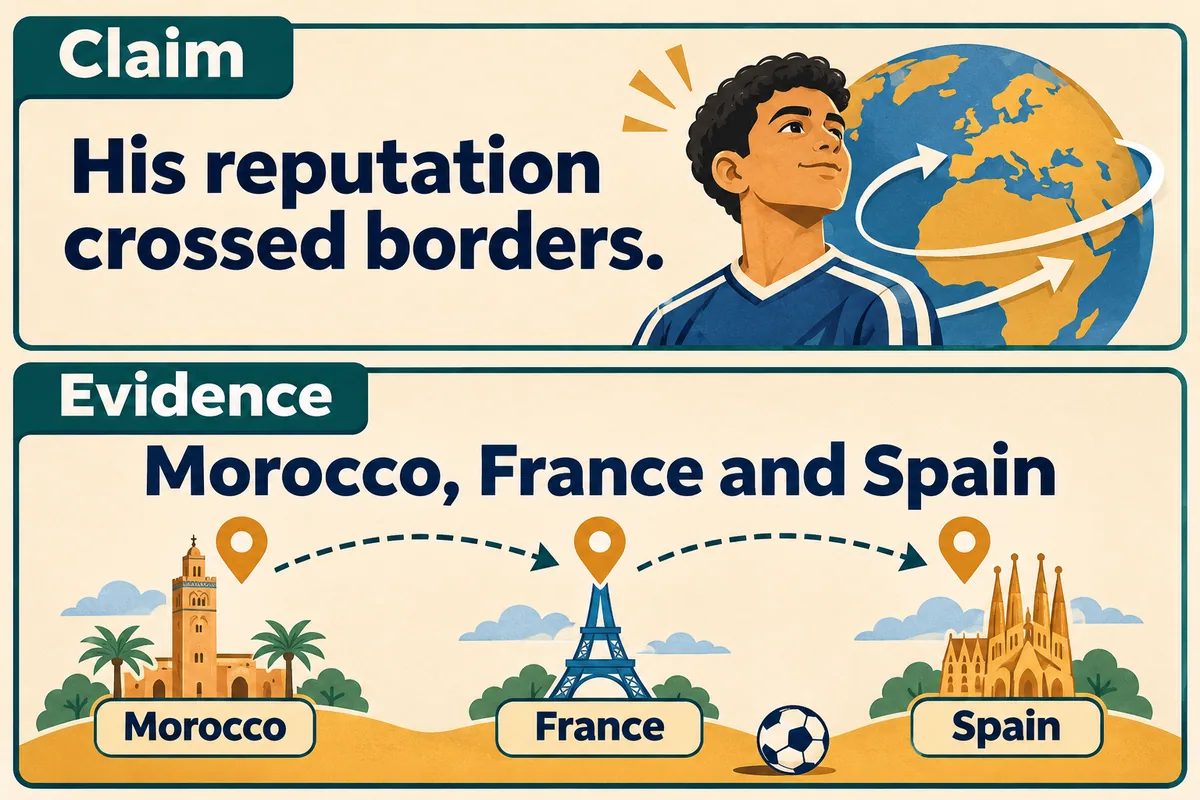
| Justify an inference | The claim that his reputation crossed borders is supported by the passage’s references to Morocco, France and Spain. |
A one-sentence summary
« Larbi Ben Barek built a career across Morocco, France and Spain by applying his football talent in different surroundings. » This sentence gives the subject and the central idea without listing every club.
Find evidence for a biography question
Before reading, use the title to predict the subject. While reading, note one event and one detail from each paragraph. When asked to correct a false statement, give the correct detail and show where it appears. When asked what a word refers to, supply the relevant noun phrase. For vocabulary in context, replace the unknown word with a possible meaning and reread the sentence.
Worked examples: answering reading questions on a biography
A true or false question with a justification
True or false? « Ben Barek won league titles with Olympique de Marseille. »
- Scan the passage for the key word titles. It appears in paragraph 2.
- Read the whole sentence: the titles belong to the years after « In 1948, Ben Barek joined Atlético de Madrid. »
- Answer: False. Justify with the text: « He spent five seasons with the Spanish club and helped it win two league titles. »
Guessing a meaning from context
What does « made his mark » mean in paragraph 2?
- Read the sentence: his career is remembered in more than one country « because he made his mark in Morocco, France and Spain ».
- The phrase explains why people remember him, so it must mean that he had a strong, lasting effect.
- Test the meaning in the sentence: « because he became well known and respected in Morocco, France and Spain ». The sentence still makes sense, so the answer is correct.
Sources and curriculum
- English Language Guidelines for Secondary Schools (Ministry of Education, 2007)
The 2nd Baccalaureate syllabus describes the ten themes, four skills and language structures. See printed pages 76–84.
- National Baccalaureate Exam Specifications (English, 2025)
Reproduction of the national framework for the reading, language and writing sections, including the science streams.
- Atlético de Madrid · Tribute to Larbi Ben Barek
Confirms his seasons at Atlético, the club’s league titles and the tribute in Madrid.
- French Football Federation · Larbi Ben Barek
Lists his professional clubs and national-team career.
Frequently asked questions
What is the main idea of A football legend?
How do I justify a reading comprehension answer?
Who was Larbi Ben Barek?
Exercises with answers
4 exercises, from easy practice to challenges. Try each one yourself, then reveal the answer and explanation.
Exercise 1
EasyAnswer each question with a short phrase from the passage.
- In which city did Ben Barek grow up?
- Which French club did he join in 1938?
- How many seasons did he spend with Atlético de Madrid?
- How many official appearances does Atlético record for him?
- Before which match did the tribute take place?
Answer and explanation
- Casablanca.
- Olympique de Marseille.
- Five seasons.
- 123 official appearances.
- A Morocco–Peru match in Madrid.
Exercise 2
Intermediate- True or false? Ben Barek joined Atlético before moving to Marseille. Justify.
- Find the expression that means publicly showed respect for him.
- Why does the writer mention three countries?
Answer and explanation
- False. The opening describes his move to Marseille. He joined Atlético later, in 1948.
- Paid tribute to him.
- They support the point that he played and earned recognition across different countries.
Exercise 3
IntermediateAnswer the questions about words in the passage.
- Find a word in paragraph 1 that means to check how good something is.
- Find a word in paragraph 3 that means clapped to show approval.
- Find the word in paragraph 1 that names a player whose main role is to attack and score.
- In « was that of a player from another generation », what does that refer to?
- In « could still learn something from his story », whose story is it?
Answer and explanation
- Test (« to test his skills at a new level »).
- Applauded.
- Forward.
- The name. The first name the crowd celebrated was the name of a player from another generation.
- Larbi Ben Barek’s story.
Exercise 4
ChallengeAnswer in complete sentences and support your answers with the passage.
- Why does the writer point out that the tribute took place before either team had scored?
- Quote the sentence that explains why goals alone do not describe a forward’s contribution.
- What lesson does the writer draw for young spectators?
- In about 40 words, say whether Ben Barek is a good role model for young Moroccan athletes and why.
Answer and explanation
- To show that the crowd celebrated a player from the past before celebrating anyone on the pitch, which shows how much he is still respected.
- « A forward’s goals are easy to count, but an attack also depends on the players’ ability to read the game and create chances together. »
- Talent can open doors, but the ability to adapt helps a person keep creating opportunities.
- One answer is « Yes. Ben Barek left Casablanca, adapted to new clubs in France and Spain and succeeded at each level. His career shows young athletes that talent must be combined with hard work and the courage to try new challenges. »