



Writing 4 : A formal letter
A formal letter states its purpose early, explains the request clearly and uses a closing that matches the greeting. In this English 2 Bac writing model, a student writes on behalf of a school eco-club to request two recycling bins.
By the end of this lesson, you can
- Organise a formal letter from date and greeting to signature.
- State a specific request and explain why it is needed.
- Match the closing to the salutation in British English.
Un bon cours, ça se partage.
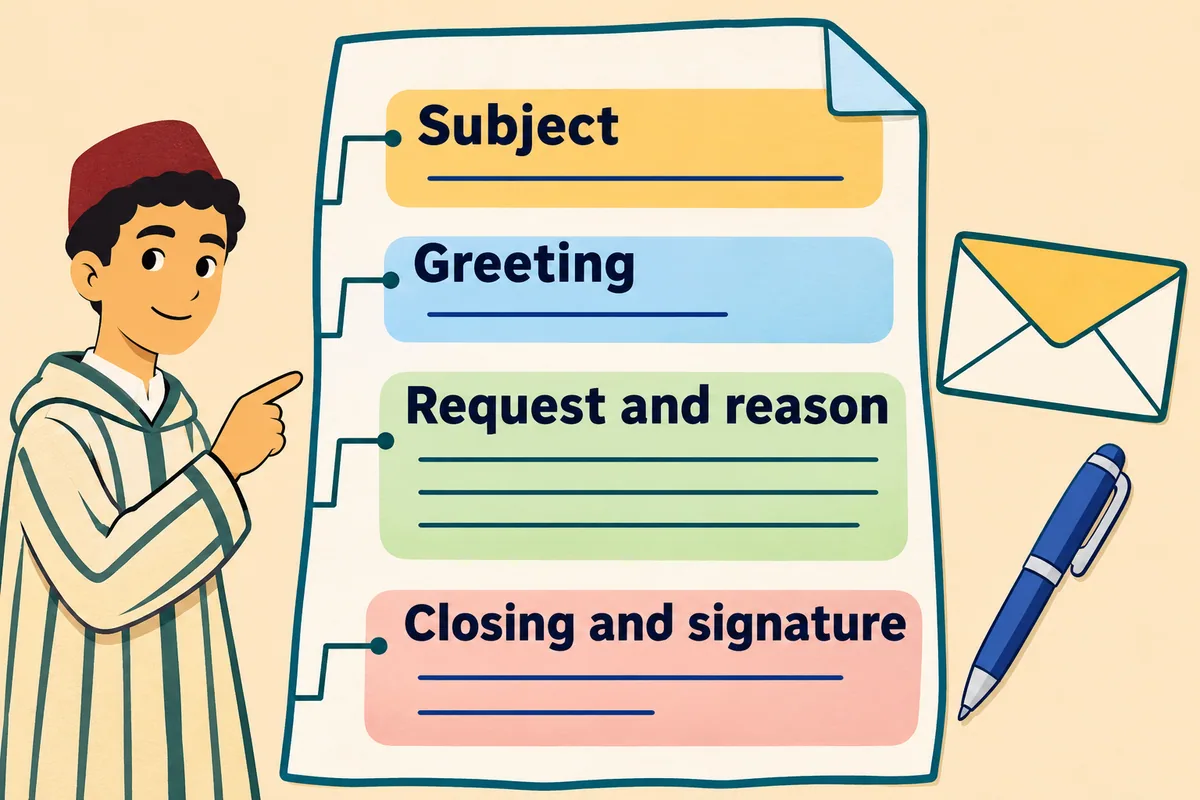
How do you structure a formal letter?
| Part | What to write |
|---|---|
| Date and addresses | Use a clear date. Include sender and recipient addresses if your task expects a full postal format. |
| Subject and salutation | Give a brief subject if appropriate. Use « Dear Sir or Madam, » when the recipient’s name is unknown. |
| Opening | State who you are if relevant and give the purpose in the first sentence. |
| Body | Explain the issue, specify what you are asking for and add practical details. |
| Close and signature | Thank the reader, use an appropriate sign-off and sign with your name and role. |
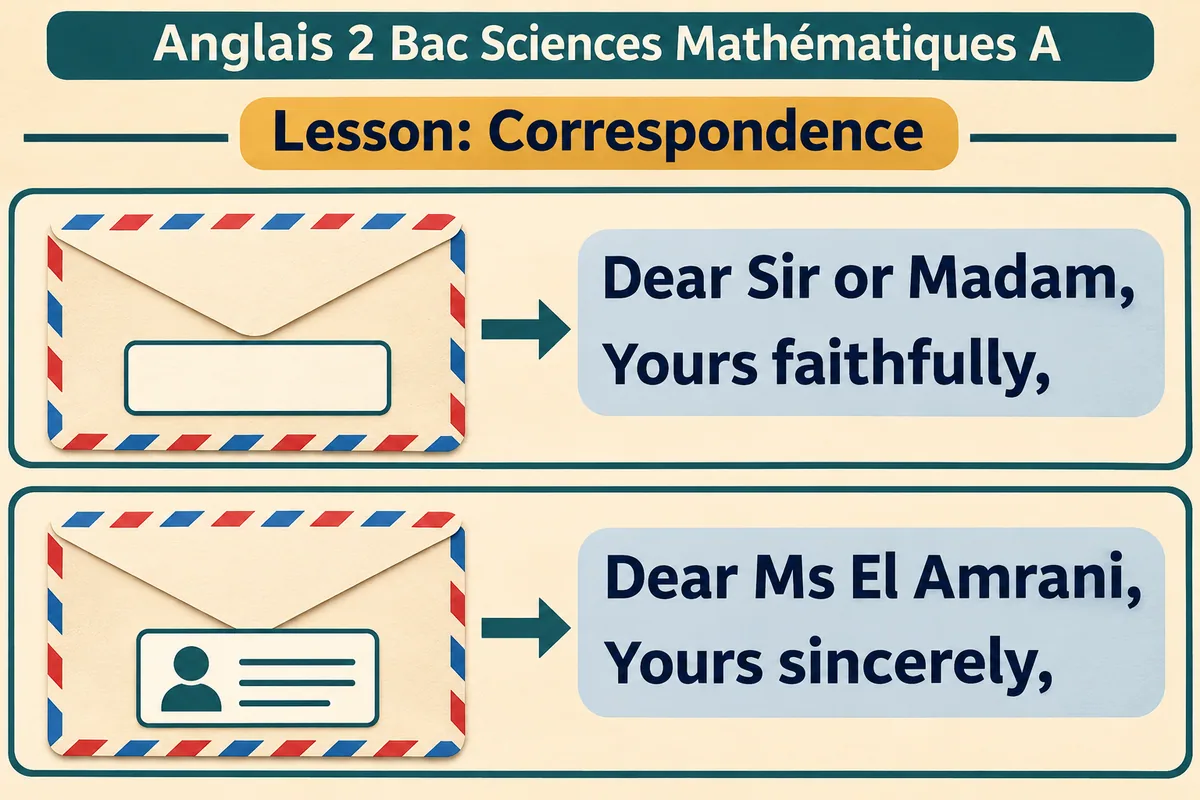
Use a courteous form such as « Could you provide …? » or « I would be grateful if you could … ». Use the full form « I am writing » in a formal request. In British convention, « Dear Sir or Madam » pairs with « Yours faithfully ». A named greeting commonly pairs with « Yours sincerely ».
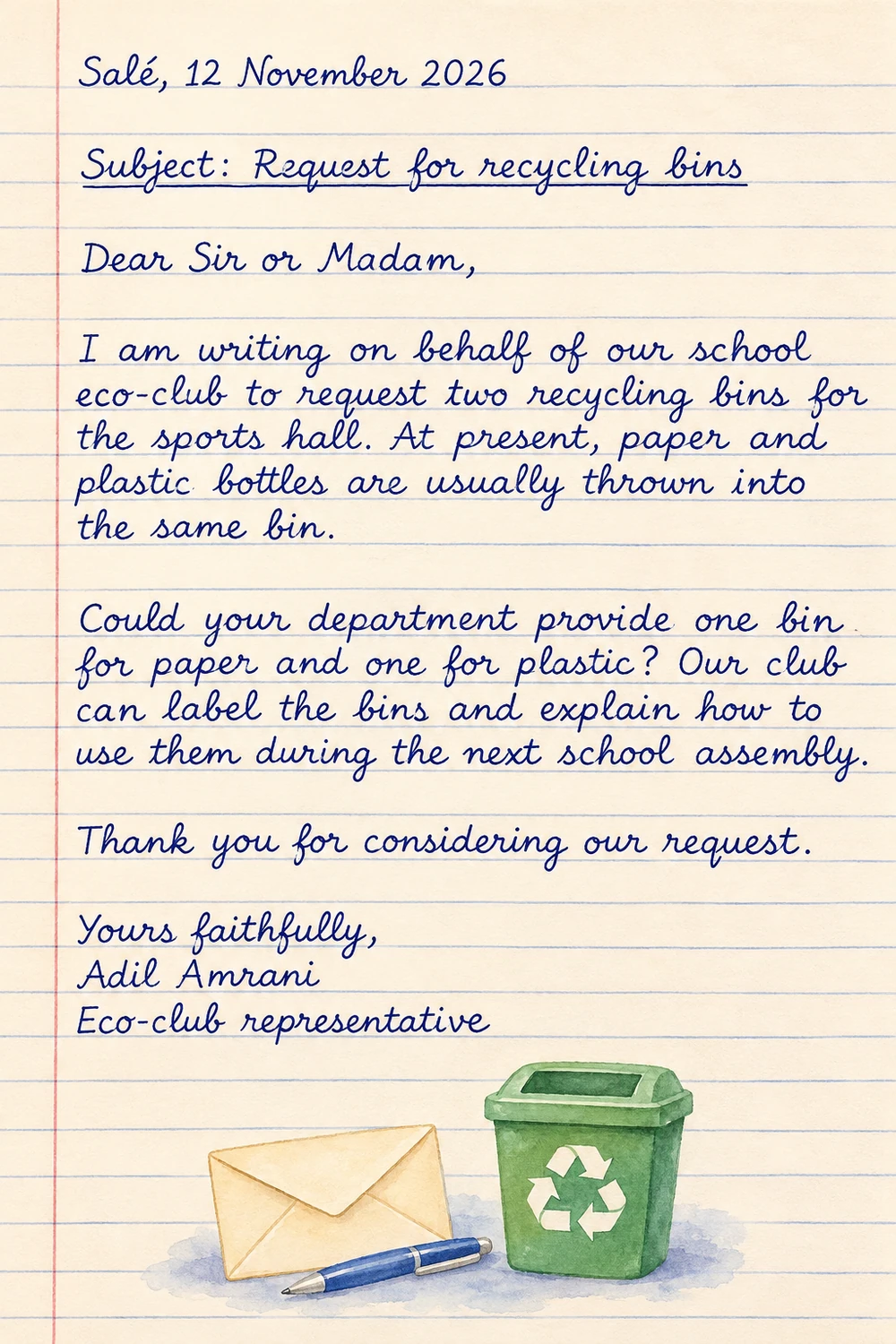
Complete model: Request for recycling bins
Salé, 12 November 2026
Subject: Request for recycling bins
Dear Sir or Madam,
I am writing on behalf of our school eco-club to request two recycling bins for the sports hall. At present, paper and plastic bottles are usually thrown into the same bin.
Could your department provide one bin for paper and one for plastic? Our club can label the bins and explain how to use them during the next school assembly.
Thank you for considering our request.
Yours faithfully,
Adil Amrani
Eco-club representative
Why the model works
The writer gives the reader a precise quantity, location and purpose. « At present » introduces the existing problem. In the following paragraph, the club offers to label the bins and explain their use, which makes the request easier to act on.
Remember
Keep the same level of formality from start to finish. If the recipient is unknown, « Dear Sir or Madam » and « Yours faithfully » are a consistent pair.
Write a request, complaint or application
Match the opening to the task: « I am writing to request … », « I am writing to complain about … » or « I am writing to apply for … ». Follow it with relevant facts, describe the action you are asking for and close courteously. In a British-style letter, Yours faithfully usually follows a greeting without a personal name, and Yours sincerely follows a named recipient. Follow any exam direction about signing.
Worked examples: writing in a formal register
Making a request formal
Rewrite « I want you to fix the street lights near our school. »
- Replace the direct I want you to with a polite structure: « I would be grateful if you could … ».
- Replace the informal verb fix with repair.
- Add the reason that makes the request urgent: « as students walk home after dark in winter ».
- Final version: « I would be grateful if you could repair the street lights near our school, as students walk home after dark in winter. »
Building a complaint letter
Order the parts of a complaint about a broken water fountain in a public garden.
- Opening: « I am writing to complain about the water fountain in Al Amal Garden, which has been broken for two months. »
- Facts: when you noticed the problem and who is affected, for example families with young children in summer.
- Request: « Could your department repair the fountain before the summer holidays? »
- Closing: « Thank you for your attention. I look forward to hearing from you. » Then Yours faithfully and your full name.
Sources and curriculum
- English Language Guidelines for Secondary Schools (Ministry of Education, 2007)
The 2nd Baccalaureate syllabus describes the ten themes, four skills and language structures. See printed pages 76–84.
- National Baccalaureate Exam Specifications (English, 2025)
Reproduction of the national framework for the reading, language and writing sections, including the science streams.
Frequently asked questions
When do I use Yours faithfully or Yours sincerely?
What is a good first sentence for a formal request letter?
What is the difference between a formal letter and a formal email?
Exercises with answers
4 exercises, from easy practice to challenges. Try each one yourself, then reveal the answer and explanation.
Exercise 1
EasySay whether each expression is formal or informal.
- « Hi there! »
- « Dear Sir or Madam, »
- « I’m writing to ask … »
- « I look forward to hearing from you. »
- « See you soon! »
Answer and explanation
- Informal.
- Formal.
- Informal, because of the contraction. The formal version is « I am writing to ask … ».
- Formal.
- Informal.
Exercise 2
Intermediate- Write to a town council about broken signs near your school and ask for a specific action.
Answer and explanation
- One answer is « Dear Sir or Madam, I am writing about two damaged signs near the entrance to our school. Could the council replace them before the new term begins? Clear signs would help drivers see where students cross. Yours faithfully, »
Exercise 3
IntermediateRewrite each sentence for a formal letter.
- « Can you send me the form? »
- « The bus is always late and it’s really annoying. »
- « Thanks a lot. »
- « Write back soon. »
- « I want to complain about the noise. »
Answer and explanation
- « I would be grateful if you could send me the application form. »
- « The bus is regularly late, which causes serious difficulties for students. »
- « Thank you for your attention. »
- « I look forward to hearing from you. »
- « I am writing to complain about the noise. »
Exercise 4
ChallengeWrite a formal letter of about 120 words to the director of your town’s youth centre. Ask for the computer room to open on Saturday mornings and explain why.
- Write your letter.
Answer and explanation
- Possible answer: « Dear Sir or Madam, I am writing on behalf of a group of 2 Bac students to request that the computer room of the youth centre be opened on Saturday mornings. At present, the room is only open on weekday afternoons, when we are still at school. Many of us do not have a computer at home, and we need one to prepare our university applications and to practise online exercises. Could the centre open the room from 9 a.m. to 12 p.m. on Saturdays? Two of our parents have offered to supervise the room, and we would take care of the equipment. Thank you for considering our request. I look forward to hearing from you. Yours faithfully, Youssef Bennani »