



Vocabulary 4 · Sustainable Development
Sustainable development meets people’s needs now while protecting the ability of future generations to meet theirs. English 2 Bac students can explain a project by considering its environmental, social and economic effects and choosing precise words for each one.
By the end of this lesson, you can
- Explain the three dimensions of sustainable development.
- Use topic vocabulary, word families and collocations in context.
- Describe local action with an observable result.
Un bon cours, ça se partage.
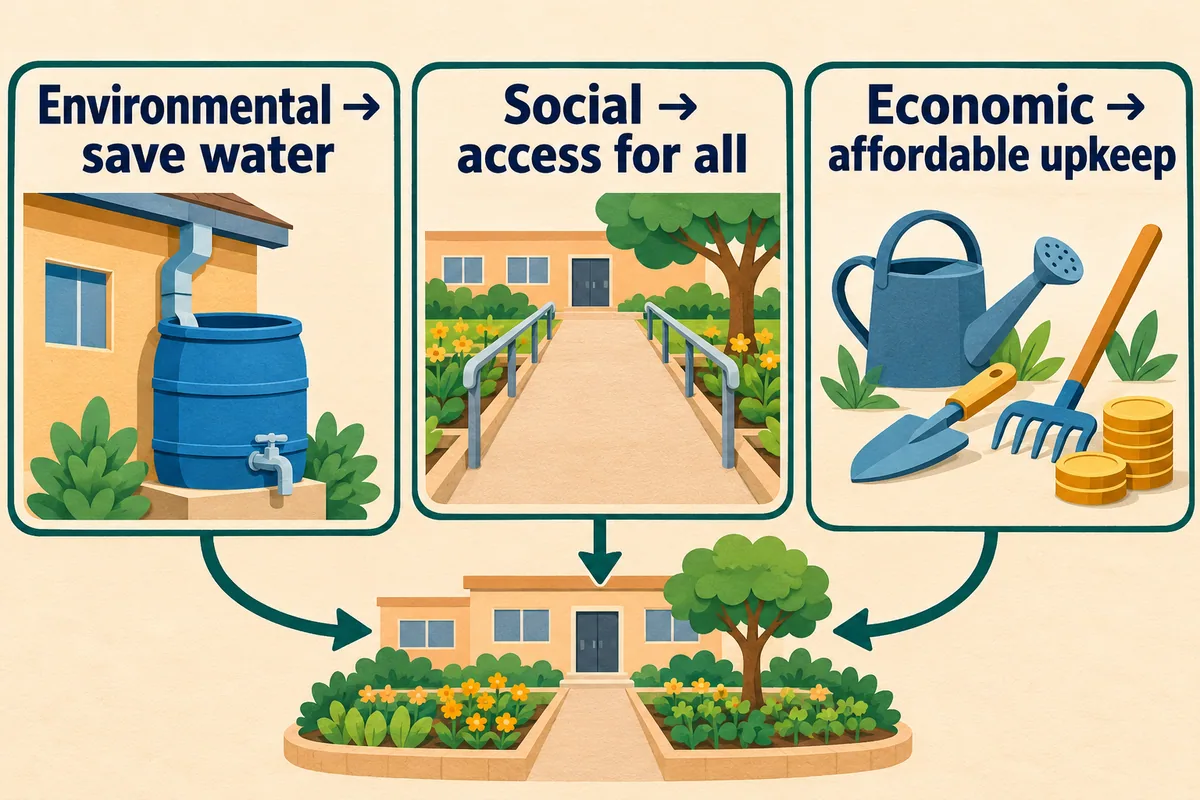
What does sustainable development include?
| Dimension | What it considers | School example |
|---|---|---|
| environmental | water, energy, biodiversity, pollution and waste | Collect rainwater for the school garden. |
| social | fair access, health, education and participation | Keep the school garden accessible to more students. |
| economic | costs, maintenance, jobs and resources over time | Choose durable equipment the school can afford to maintain. |
One project can involve all three dimensions. A water-saving garden reduces demand for tap water, gives students a shared space and can lower maintenance costs if the plants are suitable for the local climate.
Key terms and natural combinations
| Term | Meaning | Collocation |
|---|---|---|
| natural resources | materials or supplies found in nature | conserve natural resources |
| renewable energy | energy from sources that replenish naturally, such as sunlight | invest in renewable energy |
| waste | materials people discard | reduce household waste |
| pollution | harmful substances or effects in the environment | prevent water pollution |
| conservation | protection and careful use of something valuable | water conservation |
| awareness | knowledge that a problem exists | raise awareness of water scarcity |
Use the vocabulary to explain a local project
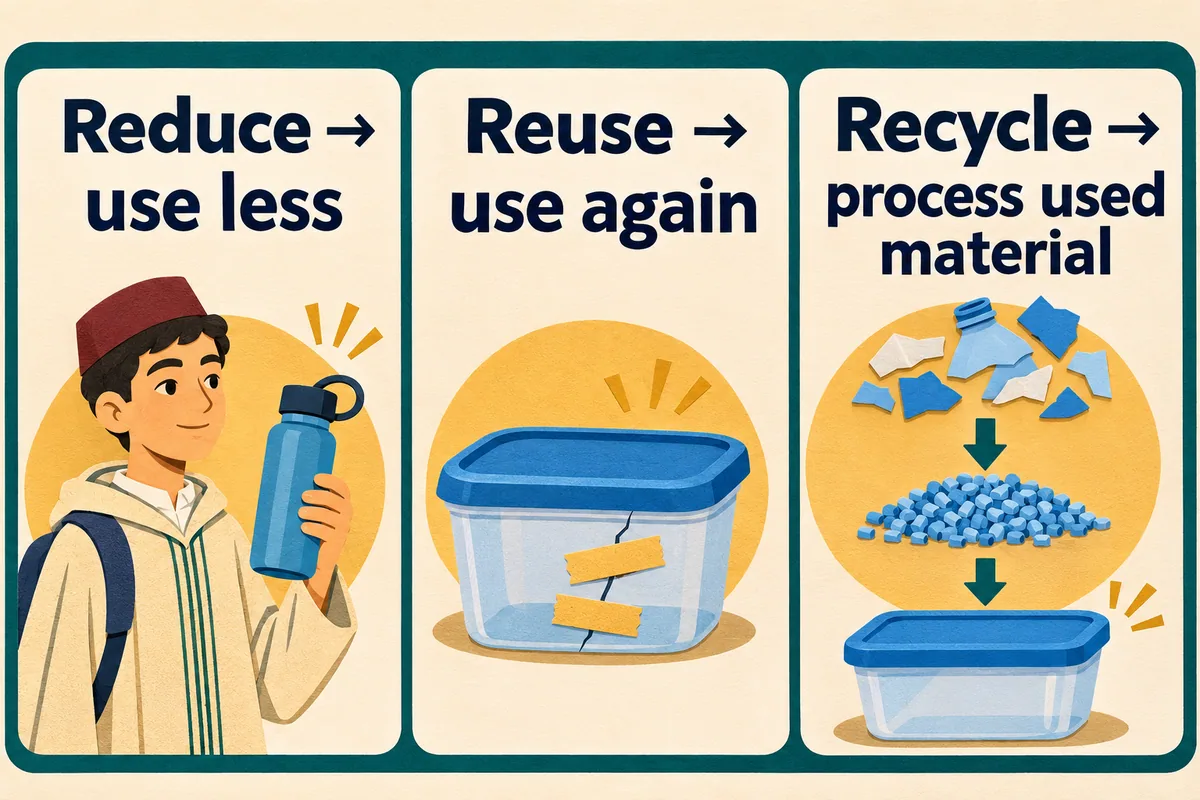
Reduce means use less in the first place. Reuse means use the same item again. Recycle means process discarded material into material that can be used again. A refillable bottle reduces single-use waste. A repaired container can be reused. Sorting plastic into a separate bin helps make recycling possible.
A paragraph about a school
« Our school collects rainwater to water its plants. The eco-club also raises awareness of water scarcity and checks how much tap water the garden uses each month. Measuring consumption helps the school see whether the project saves water. »
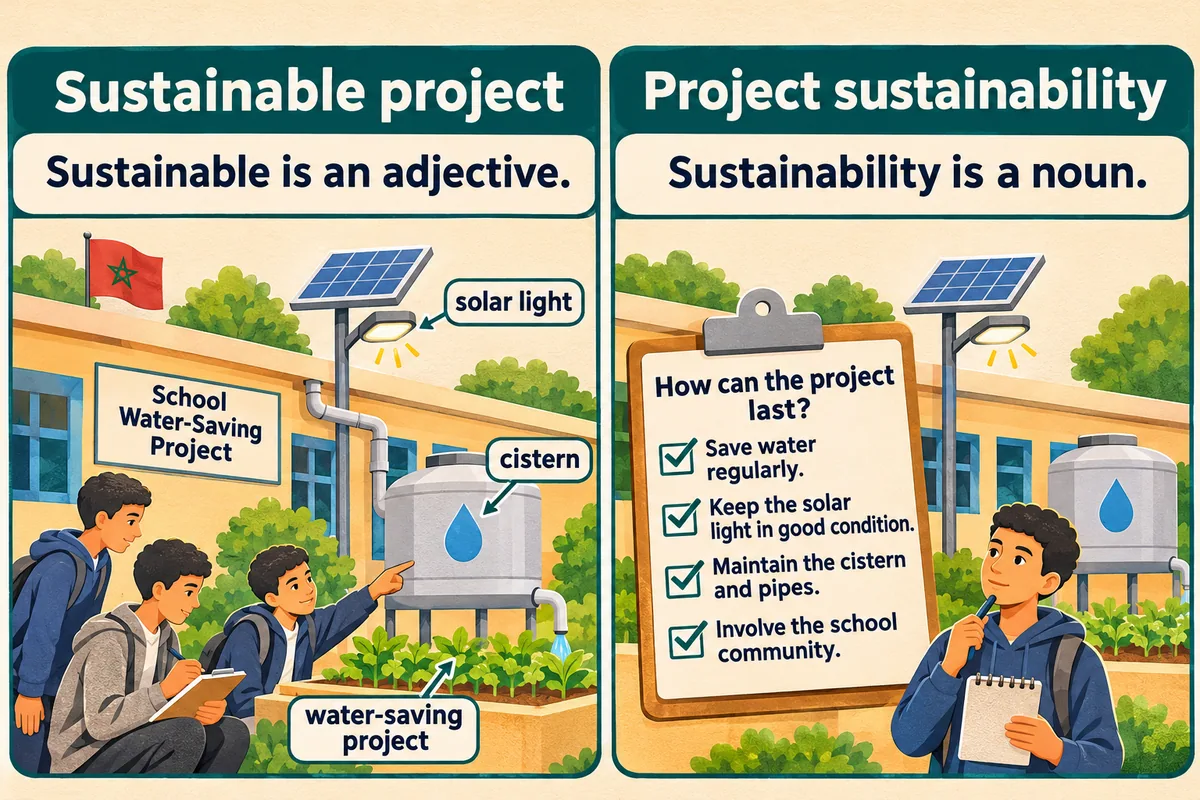
Sustain, sustainable and sustainability belong to one word family. Use sustainable before a noun, as in « a sustainable project ». Use sustainability as a noun, as in « The school is studying the project’s sustainability ».
Sustainable development goals and environmental collocations
Sustainable development balances environmental protection, social well-being and economic opportunity. Use conserve water, reduce emissions, protect biodiversity, improve living conditions and create decent jobs. A repair workshop can keep products in use, lower replacement costs and help people develop practical skills. The UN Sustainable Development Goals also address issues including education, clean water and responsible consumption.
Worked examples: sustainable development in real projects
Classifying a project by its three dimensions
A women’s cooperative in the Souss region produces argan oil, plants new argan trees and pays its members a regular income. Which dimensions of sustainable development does it cover?
- Planting new trees protects the argan forest and the soil. This is the environmental dimension.
- A regular income from selling oil is the economic dimension.
- Paid work gives women more independence and keeps families in their villages. This is the social dimension.
- Answer: « The cooperative covers all three dimensions: it protects the forest, creates income and improves women’s living conditions. »
Using the word family of sustain
Complete « Overfishing is ___ (sustain) because it reduces fish stocks faster than they can recover. »
- After is, the gap needs an adjective.
- The sentence describes a practice that cannot continue in the long term, so the adjective needs a negative prefix.
- Answer: unsustainable. The family is sustain (verb), sustainable / unsustainable (adjectives) and sustainability (noun).
Sources and curriculum
- English Language Guidelines for Secondary Schools (Ministry of Education, 2007)
The 2nd Baccalaureate syllabus describes the ten themes, four skills and language structures. See printed pages 76–84.
- National Baccalaureate Exam Specifications (English, 2025)
Reproduction of the national framework for the reading, language and writing sections, including the science streams.
Frequently asked questions
What are the three dimensions of sustainable development?
What is the difference between reuse and recycle?
What are the Sustainable Development Goals?
Exercises with answers
4 exercises, from easy practice to challenges. Try each one yourself, then reveal the answer and explanation.
Exercise 1
EasyWrite the word or phrase that matches each definition.
- Energy from sources that do not run out, such as the sun and the wind.
- The variety of plants and animals in a particular area.
- Gases released into the air, for example by cars and factories.
- A situation in which there is not enough of something.
- Material that people throw away because they no longer want it.
Answer and explanation
- Renewable energy.
- Biodiversity.
- Emissions.
- Scarcity.
- Waste.
Exercise 2
Intermediate- A school collects rainwater to use in its garden. Give an environmental benefit and explain what evidence could show it.
- Complete « We can ___ waste by repairing school furniture. »
Answer and explanation
- For example, the garden can use less tap water. Compare its tap-water use before and after the project, allowing for differences in rainfall.
- Reduce. Repairing furniture can reduce the amount thrown away.
Exercise 3
IntermediateChoose the verb that forms a natural combination.
- (raise / rise) awareness of water scarcity
- (make / do) a difference in your neighbourhood
- (protect / defend) endangered species
- (take / make) action against pollution
- (meet / reach) the needs of future generations
Answer and explanation
- Raise. Rise has no object.
- Make.
- Protect.
- Take.
- Meet. Development that meets present needs without harming future generations is the classic definition of sustainable development.
Exercise 4
ChallengeComplete the paragraph with the words from the box: scarcity, renewable, awareness, waste, sustainable. Then answer the last question.
« In many regions, water (1) ___ is a growing concern, so a school near Errachidia decided to act. Students installed a drip system powered by (2) ___ energy from a small solar panel. They also organised a week to raise (3) ___ about food (4) ___ in the canteen. The head teacher hopes these habits will make the school more (5) ___ in the long term. »
- Gap 1
- Gap 2
- Gap 3
- Gap 4
- Gap 5
- Which action in the paragraph has an economic benefit? Explain.
Answer and explanation
- Scarcity.
- Renewable.
- Awareness.
- Waste.
- Sustainable.
- Cutting food waste in the canteen saves money, and the solar panel lowers the cost of pumping water.