



Writing 2 : A funny story
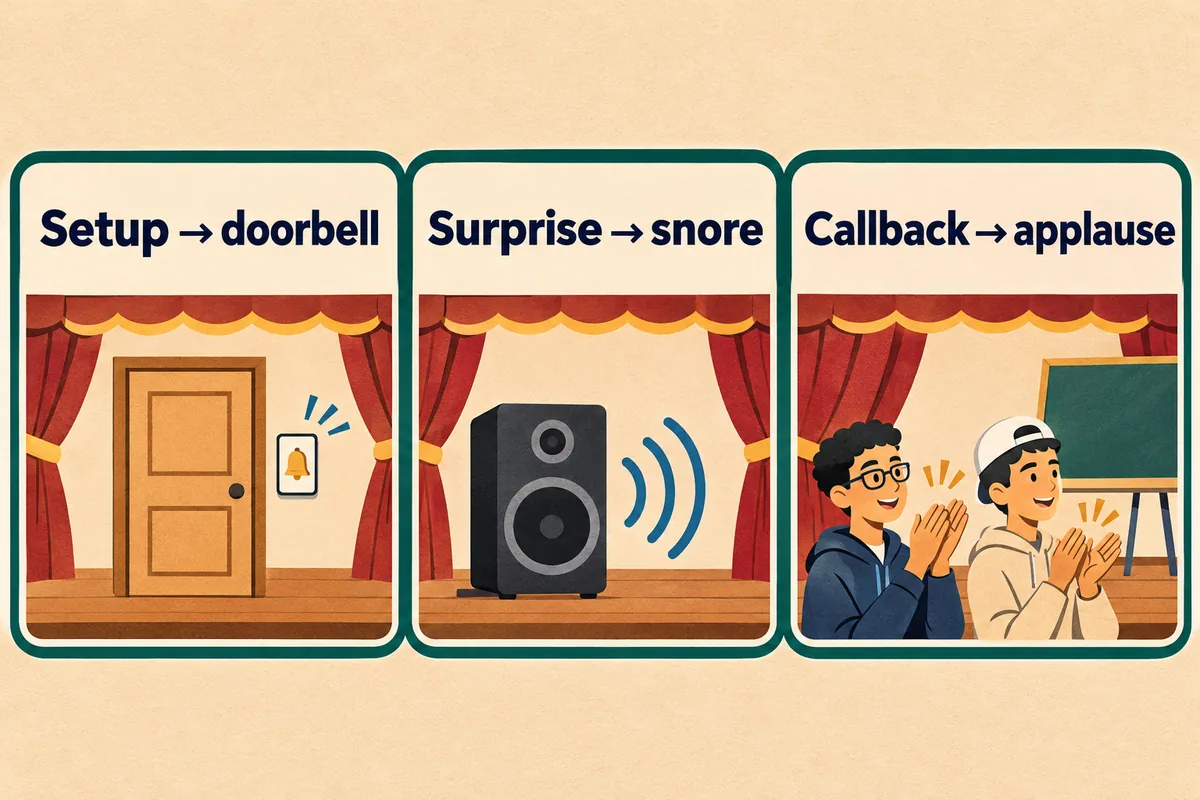
A funny story works when the reader expects one thing and a believable surprise happens. Set the scene briefly, narrate the main events in order and save the funny line or reaction for the right moment. This English 2 Bac model takes place during a school play rehearsal.
By the end of this lesson, you can
- Organise a narrative around a setup, a surprise and an ending.
- Use past continuous for background and past simple for events.
- Place dialogue and a punchline where they make sense.
Un bon cours, ça se partage.
How do you plan a funny story?
Step by step
Build the surprise
- Set the scene with one time, one place and a clear expectation.
- Introduce a small mistake or unexpected event. Give only the details the reader needs to understand it.
- Let a character react. End with a brief consequence or a line that calls back to the surprise.
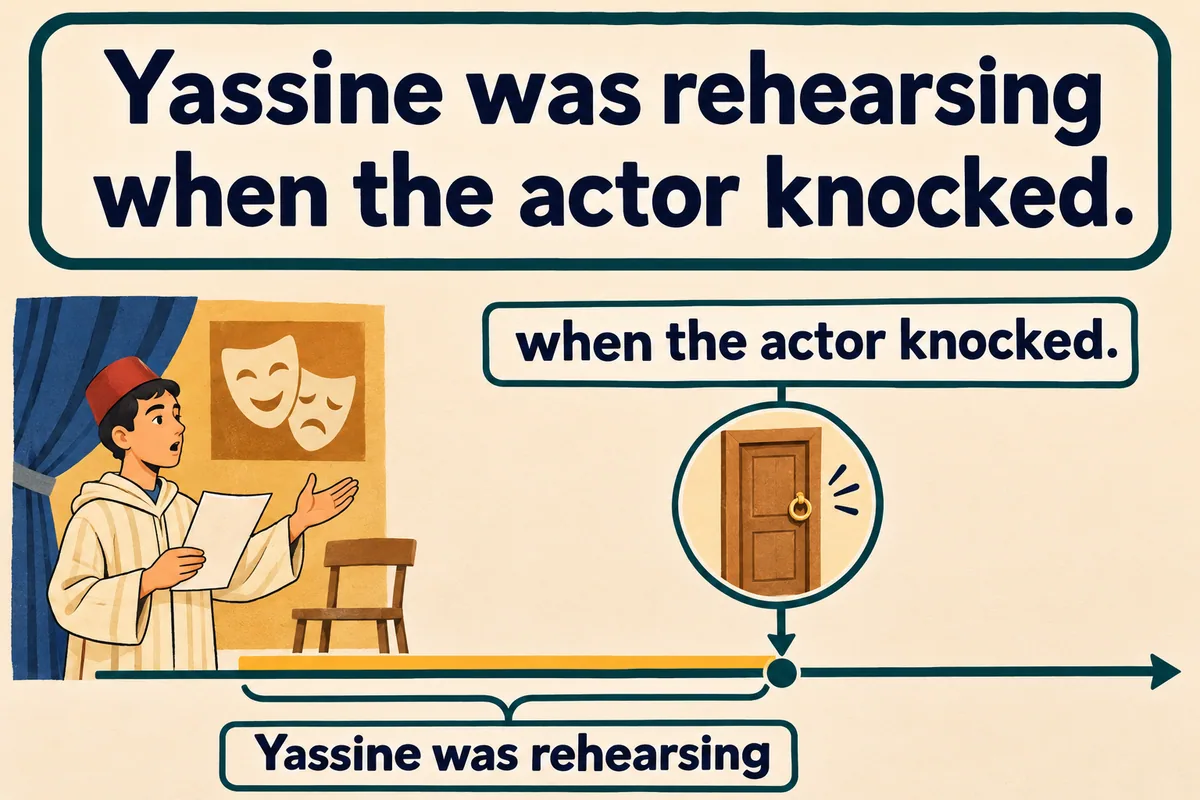
Use the past continuous to show what was already happening and the past simple for the events that move the story forward. In « Yassine was rehearsing when the actor knocked », was rehearsing is the background and knocked is the new event.
Complete model: The wrong sound
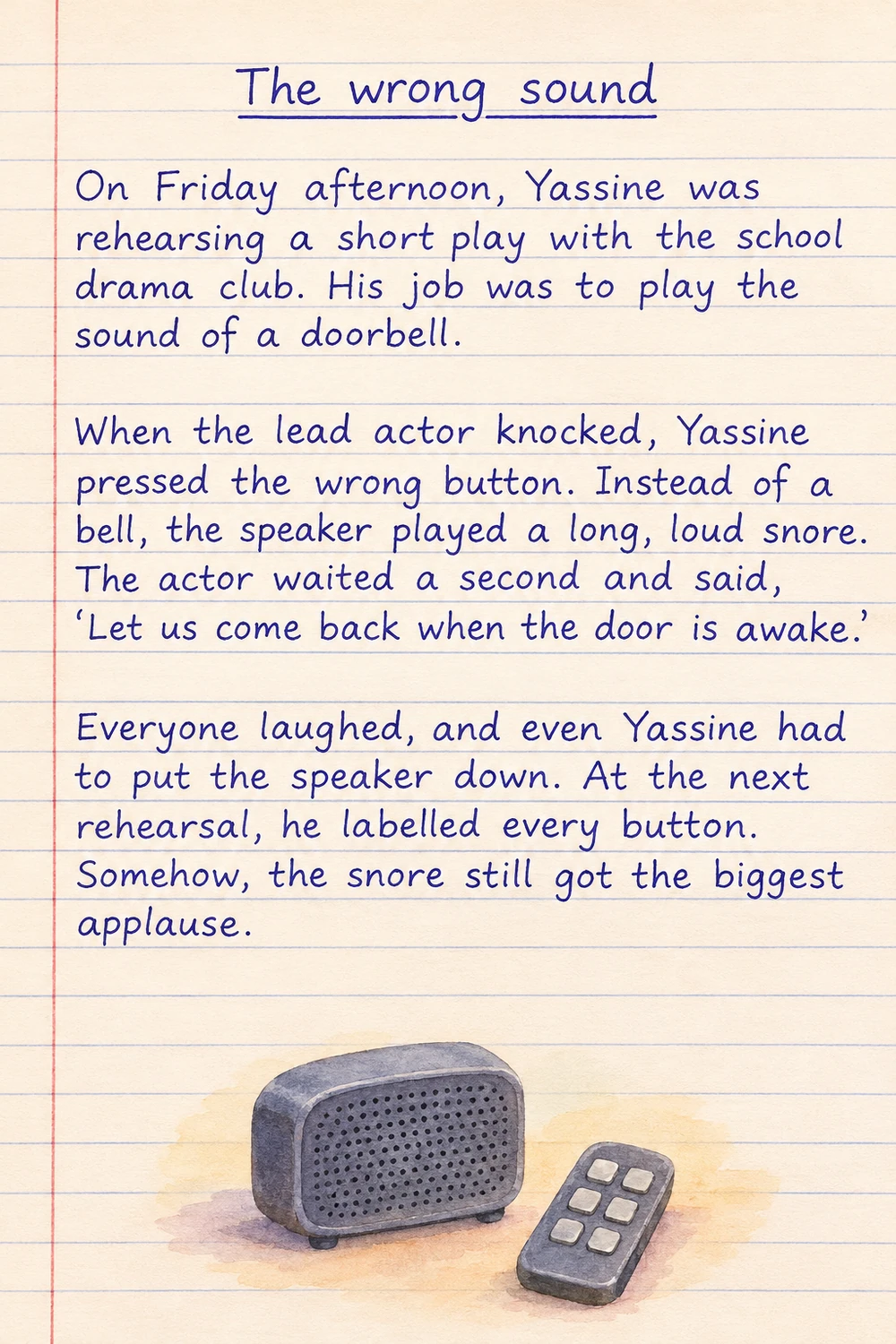
On Friday afternoon, Yassine was rehearsing a short play with the school drama club. His job was to play the sound of a doorbell.
When the lead actor knocked, Yassine pressed the wrong button. Instead of a bell, the speaker played a long, loud snore. The actor waited a second and said, 'Let us come back when the door is awake.'
Everyone laughed, and even Yassine had to put the speaker down. At the next rehearsal, he labelled every button. Somehow, the snore still got the biggest applause.
Why the model works
The word doorbell sets the expectation before the reader hears the snore. Instead of announces the surprise at the exact point where it matters. The actor’s reply treats the door as if it were asleep, which links the joke to the sound the reader has just imagined.
Punctuation in direct speech
Introduce a short spoken line with a reporting verb and a comma. The character’s exact words belong inside quotation marks, as in « He said, 'The door is asleep.' »
Narrative tenses and the effect of direct speech
Use the past continuous to set up an action in progress, then the past simple to show what interrupts it. « While we were rehearsing, someone rang the doorbell. » Use the past perfect for an earlier event the reader needs to know, as in « We had forgotten to turn off the microphone. » A single short line of dialogue can deliver the surprise.
Worked examples: building a funny story
From a flat sentence to an opening
Improve the opening « Something funny happened at school. »
- Give a precise time and place: « On the morning of our English exam, … ».
- Set an expectation the reader can follow: « … I had prepared everything: two pens, my ID card and a bottle of water. »
- Hint at the surprise without revealing it: « Everything, that is, except my shoes. »
- The reader now wants to know what happened, which is the job of an opening.
Punctuating direct speech
Correct: He said where is my bag
- The words are a question, so the reporting verb ask fits better than say: « He asked ».
- Put a comma after the reporting verb and quotation marks around the exact words.
- Start the spoken words with a capital letter and keep the question mark inside: « He asked, ‘Where is my bag?’ »
Sources and curriculum
- English Language Guidelines for Secondary Schools (Ministry of Education, 2007)
The 2nd Baccalaureate syllabus describes the ten themes, four skills and language structures. See printed pages 76–84.
- National Baccalaureate Exam Specifications (English, 2025)
Reproduction of the national framework for the reading, language and writing sections, including the science streams.
Frequently asked questions
What is a good opening sentence for a funny story in English?
Which tenses are used to write a funny story?
How do you end a funny story in English?
Exercises with answers
4 exercises, from easy practice to challenges. Try each one yourself, then reveal the answer and explanation.
Exercise 1
EasyPut the five sentences in the right order to make a short funny story.
A. Just as the cake reached the table, the lights went out.
B. My father said, ‘Well, at least nobody can count the candles.’
C. Last Saturday, we were preparing a surprise party for my grandmother’s birthday.
D. Now my grandmother asks for a power cut every year.
E. In the darkness, my grandmother blew out the candles before we could sing.
- Which sentence comes first?
- Which sentence comes second?
- Which sentence comes third?
- Which sentence comes fourth?
- Which sentence comes last?
Answer and explanation
- C. It sets the scene with a time, a place and an expectation.
- A. It introduces the problem.
- E. It shows the surprise.
- B. It gives a character’s reaction.
- D. It ends with a consequence that recalls the surprise.
Exercise 2
Intermediate- Write three sentences beginning « While we were rehearsing, … ». Set up a surprise and give a brief ending.
Answer and explanation
- One answer is « While we were rehearsing, a phone rang from inside the cardboard castle. We had used my bag to hold the wall upright, and my phone was still in it. Our director pointed to the castle and said, ‘At least the king is taking calls.’ »
Exercise 3
IntermediatePut each verb in the past simple, past continuous or past perfect.
- Last Sunday, my cousin and I ___ (cook) dinner for the family …
- … when the lights suddenly ___ (go) out.
- We soon discovered that my little brother ___ (switch) off the main switch by mistake.
- While my cousin ___ (look) for candles, …
- … I ___ (drop) the whole salt pot into the soup.
Answer and explanation
- Were cooking. The action was in progress.
- Went. A short event interrupts it.
- Had switched. His mistake happened before we discovered it.
- Was looking. Another background action.
- Dropped. The new event moves the story forward.
Exercise 4
ChallengeWrite a funny story of about 120 words that begins « It was the morning of the school photo … ».
- Write your story.
Answer and explanation
- Possible answer: « It was the morning of the school photo, and I had spent twenty minutes on my hair. While I was waiting for the bus with my little brother, a van drove through a puddle and splashed my trousers. I had no time to go home, so I borrowed the tracksuit bottoms from his sports bag. They were bright orange and far too short. At school, the photographer looked at me for a long time. ‘Don’t worry,’ he said, ‘we’ll put you in the back row.’ Everyone laughed, including me. When the photos arrived a month later, the back row was perfect: only my head was visible. My mother still says it is my best school photo. »