



Functions 2 : Expressing lack of understanding and asking for clarification
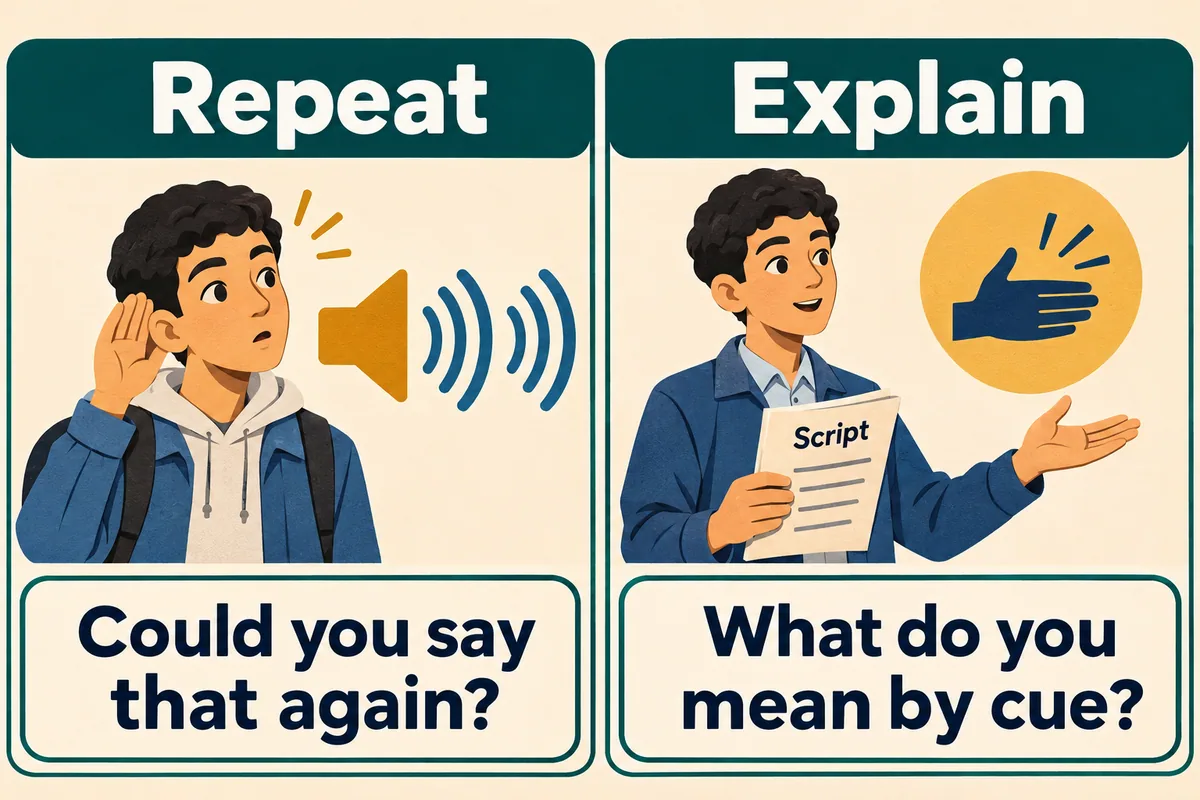
When you do not understand something in English, identify the word or instruction that caused the difficulty. « Could you repeat the last part? » asks to hear it again. « What do you mean by …? » asks for its meaning. Choose the phrase that will solve the problem.
By the end of this lesson, you can
- Distinguish repetition from clarification.
- Ask for a definition, example or slower repetition politely.
- Check understanding by rephrasing what you heard.
Un bon cours, ça se partage.
Listen to the text
Listen before opening the transcript. This original English practice text is read by a synthetic voice.
Show the transcript
Before the show, our teacher asked me to wait for the cue. I heard the word, but I wasn’t sure what it meant. I asked her whether the cue was a movement or a sound. She explained that she would raise a blue card. I repeated the instruction in my own words to check. When the card went up, I began the sketch at exactly the right moment.
What can you say when you do not understand?
| What happened | What to say | Expected reply |
|---|---|---|
| You missed some words. | Sorry, could you repeat the last part? | The speaker says those words again. |
| One word is unfamiliar. | What does « cue » mean here? | The speaker explains cue in this situation. |
| The instruction is vague. | What do you mean by « the small box »? | The speaker names or points to the box. |
| An explanation still feels abstract. | Could you give me an example? | The speaker gives one concrete instance. |
| You think you understood. | Do you mean we should wait for a signal? | The speaker confirms or corrects your interpretation. |
A model dialogue at a rehearsal
Clarifying a cue
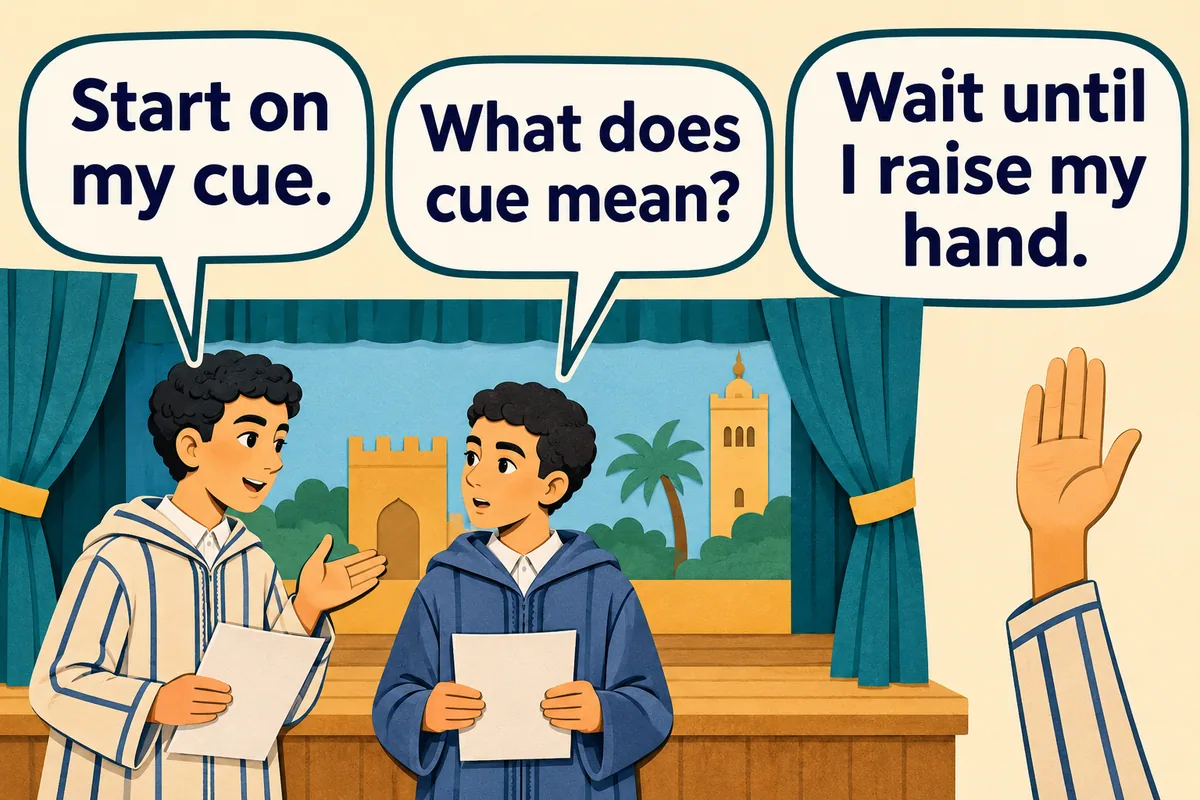
Nassim: Start the sound effect on my cue.
- Adil: I’m not sure I understand. What do you mean by « on my cue »?
- Nassim: I mean you should start when I raise my hand.
- Adil: So I wait for your hand signal before I press the button, right?
- Nassim: Exactly.
Adil first identifies the phrase. Then he restates the instruction in his own words. His final check also tells Nassim which action he plans to take.
Polite language and word order
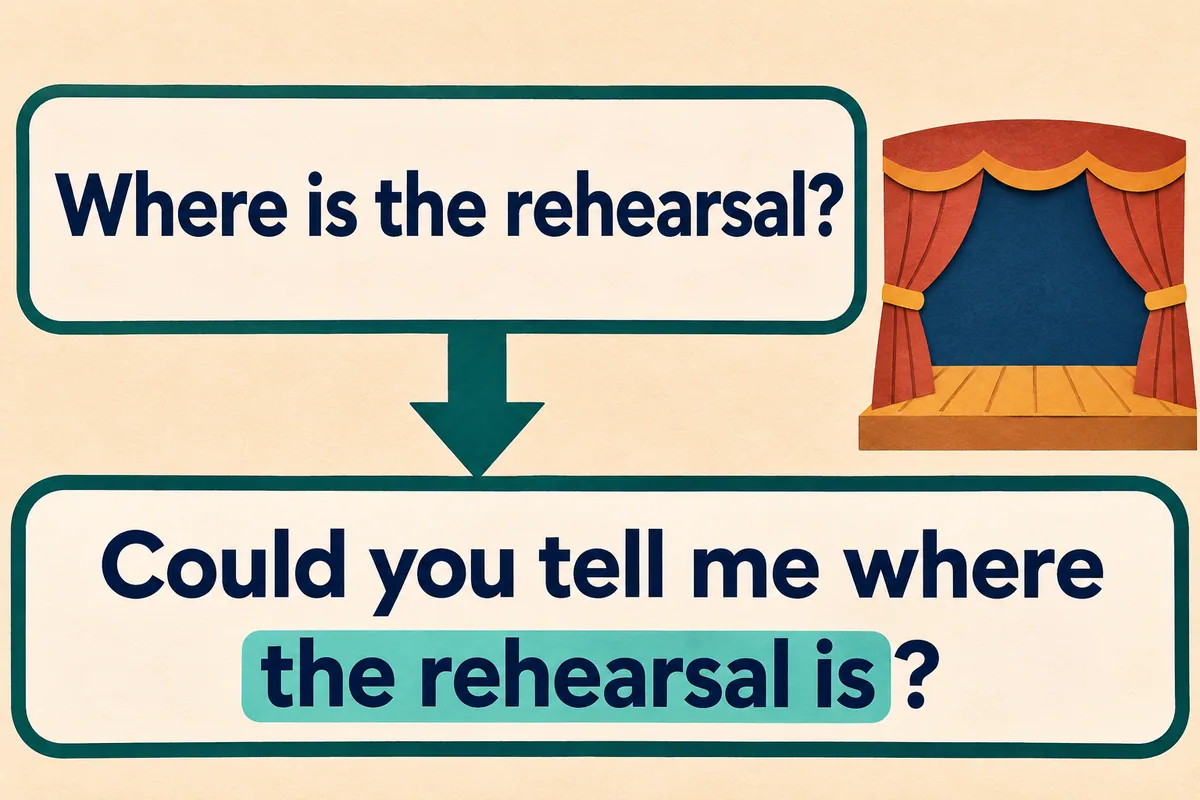
With a friend, « Sorry, what did you mean? » is natural. In a formal exchange, « Could you explain what you meant by that? » is a little more courteous. An indirect question keeps statement word order after the introductory phrase.
Direct and indirect questions
« Where is the rehearsal? » becomes « Could you tell me where the rehearsal is? » The subject the rehearsal comes before is inside the indirect question.
Clarify a reference, a word or an instruction
Name the part you need clarified. « Could you repeat the last step? » asks to hear it again. « What does rehearsal mean? » asks for a definition. « By after lunch, do you mean at one o’clock? » checks a possible interpretation. To clarify your own words, say « What I mean is … » or « Let me put it another way. »
Give your partner an ambiguous instruction, such as « bring the forms later ». They must check which forms and when. Confirm their final interpretation, then switch roles.
Worked examples: checking what you heard
Turning a vague instruction into precise questions
Your teacher says « Hand in the second part by the end of next week. » You are not sure which part and which day.
- Identify what is unclear: the second part of what, and which day is the end of next week?
- Ask about the first point and offer your interpretation: « Sorry, by the second part, do you mean the exercises on page 12? »
- Ask about the second point in the same way: « And does the end of next week mean Friday? »
- Confirm the whole instruction: « So I should hand in the page 12 exercises on Friday. Is that right? »
Making a question indirect
Make « What time does the bus leave? » more polite.
- Start with a polite phrase: « Could you tell me … ».
- Remove the auxiliary does, which only forms the direct question.
- Put the subject before the verb and keep the -s of the present simple: « the bus leaves ».
- Final version: « Could you tell me what time the bus leaves? »
Listening and speaking practice
Listen to the recording and answer this question. What did the speaker misunderstand, and how did they check the answer?
Give a partner an instruction with an unclear time or word. They should ask for clarification and confirm what they have understood.
Sources and curriculum
- English Language Guidelines for Secondary Schools (Ministry of Education, 2007)
The 2nd Baccalaureate syllabus describes the ten themes, four skills and language structures. See printed pages 76–84.
- National Baccalaureate Exam Specifications (English, 2025)
Reproduction of the national framework for the reading, language and writing sections, including the science streams.
Frequently asked questions
What is a polite way to ask someone to clarify?
What is the difference between « Pardon? » and « What do you mean? »
How do you ask someone to repeat something in English?
Exercises with answers
5 exercises, from easy practice to challenges. Try each one yourself, then reveal the answer and explanation.
Exercise 1
EasySay whether each phrase asks someone to repeat, asks for a meaning, checks understanding or clarifies the speaker’s own words.
- « Sorry, I didn’t catch that. »
- « What exactly do you mean by a deadline extension? »
- « So you’re saying the trip is cancelled? »
- « What I mean is that we need more time. »
- « Could you say that again a bit more slowly? »
Answer and explanation
- It asks the speaker to repeat.
- It asks for a meaning.
- It checks understanding.
- It clarifies the speaker’s own words.
- It asks the speaker to repeat.
Exercise 2
Intermediate- You heard every word in « Please cue Karim », but you do not know cue. What do you say?
- Correct « Could you tell me where is the rehearsal? »
Answer and explanation
- One answer is « What does cue mean here? Could you give me an example? »
- Could you tell me where the rehearsal is? The indirect question uses statement order.
Exercise 3
IntermediateRewrite each question, starting with the words given.
- Where is the exam room? (Could you tell me …)
- When does the workshop start? (Do you know …)
- Did the coach call? (I was wondering …)
- Why are the results late? (Could you explain …)
- How much does the ticket cost? (Do you know …)
Answer and explanation
- Could you tell me where the exam room is?
- Do you know when the workshop starts?
- I was wondering if the coach called. Whether is also possible.
- Could you explain why the results are late?
- Do you know how much the ticket costs?
Exercise 4
Intermediate- What did the speaker misunderstand, and how did they check the answer?
Answer and explanation
- The speaker did not know what the cue would be. After hearing about the blue card, they repeated the instruction in their own words.
Exercise 5
ChallengeAyoub phones the youth centre to register for a robotics course. Write his lines.
- Receptionist: « Registration closes on the fifteenth, and you’ll need the usual documents. » Ayoub asks which documents.
- Receptionist: « A copy of your ID card and a recent photo. » Ayoub checks that the fifteenth is this month.
- Receptionist: « Yes, this Friday. The centre is at 14 Al Amal Street. » Ayoub asks her to repeat the address.
- Ayoub sums up everything to confirm.
Answer and explanation
- « Sorry, what do you mean by the usual documents? »
- « Do you mean the fifteenth of this month? »
- « Could you repeat the address, please? »
- « So I need to bring a copy of my ID card and a recent photo to 14 Al Amal Street by Friday. Is that right? »