



Grammar 3 : Past Perfect
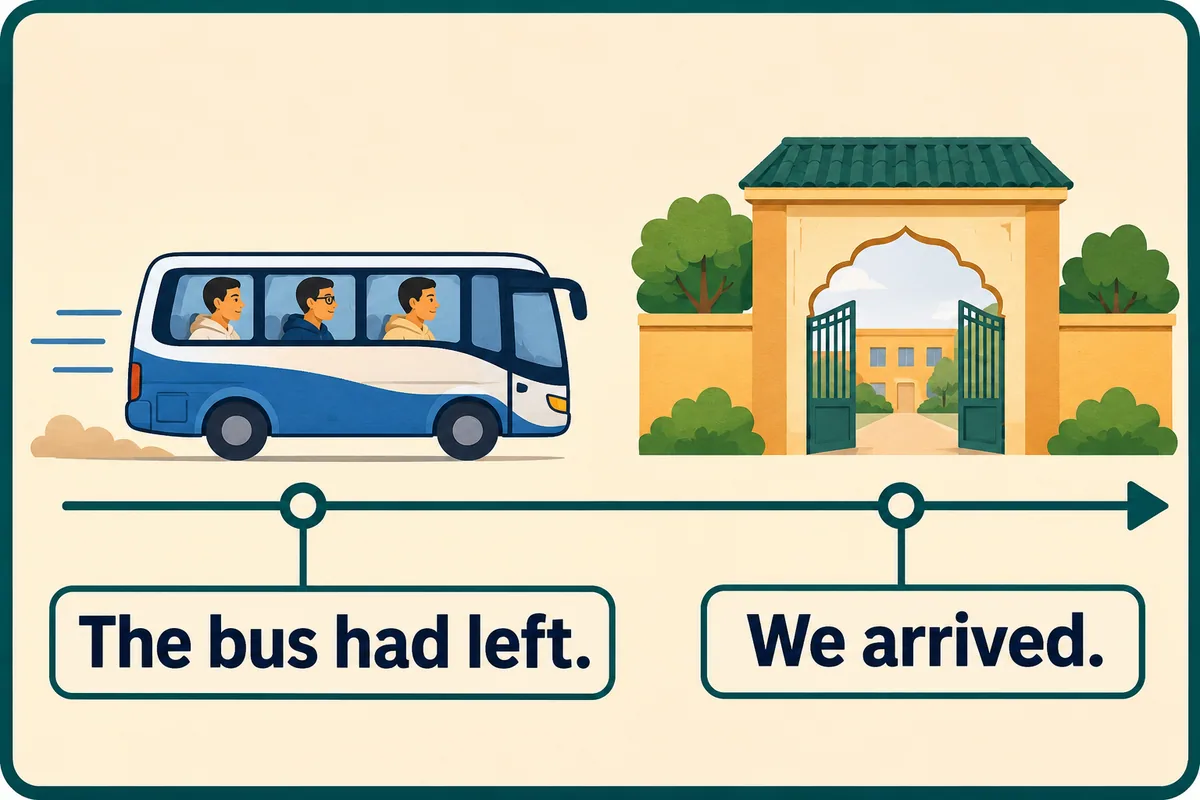
The past perfect uses had + past participle to look back from a past event or time. In « When we arrived, the bus had left », the bus left first. The past simple sets the later point. This distinction is especially useful when an English 2 Bac reading or story presents events out of order.
By the end of this lesson, you can
- Form the past perfect with regular and irregular participles.
- Explain which of two past events happened first.
- Choose the past perfect where it adds a useful time relationship.
Un bon cours, ça se partage.
How is the past perfect formed?
| Form | Pattern | Example |
|---|---|---|
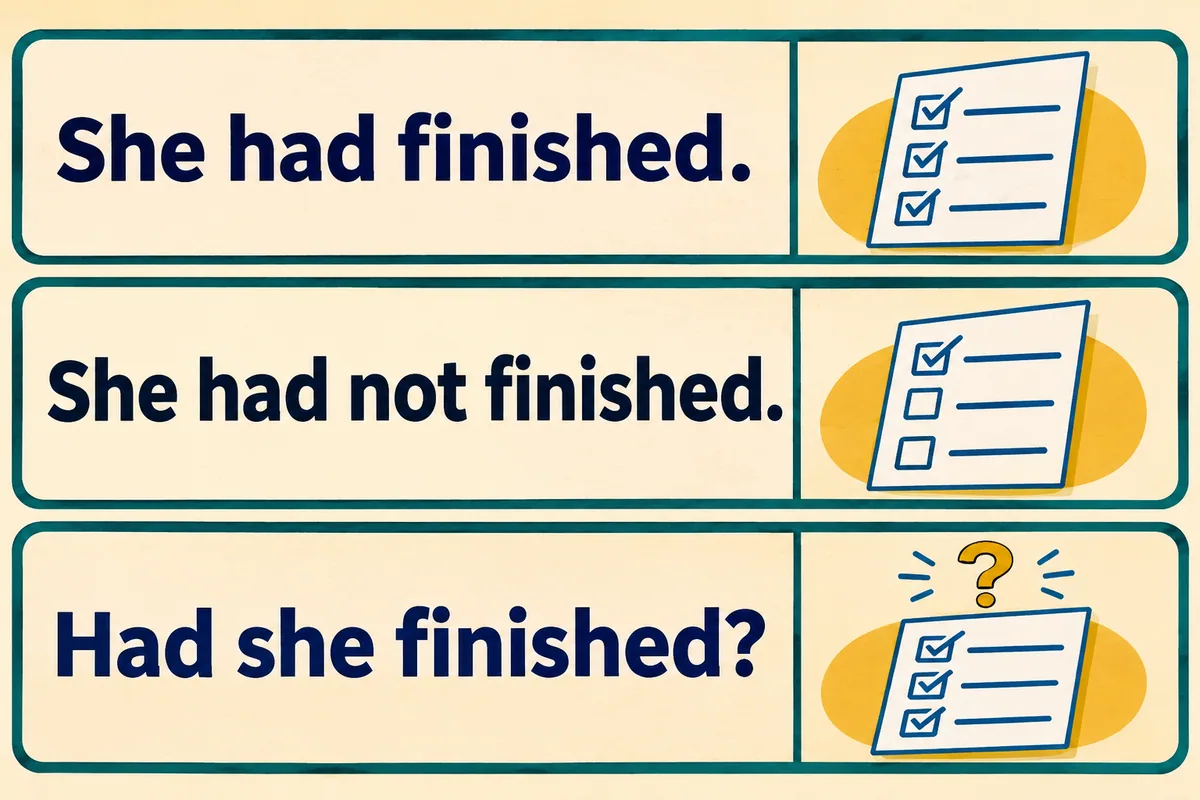
| affirmative | subject + had + past participle | The bus had left. |
| negative | subject + had not / hadn’t + past participle | The classroom hadn’t opened. |
| question | Had + subject + past participle? | Had you read the instructions? |
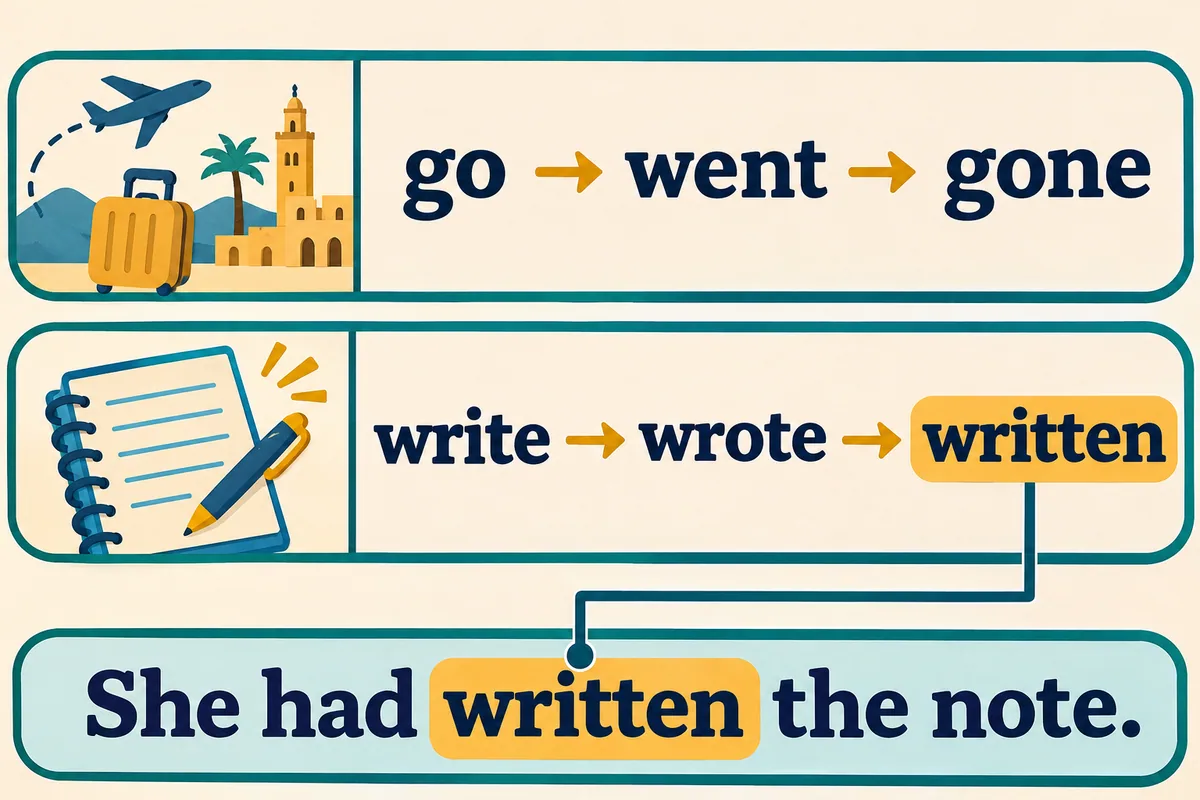
Had stays the same with every subject. Regular verbs usually add -ed. Some irregular participles differ from the past simple, such as go → went → gone, write → wrote → written and see → saw → seen. In « She had written », written is the participle.
Past perfect or past simple?
| Sentence | Time relationship |
|---|---|
| When Lina got to class, the lesson had started. | The lesson started before she arrived. |
| When Lina got to class, the lesson started. | The lesson started when she arrived or just afterwards. |
| By nine o’clock, everyone had finished the form. | They finished by the past reference time of nine. |
| She collected her form and signed it. | Both events are in the past simple and are told in chronological order. |
Before, after and by the time can make the order clear. In « After she finished the form, she gave it to the teacher », after already shows the order. « After she had finished the form » is also possible if the writer wants to emphasise the earlier completion.
Explain a past situation
A missed message
« Bilal went to the old classroom because he hadn’t read the notice. » The missed reading is earlier than the visit and explains it. The main action remains in the past simple.
The related past perfect continuous uses had been + verb-ing to focus on duration or an activity. « She had been studying for two hours when the lights went out » shows an activity in progress leading up to the interruption.
Remember
Use an irregular past participle after had. Write « They had gone », with gone rather than went.
Review common tenses before choosing the past perfect
| Tense | Main use in this example | Example |
|---|---|---|
| present simple | a habit or general fact | She reads every evening. |
| present continuous | an action in progress now | She is reading a notice. |
| present perfect | a past action connected to the present | She has finished the book and can return it now. |
| past simple | a completed event in a finished past period | She finished it yesterday. |
| past continuous | an action in progress at a past time | She was reading when the bell rang. |
| past perfect | a completed action before a past reference point | She had already read the notice when her friend called. |
Since gives a starting point and for gives a duration. « She has studied here for two years » connects the duration to now. « She had studied there for two years before she moved » measures the period up to a past point.
Worked examples: ordering past events
Two sentences, two meanings
Compare « When we arrived at the cinema, the film started » and « When we arrived at the cinema, the film had started. »
- In the first sentence, both verbs are in the past simple. The film started at the moment we arrived, so we saw the beginning.
- In the second sentence, had started is earlier than arrived. The film was already playing, so we missed the beginning.
- The past perfect changes the order of events, so choose it when the earlier action matters.
Combining with by the time
Join « The guests left. Then Amal arrived. » using by the time.
- Find the earlier event: the guests left first.
- Put the later event after by the time in the past simple: « By the time Amal arrived ».
- Put the earlier event in the past perfect in the main clause: « the guests had left ».
- Final sentence: « By the time Amal arrived, the guests had left. »
Sources and curriculum
- English Language Guidelines for Secondary Schools (Ministry of Education, 2007)
The 2nd Baccalaureate syllabus describes the ten themes, four skills and language structures. See printed pages 76–84.
- National Baccalaureate Exam Specifications (English, 2025)
Reproduction of the national framework for the reading, language and writing sections, including the science streams.
Frequently asked questions
What is the difference between past simple and past perfect?
Can we use the past simple with after?
Is « had had » correct in English?
Exercises with answers
4 exercises, from easy practice to challenges. Try each one yourself, then reveal the answer and explanation.
Exercise 1
EasyComplete each sentence with the past participle of the verb in brackets.
- By noon, the students had ___ (write) two essays.
- She had never ___ (see) the sea before that trip.
- The bus had already ___ (go) when we arrived.
- They had ___ (take) the wrong road.
- I had ___ (forget) my password, so I couldn’t log in.
Answer and explanation
- Written.
- Seen.
- Gone.
- Taken.
- Forgotten.
Exercise 2
Intermediate- By the time the tutor arrived, the class ___ (finish) the task.
- Last Thursday, while we ___ (read), someone knocked.
- They still meet at the library. They ___ (meet) there since March.
Answer and explanation
- Had finished. The task ended before the tutor arrived.
- Were reading. The longer action was in progress when someone knocked.
- Have met or have been meeting. The activity started in March and continues now.
Exercise 3
IntermediateJoin each pair with the word in brackets. Use the past perfect for the earlier action.
- The train left. We reached the station. (when)
- She finished her homework. Then she went out. (after)
- I visited Ifrane. I had never seen snow. (before)
- They cleaned the classroom. The inspector arrived. (by the time)
- He lost his key. He couldn’t open the door. (because)
Answer and explanation
- When we reached the station, the train had left.
- After she had finished her homework, she went out.
- I had never seen snow before I visited Ifrane.
- By the time the inspector arrived, they had cleaned the classroom.
- He couldn’t open the door because he had lost his key.
Exercise 4
ChallengePut each verb in the past simple or the past perfect.
- When Amine ___ (arrive) at the language centre, …
- … he ___ (realise) that …
- … he ___ (leave) his ID card at home.
- He ___ (never / feel) so nervous before.
- Luckily, his father ___ (already / send) him a photo of the card, …
- … so the receptionist ___ (accept) it for the placement test.
Answer and explanation
- Arrived.
- Realised.
- Had left. Leaving the card happened before he realised it.
- Had never felt. The experience is measured up to that moment in the past.
- Had already sent. The photo was sent before he arrived.
- Accepted. This is the next event in the story.