



Functions 1 : Expressing opinions, agreeing and disagreeing
To express an opinion in English, state your view and give a reason. To agree or disagree politely, name the point you are responding to. In a 2 Bac dialogue, « I see your point, but … » gives you room to acknowledge another student’s idea and explain your own.
By the end of this lesson, you can
- Ask for and give a reasoned opinion.
- Select an agreement or disagreement phrase for the situation.
- Recognise partial agreement in a conversation.
Un bon cours, ça se partage.
Listen to the text
Listen before opening the transcript. This original English practice text is read by a synthetic voice.
Show the transcript
At our first science club meeting, I suggested that everyone work alone. Hajar disagreed. She pointed out that our strongest designer had never built a circuit. We decided to work in pairs, and each person showed their partner how to do one task. By the end of the meeting, I still wanted time to sketch on my own, but I understood why testing our ideas together mattered.
How do you ask for and give an opinion?
| Purpose | Useful phrase | School example |
|---|---|---|
| Invite a view | What do you think about …? | What do you think about opening the library at lunch? |
| Give a view | I think … / In my opinion, … | In my opinion, lunchtime access would help students who take the school bus. |
| Agree | I agree. / That’s a good point. | I agree. Some students have to leave straight after class. |
| Agree in part | I agree up to a point, but … | I agree up to a point, but a teacher would need to be available. |
| Disagree politely | I see your point, but … / I’m not sure I agree. | I see your point, but the library is busiest at that time. |

Make the reply fit the previous speaker
A school committee discusses the library
Omar: What do you think about opening the library every lunchtime?
- Anas: I think it would help students who cannot stay after school.
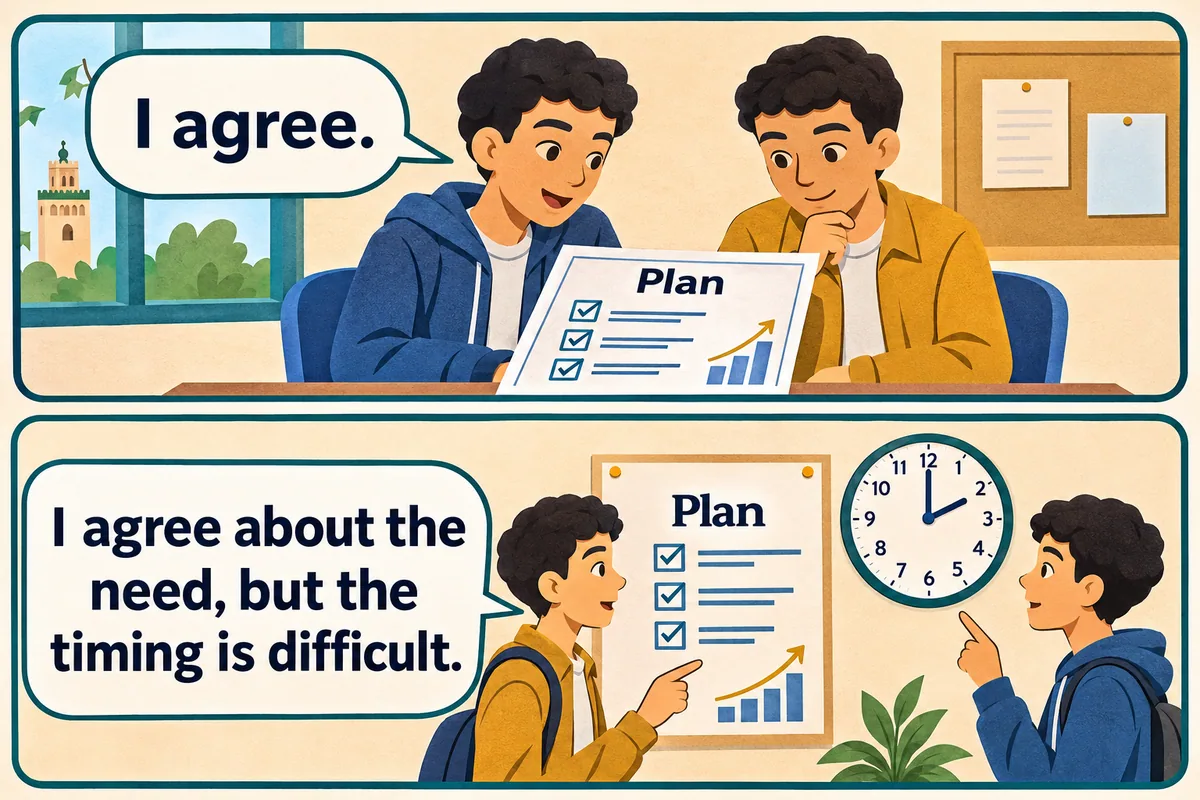
- Omar: I agree about the need for more time, but opening every day may be difficult.
- Anas: That’s a fair point. We could start with Tuesdays and Thursdays.
Omar agrees with the aim and questions the schedule. The phrase « I agree about the need » shows exactly what he accepts. Anas responds to the scheduling problem by suggesting two days.
Give a reason people can respond to
The sentence « I think the science club should meet on Friday » gives a position. Add « because more members are free then » and the other speaker has a clear point to discuss. If you are unsure how formal to be, « I see your point » works in both a classroom discussion and a school meeting.
Remember
Use « I agree with you » or « I agree that we need more time ». In this meaning agree is the main verb, so the form is « I agree ».

How do you distinguish a fact from an opinion?
A fact can be checked against evidence. « The library closed at 4 p.m. yesterday » can be checked in a record. « The library closes too early » gives a judgement. Support an opinion with a relevant fact, as in « In my view, the library should stay open longer because students whose lessons end at four cannot borrow books. »
In pairs, choose a school activity. Ask for an opinion, give a reason, and restate one part of your partner’s view before agreeing or disagreeing. Compare your reasons and suggest a next step.
Worked examples: giving and answering an opinion
Choosing the right level of agreement
A classmate says « Homework should be banned at weekends. » You think students need rest, but a short revision task before an exam can help.
- Decide your position first. You accept part of the idea, so you partly agree.
- Name the part you accept: « Students need time to rest at weekends. »
- Add your reservation with but and a reason: « but a short revision task before an exam can be useful. »
- Final reply: « I agree up to a point. Students need time to rest at weekends, but a short revision task before an exam can be useful. »
Correcting two common mistakes
Correct « I am agree with you » and « According to me, the club is useful. »
- Agree is a verb, not an adjective, so it does not take am. Write « I agree with you. »
- English speakers use according to for someone else’s view or for a source, as in « according to the report ». For your own opinion, write « In my opinion, the club is useful » or « I think the club is useful. »
Listening and speaking practice
Listen to the recording and answer this question. Why did Hajar prefer work in pairs, and what did each person have to do?
Ask a partner whether students should work alone or in pairs. Give your opinion, accept part of your partner’s view and suggest a compromise.
Sources and curriculum
- English Language Guidelines for Secondary Schools (Ministry of Education, 2007)
The 2nd Baccalaureate syllabus describes the ten themes, four skills and language structures. See printed pages 76–84.
- National Baccalaureate Exam Specifications (English, 2025)
Reproduction of the national framework for the reading, language and writing sections, including the science streams.
Frequently asked questions
How can I disagree politely in English?
Is « I am agree » correct?
What can I say instead of « I think » to give an opinion?
Exercises with answers
5 exercises, from easy practice to challenges. Try each one yourself, then reveal the answer and explanation.
Exercise 1
EasySay whether each expression asks for an opinion, gives an opinion, agrees, agrees in part or disagrees.
- « What’s your view on school uniforms? »
- « As far as I’m concerned, uniforms save time in the morning. »
- « You’re absolutely right. »
- « That’s true, but they can be expensive. »
- « I’m afraid I see it differently. »
Answer and explanation
- It asks for an opinion.
- It gives an opinion.
- It agrees completely.
- It agrees in part. That’s true accepts the point and but adds a reservation.
- It disagrees politely. I’m afraid softens the disagreement.
Exercise 2
Intermediate- Which part of « Thirty students signed up, so I think we need two groups » is an opinion?
- A partner says « All school clubs should meet at lunchtime ». Agree in part and explain one concern.
Answer and explanation
- « I think we need two groups » is the opinion. The sign-up count can be checked.
- One answer is « I agree that lunchtime is convenient for some clubs, but sports teams may need longer sessions. »
Exercise 3
IntermediateSara and Reda discuss whether the school should replace printed textbooks with tablets. Write what each speaker says.
- Sara asks for Reda’s opinion.
- Reda gives his opinion with a reason.
- Sara disagrees politely and gives a reason.
- Reda agrees in part and suggests a compromise.
Answer and explanation
- « What do you think about replacing our textbooks with tablets? »
- « In my view, it’s a good idea, because our bags would be much lighter. »
- « I see your point, but some families can’t afford to repair a tablet if it breaks. »
- « That’s a fair point. Maybe the school could lend tablets and keep a few printed copies in the library. »
Exercise 4
Intermediate- Why did Hajar prefer work in pairs, and what did each person have to do?
Answer and explanation
- Pair work let students combine different skills. Each person had to show their partner how to do one task.
Exercise 5
ChallengeWrite a reply that agrees, agrees in part or disagrees. Give a reason in each reply and use a different expression each time.
- « Social media helps teenagers discover their talents. »
- « Students should choose their university course without asking their parents. »
- « Sport is a waste of time in the 2 Bac year. »
Answer and explanation
- One answer is « I agree to some extent. Some young musicians become known online, but they still need training to develop their talent. »
- One answer is « I’m not sure I agree. Parents often know our strengths and can help us compare costs and distances, even if the final choice is ours. »
- One answer is « I completely disagree. An hour of football twice a week helps me sleep better and concentrate when I revise. »