



Vocabulary 3 · Education
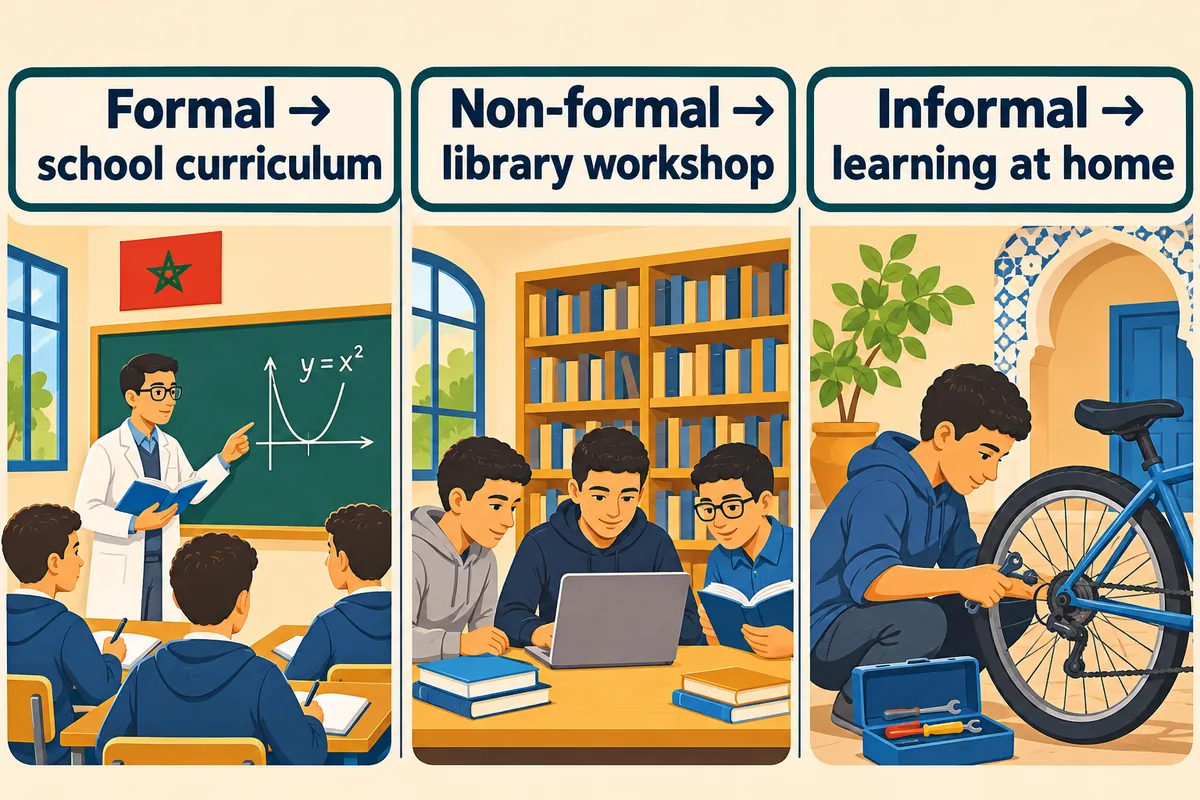
Formal education follows a recognised curriculum. Non-formal education is organised learning outside the regular school or university system. Informal learning comes from everyday activities. This English 2 Bac lesson shows why a classroom course, a library workshop and learning at home belong to different categories.
By the end of this lesson, you can
- Distinguish formal, non-formal and informal education from real situations.
- Use education word families and common collocations.
- Explain one barrier to education and how a programme can address it.
Un bon cours, ça se partage.
Formal, non-formal and informal education
| Type | What makes it different? | Example |
|---|---|---|
| formal education | A recognised institution offers a structured programme with a curriculum and assessment. | A student follows the 2 Bac English programme at school. |
| non-formal education | An organised programme has a learning goal outside the regular school system. | A local association runs an evening literacy course for adults. |
| informal learning | Learning happens in everyday life, often by watching, talking, reading or trying things. | A teenager learns to repair a bicycle while helping a relative at home. |
The place alone cannot tell you the type. A coding workshop held in a school library can be non-formal if an association organises it outside the regular curriculum. Informal learning can be intentional. You can decide to learn a new recipe from a relative without following a course.
Key words about school and access to education
| Word or phrase | Meaning | Common combination |
|---|---|---|
| curriculum | the content and goals of a programme | follow a curriculum |
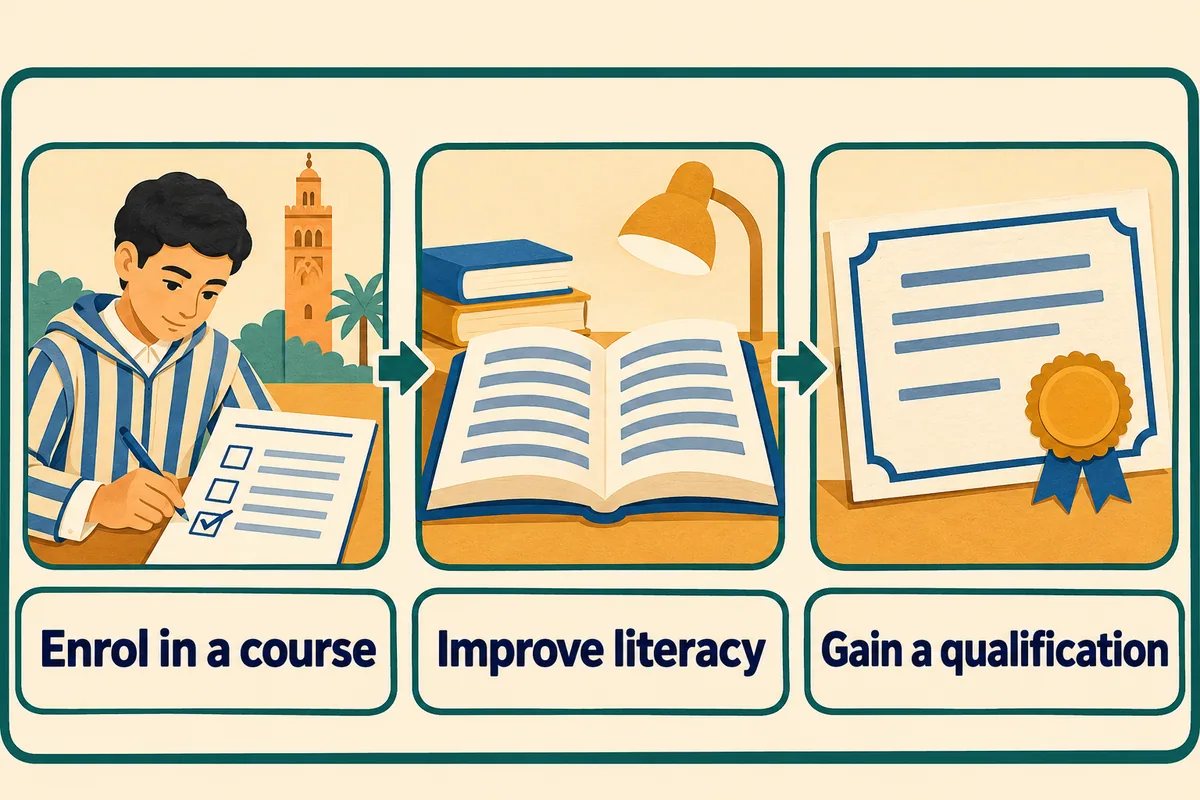
| qualification | official evidence of a level or skill | obtain a qualification |
| literacy | the ability to read and write | improve literacy |
| enrol | officially join a course or institution | enrol in a course |
| drop out | leave a programme before finishing it | drop out of school |
| vocational | related to training for a particular job | vocational training |
| scholarship | financial support for study | apply for a scholarship |
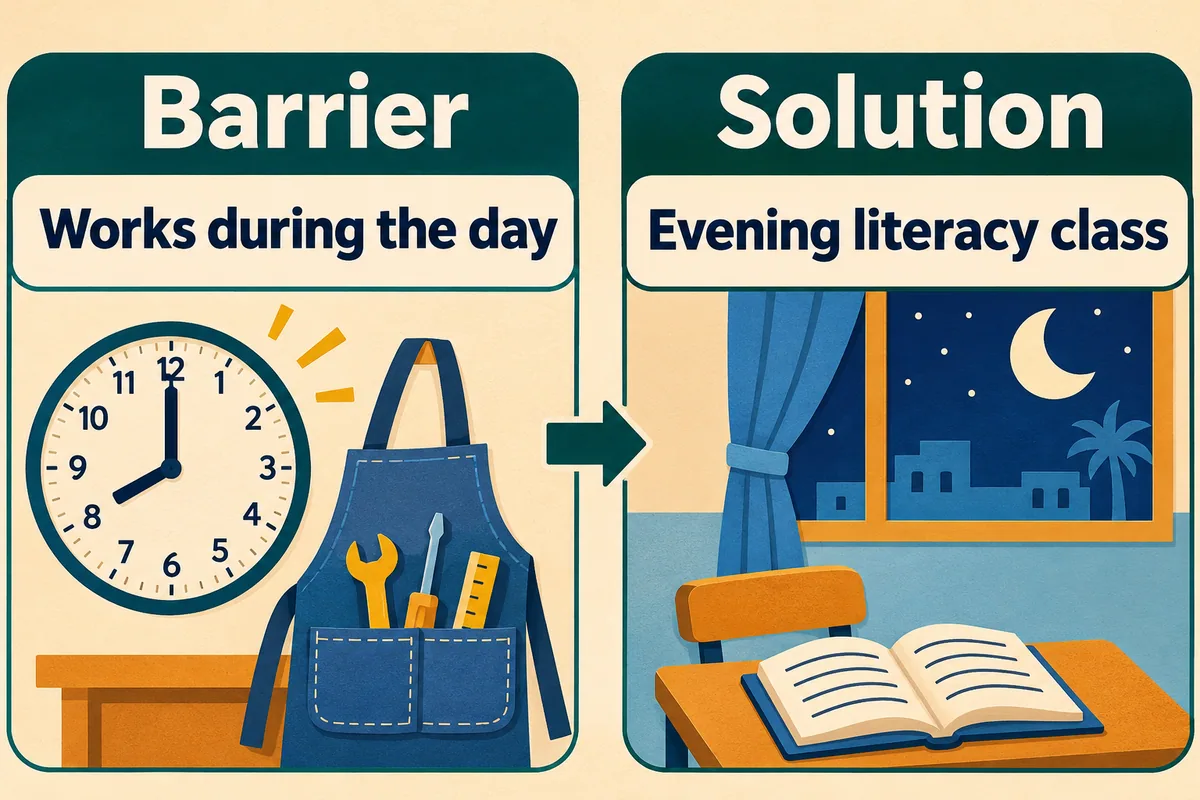
From a problem to a solution
Access to an evening class
An adult wants to improve her literacy, but she works during the day. A local centre offers evening classes, so she can attend after work. The time of the class removes a barrier and gives her access to organised learning.
| Word family | Example |
|---|---|
| educate / education / educated | Education can continue throughout a person’s life. |
| literate / illiterate / literacy | A literacy course helps adults read notices and complete everyday forms. |
| qualify / qualification / qualified | A qualified electrician has met the required training standards. |
Access to education and lifelong learning
Literacy is the ability to read and write, and numeracy is the ability to use numbers in everyday situations. Use attend classes, enrol in a course, earn a qualification, drop out of school and improve access to education. An organised literacy workshop may be non-formal even if it takes place in a classroom. A student who learns a useful skill while helping a relative is learning informally.
Worked examples: education words in context
Choosing verb collocations
Complete « Salma ___ in a vocational course, ___ her final exams and ___ a qualification in electrical work. »
- A course is something you join officially, so the verb is enrolled (enrol in a course).
- Exams are something you succeed in, so the verb is passed (pass an exam).
- A qualification is something you receive at the end, so the verb is obtained or earned.
- Final sentence: « Salma enrolled in a vocational course, passed her final exams and obtained a qualification in electrical work. »
A word family: literate, literacy, illiterate
Complete « Adult ___ (literate) classes help people who are ___ (literate) to read official forms. »
- The first gap comes before the noun classes and names the subject of the classes. Use the noun literacy.
- The second gap describes people who cannot read, so it needs the adjective with a negative prefix: illiterate.
- Final sentence: « Adult literacy classes help people who are illiterate to read official forms. »
Sources and curriculum
- English Language Guidelines for Secondary Schools (Ministry of Education, 2007)
The 2nd Baccalaureate syllabus describes the ten themes, four skills and language structures. See printed pages 76–84.
- National Baccalaureate Exam Specifications (English, 2025)
Reproduction of the national framework for the reading, language and writing sections, including the science streams.
Frequently asked questions
What is the difference between informal and non-formal education?
Can a non-formal course give a certificate?
What is lifelong learning?
Exercises with answers
4 exercises, from easy practice to challenges. Try each one yourself, then reveal the answer and explanation.
Exercise 1
EasyWrite the word from the lesson that matches each definition.
- The subjects and content taught in a school or course.
- Money given to a student to help pay for studies.
- To leave school before finishing the course.
- Connected with training for a particular job.
- To put your name on the official list of a course.
Answer and explanation
- Curriculum.
- A scholarship.
- Drop out (of school).
- Vocational.
- Enrol.
Exercise 2
Intermediate- Classify a secondary school course leading to a recognised qualification.
- Classify a planned weekend literacy course run by an association.
- Classify a child learning to repair a bike by watching a relative.
Answer and explanation
- Formal education. It is part of a recognised education system.
- Non-formal education. It is organised learning outside the regular school system.
- Informal learning. The learning happens through everyday experience.
Exercise 3
IntermediateGive the correct form of the word in brackets.
- Free ___ (educate) is a right for every child.
- The museum offers ___ (educate) visits for schools.
- He is a highly ___ (educate) engineer.
- She hopes to ___ (qualification) as a nurse next year.
- The ___ (enrol) period ends on Friday.
Answer and explanation
- Education. The gap is the subject of the sentence, so it needs a noun.
- Educational. The adjective describes visits.
- Educated. The past participle adjective describes a person who has had a good education.
- Qualify. After hopes to, use a base verb.
- Enrolment. The noun names the period of registration.
Exercise 4
ChallengeAnswer in complete sentences.
- A women’s association runs a cooking and accounting course twice a week. Is it formal, non-formal or informal education? Explain.
- Give an example of lifelong learning in your family or neighbourhood.
- Write three sentences about one barrier to education in rural areas and one solution. Use access, drop out and scholarship.
Answer and explanation
- It is non-formal education. The course is organised and has a timetable, but it is outside the official school system.
- One answer is « My grandfather joined an evening literacy class at sixty so that he could read the newspaper himself. »
- One answer is « In some villages, the nearest secondary school is far away, so students lack access to education. Some girls drop out because the journey is long and expensive. A scholarship that pays for boarding could help them continue their studies. »