



Functions 5 : Expressing addition and concession
Addition brings in a supporting point, with expressions such as also, in addition and moreover. Concession acknowledges an obstacle or an unexpected contrast, with expressions such as although and despite. For English 2 Bac, pick a connector based on the relationship and the structure that follows it.
By the end of this lesson, you can
- Tell whether a writer is adding a point or acknowledging a contrast.
- Use although before a clause and despite before a noun or -ing phrase.
- Punctuate a linking adverb in formal writing.
Un bon cours, ça se partage.
Listen to the text
Listen before opening the transcript. This original English practice text is read by a synthetic voice.
Show the transcript
Although the robotics club advertised its course to all students, several girls thought that applicants needed previous experience. The organisers changed the notice to explain that beginners were welcome. In addition, they arranged a short introductory session led by two former participants. More students applied the next week, but the club will also check how many can attend regularly.
How do you add information in English?
| Expression | Position or pattern | Example |
|---|---|---|
| also | before most main verbs or after be | She also manages the workshop budget. |
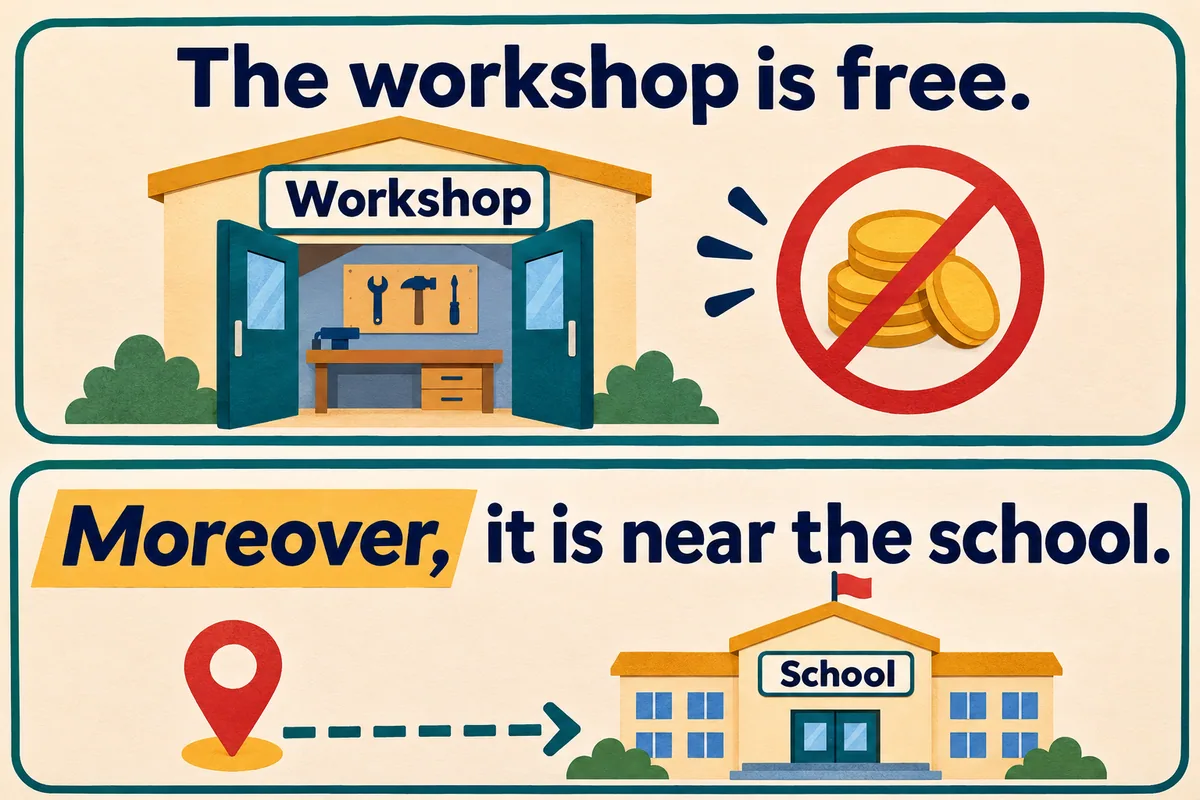
| in addition / moreover / furthermore | often at the start of a new sentence with a comma | The sessions are free. Moreover, they take place near the school. |
| in addition to / as well as | before a noun or an -ing form in this pattern | In addition to teaching, she mentors new club leaders. |
| both … and … | join parallel words or phrases | The training improves both technical skills and confidence. |
Although, despite and however
| Connector | What follows | Example |
|---|---|---|
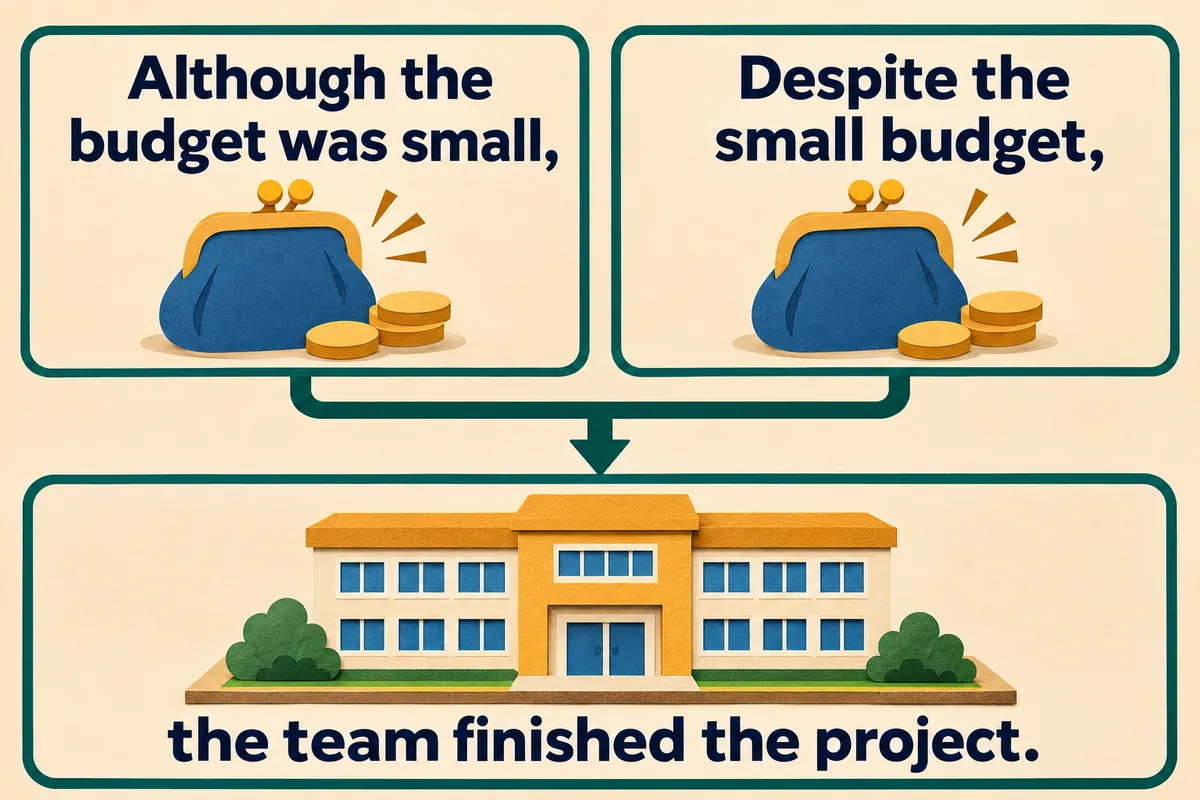
| although / even though | subject + verb | Although the budget was small, the team finished the project. |
| despite / in spite of | noun phrase or verb-ing | Despite the small budget, the team finished the project. |
| despite the fact that | subject + verb after that | Despite the fact that the budget was small, the team finished. |
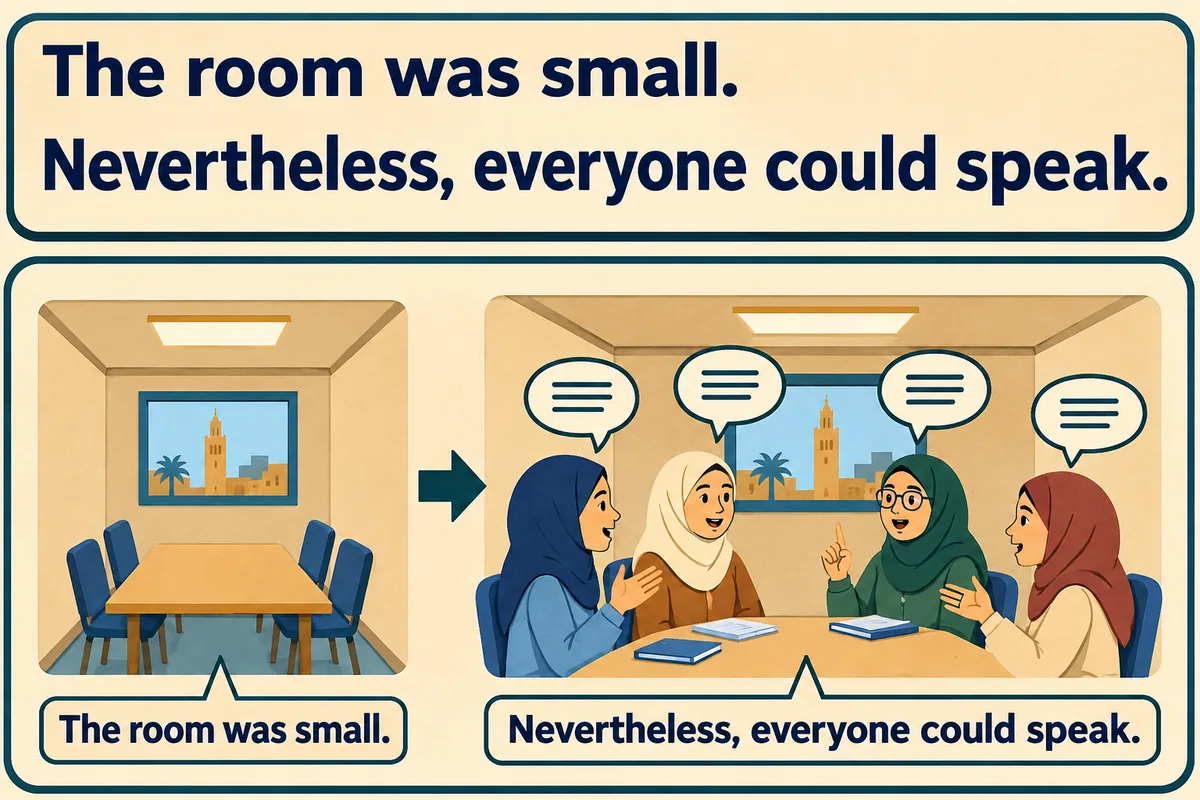
| however / nevertheless | a new sentence or a properly separated clause | The budget was small. Nevertheless, the team finished. |
Even though gives more emphasis than although. When an although clause comes first, put a comma before the main clause. When a linking adverb such as however starts a sentence, follow it with a comma.
Combine ideas without changing the meaning
Moving from addition to concession
« The workshop was free. In addition, it was close to the school. Although the room was small, every participant had a chance to speak. » In addition adds another benefit. Although introduces a limitation before the outcome that followed despite it.
Remember
Use « despite the rain » or « in spite of the rain ». With although, use a full clause, as in « although it rained ». One although already shows the contrast, so continue with the main clause directly.
How do you use in addition to, even though and nevertheless?
In addition to takes a noun or verb-ing, as in « In addition to offering training, the club gives students access to equipment. » Even though takes a clause and gives the concession extra emphasis. Nevertheless can connect two sentences, as in « The team had limited time. Nevertheless, it completed the survey. » Use both … and … to link parallel words or phrases.
Worked examples: adding ideas and making concessions
One concession, three structures
Rewrite « The road was icy, but the bus arrived on time » with although, despite and however.
- Although takes a full clause: « Although the road was icy, the bus arrived on time. »
- Despite takes a noun phrase: « Despite the icy road, the bus arrived on time. »
- However links two sentences and takes a comma after it: « The road was icy. However, the bus arrived on time. »
Adding with in addition to
Join « She studies medicine. She also volunteers with the Red Crescent. » with in addition to.
- In addition to is a preposition, so it is followed by a noun or an -ing form.
- Turn the first sentence into an -ing form: « In addition to studying medicine ».
- Final sentence: « In addition to studying medicine, she volunteers with the Red Crescent. » As well as studying would also be correct.
Listening and speaking practice
Listen to the recording and answer this question. Which two changes did the organisers make, and what will they check after applications?
Propose two ways to remove a barrier to a school activity. Present a difficulty with although, then add another proposal with in addition.
Sources and curriculum
- English Language Guidelines for Secondary Schools (Ministry of Education, 2007)
The 2nd Baccalaureate syllabus describes the ten themes, four skills and language structures. See printed pages 76–84.
- National Baccalaureate Exam Specifications (English, 2025)
Reproduction of the national framework for the reading, language and writing sections, including the science streams.
Frequently asked questions
What is the difference between although and despite?
What can I use instead of moreover?
What is the difference between however and although?
Exercises with answers
5 exercises, from easy practice to challenges. Try each one yourself, then reveal the answer and explanation.
Exercise 1
EasySay whether each word or phrase adds information or expresses a concession.
- moreover
- although
- besides
- nevertheless
- as well as
- in spite of
Answer and explanation
- Addition.
- Concession.
- Addition.
- Concession.
- Addition.
- Concession.
Exercise 2
Intermediate- The project had little funding. It reached its target. Join with despite.
- The workshop offers training. It offers mentoring. Join with in addition to.
Answer and explanation
- Despite having little funding, the project reached its target. Despite takes a noun phrase or -ing form.
- In addition to offering training, the workshop offers mentoring.
Exercise 3
IntermediateChoose the correct option.
- (Although / Despite) she had little experience, she was elected.
- (In spite of / However) the cost, the project continued.
- The job is well paid. (Moreover / Although), it is close to home.
- He was exhausted. (Nevertheless / Despite), he finished the report.
- (Even though / In addition) it rained, the march went ahead.
Answer and explanation
- Although. It is followed by a full clause.
- In spite of. It is followed by a noun phrase.
- Moreover. The sentence adds a second advantage.
- Nevertheless. It starts a new sentence and introduces a contrast.
- Even though. It introduces a clause and shows the contrast.
Exercise 4
Intermediate- Which two changes did the organisers make, and what will they check after applications?
Answer and explanation
- They clarified that beginners were welcome and arranged an introductory session. They will check how many students can attend regularly.
Exercise 5
ChallengeRewrite each sentence with the word or phrase in brackets. Keep the meaning.
- She didn’t have a degree, but she became a manager. (Despite)
- She didn’t have a degree, but she became a manager. (Although)
- The village has no hospital. It has no secondary school either. (In addition to)
- The campaign was short. It changed many attitudes. (Nevertheless)
- Women make up half the population, but they hold fewer seats in parliament. (despite the fact that)
Answer and explanation
- Despite not having a degree, she became a manager.
- Although she didn’t have a degree, she became a manager.
- In addition to the lack of a hospital, the village has no secondary school.
- The campaign was short. Nevertheless, it changed many attitudes.
- Women hold fewer seats in parliament despite the fact that they make up half the population.