



Grammar 1 : Gerund or infinitive
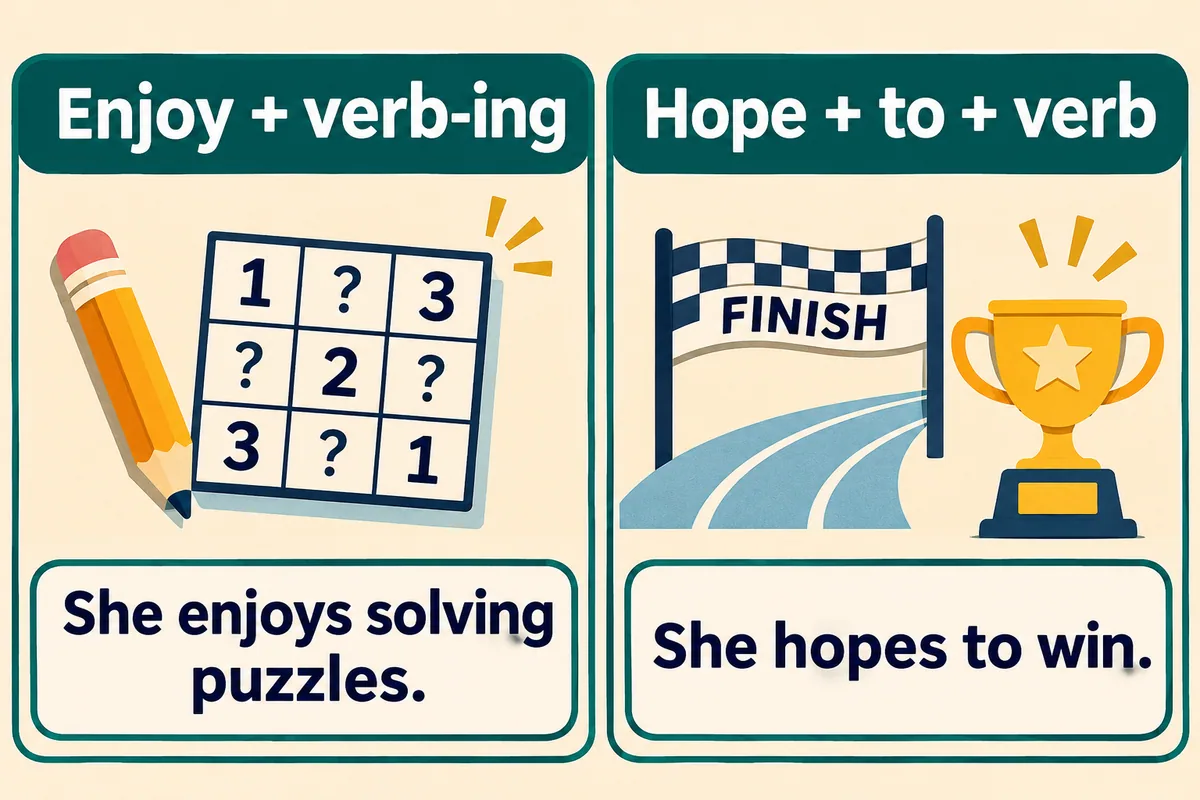
Use the gerund (verb-ing) after verbs such as enjoy and avoid, and the to-infinitive after verbs such as decide and hope. Some verbs, including stop and remember, allow both forms with different meanings. This English 2 Bac lesson shows how to decide from the first verb and what the speaker wants to say.
By the end of this lesson, you can
- Choose a gerund, to-infinitive or bare infinitive in a sentence.
- Use verb-ing as a subject and after a preposition.
- Distinguish stop doing from stop to do and remember doing from remember to do.
Un bon cours, ça se partage.
When do we use a gerund or infinitive?
| Pattern | Common words and structures | Example |
|---|---|---|
| gerund (verb-ing) | enjoy, avoid, finish, keep, mind, suggest, consider, practise | Meryem enjoys solving logic problems. |
| to-infinitive (to + base verb) | agree, decide, hope, learn, plan, refuse, want, would like | She hopes to enter the competition. |
| object + to-infinitive | ask, advise, encourage, invite, tell, want | The teacher encouraged her to enter. |
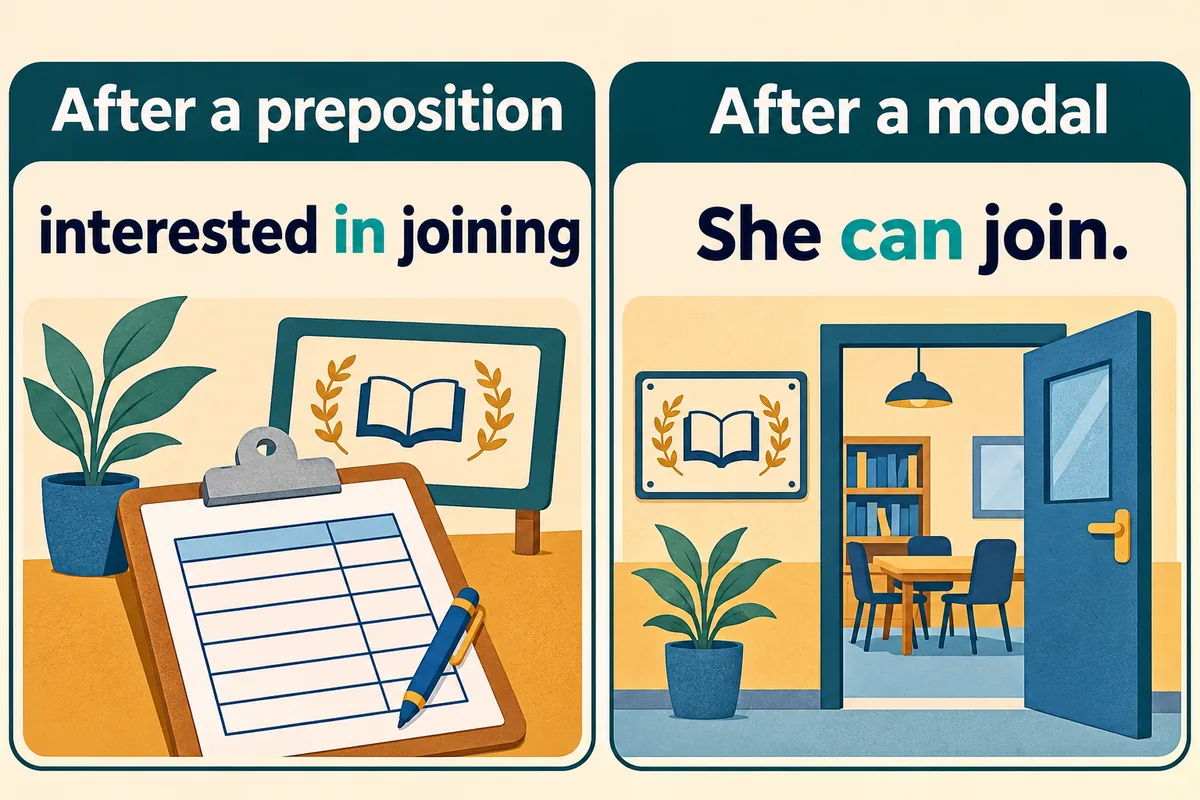
| bare infinitive (base verb) | after can, must, should and after let or make + object in an active clause | The teacher let her try another method. |
A gerund can be the subject of a sentence, as in « Solving problems builds confidence ». Use verb-ing after a preposition, as in « interested in joining » and « before leaving ». In « look forward to meeting », to is a preposition, so it is followed by verb-ing.
When the second form changes the meaning
| First example | Second example | Difference |
|---|---|---|
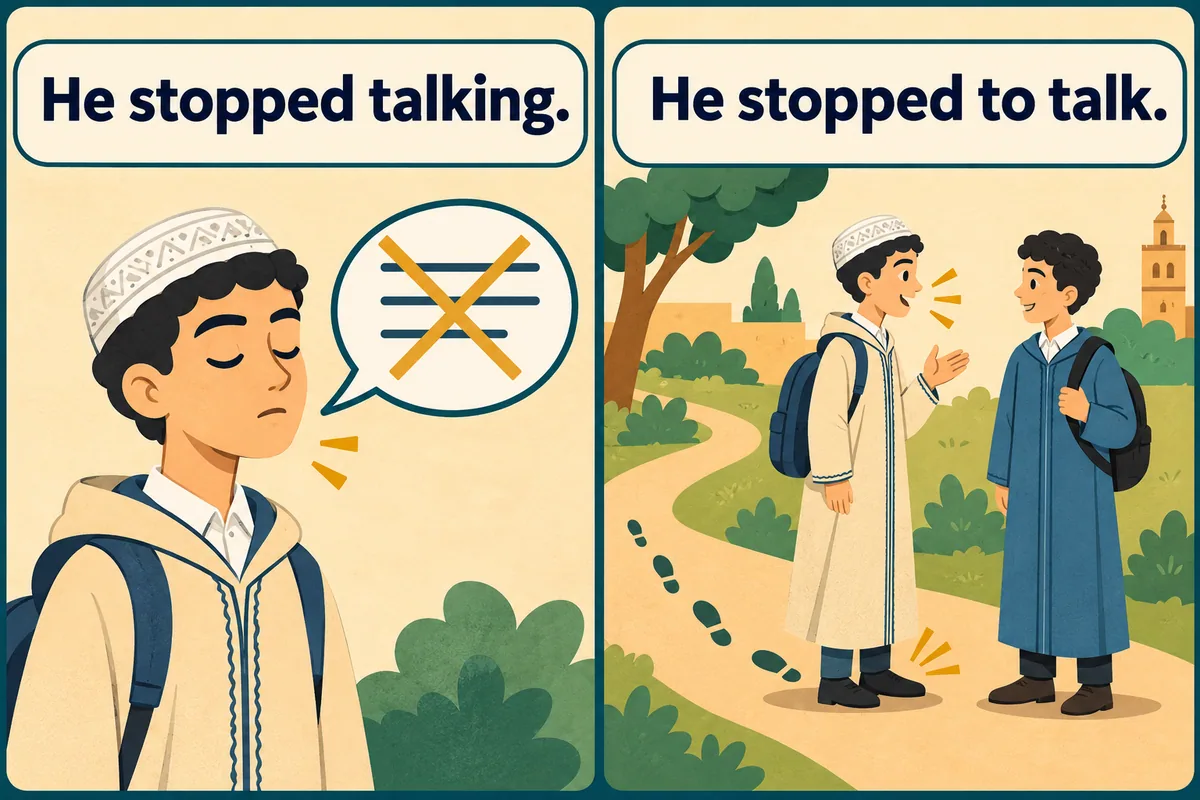
| He stopped talking. | He stopped to talk. | He ended the conversation activity in the first. In the second he paused another activity so he could talk. |
| I remember locking the door. | I remembered to lock the door. | A memory of an earlier action versus remembering a task and doing it. |
| Try restarting the tablet. | Try to restart the tablet. | Test a possible solution versus make an effort to do the action. |
| I regret saying that. | I regret to say that the club is closed. | Regret for a past action versus introducing unwelcome news formally. |
With begin, start and continue, both forms are often possible with little change in meaning. In « It started raining » and « It started to rain », the event is the same.
Choose the form in a complete sentence
A student talks about the science fair
« I wanted to present our project, so my partner helped me prepare. We kept practising until I felt ready. » Wanted takes to present. Help permits either prepare or to prepare here. Kept takes practising.
Remember
Follow suggest with verb-ing or a that-clause. Say « He suggested leaving early » or « He suggested that we leave early ».
Try, regret and the infinitive after an adjective
« Try restarting the computer » means test a possible solution. « Try to restart the computer » means make an effort to do it. « I regret leaving early » looks back at a past action. « I regret to say that the club is closed » introduces unwelcome news.
An adjective can be followed by to + base verb, as in « She was pleased to join ». Use not before the non-finite verb phrase in « She decided not to join » and « He suggested not using plastic ».
Worked examples: gerund or infinitive step by step
Read the verb before the gap
Complete « Our coach suggested ___ (train) at dawn, but most players refused ___ (get) up so early. »
- The first gap follows suggested. Suggest takes the -ing form, so write training.
- The second gap follows refused. Refuse takes to + base verb, so write to get.
- Check the whole sentence: « Our coach suggested training at dawn, but most players refused to get up so early. »
Same verb, different meaning
Explain the difference between « I’ll never forget visiting Chefchaouen » and « Don’t forget to visit Chefchaouen. »
- Forget + -ing looks back at an experience that already happened. The speaker visited the town and keeps the memory.
- Forget + to + base verb looks forward to a task. The visit has not happened yet, and the speaker reminds someone to do it.
- The same rule works with remember: « I remember locking the door » (a memory) and « Remember to lock the door » (a task).
Sources and curriculum
- English Language Guidelines for Secondary Schools (Ministry of Education, 2007)
The 2nd Baccalaureate syllabus describes the ten themes, four skills and language structures. See printed pages 76–84.
- National Baccalaureate Exam Specifications (English, 2025)
Reproduction of the national framework for the reading, language and writing sections, including the science streams.
Frequently asked questions
What is the difference between a gerund and an infinitive?
Do we say enjoy to read or enjoy reading?
Which verbs can take both the gerund and the infinitive?
Exercises with answers
4 exercises, from easy practice to challenges. Try each one yourself, then reveal the answer and explanation.
Exercise 1
EasyChoose the correct option in each sentence.
- Rim avoids (to eat / eating) late at night.
- They decided (to start / starting) a recycling club.
- My parents let me (go / to go) to the summer camp.
- I’m interested in (to learn / learning) Japanese.
- We can’t afford (to buy / buying) new equipment this year.
Answer and explanation
- Eating. Avoid takes the -ing form.
- To start. Decide takes to + base verb.
- Go. Let + object takes the bare infinitive.
- Learning. A preposition (in) is followed by the -ing form.
- To buy. Afford takes to + base verb.
Exercise 2
Intermediate- Complete « He suggested ___ (hold) the meeting earlier. »
- Complete the advice « If the alarm still rings, try ___ (replace) the battery. »
- Complete « She agreed ___ (help) the younger students. »
Answer and explanation
- Holding. Suggest can take an -ing form.
- Replacing. The proposal is a possible solution to test.
- To help. Agree takes a to-infinitive here.
Exercise 3
IntermediateWrite the -ing form, to + base verb or the bare infinitive.
- Would you mind ___ (close) the window?
- The teacher made us ___ (rewrite) the paragraph.
- She is used to ___ (wake) up at six.
- I’d like ___ (thank) everyone who helped us.
- It’s no use ___ (complain) about the results now.
Answer and explanation
- Closing. Mind takes the -ing form.
- Rewrite. Make + object takes the bare infinitive in the active voice.
- Waking. In be used to, to is a preposition, so it takes the -ing form.
- To thank. Would like takes to + base verb.
- Complaining. The expression it’s no use takes the -ing form.
Exercise 4
ChallengeEach sentence of this paragraph contains one mistake in a verb form. Correct it and explain your choice.
(1) Last summer, I decided joining a volunteer camp in Ifrane. (2) I soon got used to wake up at six. (3) The leader encouraged us taking the initiative. (4) I’ll never forget to cook for forty people on the last night. (5) Next year, I hope coming back with my cousin.
- Correct sentence 1.
- Correct sentence 2.
- Correct sentence 3.
- Correct sentence 4.
- Correct sentence 5.
Answer and explanation
- « I decided to join a volunteer camp. » Decide takes to + base verb.
- « I soon got used to waking up at six. » In get used to, to is a preposition.
- « The leader encouraged us to take the initiative. » Encourage + object takes to + base verb.
- « I’ll never forget cooking for forty people. » The speaker remembers a past experience, so forget takes the -ing form.
- « I hope to come back with my cousin. » Hope takes to + base verb.