



Vocabulary 5 · Women and Power
Women and Power vocabulary gives you precise ways to talk about leadership, equal opportunities and the barriers people face. In English 2 Bac, distinguish equality, which describes access or treatment, from empowerment, which describes gaining the resources and ability to make choices.
By the end of this lesson, you can
- Use topic terms accurately in written and spoken English.
- Recognise equality and empowerment word families.
- Explain a barrier and a practical way to address it.
Un bon cours, ça se partage.
Words for leadership and equal opportunities
| Word or expression | Meaning | Example |
|---|---|---|
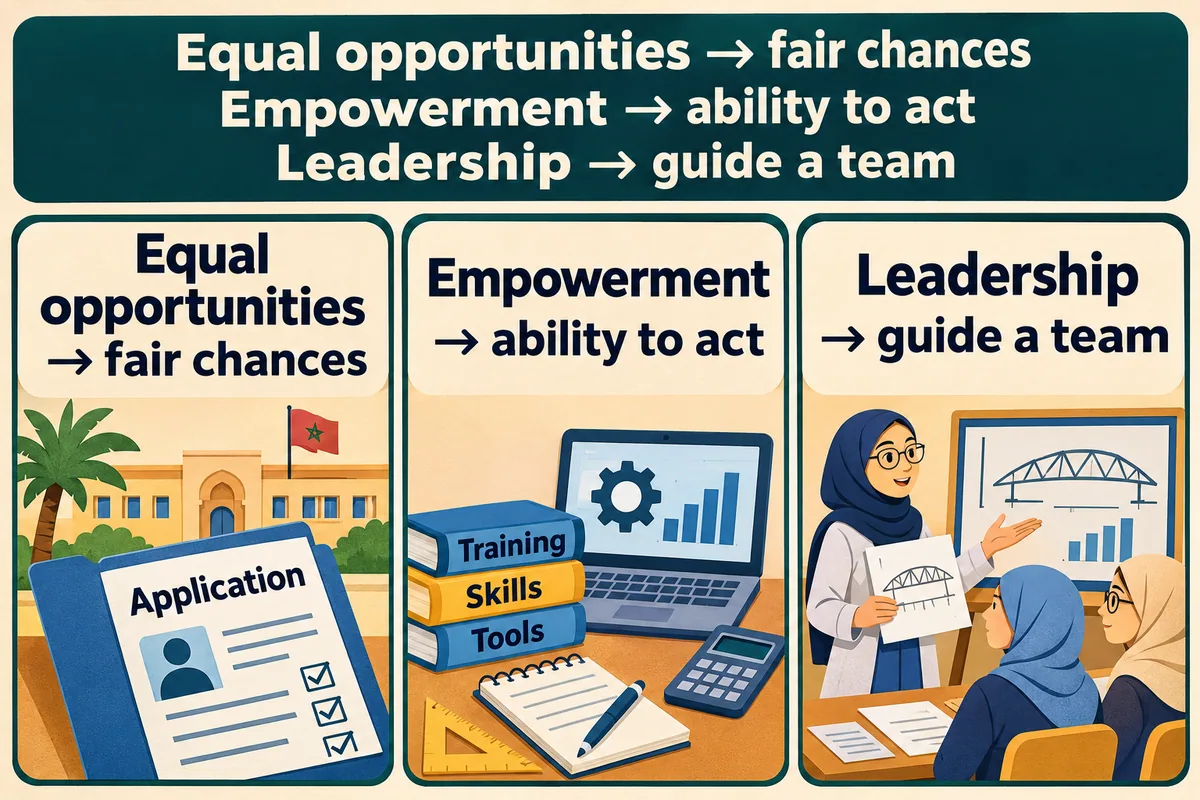
| equal opportunities | fair chances to study, work or participate | Equal opportunities allow every qualified student to apply. |
| empowerment | a process that increases people’s ability to make decisions and act | Access to training can support women’s economic empowerment. |
| leadership | guiding a group toward a shared goal | Aïcha showed leadership by giving each team member a role. |
| representation | the presence or participation of a group in decisions or public roles | The committee is increasing the representation of women. |
| discrimination | unfair treatment based on a characteristic such as gender | A transparent selection process can reduce discrimination. |
| stereotype | a fixed, oversimplified belief about a group | The claim that only some students can lead a technical club is a stereotype. |
Word families and useful combinations
| Family | Example combinations |
|---|---|
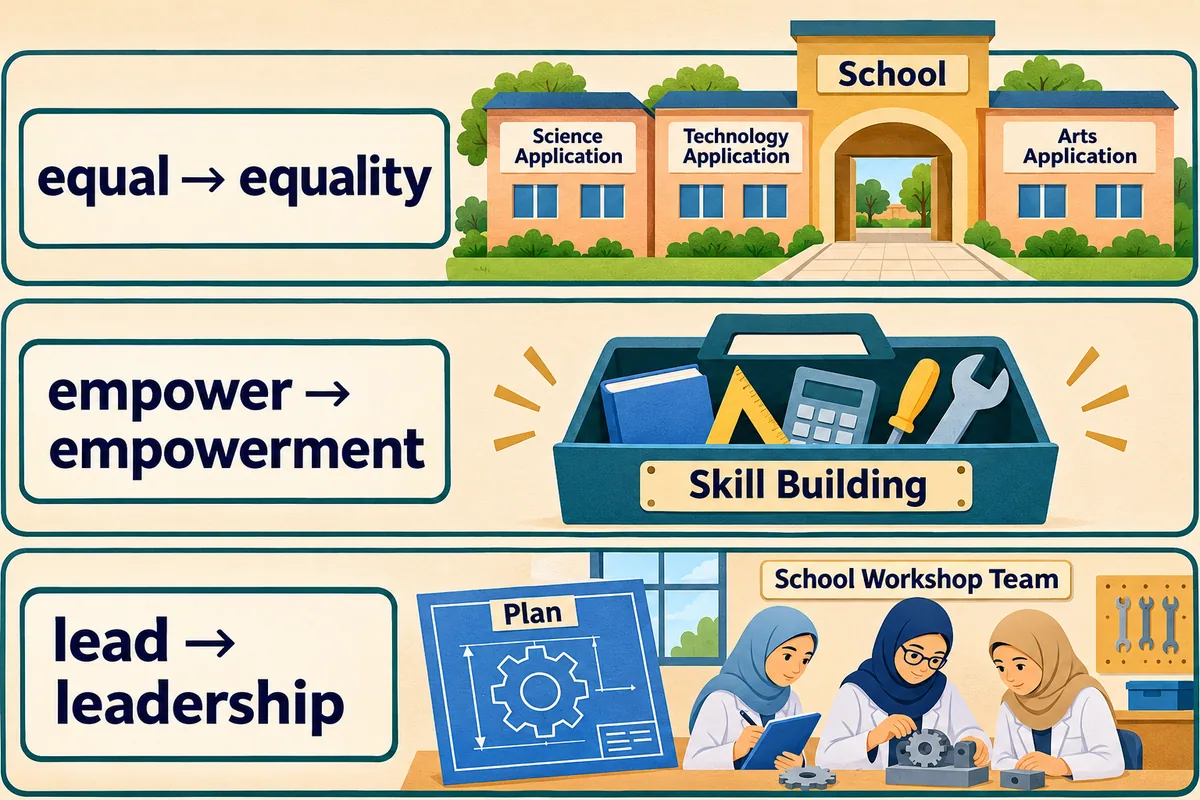
| equal / equally / equality | equal access to training / treat applicants equally / promote equality |
| empower / empowerment | empower women to start businesses / support women’s empowerment |
| lead / leader / leadership | lead a team / elect a leader / develop leadership skills |
| participate / participation / participant | participate in a meeting / increase participation / welcome new participants |
Explain a barrier through an example
Who can take part in a school club?
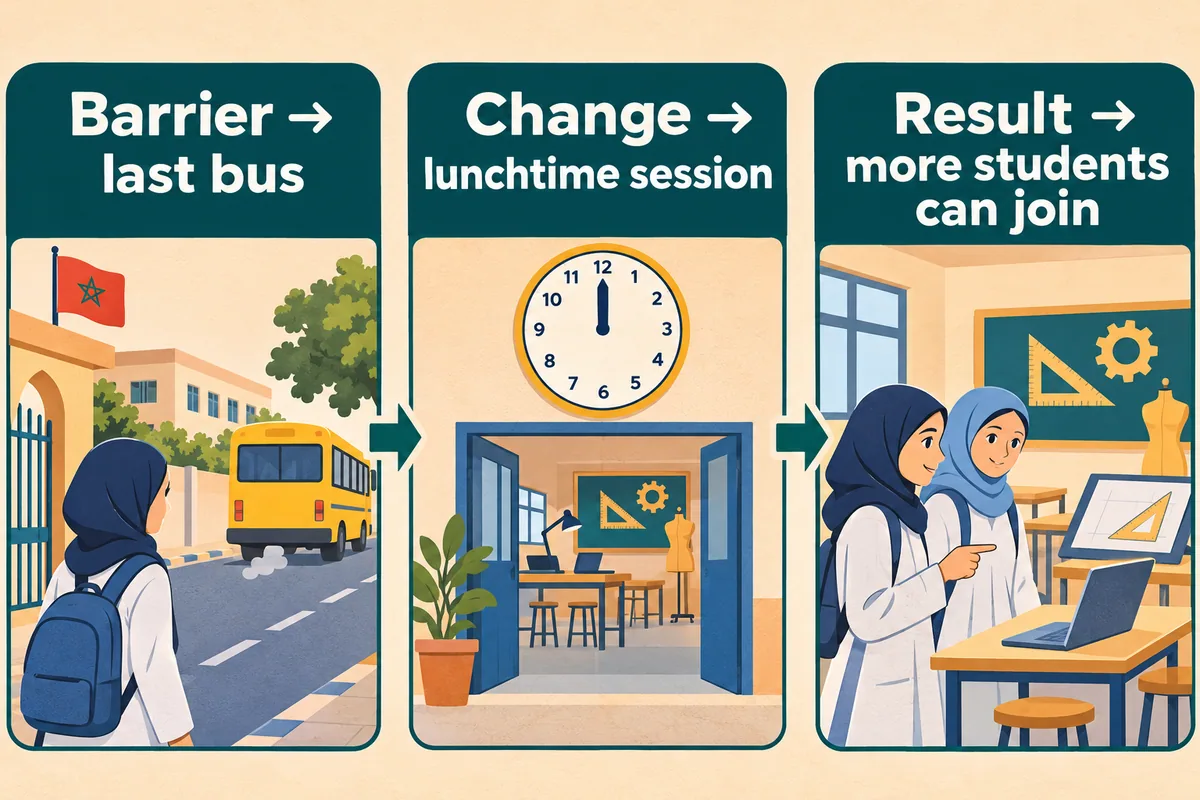
« Some girls wanted to join the design club, but its meetings ended after their last bus. The school moved one weekly session to lunchtime. The change gave more students access to the workshop and created opportunities to lead projects. » The paragraph names a practical barrier and a response.
Use specific descriptions of a situation. When you write « women face barriers », add the relevant barrier, such as training that is expensive or offered at an inaccessible time. Then say who could change it and how.
Gender equality, representation and barriers
Representation is the presence or participation of a group in a setting, such as a committee. A barrier is something that limits access or participation. A stereotype is an oversimplified assumption about a group. Use challenge stereotypes, close a gap, promote equal opportunities and take on a leadership role.
Distinguish equality, equal and equally. The noun empowerment names a process of giving people more control over decisions. The verb empower needs an object: a training programme can empower participants to lead projects.
Worked examples: discussing equality precisely
Equal, equally or equality?
Complete « Girls and boys should be treated ___ (equal), because ___ (equal) of opportunity benefits the whole of society. »
- The first gap describes how they are treated, so it needs an adverb: equally.
- The second gap is the subject of benefits, so it needs a noun: equality.
- Final sentence: « Girls and boys should be treated equally, because equality of opportunity benefits the whole of society. »
Answering a stereotype with evidence
Respond to the stereotype « Girls are not good at engineering. »
- Identify the problem: the sentence makes a generalisation about a whole group.
- State the principle in neutral words: « Ability in engineering does not depend on gender. »
- Support it with a concrete example: « In our school robotics team, two of the four best programmers are girls. »
- Add the real barrier, if there is one: « When girls are less present in engineering, the cause is often a lack of encouragement or role models, not a lack of ability. »
Sources and curriculum
- English Language Guidelines for Secondary Schools (Ministry of Education, 2007)
The 2nd Baccalaureate syllabus describes the ten themes, four skills and language structures. See printed pages 76–84.
- National Baccalaureate Exam Specifications (English, 2025)
Reproduction of the national framework for the reading, language and writing sections, including the science streams.
Frequently asked questions
What does women’s empowerment mean in English?
What is the difference between a stereotype and discrimination?
What is a glass ceiling?
Exercises with answers
4 exercises, from easy practice to challenges. Try each one yourself, then reveal the answer and explanation.
Exercise 1
EasyWrite the word from the unit that matches each definition.
- The presence of a group, for example women, in a committee or a parliament.
- Unfair treatment of a person because of their gender, origin or age.
- A fixed and oversimplified idea about a whole group.
- A person whose behaviour other people admire and want to copy.
- The ability to guide a group and make decisions.
Answer and explanation
- Representation.
- Discrimination.
- A stereotype.
- A role model.
- Leadership.
Exercise 2
Intermediate- Complete « The programme aims to improve ___ (represent) of women in decision-making. »
- Use equal opportunities and name an action that could help.
Answer and explanation
- Representation. The gap is the object of improve, so it needs a noun.
- One answer is « The school can promote equal opportunities by giving all students access to workshop materials and mentoring. »
Exercise 3
IntermediateGive the correct form of the word in brackets.
- Women’s ___ (participate) in local councils has grown.
- She was the first woman to be ___ (elect) mayor of the town.
- The training aims to ___ (power) young women in rural areas.
- Gender ___ (equal) still exists in some workplaces.
- She runs a ___ (success) business selling handmade carpets.
Answer and explanation
- Participation. The gap is the subject, so it needs a noun.
- Elected. The passive needs the past participle.
- Empower. After aims to, use a base verb.
- Inequality. The sentence describes a problem that still exists.
- Successful. The adjective describes business.
Exercise 4
ChallengeAnswer each question in one or two sentences.
- Name one barrier that keeps women out of leadership roles and suggest a solution.
- Rewrite the stereotype « Housework is a woman’s job » as a balanced statement.
- Describe a woman you admire and explain why. Use challenge stereotypes or empower.
Answer and explanation
- One answer is « Long evening meetings can be difficult for parents who look after young children. Organisations could hold meetings during the day and offer online attendance. »
- One answer is « Housework is a shared responsibility, and every member of the family can take part in it. »
- One answer is « I admire my aunt, who became the first woman engineer in her company. She challenges stereotypes every day and empowers younger women by mentoring them. »