



Grammar 4 : Future simple/perfect
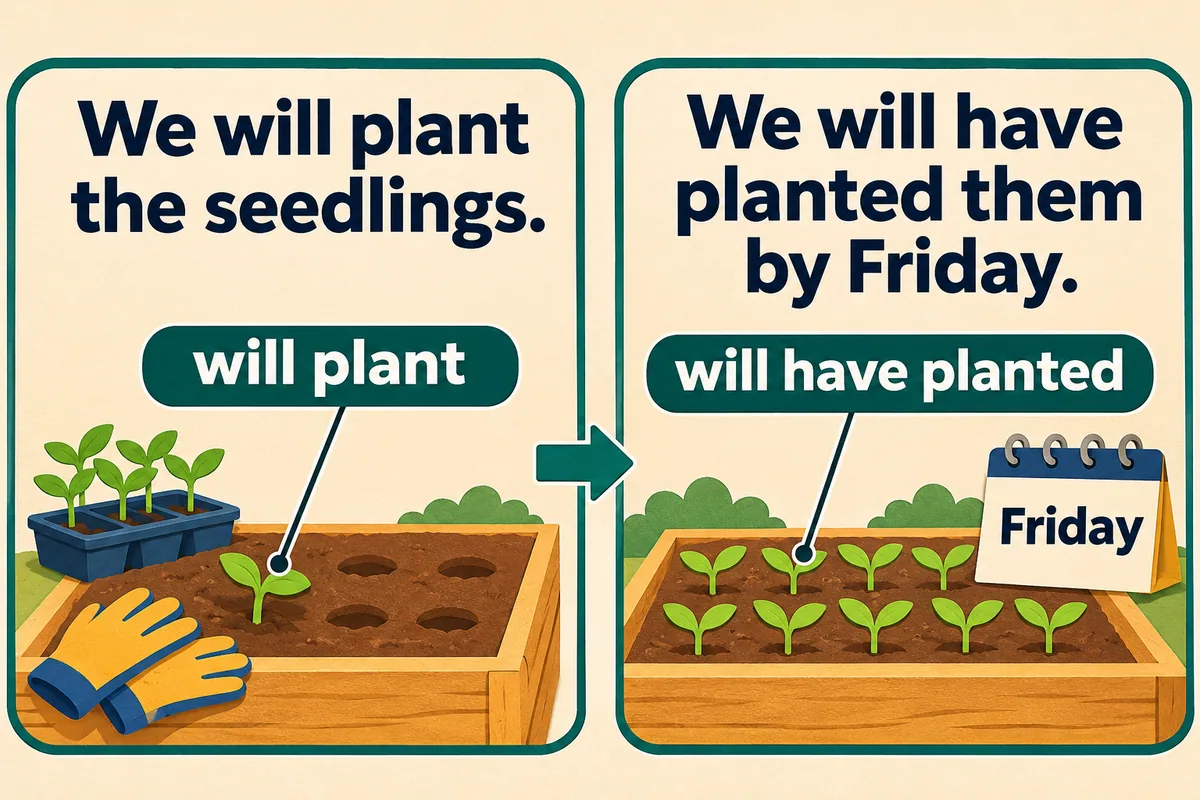
The future simple with will + base verb describes a prediction, promise or future decision. The future perfect with will have + past participle shows that something will be complete by a future time. In « By Friday, we will have planted the herbs », Friday is the point from which you look back.
By the end of this lesson, you can
- Build future simple and future perfect sentences.
- Recognise a deadline introduced by by or by the time.
- Choose the tense that matches the speaker’s time perspective.
Un bon cours, ça se partage.
Future simple and future perfect forms
| Use | Form | Example |
|---|---|---|
| future simple | will + base verb | We will plant the seedlings on Friday. |
| future simple negative | will not / won’t + base verb | We won’t move the pots today. |
| future simple question | Will + subject + base verb? | Will the seedlings survive the heat? |
| future perfect | will have + past participle | By Friday, we will have planted all the seedlings. |
| future perfect negative | won’t have + past participle | We won’t have finished the path by noon. |
| future perfect question | Will + subject + have + past participle? | Will you have finished the path by noon? |
Will can introduce a prediction (« I think it will rain »), an offer (« I’ll help carry the tools »), a promise or a decision made now. A plan already decided can be expressed with be going to, as in « We’re going to plant herbs this week ».
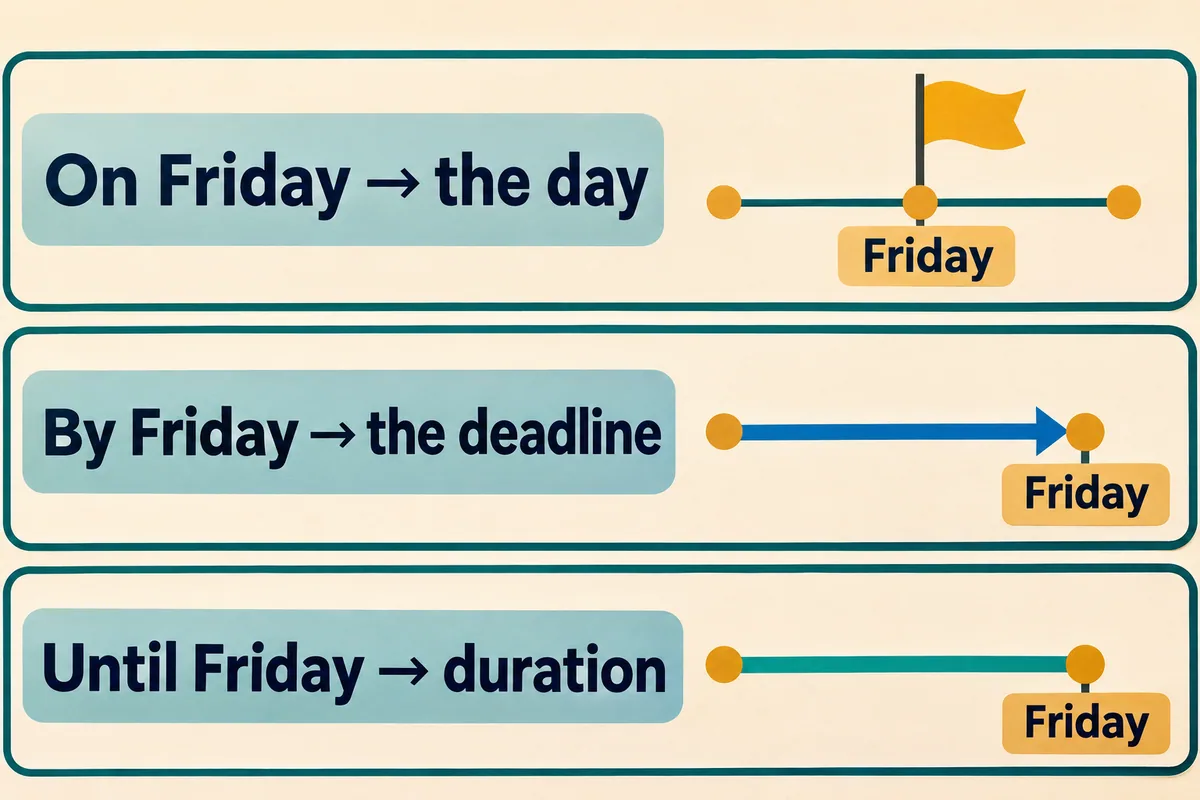
On Friday, by Friday and until Friday
| Time expression | What it tells you | Example |
|---|---|---|
| on Friday | the day of the action | We will fix the tank on Friday. |
| by Friday | no later than that deadline | We will have fixed the tank by Friday. |
| until Friday | how long a situation continues | The old tank will stay outside until Friday. |
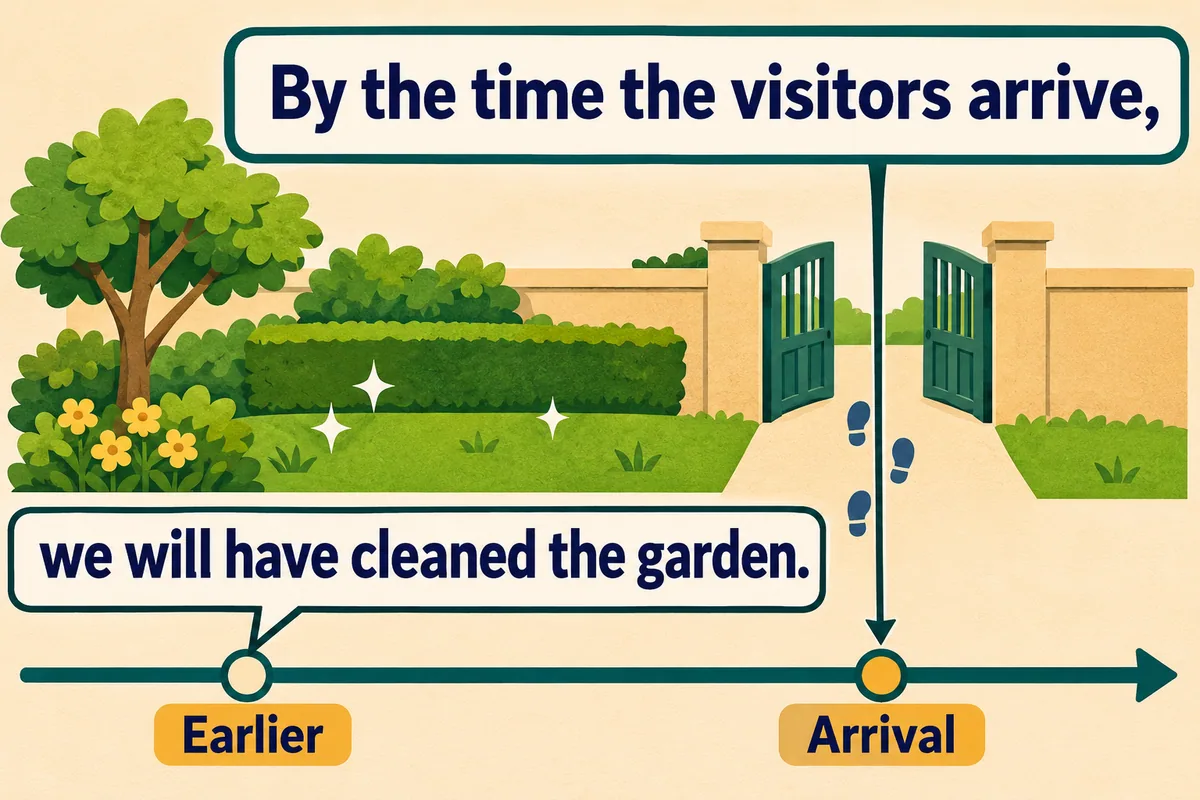
Two actions can mark the same point. In « By the time the visitors arrive, we will have cleaned the garden », arrive is in the present simple in the future time clause. Will have cleaned is in the main clause.
Speak from a future point in time
A project update
« We will start sorting the plastic after lunch. By the end of the day, we will have filled two bags. » The first sentence names a future starting action. The second gives the expected total at the future deadline.
Remember
Use the past participle after will have. Write « will have written », « will have gone » or « will have made ».
Will, going to and completion by a deadline
Will can express a prediction, promise or immediate decision. Going to can express an existing intention or a prediction based on present evidence. Use will have + past participle when looking back from a future reference point. « By the time the audit starts, we will have collected the figures » uses the present simple in the time clause.
Worked examples: choosing a future form
Will, going to or the future perfect?
Choose a future form for each situation: dark clouds in the sky, a decision made now, a target to reach by a deadline.
- Dark clouds are present evidence, so use going to: « It’s going to rain. »
- A decision made at the moment of speaking takes will: « I’ll take an umbrella. »
- An action completed before a future deadline takes will have + past participle: « By 2030, our town will have planted ten thousand trees. »
Negatives and questions in the future perfect
Ask whether a report will be finished by Monday, then answer that it will only be finished on Wednesday.
- Question: put will before the subject: « Will you have finished the report by Monday? »
- Negative answer: « No, I won’t have finished it by Monday. »
- Add the real deadline with until: « I won’t have finished it until Wednesday » means Wednesday is the earliest day it will be finished.
Sources and curriculum
- English Language Guidelines for Secondary Schools (Ministry of Education, 2007)
The 2nd Baccalaureate syllabus describes the ten themes, four skills and language structures. See printed pages 76–84.
- National Baccalaureate Exam Specifications (English, 2025)
Reproduction of the national framework for the reading, language and writing sections, including the science streams.
Frequently asked questions
What is the difference between future simple and future perfect?
Does by Friday mean the action happens on Friday?
Why do we use the present simple after when to talk about the future?
Exercises with answers
4 exercises, from easy practice to challenges. Try each one yourself, then reveal the answer and explanation.
Exercise 1
EasyChoose the correct option.
- Look at those clouds! It (will / is going to) rain.
- « The phone is ringing. » « I (’ll / am going to) answer it. »
- By June, we (will finish / will have finished) the project.
- I promise I (will / am going to) call you tonight.
- We’ll start the meeting when the director (arrives / will arrive).
Answer and explanation
- Is going to. The clouds are present evidence.
- ’ll. The decision is made at the moment of speaking.
- Will have finished. The project will be complete before June.
- Will. Will expresses a promise.
- Arrives. Time clauses take the present simple.
Exercise 2
Intermediate- Complete « By Friday afternoon, the group ___ (analyse) all the forms. » Show a finished result.
- Complete « I’ll call you as soon as the manager ___ (arrive). »
Answer and explanation
- Will have analysed. The analysis will be complete by the future deadline.
- Arrives. Use the present simple in this future time clause.
Exercise 3
IntermediatePut the verbs in brackets in the future perfect.
- By the end of the year, the town ___ (install) 200 solar street lights.
- By 2030, many countries ___ (reduce) their emissions.
- ___ you ___ (finish) the survey by Friday?
- We ___ (not / collect) enough data by then.
- By the time you read this letter, I ___ (leave) for Agadir.
Answer and explanation
- Will have installed.
- Will have reduced.
- Will you have finished.
- Won’t have collected.
- Will have left.
Exercise 4
ChallengeUse the club’s plan to write one sentence for each instruction. Plan: September, start composting · December, 500 kg of compost collected · March, 50 trees planted.
- Say what the club will do in September.
- Say what the club will have done by December.
- Say what the club will have done by March.
- Write a sentence that begins « By the time the summer holidays start, … ».
- Make a prediction with going to based on this evidence: the young trees are growing quickly.
Answer and explanation
- The club will start composting in September.
- By December, the club will have collected 500 kg of compost.
- By March, the club will have planted fifty trees.
- By the time the summer holidays start, the students will have planted fifty trees.
- The young trees are growing quickly, so the schoolyard is going to be shadier next year.