



Functions 3 : Expressing purpose
Purpose tells us the aim of an action. Use to + base verb when the person doing the action also has that aim. Use so that + subject + verb when you need to state who should benefit or what should happen. These expressions answer « What for? » in an English 2 Bac sentence.
By the end of this lesson, you can
- Identify the intended goal of an action.
- Choose an infinitive phrase or a full so that clause.
- Write a negative purpose clearly.
Un bon cours, ça se partage.
Listen to the text
Listen before opening the transcript. This original English practice text is read by a synthetic voice.
Show the transcript
Our library started a Saturday workshop so that people who work during the week could attend. Volunteers used real notices and timetables to help learners practise finding information. They provided large-print copies so that everybody could read the examples. At the end of each session, learners chose one task to try during the week.
How do you express purpose in English?
| Expression | What follows | Example |
|---|---|---|
| to / in order to / so as to | base verb | Hamid stayed after class to ask about the project. |
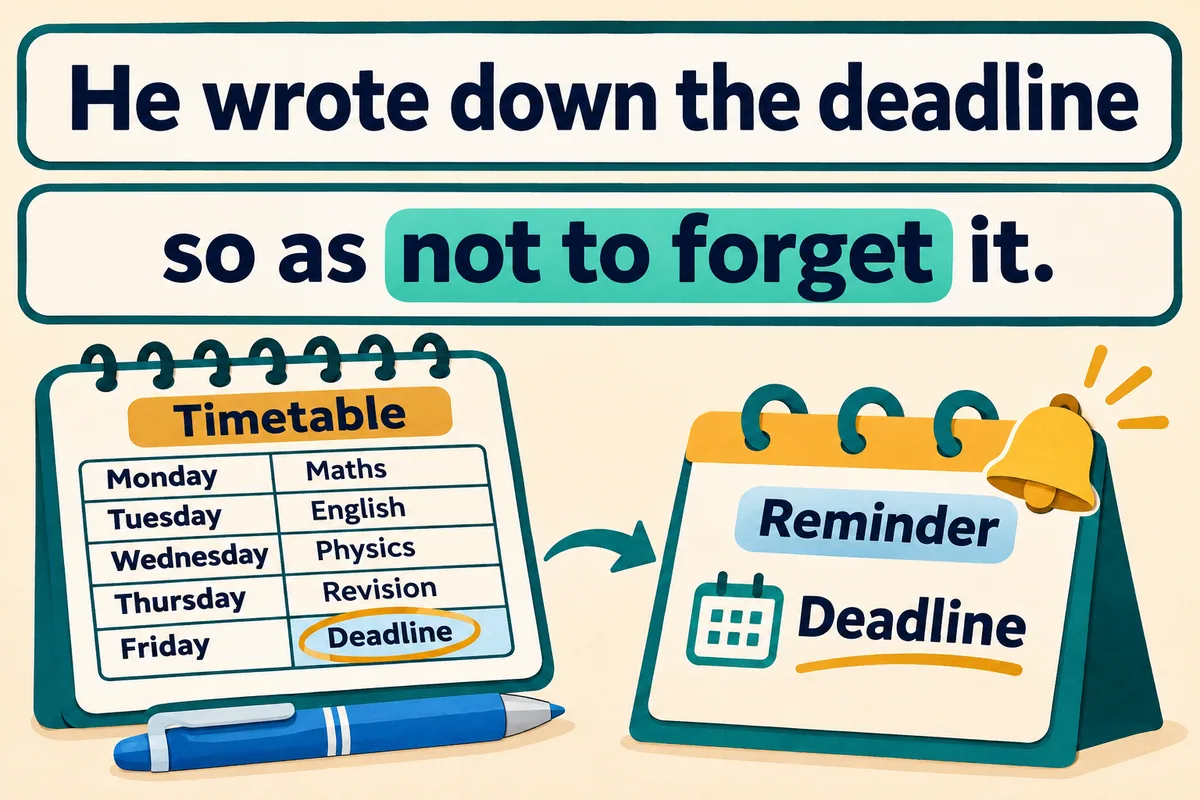
| in order not to / so as not to | base verb | He wrote down the deadline so as not to forget it. |
| so that | subject + verb, often with can, could, will or would | Hamid moved the model so that the class could see it. |
| for | a noun or verb-ing when describing a use or function | This switch is for controlling the light. |
To is the most direct choice in many sentences. In order to or so as to makes the link to the goal more explicit. When another person has the ability or benefit, include that person after so that. In « I sent the map so that you could find the centre », I sent it and you can use it.

Purpose, reason and result
One situation, three links
A library opens earlier to help pupils who take the school bus.
- Purpose: It opens earlier so that those pupils can borrow books.
- Reason: It opens earlier because some pupils leave straight after school.
- Result: It opens earlier, so more pupils can borrow books.
Purpose describes an intention. A result describes what follows or what actually happens in a particular situation. You can say « She called early so that he could hear the news », even if he did not answer.

Choose the form by reading both parts
Step by step
Read the action and the aim together
- Find the action and ask what the speaker wants it to achieve.
- If one subject controls the action and the aim, try to + base verb.
- If the aim needs its own subject, use so that and make a complete clause.
Remember
For the aim of a personal action, say « I came to borrow a book ». Use for + verb-ing to explain a function, as in « This card is for borrowing books ».
Purpose with so that, for and in order for
When the subjects differ, use « We printed a larger timetable so that our visitors could read it » or « We printed a larger timetable in order for our visitors to read it ». A tool’s usual function can be described with for + verb-ing: « This form is for registering volunteers ». To explain the intention behind an action, « I opened the form to register » is more natural.
Worked examples: joining an action and its purpose
To or so that?
Join « Salma saved money. She wanted to buy a laptop. » and « The teacher wrote the steps on the board. The students could copy them. »
- In the first pair, Salma is the subject of both actions, so to + base verb is enough: « Salma saved money to buy a laptop. »
- In the second pair, the subjects are different (the teacher and the students), so use so that and a full clause: « The teacher wrote the steps on the board so that the students could copy them. »
- After a past verb, so that is usually followed by could or would.
A negative purpose
Join « He set two alarms. He didn’t want to miss the bus. »
- With the same subject, put not before to: « He set two alarms so as not to miss the bus » or « in order not to miss the bus ».
- With so that, use a negative clause: « He set two alarms so that he wouldn’t miss the bus. »
- Avoid « for not missing » and « for to not miss ». They are translations of French pour and are not correct here.
Listening and speaking practice
Listen to the recording and answer this question. Why did the library choose Saturdays, and why did volunteers provide large-print copies?
Suggest two changes to make a class more accessible. Explain one purpose with to and another with so that.
Sources and curriculum
- English Language Guidelines for Secondary Schools (Ministry of Education, 2007)
The 2nd Baccalaureate syllabus describes the ten themes, four skills and language structures. See printed pages 76–84.
- National Baccalaureate Exam Specifications (English, 2025)
Reproduction of the national framework for the reading, language and writing sections, including the science streams.
Frequently asked questions
What is the difference between so that and in order to?
Where does not go in a negative purpose phrase?
Why can’t I say « for to learn » in English?
Exercises with answers
5 exercises, from easy practice to challenges. Try each one yourself, then reveal the answer and explanation.
Exercise 1
EasyComplete each sentence with to, so that or for.
- I went to the library ___ borrow a dictionary.
- She spoke loudly ___ everyone at the back could hear.
- This app is ___ translating short texts.
- We left early ___ we wouldn’t miss the train.
- He saved his pocket money ___ buy a bike.
Answer and explanation
- To. Same subject, followed by a base verb.
- So that. The subject changes to everyone.
- For. For + -ing describes what the app is used for.
- So that. It introduces a full clause with would.
- To. Same subject, followed by a base verb.
Exercise 2
Intermediate- The tutor spoke slowly. She wanted the visitors to understand. Join with so that.
- I took a photo of the timetable. I didn’t want to forget the dates. Join with in order not to.
Answer and explanation
- The tutor spoke slowly so that the visitors could understand.
- I took a photo of the timetable in order not to forget the dates.
Exercise 3
IntermediateJoin each pair with the word or phrase in brackets.
- Nadia took notes. She wanted to remember the main ideas. (in order to)
- The school opened a study room. Students can revise in the evening. (so that)
- I whispered. I didn’t want to wake the baby. (so as not to)
- The organisers printed maps. Visitors wouldn’t get lost. (so that)
- She joined the debate club. She wanted to improve her English. (to)
Answer and explanation
- Nadia took notes in order to remember the main ideas.
- The school opened a study room so that students can revise in the evening.
- I whispered so as not to wake the baby.
- The organisers printed maps so that visitors wouldn’t get lost.
- She joined the debate club to improve her English.
Exercise 4
Intermediate- Why did the library choose Saturdays, and why did volunteers provide large-print copies?
Answer and explanation
- Saturday sessions allowed people who work during the week to attend. Large-print copies made the examples easier for everyone to read.
Exercise 5
ChallengeEach sentence contains one mistake. Correct it and explain.
- I came here for learn English.
- She studies hard for to pass the exam.
- He left early so that not to miss the bus.
- We bought a map in order that find the museum.
- Turn on the light so that I can to see.
Answer and explanation
- I came here to learn English. Purpose with the same subject takes to + base verb.
- She studies hard to pass the exam. For to is not used in standard English.
- He left early so as not to miss the bus. So that needs a full clause: so that he wouldn’t miss it.
- We bought a map in order to find the museum. In order that needs a clause with a subject.
- Turn on the light so that I can see. A modal is followed by the base verb without to.