



Vocabulary 2 · Humour
Humour vocabulary describes what makes people laugh and how they react. A joke has a setup and often a punchline. Witty suggests a clever use of words, while hilarious describes something very funny. These distinctions help you discuss humour precisely in English 2 Bac.
By the end of this lesson, you can
- Describe a joke, a comedian and a reaction with different words.
- Use make someone laugh, laugh at and have a sense of humour.
- Explain a punchline in your own words.
Un bon cours, ça se partage.
Words for a joke and its audience
| Word | Meaning | Example |
|---|---|---|
| a joke | a short remark or story meant to make people laugh | Yassine told a joke before the rehearsal. |
| a punchline | the funny final line, often with a surprise | A pause made the punchline more effective. |
| a comedian | a person who performs comedy | The comedian used a squeaky chair in his act. |
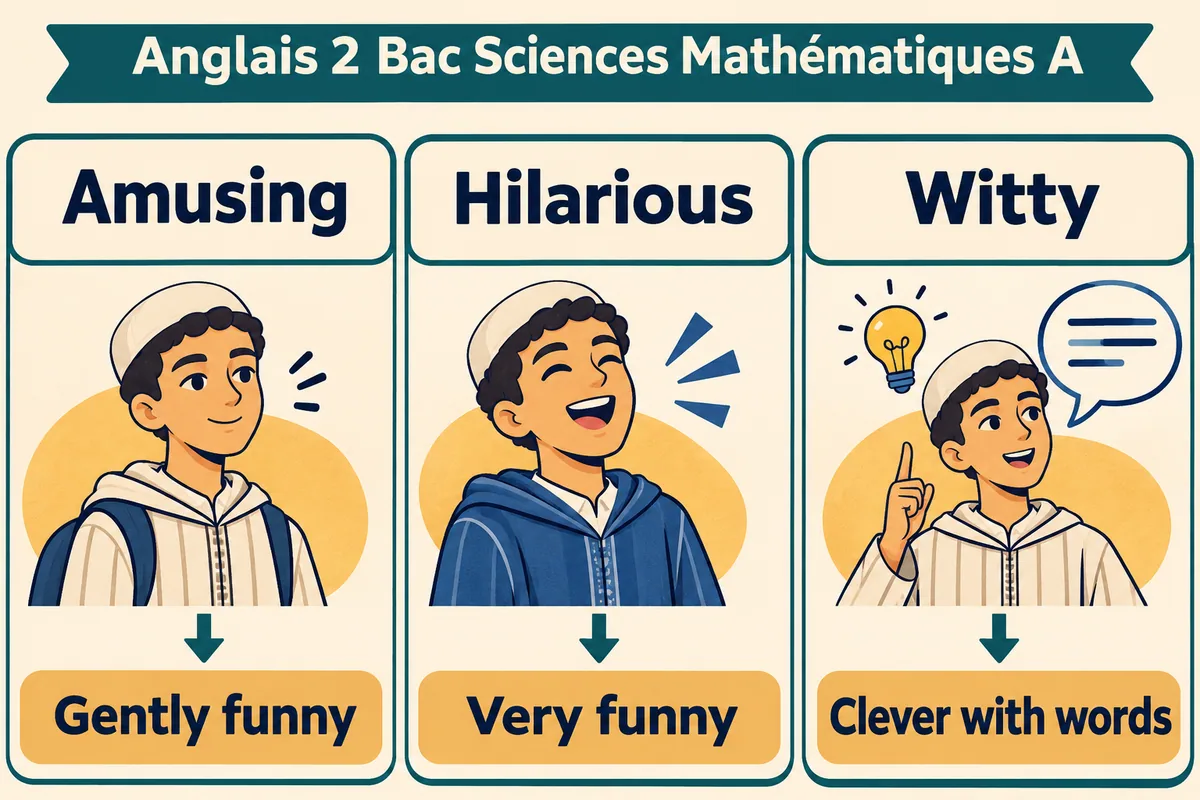
| amusing | pleasantly funny | It was an amusing story about a late bus. |
| hilarious | extremely funny | The unexpected sound was hilarious. |
| witty | clever and funny, especially with words | His witty reply made the whole room smile. |
| laughter | the sound or act of laughing | Laughter came from the back row. |
Collocations and word forms
| Phrase | Example | Usage |
|---|---|---|
| tell / crack a joke | He told a joke about his alarm clock. | Tell is neutral. Crack is more informal. |
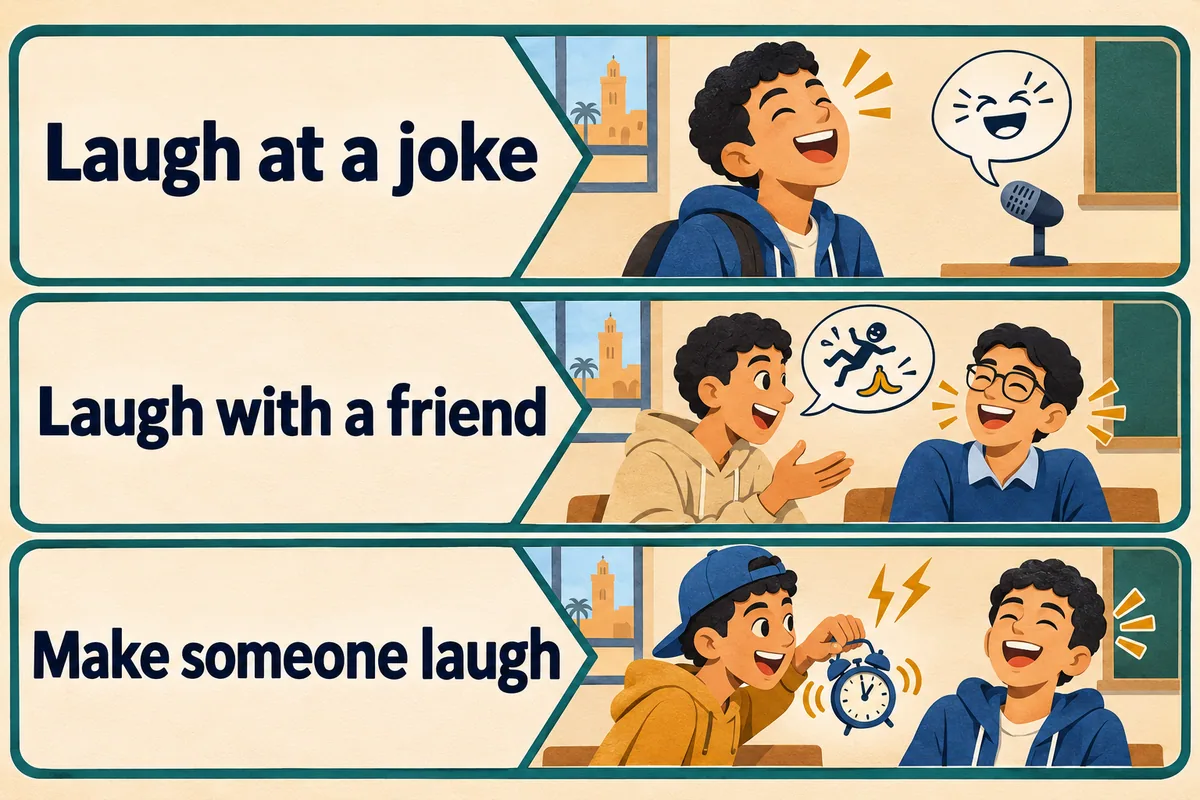
| make someone laugh | The imitation made the audience laugh. | Use make + person + base verb. |
| burst out laughing | The boys burst out laughing. | The laugh started suddenly. |
| laugh at / laugh with | They laughed at the joke and laughed with the performer. | At can give the reason for laughter. With signals a shared reaction. |
| have a sense of humour | His brother has a great sense of humour. | He can enjoy humour and see the funny side of things. |
Humour and laughter are usually uncountable when you mean the general qualities or reactions. Joke and comedian are countable. Funny can also mean strange, as in « There is a funny noise coming from the speaker ». The situation tells you which meaning fits.
How the punchline changes the meaning
A joke about a clock
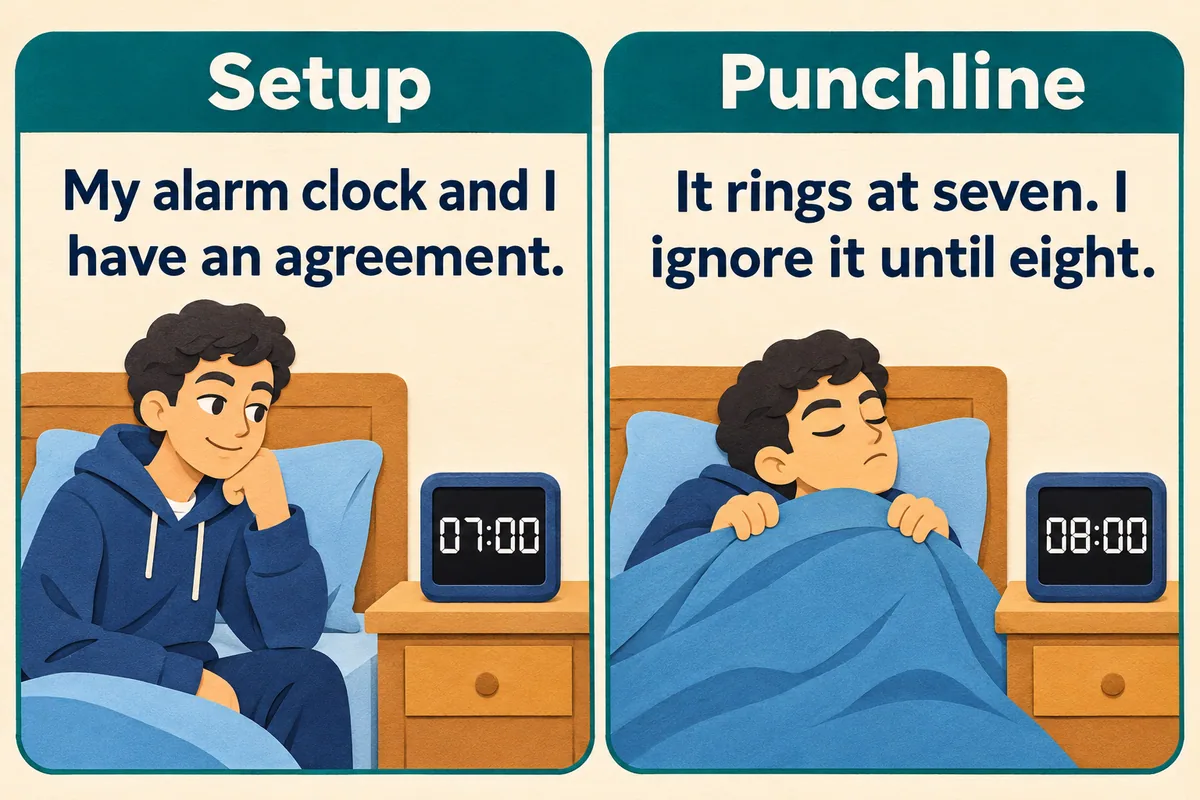
« My alarm clock and I have an agreement. It goes off at seven, and I ignore it until eight. » At first, agreement sounds as if both sides cooperate. The last words reveal that the speaker pays no attention to the clock.
A pun creates humour through two meanings of a word or through similar sounds. In « The school library had too many problems, so I booked a meeting », booked means arranged, and echoes the books around the speaker.
Types of humour, synonyms and idioms
A pun plays on two meanings or similar sounds. A comic sketch is a short performance, and a cartoon can tell a joke through an image. Witty describes a clever use of words. Hilarious describes something extremely funny. Amused describes a person’s reaction, while amusing describes what causes that reaction.
« That broke the ice » means it made people feel more comfortable at the start of an interaction. A joke can lift someone’s spirits or lighten the mood. Context and audience help determine whether a joke is kind, confusing or hurtful.
Worked examples: talking about humour precisely
Amused or amusing?
Complete « The audience was ___ (amuse) by the comedian’s ___ (amuse) imitation of a taxi driver. »
- The first gap describes how the audience felt. A feeling takes the -ed adjective: amused.
- The second gap describes the imitation, the thing that causes the feeling. The cause takes the -ing adjective: amusing.
- The same pair works with bored and boring, surprised and surprising, embarrassed and embarrassing.
Explaining why a joke works
Explain the joke « Why did the student take a ladder to school? Because she wanted to go to high school. »
- Find the punchline: the last words, « go to high school ».
- Find the two meanings. High school can mean secondary school, but with a ladder the listener pictures a school that is physically high.
- Write the explanation in one sentence: « The joke is a pun, because high school means a secondary school and also a school high up, which explains the ladder. »
Sources and curriculum
- English Language Guidelines for Secondary Schools (Ministry of Education, 2007)
The 2nd Baccalaureate syllabus describes the ten themes, four skills and language structures. See printed pages 76–84.
- National Baccalaureate Exam Specifications (English, 2025)
Reproduction of the national framework for the reading, language and writing sections, including the science streams.
Frequently asked questions
What is the difference between a joke and a punchline?
Are humour and humor both correct?
What does it mean to have a sense of humour?
Exercises with answers
4 exercises, from easy practice to challenges. Try each one yourself, then reveal the answer and explanation.
Exercise 1
EasyWrite the word or expression that matches each definition.
- The last line of a joke, which makes it funny.
- A joke that plays on two meanings of a word or on similar sounds.
- Clever and quick with words.
- Extremely funny.
- The ability to see what is funny and to enjoy it.
Answer and explanation
- A punchline.
- A pun.
- Witty.
- Hilarious.
- A sense of humour.
Exercise 2
Intermediate- Use amused or amusing: « We were ___ by the speaker’s ___ sketch. »
- A playful greeting made a nervous group start talking. Use the idiom break the ice.
Answer and explanation
- Amused, amusing. The people experience the reaction and the sketch causes it.
- The speaker’s playful greeting broke the ice.
Exercise 3
IntermediateGive the correct form of the word in brackets.
- Her ___ (humour) remarks lightened the mood before the exam.
- The room filled with ___ (laugh) when the microphone squeaked.
- Hassan wants to become a professional ___ (comedy).
- We found the sketch very ___ (entertain).
- The twins burst out laughing ___ (control) and could not stop.
Answer and explanation
- Humorous. The adjective describes the noun remarks.
- Laughter. After filled with, the gap needs a noun.
- Comedian. The noun names the person.
- Entertaining. The -ing adjective describes the sketch that causes the feeling.
- Uncontrollably. The adverb with a negative prefix describes how they laughed.
Exercise 4
ChallengeRead each situation. Say whether the humour is kind or hurtful and explain why.
- A student imitates a teacher’s accent in front of the class while the teacher is out of the room.
- A speaker opens a school ceremony with a short joke about his own lateness.
- Friends laugh loudly at a classmate who trips on the stairs.
- Write two sentences that explain the difference between laugh at someone and laugh with someone.
Answer and explanation
- Hurtful. The joke mocks a person who is not there to answer, and the class laughs at her rather than with her.
- Kind. Self-mocking humour makes the speaker seem friendly and puts the audience at ease.
- Hurtful. The classmate may be embarrassed or hurt, and the laughter targets an accident.
- One answer is « When we laugh with someone, we share the joke and they enjoy it too. When we laugh at someone, we make them the target, and they may feel humiliated. »