



Comprehension 3 : A new beginning
A new beginning is a fictional English 2 Bac reading about a student who returns to learning. Some events belong to the past before the story opens. Put the events in order and look for small changes in what the character does to understand what the new beginning means to her.
By the end of this lesson, you can
- Distinguish an earlier obstacle from later events.
- Find the cause of a decision in a narrative.
- Infer a feeling and support it with a detail.
Un bon cours, ça se partage.
Reading passage: Mariam’s return to learning
On Tuesday evening, Mariam stopped outside the community library with an unused notebook in her bag. She had left school the previous year, when her family had moved and the bus journey had become difficult. She wanted to return, but the thought of sitting in a classroom again made her nervous. Through the library window, she could see people around a small table. Some were younger than she was and others were much older. One of them noticed her and pulled out an empty chair.
A neighbour had told her about a small group that met in the library twice a week. There, a volunteer helped learners read public notices and write messages. In the first session, Mariam worked with a girl who had also missed part of the school year. Together they read the timetable at the bus station and worked out how to get to the library on Saturdays. They nearly wrote down a bus that only ran on weekdays. Mariam spotted the note at the bottom of the timetable and suggested another route.
A month later, the volunteer asked Mariam to explain a short notice to a new learner. Mariam opened the same notebook. The first page held the bus times in large letters. The next pages held notes on announcements, forms and an application to return to school. Mariam remembered how difficult it had been to put her first question into words. She moved her chair closer to the new girl and asked where they should begin.
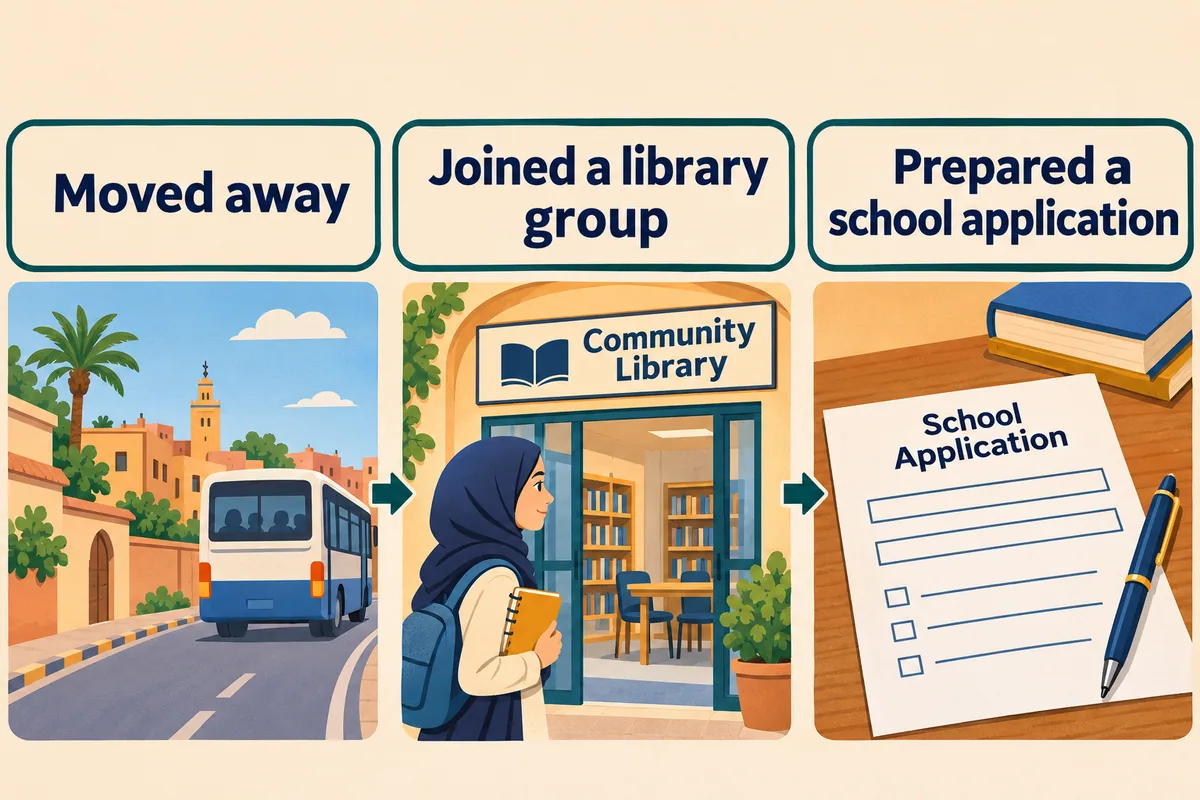
Build the timeline before explaining the story
Step by step
Follow three stages
- Before the opening, the move and the difficult bus journey interrupt Mariam’s schooling.
- At the library, Mariam joins a planned group and works out a practical transport plan.
- A month later, she starts helping another learner and has prepared a school application.
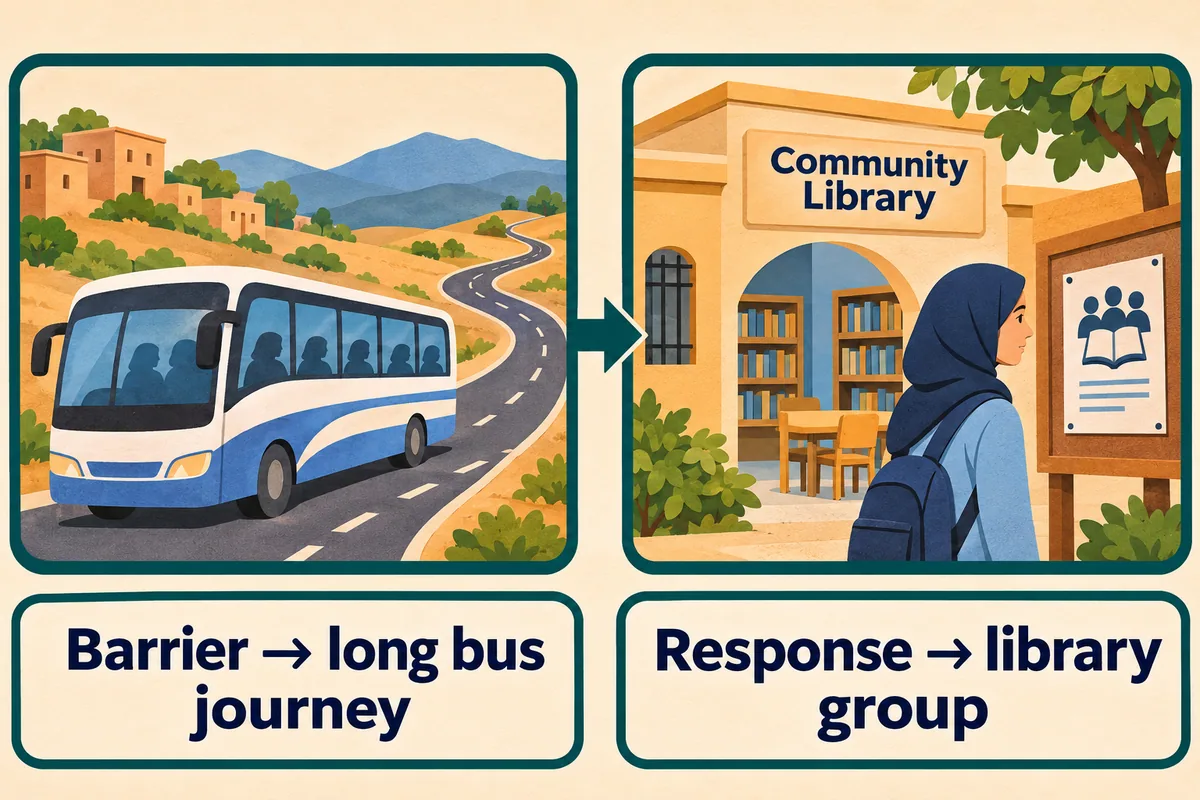
Support an interpretation with a detail
| Focus | Interpretation and evidence |
|---|---|
| Cause | The school journey became difficult after the move. The passage gives this transport barrier before Mariam arrives at the library. |
| Reference | The word There points to the library, the place mentioned in the previous sentence. |
| Inference | Mariam is becoming more confident. At the start she hesitates outside. At the end she moves closer and offers to begin helping. |
| Central idea | Access to a local learning group helps a student rebuild confidence and prepare to return to school. |
The library programme fits non-formal education because it has scheduled meetings and an organiser outside the school system. The bus timetable is an example of a practical text used there.
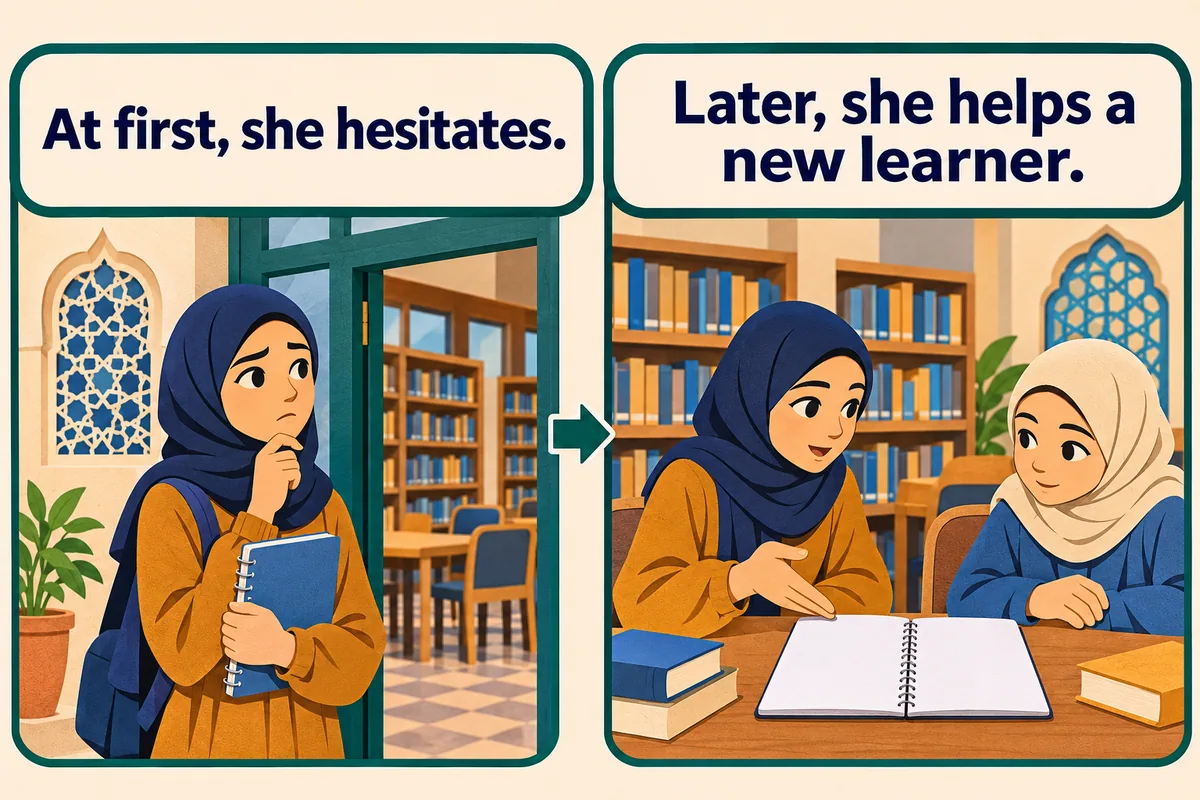
Reading a problem, a response and a change
The move and difficult bus journey explain why Mariam left school. The library sessions give her practice with materials she needs in everyday life. Use the notebook and the final action as evidence to explain how her behaviour has changed.
Worked examples: answering questions on A new beginning
A why question about a feeling
Why did Mariam feel nervous outside the library?
- Find the word nervous in paragraph 1.
- Read the sentence: « the thought of sitting in a classroom again made her nervous ».
- Link it to what happened before: she had left school the previous year.
- Answer: « She had been away from school for a year, and the idea of sitting in a classroom again made her nervous. »
Finding a word from its definition
Find a word in paragraph 1 that means not used before.
- The meaning describes an object, so look for an adjective before a noun.
- Paragraph 1 says Mariam had « an unused notebook in her bag ».
- Check the parts: un- (not) + used. The answer is unused.
Sources and curriculum
- English Language Guidelines for Secondary Schools (Ministry of Education, 2007)
The 2nd Baccalaureate syllabus describes the ten themes, four skills and language structures. See printed pages 76–84.
- National Baccalaureate Exam Specifications (English, 2025)
Reproduction of the national framework for the reading, language and writing sections, including the science streams.
Frequently asked questions
Why did Mariam leave school in A new beginning?
What does the notebook show about Mariam’s progress?
What is the main idea of A new beginning?
Exercises with answers
4 exercises, from easy practice to challenges. Try each one yourself, then reveal the answer and explanation.
Exercise 1
EasySay whether each statement is true or false and quote the passage.
- Mariam left school because she failed her exams.
- Everyone in the group was older than Mariam.
- The group met in the library twice a week.
- Mariam spotted an important note on the timetable.
Answer and explanation
- False. « She had left school the previous year, when her family had moved and the bus journey had become difficult. »
- False. « Some were younger than she was and others were much older. »
- True. « a small group that met in the library twice a week ».
- True. « Mariam spotted the note at the bottom of the timetable. »
Exercise 2
Intermediate- Why had Mariam left school?
- What kind of materials did the group practise with?
- What detail suggests Mariam was more confident after a month?
Answer and explanation
- Her family had moved and the bus journey had become difficult.
- They practised reading public notices and using information such as bus times, announcements and forms.
- She agreed to help the new learner and asked where they should begin.
Exercise 3
IntermediateAnswer the questions.
- In « One of them noticed her », what does them refer to?
- In « Together they read the timetable », who are they?
- Find a word in paragraph 2 that means noticed.
- Find a word in paragraph 1 that means worried.
- In « a bus that only ran on weekdays », what does that refer to?
Answer and explanation
- The people sitting around the small table.
- Mariam and the girl who had also missed part of the school year.
- Spotted.
- Nervous.
- The bus.
Exercise 4
ChallengeAnswer the questions.
- Put these events in order: A. Mariam helps a new learner. B. Her family moves. C. A neighbour tells her about the group. D. Mariam reads a bus timetable with a partner.
- How does Mariam’s notebook show her progress?
- Why can the library group be called non-formal education?
- In about 40 words, suggest one more way a community could help young people return to school.
Answer and explanation
- B, C, D, A.
- It starts with bus times and later contains notes on announcements, forms and an application to return to school.
- It is organised, with regular meetings and a volunteer, but it is outside the official school system.
- One answer is « Secondary students could offer free tutoring at the local youth centre. Learners who have missed lessons would catch up in small groups and feel less nervous about returning to a full classroom. »