



Grammar 2 : Modals
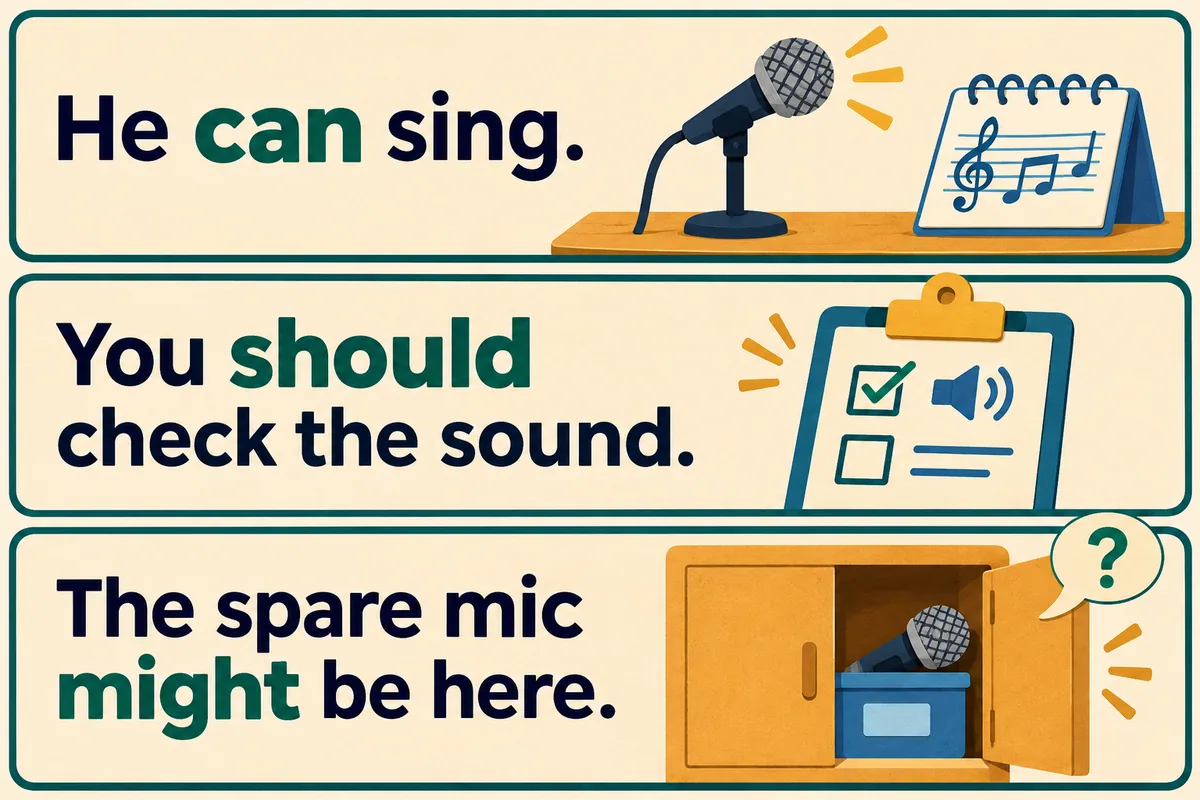
A modal verb changes the meaning of a main verb. In English 2 Bac, use can for ability, should for advice, must for strong obligation and may or might for possibility. Follow a central modal with the base form, as in « She can help ». The context distinguishes a rule from a suggestion or a deduction.
By the end of this lesson, you can
- Use a modal with a base verb in statements, questions and negatives.
- Distinguish mustn’t from don’t have to.
- Use a perfect modal to reason about or evaluate a past event.
Un bon cours, ça se partage.
Modal verbs and what they express
| Meaning | Forms | Example |
|---|---|---|
| present or past ability | can / could | He can imitate the sound now. At twelve, he could already perform on stage. |
| permission or request | can, could, may | May I use the microphone? Could you turn it down? |
| advice | should / ought to | You should check the microphone first. |
| obligation | must / have to | Visitors must show a school pass. We have to leave by six. |
| prohibition | mustn’t / can’t | You mustn’t touch the electrical equipment. |
| absence of obligation | don’t have to / needn’t | You don’t have to bring a microphone. |
| possibility | may / might / could | The spare microphone might be in the cupboard. |
| deduction | must / can’t | Everyone is carrying a script. It must be rehearsal day. |
Central modals have no third-person -s. Say « She can sing ». Form a negative with not and a question by moving the modal before the subject, as in « Can she sing? ». Ought to and have to contain to. Have to also changes form, as in « he has to » and « they had to ».
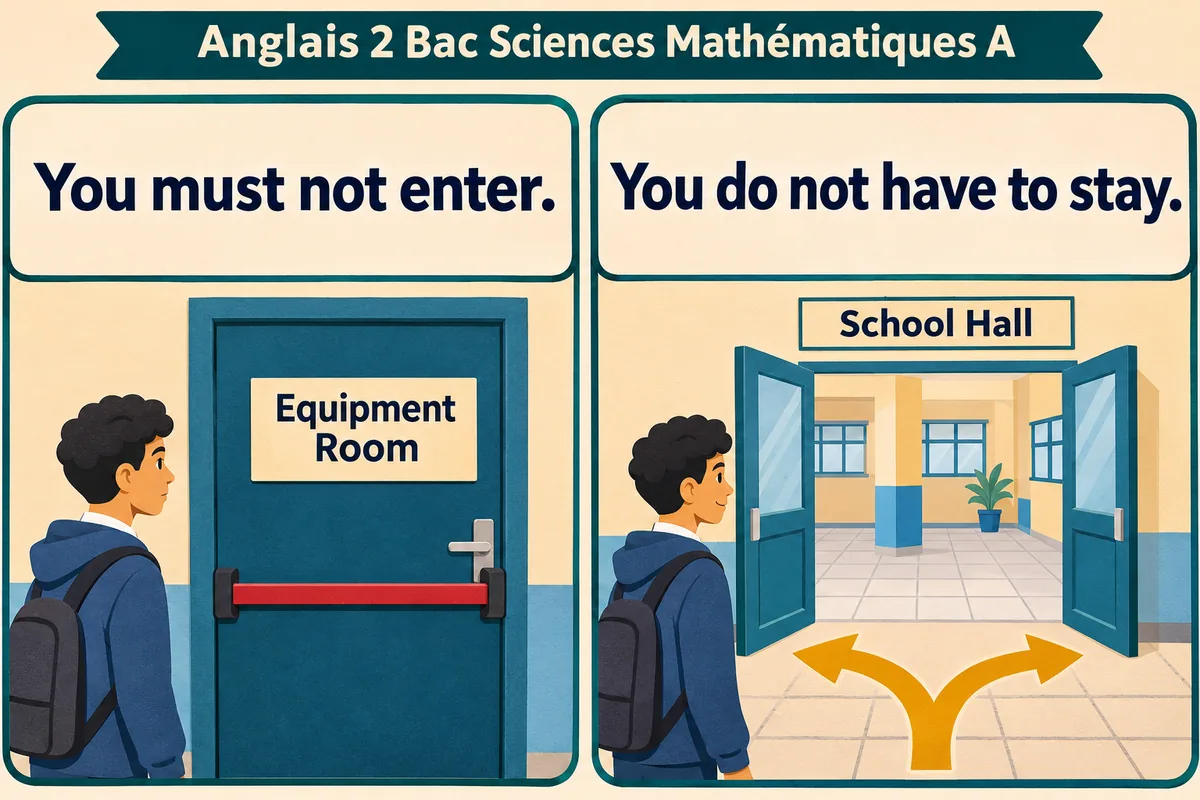
How do mustn’t and don’t have to differ?
Two notices at a school event
« You mustn’t switch off the main speaker » is a prohibition. « You don’t have to stay after the show » makes staying optional. Use had to for a past obligation, as in « We had to finish by five ».
Modal + have + past participle
| Example | Meaning |
|---|---|
| He must have heard the alarm. | The speaker draws a strong conclusion about the past. |
| He may have left early. | Leaving early is a past possibility. |
| He can’t have left early. I saw him at six. | The evidence makes that past possibility incompatible. |
| He should have tested the sound. | The speaker criticises a past decision or expresses regret. |
| She needn’t have printed the scripts. | She printed them, although printing was unnecessary. |
Remember
Could often describes a general past ability. For one particular success, « We managed to fix the speaker » or « We were able to fix it » is usually clearer.
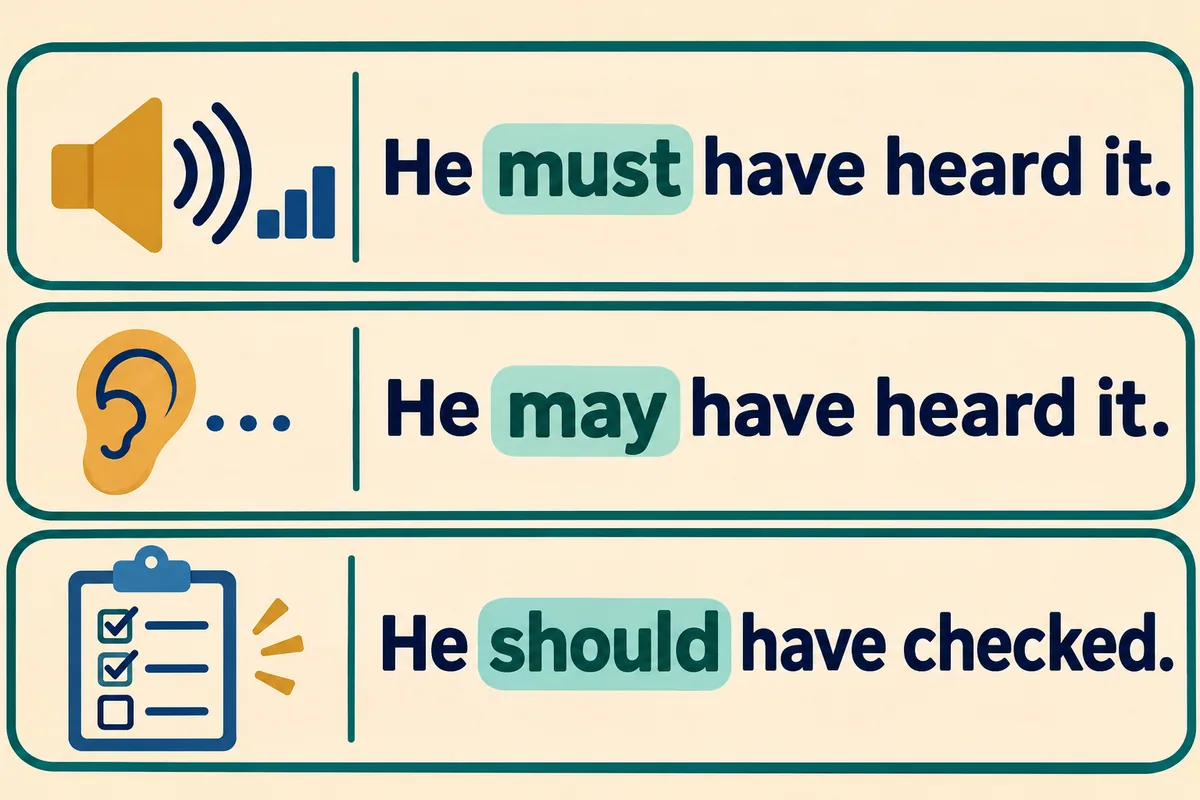
Ability, obligation and deduction across time
Use can for present ability, could for general past ability and be able to for forms such as will be able to. For a single past achievement, « she managed to finish » clearly states success. Have to can express obligation in forms such as had to and will have to.
« We didn’t need to book » says booking was unnecessary. It leaves open whether we did. « We needn’t have booked » usually means we booked even though it was unnecessary. « She must have booked » expresses a strong deduction about the past. « She can’t have booked » expresses a strong negative deduction.
Worked examples: choosing the right modal
Mustn’t, don’t have to or needn’t?
A library notice says that food is forbidden and that registration is optional. Write the two rules.
- Food is forbidden, so the rule is a prohibition: « You mustn’t eat in the library. »
- Registration is optional, so there is no obligation: « You don’t have to register » or « You needn’t register. »
- Do not use mustn’t for the second rule. « You mustn’t register » would forbid registration.
Deducing what happened
Karim’s phone is on his desk, but he is not answering messages. Make deductions.
- The phone on the desk is strong evidence, so use must have or can’t have: « He must have forgotten his phone » and « He can’t have taken it with him. »
- Where he is now is only a possibility, so use might have: « He might have gone to the library. »
- Each deduction uses modal + have + past participle because it is about the past.
Sources and curriculum
- English Language Guidelines for Secondary Schools (Ministry of Education, 2007)
The 2nd Baccalaureate syllabus describes the ten themes, four skills and language structures. See printed pages 76–84.
- National Baccalaureate Exam Specifications (English, 2025)
Reproduction of the national framework for the reading, language and writing sections, including the science streams.
Frequently asked questions
What is the difference between mustn’t and don’t have to?
When do we use should have and must have?
What is the difference between must and have to?
Exercises with answers
4 exercises, from easy practice to challenges. Try each one yourself, then reveal the answer and explanation.
Exercise 1
EasyChoose the correct option.
- You (must / mustn’t) wear a helmet on a motorbike. It’s the law.
- (May / Must) I borrow your calculator?
- You (mustn’t / don’t have to) bring food. Lunch is provided.
- At five, she (could / can) already read.
- You look exhausted. You (should / mustn’t) go to bed earlier.
Answer and explanation
- Must. The law creates an obligation.
- May. It asks for permission.
- Don’t have to. Bringing food is unnecessary, not forbidden.
- Could. It describes a general ability in the past.
- Should. It gives advice.
Exercise 2
Intermediate- The workshop is free and registration is optional. Write a sentence with have to.
- She took an umbrella, although it stayed dry. Rewrite with needn’t have.
- All the invitations are still on my desk, so I’m sure she didn’t send them. Rewrite with can’t.
Answer and explanation
- You don’t have to register. There is no obligation.
- She needn’t have taken an umbrella. She took it, but it was unnecessary.
- She can’t have sent the invitations. Use can’t have + past participle for a strong negative deduction.
Exercise 3
IntermediateKeep the meaning of each sentence.
- It isn’t necessary to print the tickets. (have)
- I’m sure she passed the test. She’s smiling. (must)
- It was a mistake not to rehearse. (should)
- Perhaps the show was cancelled. (might)
- Smoking is forbidden here. (mustn’t)
Answer and explanation
- You don’t have to print the tickets.
- She must have passed the test.
- We should have rehearsed.
- The show might have been cancelled.
- You mustn’t smoke here.
Exercise 4
ChallengeExplain the difference in meaning between the two sentences in each pair.
- « We didn’t need to buy tickets. » / « We needn’t have bought tickets. »
- « She may have left. » / « She must have left. »
- « You mustn’t tell him. » / « You don’t have to tell him. »
- « I could swim at six. » / « I managed to swim across the lake. »
Answer and explanation
- The first says the tickets were unnecessary and usually that we did not buy them. The second says we bought them although it was unnecessary.
- May have is a possibility. Must have is a strong deduction based on evidence.
- Mustn’t forbids telling him. Don’t have to means telling him is optional.
- Could describes a general ability in the past. Managed to describes success on one particular occasion.