



Writing an Argumentative Essay
An argumentative essay gives a position and explains why the reader should accept it. Support each reason with a specific example and address a serious objection before restating your conclusion.
By the end of this lesson, you can
- Develop a clear thesis and logically connected arguments.
- Use a counterargument and a response to strengthen an opinion.
Un bon cours, ça se partage.
How do you structure an argumentative essay?
Step by step
From prompt to argument
- Identify the exact claim you are asked to discuss.
- Introduce the question and give a clear position.
- Develop each reason with an example or evidence. Address a relevant objection.
- Draw a conclusion that follows from the arguments and answers the prompt.

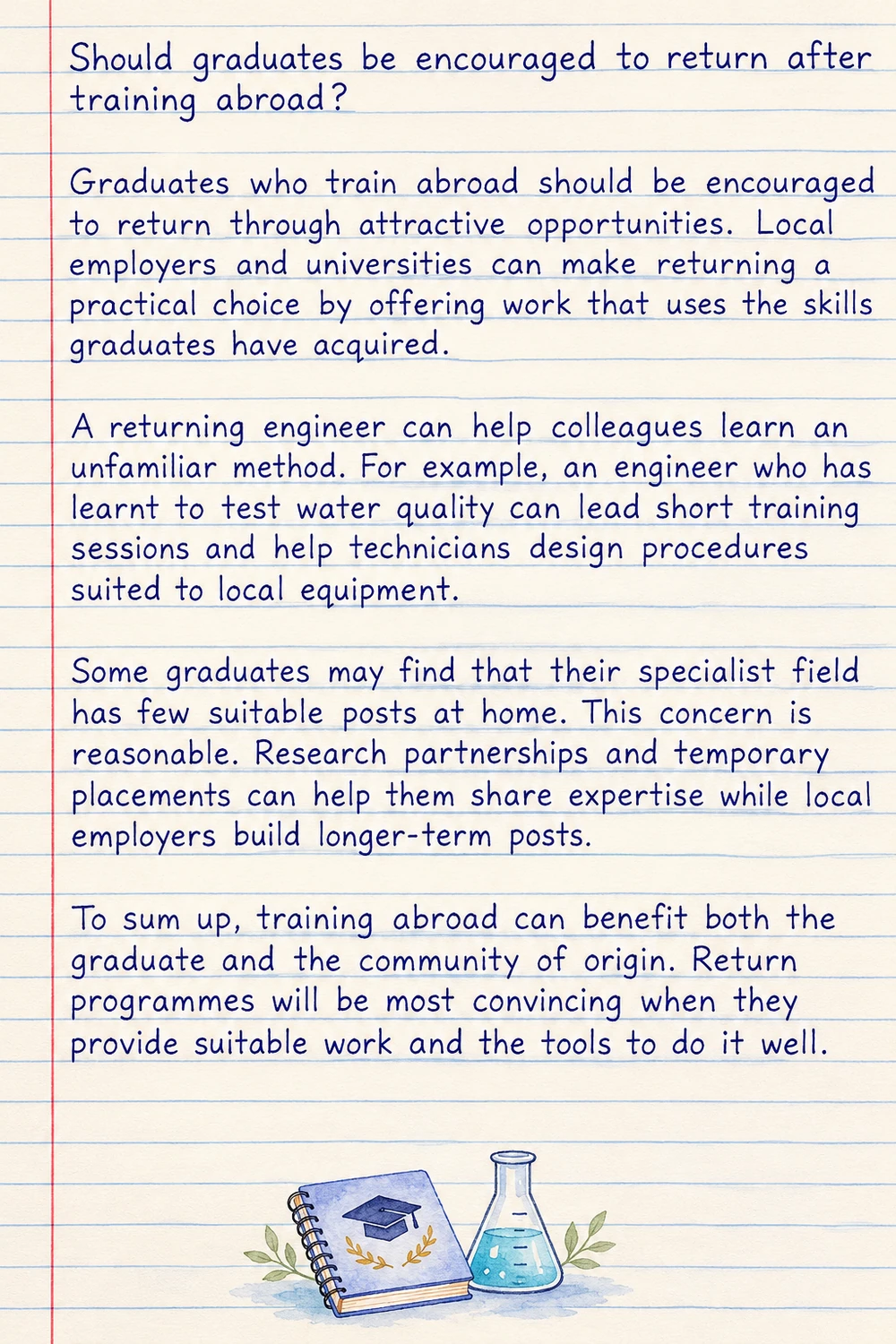
Model essay · Should graduates be encouraged to return after training abroad?
Graduates who train abroad should be encouraged to return through attractive opportunities. Local employers and universities can make returning a practical choice by offering work that uses the skills graduates have acquired.
A returning engineer can help colleagues learn an unfamiliar method. For example, an engineer who has learnt to test water quality can lead short training sessions and help technicians design procedures suited to local equipment.
Some graduates may find that their specialist field has few suitable posts at home. This concern is reasonable. Research partnerships and temporary placements can help them share expertise while local employers build longer-term posts.
To sum up, training abroad can benefit both the graduate and the community of origin. Return programmes will be most convincing when they provide suitable work and the tools to do it well.
Adapt the structure to opinion or for-and-against prompts
An opinion essay normally states a thesis and develops the case for it. A for-and-against prompt asks you to present reasons on both sides. Read the exact wording to decide where to give your judgement. For a paragraph-length task, use one position, a developed reason and a final sentence that returns to the main point.

Worked examples: building an argument
Writing a thesis statement
Improve the vague thesis « Brain drain is a big problem. »
- A thesis takes a clear position that someone could disagree with.
- Add what should be done: « Governments should fund research jobs for young scientists ».
- Add the main reasons that your paragraphs will develop: « because this would keep talent at home and attract graduates back ».
- Final thesis: « Governments should fund research jobs for young scientists, because this would keep talent at home and attract graduates back. »
Answering a counterargument
Answer the objection « Graduates have the right to work wherever they want. »
- Present the objection fairly: « Some people argue that graduates have the right to work wherever they want. »
- Concede the part that is true: « This is true, and nobody should be forced to stay. »
- Answer it with your own point: « However, if attractive jobs existed at home, many graduates would choose to stay. »
Sources and curriculum
- English Language Guidelines for Secondary Schools (Ministry of Education, 2007)
The 2nd Baccalaureate syllabus describes the ten themes, four skills and language structures. See printed pages 76–84.
- National Baccalaureate Exam Specifications (English, 2025)
Reproduction of the national framework for the reading, language and writing sections, including the science streams.
Frequently asked questions
What is the difference between an opinion essay and a for-and-against essay?
What is a thesis statement in an essay?
Exercises with answers
4 exercises, from easy practice to challenges. Try each one yourself, then reveal the answer and explanation.
Exercise 1
EasySay whether each sentence is a thesis, an argument, a counterargument, a refutation or a conclusion.
- « Universities should offer more scholarships for research at home. »
- « Firstly, local research would solve local problems such as water shortages. »
- « Some people claim that research abroad is of higher quality. »
- « However, partnerships with foreign universities can bring that quality home. »
- « To conclude, investing in research at home benefits both students and the country. »
Answer and explanation
- Thesis.
- Argument.
- Counterargument.
- Refutation.
- Conclusion.
Exercise 2
Intermediate- Should universities offer short return placements for graduates abroad? Write a thesis, one objection and a response.
Answer and explanation
- One thesis is « Universities should offer short return placements because graduates can mentor students while continuing their research abroad. » A short stay may be hard to schedule. Universities could publish dates well in advance and prepare follow-up sessions online.
Exercise 3
IntermediateComplete the paragraph with firstly, moreover, some people argue that, however and to conclude.
« Studying abroad has many benefits. (1) ___, students learn new methods in well-equipped universities. (2) ___, they become more independent and open-minded. (3) ___ it encourages brain drain. (4) ___, many graduates return and use what they have learnt at home. (5) ___, studying abroad is an opportunity, as long as countries create conditions that attract graduates back. »
- Gap 1
- Gap 2
- Gap 3
- Gap 4
- Gap 5
Answer and explanation
- Firstly.
- Moreover.
- Some people argue that.
- However.
- To conclude.
Exercise 4
ChallengeWrite an argumentative essay of about 150 words: « Should students who receive state scholarships to study abroad be required to work in their home country for some years? »
- Write your essay.
Answer and explanation
- Possible answer: « Every year, some of the best students receive state scholarships to study abroad. In my opinion, they should be required to work at home for a few years after graduating. Firstly, the scholarship is paid for by the whole community, so it is fair that the community benefits from the skills it has financed. Secondly, returning graduates can share new methods with colleagues, as an engineer trained in water treatment might do in a regional laboratory. Some people argue that this rule limits personal freedom. This is partly true, which is why the period should be short, for example three years, and the jobs offered should match the graduates’ training. To conclude, a short work commitment is a fair exchange for a scholarship, and it can turn brain drain into brain gain. »