



Expressing Certainty and Uncertainty
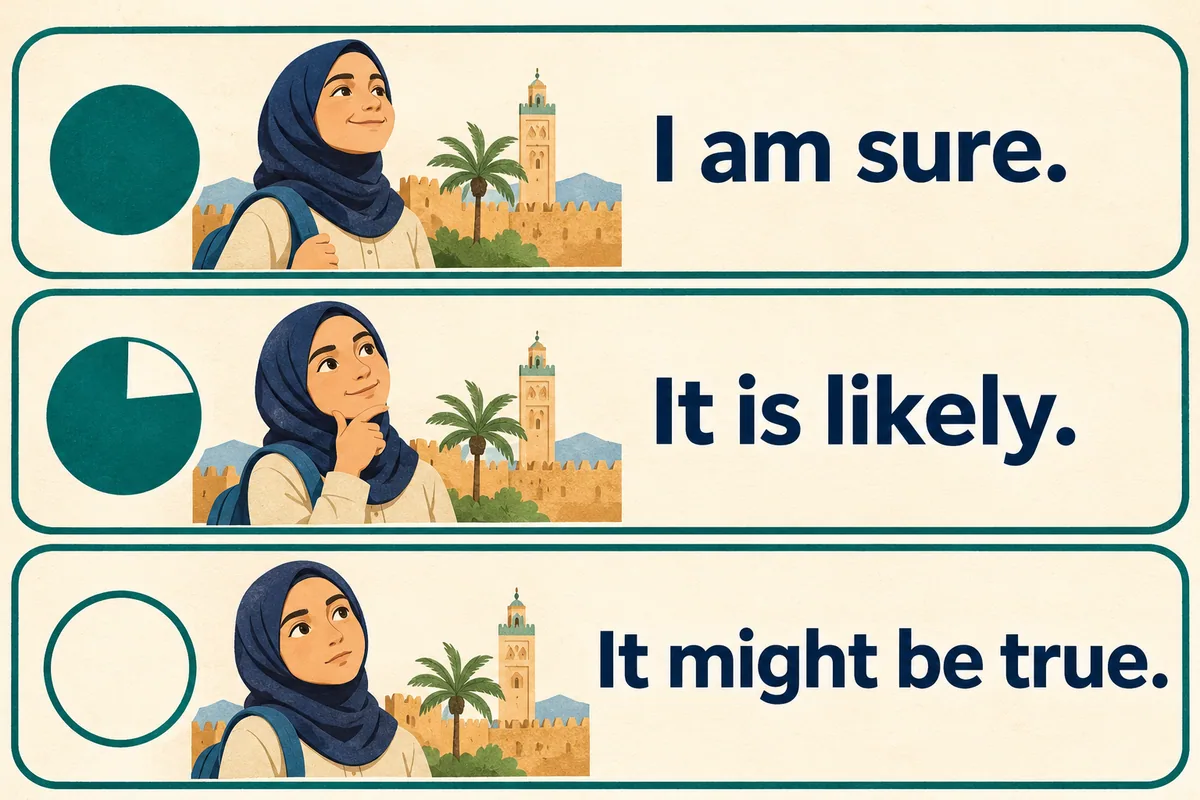
Use « I’m sure » for strong confidence, probably for a likely opinion, and may or might for a possibility. When you are drawing a conclusion from evidence, must indicates strong positive deduction and can’t indicates strong negative deduction.
By the end of this lesson, you can
- Express different degrees of certainty.
- Use evidence to support a deduction or explain why a claim is uncertain.
Un bon cours, ça se partage.
Listen to the text
Listen before opening the transcript. This original English practice text is read by a synthetic voice.
Show the transcript
Our model worked yesterday and stopped this morning. The battery indicator is full, so it probably isn’t a battery problem. A cable might have come loose during transport. I’m not sure whether we packed the spare cable, so let’s check the box first. If we find it, we can test the model again before changing anything else.
Expressions of certainty and uncertainty
| Strength | Expression | Example |
|---|---|---|
| strong confidence | I’m sure / I’m certain that | I’m sure the file is on the shared drive. I uploaded it myself. |
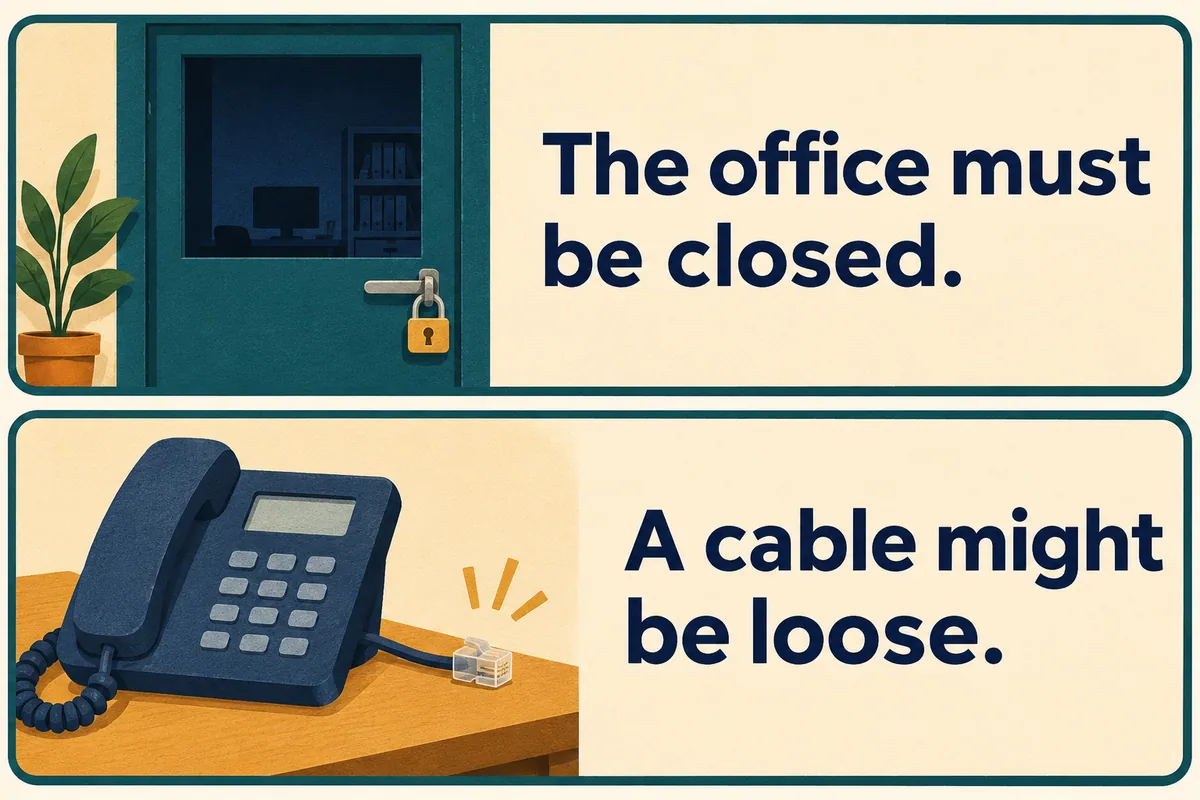
| strong deduction | must / can’t + base verb | The light is off and the door is locked. The office must be closed. |
| likely | probably / I think it is likely that | The new version will probably load faster. |
| possible | may / might / could + base verb | A loose connection might be causing the problem. |
| uncertain | I’m not sure whether … | I’m not sure whether the website works on older phones. |
Support your conclusion
If a battery indicator reads zero, you can say « The battery must be flat ». If a device stopped working and you have only one possible explanation, say « The battery may be flat ». In a negative deduction, « It can’t be the new model » expresses evidence-based confidence. « You mustn’t use it » generally expresses a prohibition.
Discuss a finding in pairs
Step by step
Give a claim and a reason
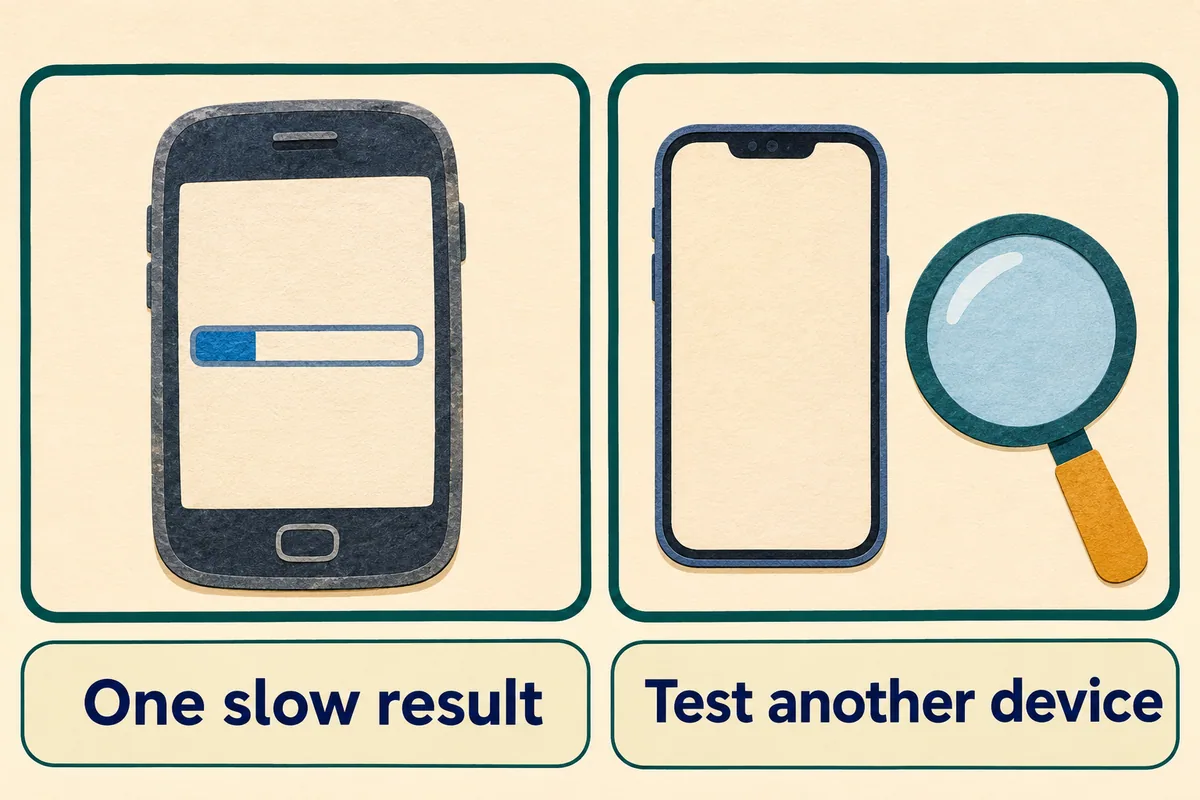
- Your class checks a website on one phone and sees it load slowly. State what this observation establishes.
- Suggest two possible explanations with might or could.
- Explain what additional information would make you more confident.
Worked examples: measuring how sure you are
Ordering expressions from sure to unsure
Order these sentences: « It might work. » « It will definitely work. » « It probably won’t work. » « I doubt that it will work. » « It will probably work. »
- Start with the strongest certainty: « It will definitely work. »
- Then a likely result: « It will probably work. »
- Then a simple possibility: « It might work. »
- Then unlikely results, from less to most negative: « It probably won’t work » and « I doubt that it will work ».
Deducing from evidence
The computer lab smells of burning plastic, and one computer is switched off. Make deductions.
- The smell is strong evidence, so use must: « Something must be overheating. »
- The switched-off computer cannot be the cause, so use can’t: « It can’t be that computer, because it’s off. »
- For a cause you are less sure about, use might: « A charger might be damaged. »
Listening and speaking practice
Listen to the recording and answer this question. Why does the speaker doubt that the battery is the problem, and what will the team check first?
Describe a possible cause for a device problem. Say how certain you are and name one test that would make you more confident.
Sources and curriculum
- English Language Guidelines for Secondary Schools (Ministry of Education, 2007)
The 2nd Baccalaureate syllabus describes the ten themes, four skills and language structures. See printed pages 76–84.
- National Baccalaureate Exam Specifications (English, 2025)
Reproduction of the national framework for the reading, language and writing sections, including the science streams.
Frequently asked questions
How can I express uncertainty in English?
Where do probably and definitely go in a sentence?
Exercises with answers
5 exercises, from easy practice to challenges. Try each one yourself, then reveal the answer and explanation.
Exercise 1
EasySay whether each expression shows certainty or uncertainty.
- « I’m positive that … »
- « It’s likely that … »
- « I’m not sure whether … »
- « There’s no doubt that … »
- « Perhaps … »
Answer and explanation
- Certainty.
- Uncertainty: it is probable but not sure.
- Uncertainty.
- Certainty.
- Uncertainty.
Exercise 2
Intermediate- You have a charging problem and suspect a loose cable. Express the possibility.
- Both keys are in your bag, so your friend could not have taken one of them. Express the deduction about the past.
Answer and explanation
- The cable might be loose. Might marks a possibility.
- My friend can’t have taken either key. Can’t have + past participle marks a strong negative deduction about the past.
Exercise 3
IntermediateKeep the meaning of each sentence.
- I’m sure robots will replace some jobs. (definitely)
- It’s possible that the app has a virus. (might)
- I’m sure he isn’t at home. His car has gone. (can’t)
- Probably, the price of phones will fall. Put probably in the right place.
- I’m sure she has received my email. (must)
Answer and explanation
- Robots will definitely replace some jobs.
- The app might have a virus.
- He can’t be at home. His car has gone.
- The price of phones will probably fall.
- She must have received my email.
Exercise 4
Intermediate- Why does the speaker doubt that the battery is the problem, and what will the team check first?
Answer and explanation
- The battery indicator is full. The team will check the box for the spare cable.
Exercise 5
ChallengeSay how sure you are about each prediction and give a reason. Use a different expression each time.
- « People will live on Mars by 2050. »
- « Smartphones make it harder for students to concentrate. »
- « Electric cars will be cheaper than petrol cars in ten years. »
Answer and explanation
- One answer is « I doubt it. Travelling to Mars is still extremely expensive, and nobody has solved the problem of radiation. »
- One answer is « I’m fairly sure that’s true when notifications are on, but it depends on how students use their phones. »
- One answer is « It’s quite likely, because battery prices are falling, but I’m not certain about the cost of charging stations. »