



Responding to Good or Bad News and Making Requests
React to good news with congratulations or encouragement. For bad news, use a phrase that shows sympathy. Use a polite question such as « Could you …, please? » to request an action, and make your answer clear when someone asks for help.
By the end of this lesson, you can
- Respond to good or bad news in a way that fits the situation.
- Make, accept or decline a request politely.
Un bon cours, ça se partage.
Listen to the text
Listen before opening the transcript. This original English practice text is read by a synthetic voice.
Show the transcript
I have some good news about the reading project. Our partner has agreed to send forty books next month. Congratulations to everyone who helped with the application. Unfortunately, we can no longer use the hall on Friday. Could someone check whether the library has space on Saturday? Please let me know by Wednesday so that we can tell the volunteers where to meet.
How do you respond to good news or bad news?
| Situation | Response | Possible follow-up |
|---|---|---|
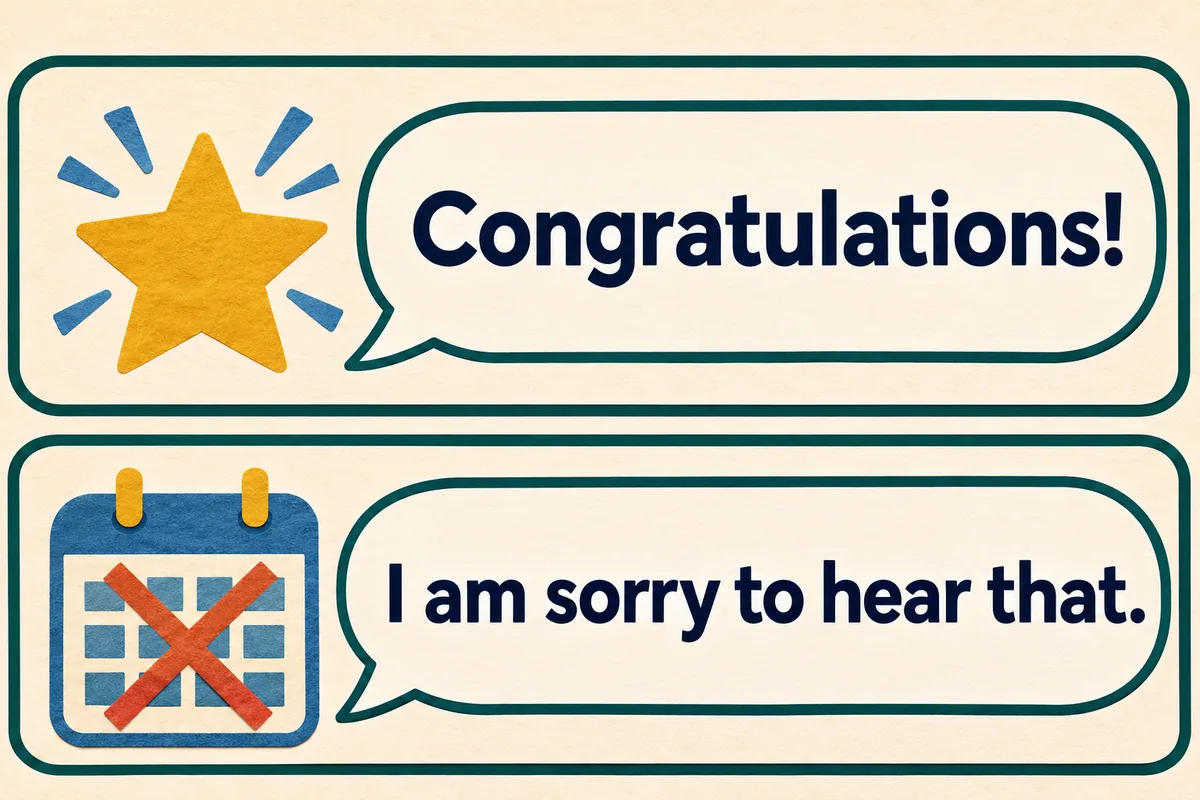
| A team receives funding | That’s great news! Congratulations! | When will the project start? |
| A friend receives a prize | Well done! I’m happy for you. | What did the judges like about your project? |
| A project is cancelled | I’m sorry to hear that. | Is there another date we can try? |
| Bad news involves a loss | I’m very sorry for your loss. | Please let me know if I can help. |
Make and answer a polite request
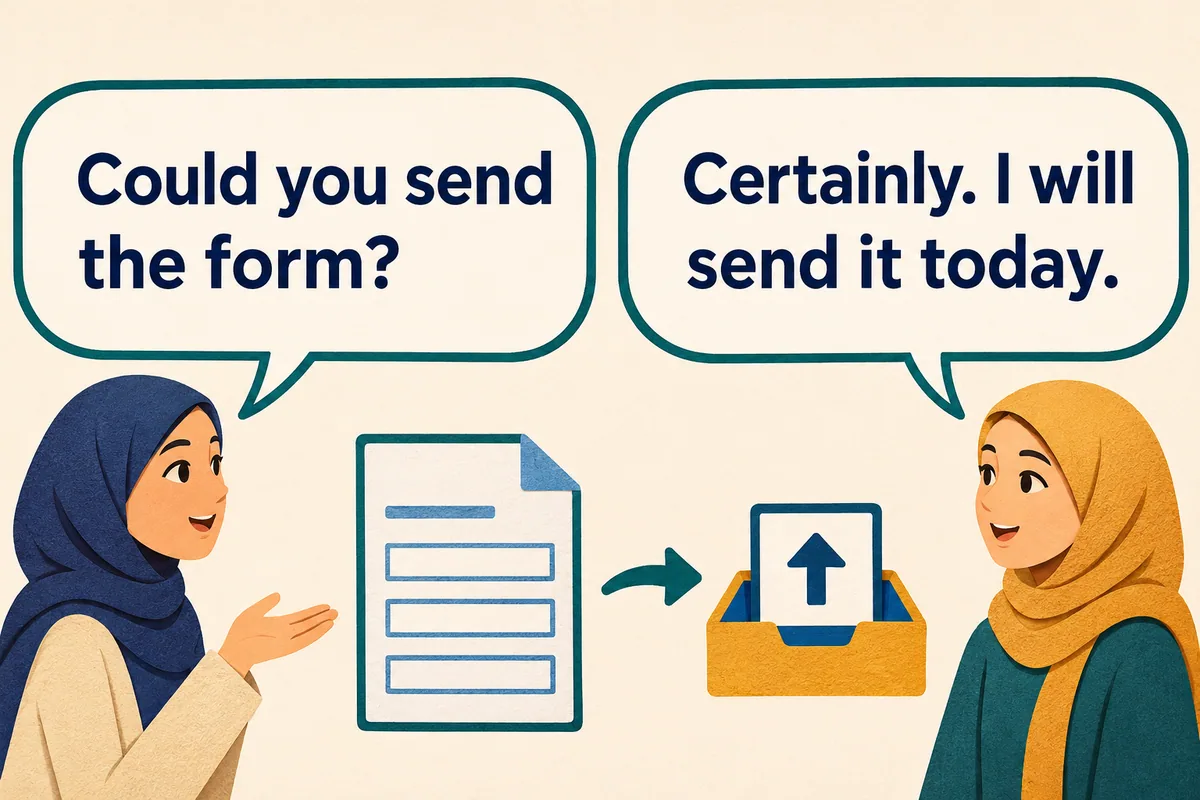
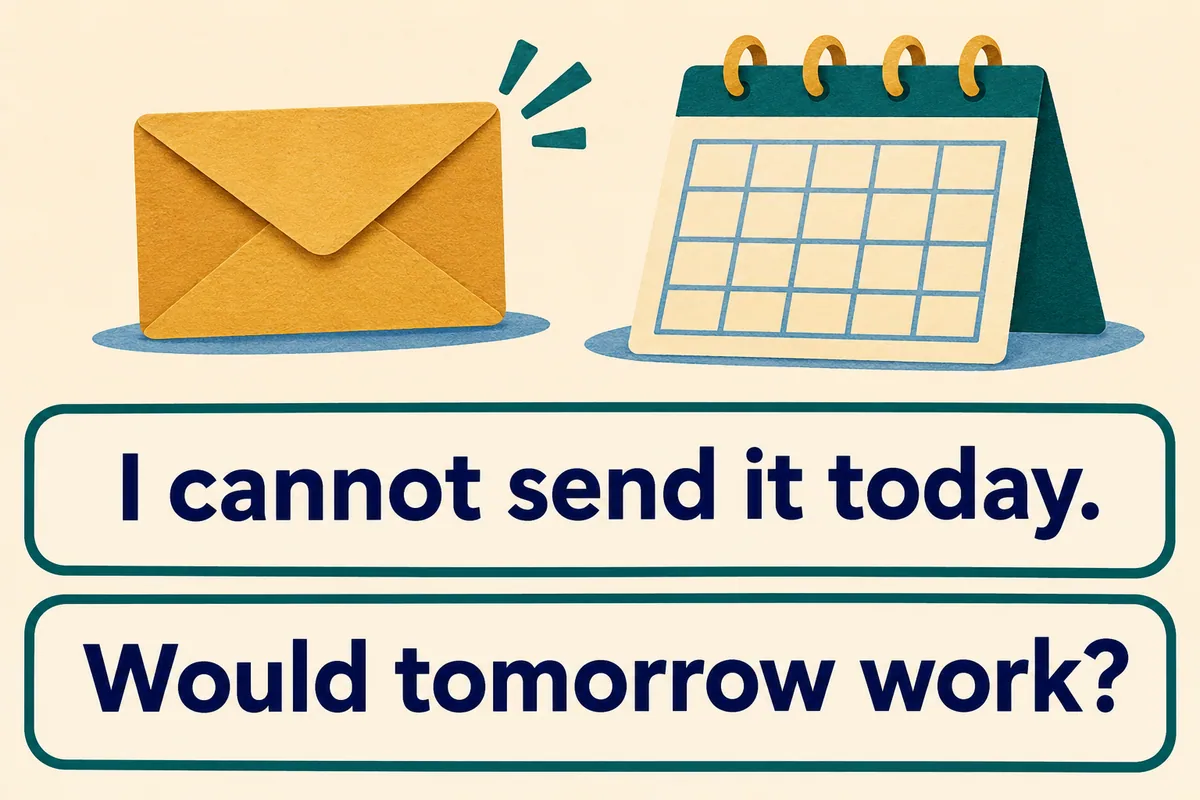
Use « Could you send the application form, please? » to ask the listener to act. Use « May I ask a question? » to ask permission for your own action. A formal written request can begin « I would be grateful if you could … ». Say « Certainly. I’ll send it this afternoon » to agree, or « I’m afraid I can’t send it today. Can I send it tomorrow? » to decline and offer an alternative.
Practise a conversation about a community project
Step by step
Two exchanges
- Tell your partner that a reading project received a donation. Listen to their response and ask for help moving the books.
- Tell them a delivery was cancelled. Ask for a new date. Your partner should decline one possibility and offer another.
Remember
In « Would you mind sending the form? », use verb-ing after mind. « No, not at all » can signal agreement, so add a clear action: « I’ll send it now. »
Worked examples: reacting to news and asking politely
Matching the reaction to the news
React to « I passed my driving test! » and « My grandfather is in hospital. »
- The first piece of news is good, so congratulate and show interest: « Congratulations! That’s brilliant. Was it difficult? »
- The second piece of news is bad, so show sympathy first: « Oh no, I’m sorry to hear that. »
- Add a kind wish or an offer: « I hope he gets better soon. Let me know if I can help. »
Making a request more polite
You want your teacher to give you one more day for a project. Make the request more and more polite.
- Direct: « Can you give me one more day? » It is fine with a friend but too direct here.
- Polite: « Could you give me one more day, please? »
- More polite: « Would you mind giving me one more day? » Mind is followed by the -ing form.
- Most polite: « I was wondering if you could give me one more day to finish the project. »
Listening and speaking practice
Listen to the recording and answer this question. Which news is good, and what does the speaker ask someone to check?
Give a partner one piece of good news and one scheduling problem. Ask for help and respond politely to the answer.
Sources and curriculum
- English Language Guidelines for Secondary Schools (Ministry of Education, 2007)
The 2nd Baccalaureate syllabus describes the ten themes, four skills and language structures. See printed pages 76–84.
- National Baccalaureate Exam Specifications (English, 2025)
Reproduction of the national framework for the reading, language and writing sections, including the science streams.
Frequently asked questions
How can I respond politely to bad news in English?
How do you make a polite request in English?
Exercises with answers
5 exercises, from easy practice to challenges. Try each one yourself, then reveal the answer and explanation.
Exercise 1
EasyChoose the most suitable response.
- « I’ve been accepted at the engineering school. » (a) What a shame! (b) That’s fantastic news!
- « Our trip has been cancelled. » (a) Lucky you! (b) Oh no, what a pity.
- « My sister has had a baby boy. » (a) Congratulations! (b) I’m sorry to hear that.
- « I failed my driving test. » (a) Never mind, you’ll pass next time. (b) Well done!
- « I won a scholarship. » (a) Well done, you deserve it! (b) That’s too bad.
Answer and explanation
- (b)
- (b)
- (a)
- (a)
- (a)
Exercise 2
Intermediate- Your friend’s community project has just won a grant. Respond.
- A partner asks you to send a document today, but you can send it tomorrow. Reply politely.
Answer and explanation
- One answer is « Congratulations! That’s great news for your team. »
- One answer is « I’m afraid I can’t send it today. Would tomorrow morning work for you? »
Exercise 3
IntermediateTurn each idea into a polite request using the words in brackets.
- Open the window. (Could you)
- Lend me your notes. (Would you mind)
- Help me with my CV. (I was wondering if)
- Send the documents by email. (Would it be possible)
- Turn the music down. (Can you)
Answer and explanation
- Could you open the window, please?
- Would you mind lending me your notes?
- I was wondering if you could help me with my CV.
- Would it be possible to send the documents by email?
- Can you turn the music down, please?
Exercise 4
Intermediate- Which news is good, and what does the speaker ask someone to check?
Answer and explanation
- The partner will send forty books. The speaker asks whether the library has space on Saturday.
Exercise 5
ChallengeYour friend Adam has some news. Write your replies.
- Adam: « I’ve been selected for an international youth camp in Geneva! » React to the good news.
- Adam: « The problem is that I can’t afford the plane ticket. » React to the bad news.
- Offer an idea and make a request to Adam.
- Adam: « Could you help me write an email to the organisers? » Accept the request.
Answer and explanation
- « Congratulations! That’s amazing news. When does it start? »
- « Oh no, that’s a shame. I’m sorry to hear that. »
- « Maybe the organisers offer travel grants. Could you send me the link to their website? I’ll have a look. »
- « Of course. Let’s write it together this evening. »