



The Mobile Phone Reading Comprehension
This English 2 Bac passage compares two ways of using mobile phones during school activities. Follow the trial, identify what was measured and decide which conclusions are supported.
By the end of this lesson, you can
- Identify the writer’s purpose and interpret evidence.
- Distinguish an observation from a student’s opinion.
Un bon cours, ça se partage.
Reading passage · One phone per group
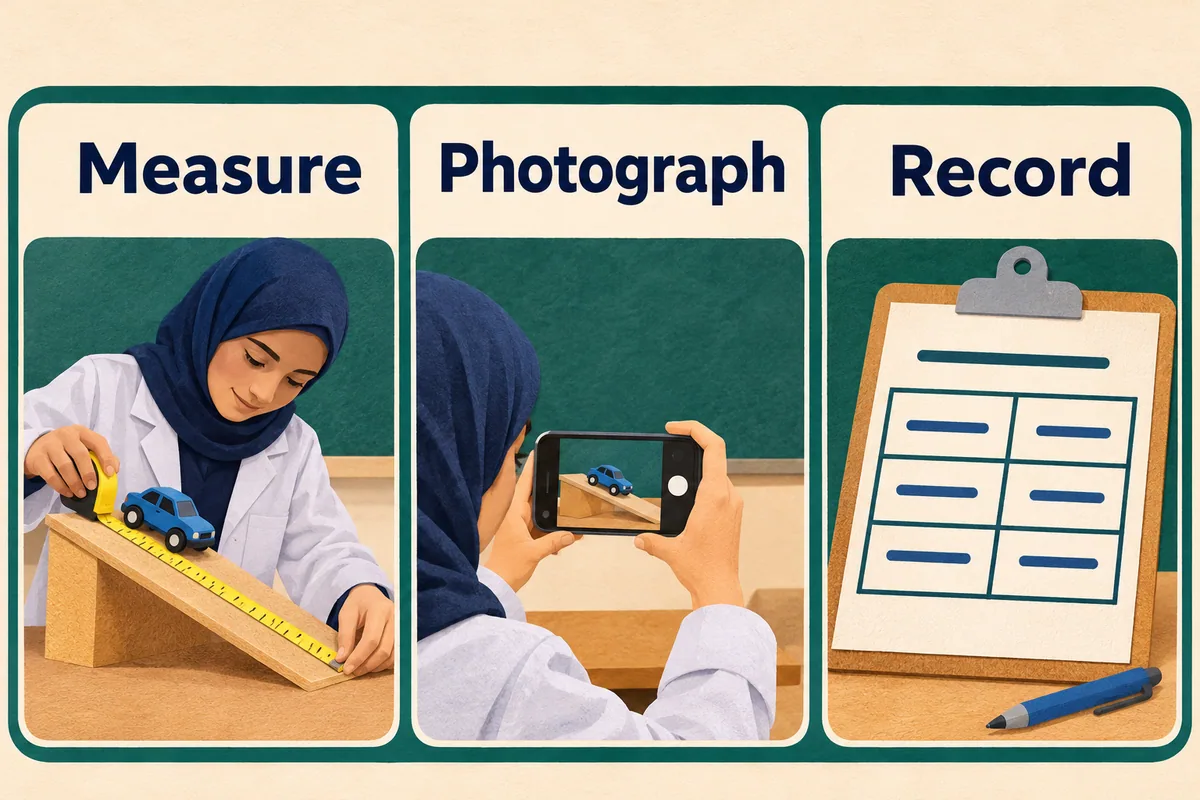
[1] During a physics project in El Jadida, students used phones to photograph how far a small car travelled on different surfaces. Each group could finish its table more quickly when it could check a photograph instead of repeating every measurement. However, some students stopped to read notifications, and one group shared four nearly identical photos without labelling any of them.
[2] The teacher asked the students to try a different arrangement. Each group would use one phone and assign a photographer, a recorder and a person responsible for checking measurements. The phone would stay in airplane mode until the group needed to share its work. Students were also asked to write the date and the surface beside every photograph.
[3] After the second lesson, most groups handed in a complete table by the end of class. Two groups still needed extra time because their measurements disagreed. When the class discussed the arrangement, one student said she liked being able to check the pictures without seeing messages. Another student said the main improvement came from knowing exactly which role he had.
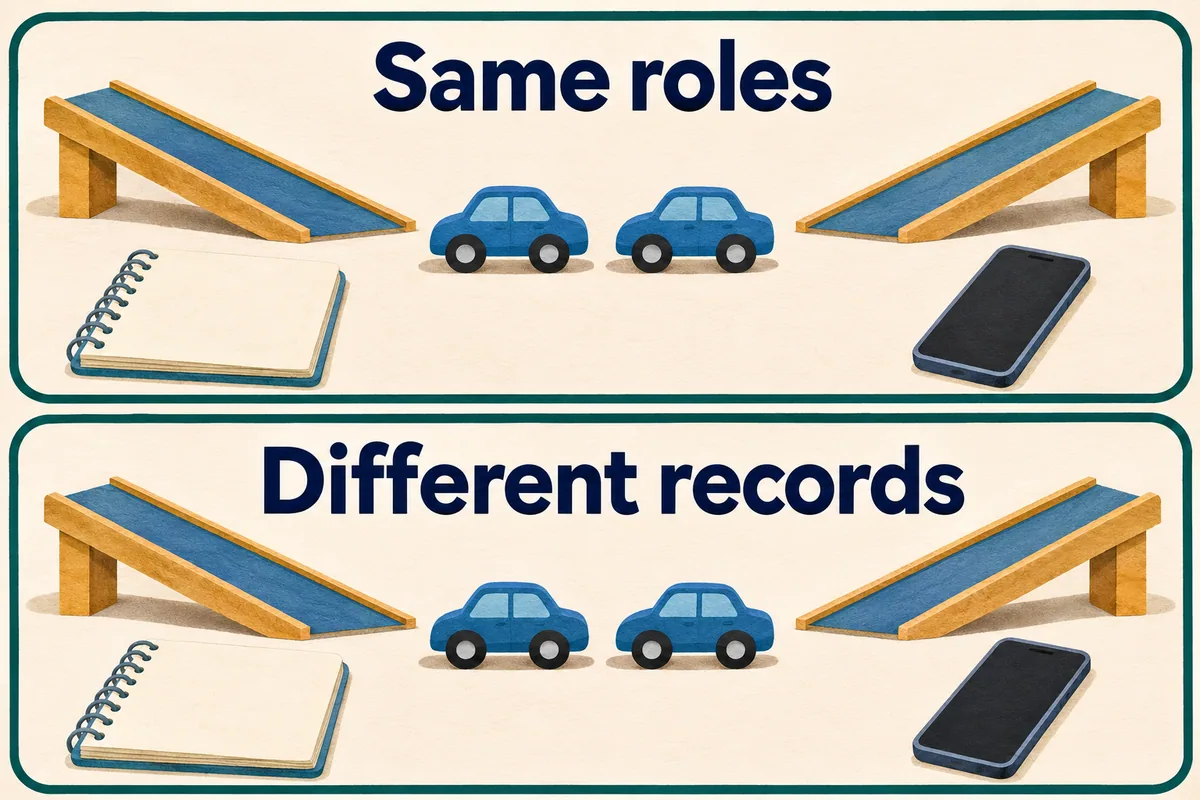
[4] The teacher kept both explanations. She had changed several parts of the activity at once, so the result could not show which change mattered most. The next class would repeat the experiment with the same roles, but half the groups would use a paper record. This would give them a clearer comparison of the different ways of recording data.
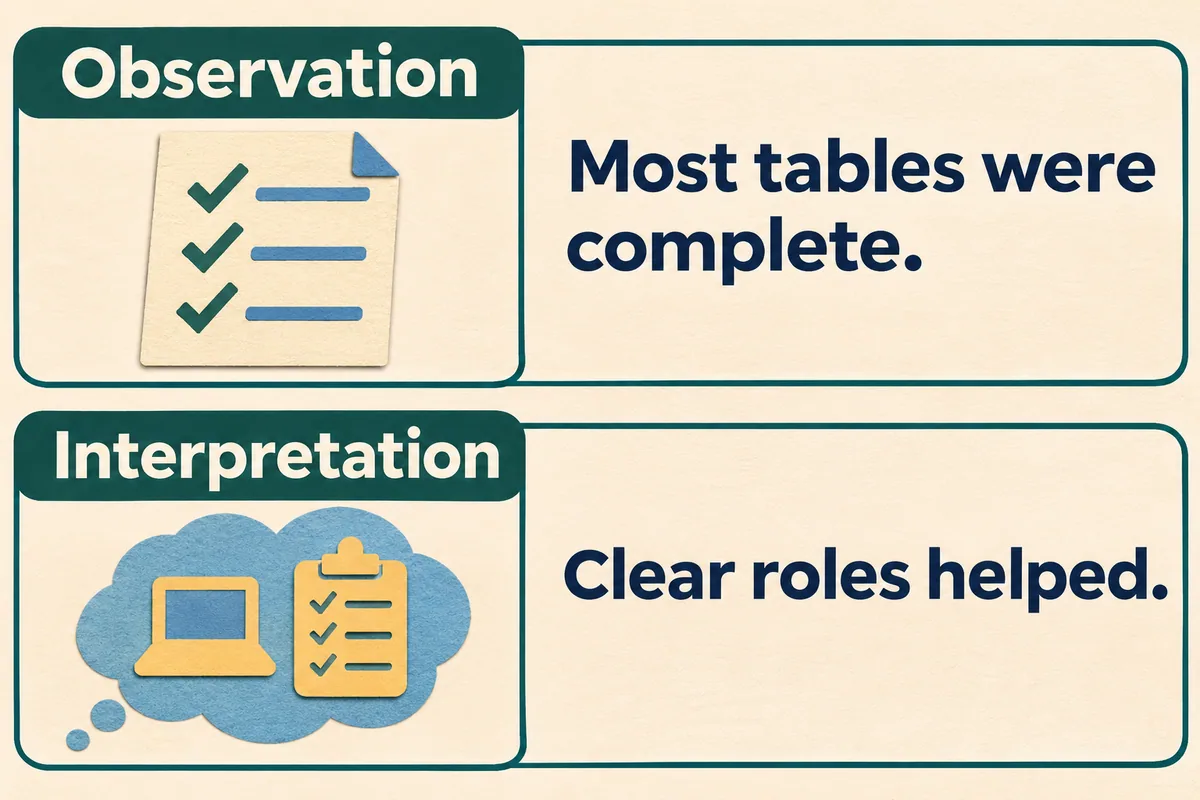
Separate observations from explanations
« Most groups handed in a complete table » is a reported observation. The student’s view about roles is an interpretation. Paragraph 4 explains why the result leaves several possible causes.
Find the writer’s purpose
The text describes how a class tested arrangements and planned a fairer comparison. A suitable title should cover both the benefits of recording evidence and the effort to manage distractions.
Worked examples: answering questions on One phone per group
Problem and change
What problems appear in paragraph 1, and which changes in paragraph 2 answer them?
- Paragraph 1 gives two problems: some students stopped to read notifications, and one group shared four nearly identical photos without labels.
- Paragraph 2 answers the first problem with airplane mode and one phone per group.
- It answers the second problem with roles and the rule to write the date and the surface beside every photograph.
Observation or opinion?
Classify « Most groups handed in a complete table by the end of class » and « she liked being able to check the pictures without seeing messages ».
- The first sentence reports what happened and could be checked, so it is an observation.
- The second sentence reports what one student felt, so it is an opinion.
- In an answer, keep the difference: write « one student said she liked … », not « the phones were better ».
Sources and curriculum
- English Language Guidelines for Secondary Schools (Ministry of Education, 2007)
The 2nd Baccalaureate syllabus describes the ten themes, four skills and language structures. See printed pages 76–84.
- National Baccalaureate Exam Specifications (English, 2025)
Reproduction of the national framework for the reading, language and writing sections, including the science streams.
Frequently asked questions
Why can’t the teacher identify a single cause of the improvement?
What is the main idea of One phone per group?
Exercises with answers
4 exercises, from easy practice to challenges. Try each one yourself, then reveal the answer and explanation.
Exercise 1
EasyAnswer each question with a short phrase from the passage.
- In which city did the physics project take place?
- What did the students photograph?
- How many phones did each group use in the new arrangement?
- What were the three roles in each group?
- In which mode did the phone stay until the group shared its work?
Answer and explanation
- El Jadida.
- How far a small car travelled on different surfaces.
- One phone.
- A photographer, a recorder and a person responsible for checking measurements.
- Airplane mode.
Exercise 2
Intermediate- Why might four unlabelled photos be difficult to use as evidence?
- True or false? Every group completed the table during the second lesson. Justify your answer.
- In paragraph 4, what does « This » refer to?
Answer and explanation
- The photos could not easily be matched to their measurements or surfaces.
- False. Paragraph 3 says two groups still needed extra time.
- Repeating the activity with the same roles while half the groups use paper records.
Exercise 3
IntermediateAnswer the questions.
- Find a word in paragraph 1 that means messages and alerts that appear on a phone screen.
- Find the phrase in paragraph 1 that means almost the same.
- Find a word in paragraph 2 that means give a job or a task to someone.
- In « finish its table more quickly » in paragraph 1, what does its refer to?
- In paragraph 3, whose measurements disagreed?
Answer and explanation
- Notifications.
- Nearly identical.
- Assign.
- Each group.
- The measurements of the two groups that still needed extra time.
Exercise 4
ChallengeAnswer in complete sentences.
- What advantage of phones does paragraph 1 describe?
- What will the next class change, and why is it a fairer comparison?
- Which title fits the whole passage best: Phones Should Be Banned, Testing a Better Way to Record Data, or The Best Physics Group? Justify.
- In about 40 words, say whether phones should be allowed in your classes and on what conditions.
Answer and explanation
- Groups could finish their tables more quickly because they could check a photograph instead of repeating every measurement.
- Half the groups will use a paper record while the roles stay the same, so only one thing changes and the results can be compared.
- Testing a Better Way to Record Data. The passage describes a trial and a plan for a fairer test, not a ban or a competition.
- One answer is « Phones should be allowed for specific tasks, such as recording results or checking a dictionary. They should stay in airplane mode, and the teacher should decide when they are used, so that they help rather than distract. »